AI Integration Services: Adding Intelligent Automation to Existing Systems
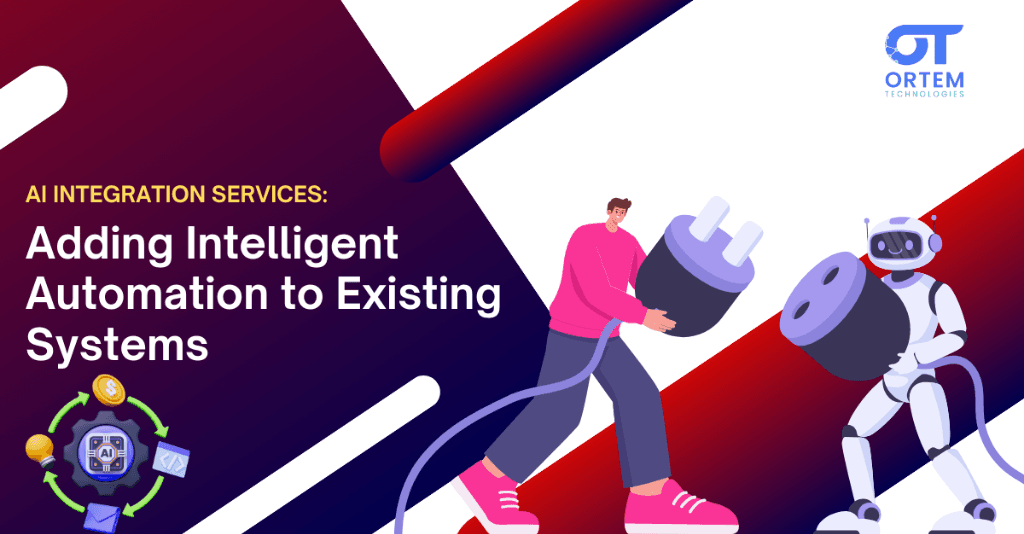
AI integration services connect large language models (LLMs), computer vision, or predictive analytics to your existing software via APIs - without rebuilding your entire system. The most common integrations in 2026 are RAG-based chatbots for customer support, ML-powered recommendation engines, and intelligent document processing pipelines.
Commercial Expertise
Need help with AI & Machine Learning?
Ortem deploys dedicated AI & ML Engineering squads in 72 hours.
Artificial Intelligence has moved beyond the "hype cycle" and entered the "deployment phase." In 2026, AI is no longer a science project; it is a standard component of modern software architecture. However, the challenge for established businesses is not building new AI models (which costs millions), but integrating existing powerful models (like GPT-5, Claude, or Llama 4) into their current workflows to drive tangible ROI.
At Ortem Technologies, we specialize in "pragmatic AI." We don't just throw chatbots at problems. We re-engineer business processes using intelligent automation.
The 3 Models of AI Integration
1. The Copilot Model (Assisted Intelligence)
This is the easiest entry point. AI acts as a sidekick to your human employees.
- Use Case: A Customer Support dashboard where the AI drafts responses to complex queries, which the agent simply reviews and hits "send."
- Benefit: Reduces average handling time (AHT) by 60% while maintaining a "human in the loop" for quality control.
2. The Agentic Model (Autonomous Action)
Here, AI doesn't just draft text; it takes action.
- Use Case: An AI agent in your Logistics ERP that notices a shipment is delayed, automatically checks alternative routes, re-books the carrier, and emails the customer-all without human intervention.
- Tech Stack: LangChain, AutoGPT, and vector databases (Pinecone/Weaviate) for long-term memory.
3. The Predictive Model (Data-Driven Insight)
Using your historical data to predict the future.
- Use Case: A Retail Inventory system that predicts exactly which SKUs will sell out next Tuesday based on weather patterns and social media trends, automatically placing restocking orders.
How We Implement AI (The "Ortem Framework")
Integrating AI into a legacy system (the "Brownfield" problem) is harder than building from scratch. Here is how we do it safely.
Step 1: Data Sanitization & Security
Your AI is only as good as your data.
- PII Redaction: We build middleware that scrubs Personally Identifiable Information (PII) before it ever touches an external API (like OpenAI).
- RAG (Retrieval-Augmented Generation): Instead of fine-tuning a model (which is slow and expensive), we use RAG. We index your company's PDFs, emails, and databases. When a user asks a question, the AI "reads" your specific documents to answer accurately, reducing hallucinations to near zero.
Step 2: Model Selection
One model does not fit all.
- GPT-5/Claude: Best for complex reasoning and creative writing.
- Llama 4 (Open Source): Best for on-premise deployment where data privacy is paramount (e.g., Healthcare/Finance). We can host this on your own AWS/Azure private cloud.
Step 3: UI/UX Integration
AI needs a new kind of interface. It's not just buttons and forms anymore; it's conversational.
- Streaming interfaces: We implement "streaming" responses so the user sees the text typing out in real-time, making the system feel instant.
Real-World Examples
1. Automated Document Processing (Fintech)
- Problem: Client had 15 employees manually typing data from PDF invoices into Excel.
- Solution: We built a Computer Vision pipeline. The AI "looks" at the PDF, extracts the Vendor Name, Date, and Line Items, and pushes them directly into SAP.
- Result: 90% reduction in manual entry. Error rate dropped from 4% to 0.1%.
2. Intelligent Search (E-commerce)
- Problem: Users couldn't find products using keyword search ("red dress").
- Solution: We implemented Vector Search. Users can now search for "something to wear to a summer wedding," and the AI understands the context and shows floral dresses.
- Result: Conversion rate increased by 22%.
The Ethics and Risks
We take Responsible AI seriously.
- Bias Testing: We rigorously test models to ensure they don't exhibit racial or gender bias.
- Transparency: We believe users should always know they are interacting with an AI.
AI is the biggest technological shift since the internet. But it requires engineering discipline to harness safely.
Get the Ortem Tech Digest
Monthly insights on AI, mobile, and software strategy - straight to your inbox. No spam, ever.
Sources & References
- 1.AI Index Report 2024 - Stanford HAI
- 2.The State of AI in 2024: GenAI Adoption Spikes - McKinsey & Company
- 3.Gartner Survey: 65% of Organizations Using GenAI in Multiple Business Functions - Gartner Research
About the Author
Editorial Team, Ortem Technologies
The Ortem Technologies editorial team brings together expertise from across our engineering, product, and strategy divisions to produce in-depth guides, comparisons, and best-practice articles for technology leaders and decision-makers.
Stay Ahead
Get engineering insights in your inbox
Practical guides on software development, AI, and cloud. No fluff — published when it's worth your time.
Ready to Start Your Project?
Let Ortem Technologies help you build innovative solutions for your business.
You Might Also Like

How Much Does an AI Chatbot Cost to Build in 2026?

Vibe Coding vs Traditional Development 2026: What Businesses Need to Know