AI Integration Services: Adding Intelligent Automation to Existing Systems
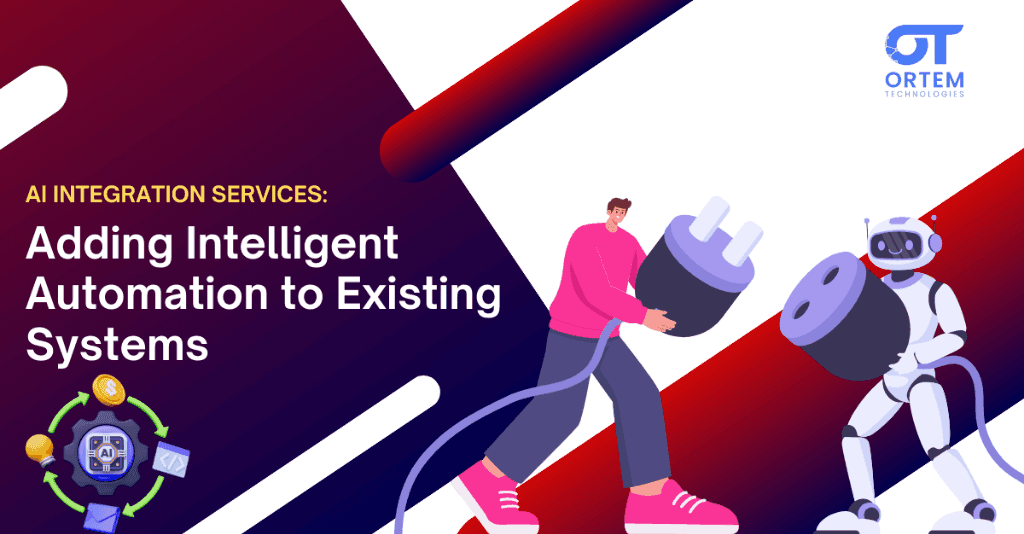
AI integration services connect large language models (LLMs), computer vision, or predictive analytics to your existing software via APIs - without rebuilding your entire system. The most common integrations in 2026 are RAG-based chatbots for customer support, ML-powered recommendation engines, and intelligent document processing pipelines.
Commercial Expertise
Need help with AI & Machine Learning?
Ortem deploys dedicated AI & ML Engineering squads in 72 hours.
Next Best Reads
Continue your research on AI & Machine Learning
These links are chosen to move readers from general education into service understanding, proof, and buying-context pages.
AI & ML Solutions
Move from concept articles to real implementation planning for copilots, RAG, automation, and analytics.
Explore AI servicesAI Agent Development
See how Ortem builds autonomous workflows, tool-using agents, and human-in-the-loop systems.
View agent serviceAI Product Case Study
Study a production AI platform with architecture, launch scope, and operating model context.
Read case studyIntegrating artificial intelligence into existing business operations and software systems is one of the highest-priority technology initiatives for enterprises in 2025. The challenge is not whether AI delivers value — the evidence from early adopters is clear: companies using AI for sales productivity, customer service automation, and operational efficiency report 15-40% productivity improvements in targeted workflows.
The challenge is identifying the highest-value integration points, selecting the right AI capabilities (foundation models vs. fine-tuned models vs. traditional ML), and building integration architectures that deliver reliable, auditable AI-assisted workflows rather than brittle demos.
The AI Integration Landscape
AI integration in 2025 operates at three levels, each with different complexity, cost, and ROI characteristics:
Level 1 — Embedding AI capabilities via API: Using foundation model APIs (OpenAI, Anthropic, Google Gemini, AWS Bedrock) to add AI features to existing applications. This level requires the least engineering investment — a few hundred lines of code to call an API and display the results — and delivers immediate value for use cases that match the foundation model's capabilities: document summarization, content generation, classification, translation, code generation, and question answering from provided context.
The tradeoff: API-based integration creates a dependency on the model provider's pricing, availability, rate limits, and policy changes. Data sent to the API leaves your environment — a compliance consideration for regulated industries.
Level 2 — Custom AI workflows with RAG and tool use: Building Retrieval-Augmented Generation (RAG) pipelines that ground AI responses in your proprietary data, and connecting AI models to external tools (databases, APIs, internal systems) via function calling.
This level produces AI features that are genuinely knowledgeable about your business — a customer service bot that can look up order status, a sales assistant that knows your product catalog and pricing, an internal tool that can query your CRM and answer questions about pipeline status.
RAG architecture: user query -> embed query with embedding model -> vector similarity search against your knowledge base -> retrieve relevant documents -> inject retrieved context into LLM prompt -> generate response grounded in your documents. This produces responses that are factually accurate about your business because the LLM is not relying on training data — it is reading the retrieved context.
Tool use (function calling): the LLM is given a set of "tools" (Python functions, API calls) and can decide to call them to gather information needed to answer a query. A customer service AI with tools for "get_order_status(order_id)", "create_support_ticket(issue, priority)", and "check_product_availability(sku)" can handle complex customer queries by combining information from multiple sources in a single response.
Level 3 — Agentic automation systems: Multi-step AI agents that autonomously plan, execute, and evaluate actions to accomplish business objectives. An agentic system for lead qualification does not just answer one question — it researches the prospect company, analyzes their website for relevant signals, queries your CRM for interaction history, generates a personalized outreach email, and schedules a follow-up if no response is received in 3 days. All without human intervention between the initial trigger and the final output.
Agentic systems require: robust tool integration (the agent needs APIs to execute actions), state management (the agent needs to track multi-step workflow progress), human-in-the-loop checkpoints (specific actions should require human approval before execution), and comprehensive audit logging (every action the agent takes should be logged for review).
High-ROI AI Integration Use Cases
Customer service and support automation: Tier-1 support ticket deflection using RAG-powered chatbots that answer common questions from your knowledge base is one of the most reliably high-ROI AI integrations. Implementation: embed your support documentation, FAQs, and past ticket resolutions in a vector database; build a RAG pipeline that retrieves relevant content for each incoming query; integrate with your support platform (Zendesk, Intercom, Freshdesk) via their API to present AI-generated draft responses to agents or to respond automatically to low-complexity queries.
Measured outcomes from published case studies: 30-60% reduction in ticket volume that reaches human agents, 40-60% reduction in first-response time, 15-25% improvement in customer satisfaction scores when AI correctly handles tier-1 queries. ROI is positive within 6 months for most deployments.
Document intelligence: Enterprise organizations produce and consume enormous volumes of documents — contracts, invoices, reports, compliance filings, engineering specifications. AI document processing that extracts structured data, identifies key clauses, flags anomalies, and summarizes long documents reduces the manual labor of document review dramatically.
Contract analysis: LLMs with document analysis capabilities can review contracts for non-standard clauses, unfavorable terms, missing required provisions, and compliance issues in seconds rather than the hours required for human legal review. Implementation as a tool for in-house legal teams (augmenting, not replacing human review) rather than autonomous execution is the appropriate use case in 2025.
Invoice processing: Computer vision and LLM extraction of structured data from invoices (vendor, invoice number, line items, amounts, payment terms) integrated with ERP systems eliminates manual data entry. AWS Textract, Azure Document Intelligence, and Google Document AI provide managed APIs for document extraction that can be fine-tuned on your document types.
Sales enablement: AI-powered sales tools that generate personalized outreach emails based on prospect research, summarize CRM activity before calls, suggest next actions based on deal stage, and identify at-risk deals from engagement pattern analysis. Integration target: your CRM (Salesforce, HubSpot) via their APIs and webhooks.
Internal knowledge management: Building an internal AI assistant that answers employee questions by searching across your internal documentation (Confluence, Notion, SharePoint, Slack archives, internal wikis) provides self-serve access to institutional knowledge that otherwise requires asking colleagues. Particularly valuable for onboarding new employees and reducing interruptions to subject matter experts.
Technical Architecture for Enterprise AI Integration
Security and data governance: Before connecting AI to internal data sources, define your data classification framework: which data can be sent to external LLM APIs, which data must stay within your infrastructure, and which data requires encryption in transit and at rest. For regulated industries, this classification drives the decision between API-based integration (convenient, potentially non-compliant for sensitive data) and private LLM deployment (compliant, higher operational complexity).
Prompt engineering and safety guardrails: System prompts that define the AI's role, capabilities, and constraints are the primary mechanism for ensuring AI behavior aligns with business requirements. Include: the AI's intended purpose and scope, what the AI should refuse to do, the format of expected outputs, how the AI should handle uncertainty (say "I don't know" rather than hallucinating), and escalation instructions for queries that exceed the AI's capabilities.
Evaluation and monitoring: Production AI systems require ongoing evaluation — measuring whether the AI is providing correct, helpful responses over time, detecting performance degradation as your data or use cases evolve, and identifying categories of queries where the AI fails that require knowledge base updates or model improvements. LangSmith (LangChain), Langfuse (open-source), and Weave (Weights and Biases) provide LLM-specific observability and evaluation tooling.
At Ortem Technologies, our AI integration practice has implemented RAG-based customer service chatbots, document processing pipelines, and sales enablement tools for clients across enterprise software, healthcare, and fintech. We design integrations that are secure, auditable, and operationally maintainable — not just impressive demos. Talk to our AI integration team | Discuss your AI integration requirements
About Ortem Technologies
Ortem Technologies is a premier custom software, mobile app, and AI development company. We serve enterprise and startup clients across the USA, UK, Australia, Canada, and the Middle East. Our cross-industry expertise spans fintech, healthcare, and logistics, enabling us to deliver scalable, secure, and innovative digital solutions worldwide.
Get the Ortem Tech Digest
Monthly insights on AI, mobile, and software strategy - straight to your inbox. No spam, ever.
Sources & References
- 1.AI Index Report 2024 - Stanford HAI
- 2.The State of AI in 2024: GenAI Adoption Spikes - McKinsey & Company
- 3.Gartner Survey: 65% of Organizations Using GenAI in Multiple Business Functions - Gartner Research
About the Author
Editorial Team, Ortem Technologies
The Ortem Technologies editorial team brings together expertise from across our engineering, product, and strategy divisions to produce in-depth guides, comparisons, and best-practice articles for technology leaders and decision-makers.
Stay Ahead
Get engineering insights in your inbox
Practical guides on software development, AI, and cloud. No fluff — published when it's worth your time.
Ready to Start Your Project?
Let Ortem Technologies help you build innovative software solutions for your business.
You Might Also Like
The Rise of Agentic AI: A 2026 Guide to Autonomous Digital Workers

How to Integrate DevOps in AI – The 2025 Blueprint for High-Performance AI Pipelines