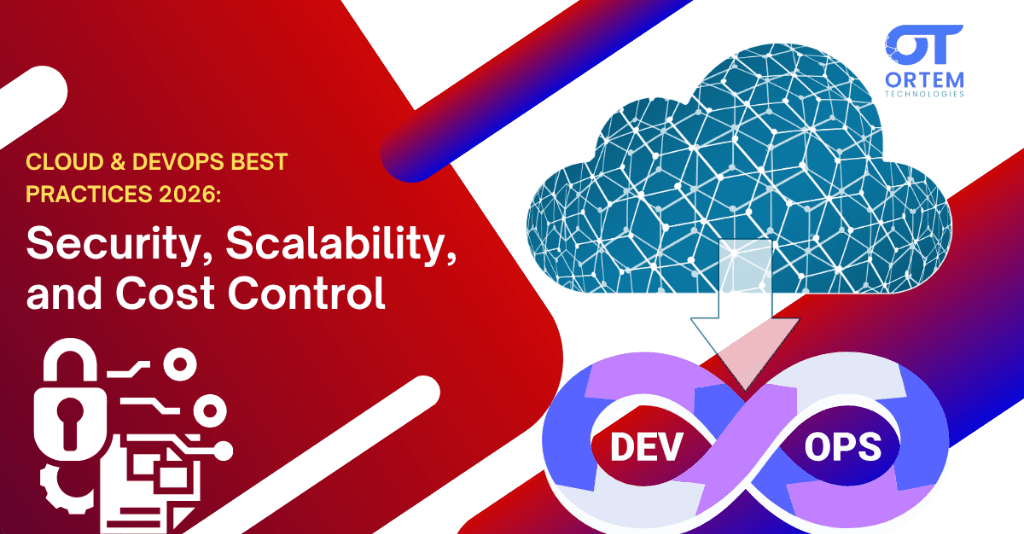
Cloud & DevOps Best Practices 2026: Security, Scalability, and Cost Control
The top Cloud & DevOps best practices in 2026 are: (1) define all infrastructure as code using Terraform or Pulumi, (2) containerize workloads with Docker and orchestrate using Kubernetes, (3) embed security scanning into your CI/CD pipeline (DevSecOps), and (4) implement FinOps practices to monitor and optimize cloud spend monthly.
Commercial Expertise
Need help with Cloud & DevOps?
Ortem deploys dedicated Cloud Infrastructure squads in 72 hours.
In 2026, "The Cloud" is not a destination; it's an operating model. But simply "moving to the cloud" (Lift and Shift) is a recipe for disaster-usually resulting in higher bills and no performance gain. To unlock the true power of the cloud, you must embrace Cloud-Native principles.
At Ortem Technologies, our Cloud & DevOps engineers help companies stop treating the cloud like a data center and start treating it like a supercomputer.
1. Infrastructure as Code (IaC)
Clicking buttons in the AWS console is forbidden. In 2026, your entire infrastructure is defined in code (Terraform, Pulumi, or AWS CDK).
- Reproducibility: We can spin up a pristine "Staging" environment that is an exact clone of "Production" in minutes.
- Disaster Recovery: If a region goes down, we can re-deploy the entire infrastructure to a new region with a single command.
2. Containerization & Orchestration (Kubernetes)
Docker containers wrap your software and its dependencies into a single package that runs anywhere. Kubernetes (K8s) manages those containers at scale.
- Self-Healing: If a container crashes, K8s restarts it automatically.
- Auto-Scaling: K8s detects a spike in traffic and adds more containers instantly, then kills them when traffic drops to save money.
3. The Rise of "FinOps" (Cloud Cost Optimization)
The #1 complaint we hear: "Our AWS bill is out of control."
- The Problem: Developers spin up expensive servers and forget to turn them off.
- The Solution: We implement strict tagging policies and automated "Garbage Collection" scripts that shut down non-production environments at 6 PM on Fridays and turn them back on at 8 AM Monday.
- Spot Instances: We re-architect workloads to run on "Spot Instances" (spare capacity), which are up to 90% cheaper.
4. DevSecOps: Security at Speed
Security used to be a bottleneck at the end of the project. Now, it is "Shifted Left."
- Automated Scanning: Every time a developer commits code, our CI/CD pipeline scans it for vulnerabilities (Snyk, SonarQube) and secrets (API keys). If a vulnerability is found, the build fails automatically.
- Zero Trust Architecture: We assume the bad guys are already inside. No service trusts another service just because they are on the same network. Every request is authenticated and authorized.
5. Multi-Cloud Strategy? (Proceed with Caution)
Everyone talks about "Multi-Cloud" (using AWS and Azure together).
- Our Advice: For 95% of companies, it is over-engineering. Pick one provider and go deep. The complexity cost of abstracting away the cloud usually outweighs the vendor lock-in risk.
- Exception: For regulatory reasons (banking data must stay in-country) or specialized AI workloads (using Google TPUs while hosting the app on Azure).
Choosing Your Cloud Provider
- AWS: The mature market leader. Best for general-purpose workloads and massive scale.
- Azure: The logical choice if you are a Microsoft shop (.NET, Enterprise agreements). Best-in-class hybrid cloud.
- GCP: The leader in Data and AI. If you are training big models, go Google.
The goal of DevOps is simple: Speed. How fast can you go from "Idea" to "Production" without breaking things?
Our Cloud & DevOps services cover the full stack — cloud migration, Kubernetes, CI/CD, and FinOps. If cloud spend is the specific pain point, see our dedicated Cloud Cost Optimisation service.
Get a Free Cloud Architecture Review | Cloud & DevOps Services →
Get the Ortem Tech Digest
Monthly insights on AI, mobile, and software strategy - straight to your inbox. No spam, ever.
About the Author
Editorial Team, Ortem Technologies
The Ortem Technologies editorial team brings together expertise from across our engineering, product, and strategy divisions to produce in-depth guides, comparisons, and best-practice articles for technology leaders and decision-makers.
Stay Ahead
Get engineering insights in your inbox
Practical guides on software development, AI, and cloud. No fluff — published when it's worth your time.
Ready to Start Your Project?
Let Ortem Technologies help you build innovative solutions for your business.
You Might Also Like

Cloud Cost Reduction: The 8 Optimisations That Actually Move the Needle
AI-Native Cloud & FinOps: Mastering Cost Optimization in the Generative AI Era