Cloud & DevOps Best Practices 2026: Security, Scalability, and Cost Control
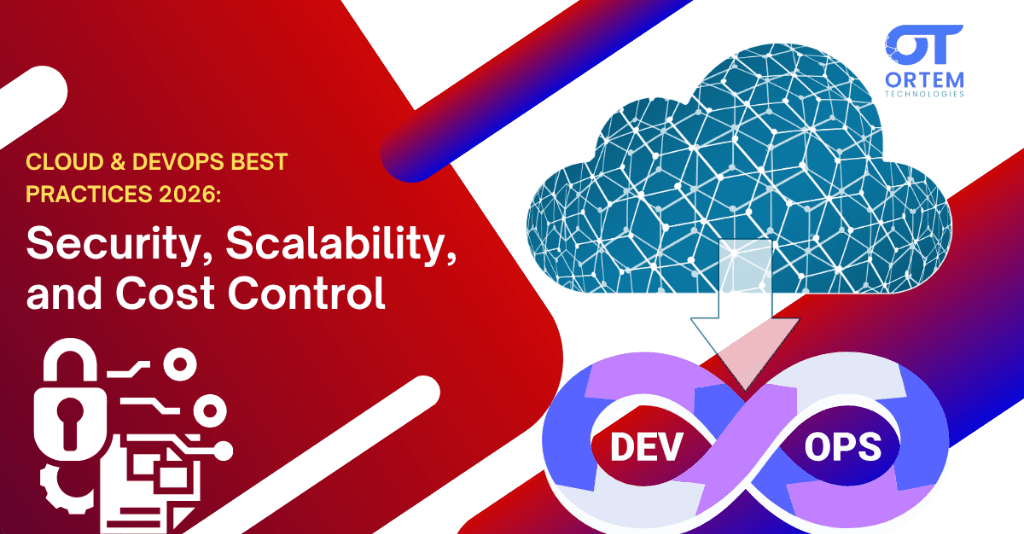
The top Cloud & DevOps best practices in 2026 are: (1) define all infrastructure as code using Terraform or Pulumi, (2) containerize workloads with Docker and orchestrate using Kubernetes, (3) embed security scanning into your CI/CD pipeline (DevSecOps), and (4) implement FinOps practices to monitor and optimize cloud spend monthly.
Commercial Expertise
Need help with Cloud & DevOps?
Ortem deploys dedicated Cloud Infrastructure squads in 72 hours.
Next Best Reads
Continue your research on Cloud & DevOps
These links are chosen to move readers from general education into service understanding, proof, and buying-context pages.
Cloud & DevOps Services
Turn infrastructure content into a delivery plan for cloud migration, CI/CD, Kubernetes, and platform engineering.
Explore cloud serviceCloud Cost Optimisation
Use this if your main search intent is FinOps, GPU efficiency, or cloud spend reduction.
View optimisation serviceCloud Platform Case Study
Review a production SaaS build with modern stack choices, compliance depth, and operational scale.
Read case studyCloud and DevOps practices have converged to the point where separating them is mostly an organizational artifact — the teams that build software and the teams that operate infrastructure increasingly use the same tools, the same automation principles, and the same feedback loops. In 2025, cloud-native DevOps is the baseline for any technology company that needs to ship software reliably at speed. This guide covers the practices, tooling, and architectural patterns that distinguish organizations operating at this standard.
The Cloud-Native DevOps Foundation
For clarity, cloud-native DevOps is the combination of: continuous integration and continuous delivery (CI/CD) pipelines that automatically test and deploy software on every code change, infrastructure as code (IaC) that manages cloud resources with the same version control and review process as application code, observability practices that give engineers visibility into system behavior in production, and a culture where the team that builds software is also responsible for operating it.
Organizations that have fully internalized these practices ship code multiple times per day, recover from production incidents in minutes rather than hours, and can onboard new engineers to a productive state in days rather than weeks. Organizations that have not — where deployments require manual steps, infrastructure is click-ops managed through the console, and production issues are investigated by SSH-ing into servers — have a structural disadvantage in engineer productivity and deployment reliability.
Continuous Integration: The Starting Point
CI is the practice of merging code changes to a shared branch frequently (at least daily) and automatically running tests against every merge. The goal is to detect integration failures immediately — before they accumulate into a crisis on release day.
A working CI pipeline for a standard web application includes: unit tests that run in under 2 minutes (slow tests are not run reliably), integration tests against a test database and mock external services, static analysis and linting to catch code quality issues automatically, dependency vulnerability scanning (Snyk or GitHub Dependabot), container image building if the application runs in Docker, and security scanning of the container image (Trivy or Snyk Container).
The choice of CI platform matters less than the commitment to keeping it green. GitHub Actions, GitLab CI, CircleCI, and Jenkins are all production-capable. The discipline of treating a failing CI build as the highest priority interruption — stopping all other work until it is fixed — is the practice that separates teams that get value from CI from teams that have CI but ignore it.
Continuous Delivery: Automating the Path to Production
CD extends CI by automating the deployment pipeline — the sequence of steps that takes a tested build artifact from the CI system to a production environment. True continuous delivery means that every green CI build can be deployed to production with one click (or automatically). Continuous deployment goes further: every green CI build is automatically deployed to production without human intervention.
Most organizations operate between these two models: automated deployment to staging/pre-production on every green build, with a manual approval gate before production deployment. This is the right balance for most applications — automation eliminates the error-prone manual steps that cause most deployment incidents, while the approval gate provides a human checkpoint for particularly sensitive changes.
Deployment strategies that eliminate downtime: Blue-green deployment maintains two identical production environments. The active environment serves all traffic. When you deploy a new version, it goes to the inactive environment. After validation, you switch all traffic to the new version. Rollback is instant — switch traffic back. Canary deployment routes a small percentage of production traffic (1-5%) to the new version while the majority continues to hit the stable version. Feature flags decouple deployment from feature release — code for a new feature is deployed to production but hidden behind a flag, enabled gradually without rolling back code if problems arise.
Infrastructure as Code: Managing Cloud Resources Like Software
Manual console-based infrastructure management is a principal source of configuration drift, security misconfigurations, and "snowflake" environments that are impossible to replicate. Infrastructure as code (IaC) treats cloud resources — VPCs, security groups, databases, load balancers, serverless functions — as code that is version-controlled, reviewed, tested, and applied automatically.
Terraform is the dominant multi-cloud IaC tool with a declarative syntax that describes the desired state of your infrastructure. Terraform calculates the difference between current state and desired state and applies only the changes needed. The Terraform state file tracks what resources exist; store it in a remote backend (S3 + DynamoDB for AWS, or Terraform Cloud) with state locking to prevent concurrent modifications.
Pulumi is the code-first alternative — infrastructure described in TypeScript, Python, or Go rather than HCL. For engineering teams that want to apply the same language and testing patterns to infrastructure as to application code, Pulumi is compelling.
The IaC discipline that matters most: never make manual changes to infrastructure in production. If you need to change something manually in an emergency, immediately update the IaC code and apply it — the drift between IaC code and actual infrastructure is the source of future incidents.
Observability: Seeing What Is Happening in Production
Observability is the ability to understand the internal state of your system by examining its outputs — logs, metrics, and traces. Without observability, debugging production incidents is guesswork. With observability, you can reconstruct exactly what happened to any user request at any point in time.
Metrics are numerical measurements aggregated over time: request rate, error rate, latency (p50, p95, p99), CPU utilization, memory usage, database query time. Prometheus with Grafana for visualization is the standard open-source metrics stack. Every production service should expose the four golden signals: latency, traffic, errors, and saturation.
Logs are the record of discrete events. Structured JSON logs (rather than free-text log strings) are queryable — you can filter by user_id, request_id, or error_type. Centralize logs in a searchable system: Elastic Stack, CloudWatch Logs Insights, or Datadog Log Management.
Distributed tracing follows a request through every service it touches, recording the latency contribution of each hop. When a request takes 3 seconds and you have 8 microservices, distributed tracing shows you exactly which service contributed which percentage of that latency. Jaeger, Zipkin, and AWS X-Ray are standard distributed tracing systems.
Alerting on the right signals is an art form. Too many alerts creates alert fatigue — engineers learn to ignore the noise. Alert on symptoms that affect users (error rate above threshold, latency above SLA) rather than causes (CPU above 80% — CPU spikes are common and rarely customer-impacting by themselves).
Security in the DevOps Pipeline (DevSecOps)
Security controls integrated into the CI/CD pipeline catch vulnerabilities before they reach production — at a fraction of the cost of finding them post-deployment.
Static Application Security Testing (SAST): Analyze source code for security vulnerabilities without executing it. Tools: Semgrep, CodeQL (GitHub), SonarQube. Run in CI on every pull request.
Dependency scanning: Check application dependencies against known vulnerability databases. Tools: Snyk, Dependabot, OWASP Dependency-Check. Block builds with critical vulnerabilities; alert on high.
Container image scanning: Analyze container images for vulnerabilities in base OS packages and application dependencies before they are deployed. Tools: Trivy, Snyk Container, Amazon Inspector. Block deployment of images with critical CVEs.
Infrastructure security scanning: Analyze Terraform and Kubernetes YAML for security misconfigurations before they are applied. Tools: Checkov, tfsec, AWS CloudFormation Guard. Catching an overly permissive S3 bucket policy in code review is free; discovering it after deployment may not be.
At Ortem Technologies, cloud-native DevOps practices are standard on every engagement — CI/CD pipelines, IaC with Terraform, Prometheus/Grafana observability, and DevSecOps controls are part of our project baseline, not optional add-ons. Talk to our cloud and DevOps team | Contact us for an infrastructure review
About Ortem Technologies
Ortem Technologies is a premier custom software, mobile app, and AI development company. We serve enterprise and startup clients across the USA, UK, Australia, Canada, and the Middle East. Our cross-industry expertise spans fintech, healthcare, and logistics, enabling us to deliver scalable, secure, and innovative digital solutions worldwide.
Get the Ortem Tech Digest
Monthly insights on AI, mobile, and software strategy - straight to your inbox. No spam, ever.
About the Author
Editorial Team, Ortem Technologies
The Ortem Technologies editorial team brings together expertise from across our engineering, product, and strategy divisions to produce in-depth guides, comparisons, and best-practice articles for technology leaders and decision-makers.
Stay Ahead
Get engineering insights in your inbox
Practical guides on software development, AI, and cloud. No fluff — published when it's worth your time.
Ready to Start Your Project?
Let Ortem Technologies help you build innovative software solutions for your business.
You Might Also Like
LLMOps and AI Maintenance: What Running AI in Production Really Costs in 2026

Cloud Cost Reduction: The 8 Optimisations That Actually Move the Needle