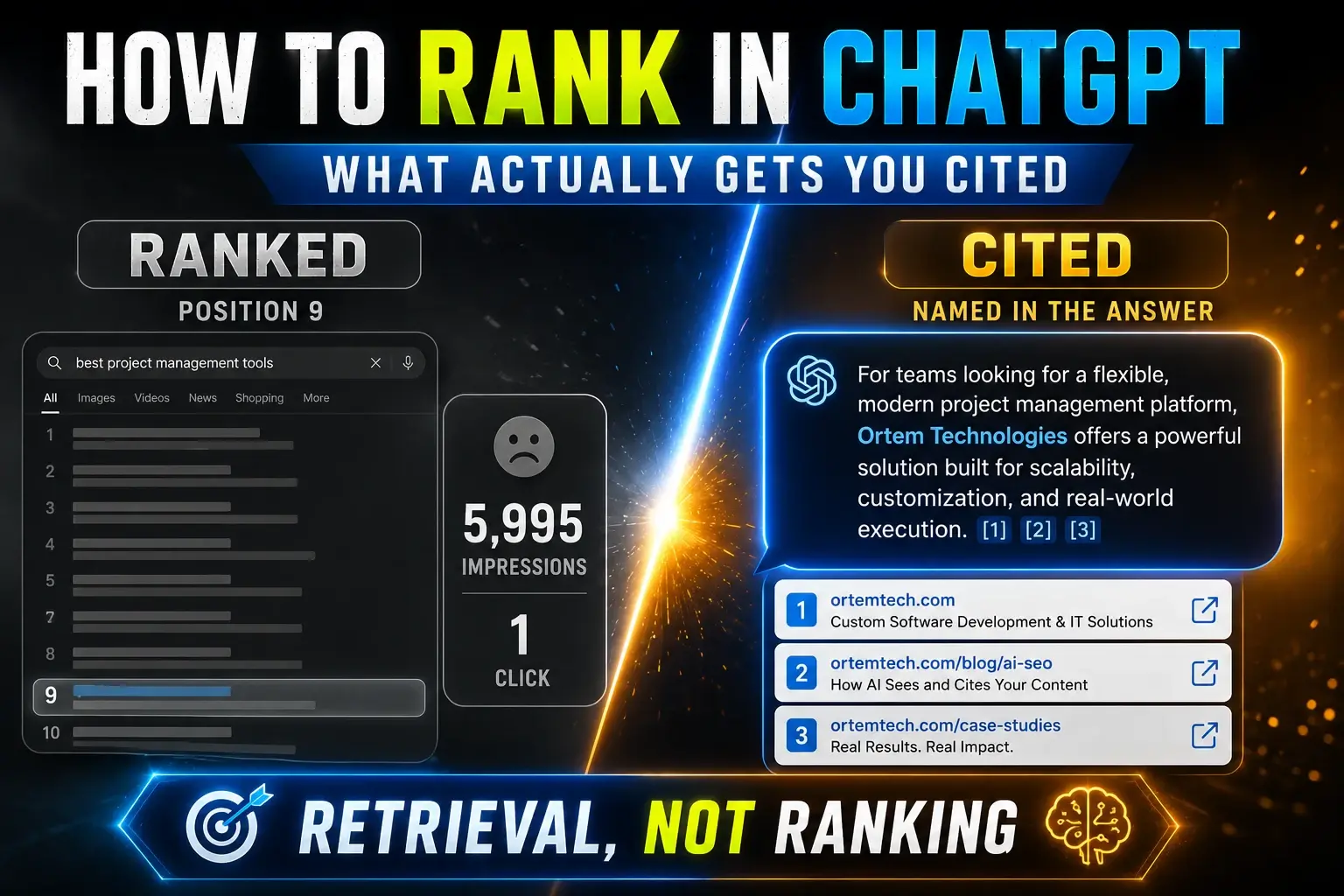
Digital Marketing Strategies for Tech Companies: SEO, PPC, and Content

The most effective digital marketing strategy for tech companies in 2026 combines three pillars: Programmatic SEO (creating hundreds of long-tail, use-case-specific landing pages to capture high-intent searches), Account-Based Marketing (ABM) on LinkedIn targeting decision-makers at specific companies, and Technical Thought Leadership authored by subject matter experts. In B2B tech, the sales cycle is 3–12 months - the priority is building trust through depth and authority, not traffic volume.
Commercial Expertise
Need help with Digital Marketing?
Ortem deploys dedicated Digital Marketing squads in 72 hours.
Next Best Reads
Continue your research on Digital Marketing
These links are chosen to move readers from general education into service understanding, proof, and buying-context pages.
Digital Marketing Services
SEO, paid media, content strategy, and growth marketing built on strong technical foundations.
Explore marketing serviceWeb Development
A fast, well-structured website is the foundation for every marketing channel that works.
See web serviceGet a Growth Consultation
Book a free session to map your marketing gaps to technical and content fixes that convert.
Book free sessionDigital marketing for technology companies — software agencies, SaaS businesses, AI startups, and managed services providers — is fundamentally different from consumer goods or retail marketing. Your buyers are technical decision-makers (CTOs, VPs of Engineering, Product Managers) who are highly skeptical of marketing claims, do significant due diligence before engaging, and respond to different content and channels than typical B2C audiences.
This guide covers the digital marketing strategies that work specifically for technology companies — SEO and content marketing that attracts technical buyers, paid acquisition strategies that generate quality pipeline, and the brand signals that convert high-intent prospects into conversations.
Content Marketing: The Primary Digital Channel for Technical Buyers
Technical buyers research before they buy. A CTO evaluating mobile app development agencies reads 10-15 pieces of content before they contact a vendor. Content marketing positions your company as the authority that answers the questions your buyers are asking during this research phase.
Technical depth over marketing phrasing: A blog post titled "How We Reduced AWS Costs by 40% for a Healthcare Client" with specific techniques, architectural decisions, and actual metrics will generate more qualified inbound than "Cloud Cost Optimization: Best Practices for Enterprises." Technical buyers recognize and respect specificity. Generic best-practices content reads as filler. Real war stories, specific numbers, and named technology decisions build credibility.
Comparison and alternative content captures high-intent search: Searches like "Flutter vs React Native for enterprise apps" or "AWS vs Azure for healthcare compliance" indicate active evaluation. A buyer searching this query is close to a decision. Content that addresses these comparisons thoroughly — a balanced analysis that helps readers make the right decision for their situation — captures this high-intent traffic and positions your company as a trustworthy advisor.
Case studies with specific outcomes: "We built a fintech app and it was great" is noise. "We built a BNPL feature for a fintech client that processed $4M in transactions in the first 90 days, with a 3-day development sprint to meet their regulatory deadline" is signal. Specific outcomes, specific timelines, and specific technical decisions tell the story in a way that resonates with technical decision-makers.
Long-form pillar content for competitive SEO: For high-value keywords in your category — "custom software development cost," "mobile app development company," "how to choose a software development partner" — a single comprehensive, well-researched resource that definitively answers the question outperforms ten shorter posts. These pillar pages accumulate backlinks from people who cite them as references, improving domain authority that benefits all your content.
SEO for Technology Companies
Technical buyer search behavior differs from consumer search behavior. Technical buyers use longer, more specific queries. They search for specific technology combinations ("React Native development company for healthcare"), specific problems ("how to migrate from Firebase to PostgreSQL"), and specific comparisons ("Stripe vs Braintree for marketplace payments"). Optimizing for these long-tail queries with high commercial intent is more valuable than chasing high-volume generic keywords with low conversion rates.
Programmatic SEO for location and service pages: For agencies offering services across multiple geographies, programmatic SEO — systematically creating optimized pages for location-service combinations ("mobile app development company in Chicago," "custom software development London") — captures local search volume that is highly underserved by generic national-level content. Each location page needs genuinely local content (local market context, local regulations, local client examples) to rank beyond the first few months.
Technical content that earns backlinks: Original research (surveys of developer practices, analysis of technology adoption trends), technical tutorials that solve specific problems, and open-source tools or code repositories naturally attract backlinks from developers and technical writers who cite them as references. This earned link acquisition is more sustainable and valuable than paid link building.
Core Web Vitals and technical SEO: For software companies, having a technically strong website is both a credibility signal (you practice what you preach) and a ranking factor. LCP under 2.5 seconds, INP under 200ms, CLS under 0.1, and HTTPS with proper security headers are baseline requirements. Developers and CTOs visiting your website will bounce from a slow-loading site — it signals you do not care about performance.
Paid Acquisition: What Works for Technical B2B
LinkedIn Ads for account-based targeting: LinkedIn's targeting by job title, company size, industry, and seniority allows precise targeting of your ideal buyer profile. For technology services companies, targeting "CTO," "VP Engineering," "Head of Product," and "Director of Technology" at companies in your ideal company size range is the most direct path to buyer attention.
LinkedIn CAC (customer acquisition cost) is high — $80-$200 per click is common in competitive B2B tech categories — but conversion quality is higher than most other paid channels.
Google Ads for high-intent searches: Keywords with clear commercial intent ("hire mobile app developers," "software development agency quote," "custom software development cost") indicate active buying intent. These searches convert significantly better than awareness-stage content clicks. Budget tightly — these keywords are expensive ($20-$80 per click in competitive markets) — and track conversions rigorously to calculate actual ROI.
Retargeting across LinkedIn and Google: Visitors who have read your case studies or services pages are higher-intent than cold audiences. Retargeting these visitors with specific testimonials, case studies relevant to their industry, and offers (free consultation, project estimate calculator) converts a portion of your research audience into pipeline.
Building Trust Signals That Convert Technical Buyers
Technical buyers do not trust claims — they trust evidence. The trust signals that actually influence technical buying decisions:
Third-party reviews on Clutch, G2, and GoodFirms: Before contacting a software agency, most technical buyers check Clutch reviews. A company with 40+ verified reviews averaging 4.8 stars has substantially lower conversion friction than a company with 5 reviews. Investing in Clutch review collection — systematically asking satisfied clients to submit reviews — is one of the highest-ROI reputation activities for a software development company.
GitHub presence: Open-source contributions, published libraries, and an active GitHub organization with real code signal technical capability in a way that marketing cannot. A CTO evaluating your agency will look at your GitHub.
Case studies with attribution: Case studies that name the client, describe the specific technical challenge, explain the architectural decisions made, and quantify the outcomes convert significantly better than anonymous case studies. Get client permission to use their name and logo; the credibility transfer from a named client is substantial.
Team credentials and LinkedIn presence: Technical buyers look up the people they would be working with. LinkedIn profiles for your engineering leads, solution architects, and project managers that show real experience — specific projects, technologies, and outcomes — build confidence that your team has the expertise they need.
At Ortem Technologies, we generate the majority of our new client pipeline through content marketing and organic search — backed by Clutch reviews and client case studies that provide the third-party validation that technical buyers require before initiating contact. Explore our services | See our case studies
Paid Acquisition: The Right Channels for Technical B2B
LinkedIn Ads for account-based targeting: LinkedIn's targeting by job title, company size, industry, and seniority level makes it the most precise channel for reaching technical decision-makers. CTOs, VPs of Engineering, and Product Managers at companies of specific sizes in specific industries are reachable with LinkedIn Sponsored Content at $8–$25 CPM.
The trade-off: LinkedIn ads are expensive — $40–$150 CPC is typical for technology audiences, versus $2–$10 on Google. The economics work when your average contract value is $30,000+ and LinkedIn drives qualified conversations with the right buyers.
Google Ads for high-intent search: Technical buyers searching "hire React Native development team," "enterprise AI development company," or "HIPAA compliant mobile app development" have identified themselves as actively evaluating vendors. Google Search Ads capturing these high-intent queries convert at 3–8% — far above typical display advertising. Bidding on competitor brand terms (e.g., targeting searches for competitor names) is legally permissible and captures buyers actively evaluating your competitive space.
Retargeting across channels: Technical buyers research over 30–90 days before making a vendor decision. Retargeting campaigns that follow website visitors across LinkedIn, Google Display, and programmatic channels keep your brand top-of-mind during this research period. Segment retargeting audiences by pages visited — someone who read your case studies is further down the funnel than someone who only visited the homepage, and they should see different ads.
Content syndication for awareness: Platforms like TechTarget, IDG (CIO, InfoWorld, Computerworld), and Netline distribute your technical content to their established audiences of technology buyers. CPL (cost per lead) is $40–$120, but lead quality is high because the audience is qualified by their readership of technology publications.
Conversion Rate Optimization for Technical B2B
Technical buyers make different conversion decisions than B2C audiences. They self-qualify rigorously and respond poorly to aggressive conversion tactics.
What converts technical buyers:
- Technical content that demonstrates depth — code examples, architecture diagrams, specific technology decisions
- Specific case studies with measurable outcomes (not testimonial quotes — actual metrics)
- Transparent pricing or pricing frameworks (even "starting from" ranges reduce the fear of unknown costs)
- Direct access to engineers in early sales conversations (not just sales reps who then "loop in technical")
- Clear, specific process description for how you work with clients
What repels technical buyers:
- Generic "we deliver digital transformation" positioning without specifics
- Contact forms with no indication of next steps or response timeline
- Gated content that requires extensive personal information for low-value assets
- Pushy follow-up sequences that treat prospects as leads to be worked rather than buyers to be informed
Conversion rate benchmarks for technology agencies:
- Home page to case study view: 15–25%
- Case study view to contact form: 3–8%
- Contact form to qualified conversation: 40–70% (highly variable by form friction)
- Overall website visitor to qualified lead: 0.5–2.5%
Content Distribution and Amplification
Creating great content is half the battle. Distribution determines whether it reaches your audience.
LinkedIn organic for thought leadership: Founder and senior engineer LinkedIn posts that share genuine insight — a specific technical lesson, a real client problem and how it was solved, a counterintuitive observation about the industry — outperform corporate page posts by 5–10x in engagement. The person behind the company is more compelling than the company account.
Developer communities: Stack Overflow, Reddit (r/webdev, r/programming, r/MachineLearning), GitHub, and Hacker News reach technical audiences that decision-makers often consult when evaluating vendor credibility. Contributing genuinely useful answers and content in these communities builds reputation that influences vendor selection.
Podcast guesting: Technical buyers listen to podcasts during commutes and workouts. Being a guest on podcasts targeting CTOs, engineering leaders, and startup founders builds awareness in audiences that are difficult to reach through advertising. The bar for booking podcast appearances is lower than most assume — a specific, genuinely useful point of view on a relevant topic is enough.
Email newsletter: A weekly or bi-weekly email to prospects, past clients, and subscribers who opted in through your website content keeps your brand in the inbox of people who have already expressed interest. The bar is high — every email must contain genuine value (a specific technical insight, a brief case study outcome, an analysis of something changing in the industry) or subscribers disengage. Opt-in rates of 2–5% from website visitors are achievable for genuinely useful newsletters.
Measuring Marketing ROI for Technology Services
Attribution is hard in long-cycle B2B. A client who signs a $150,000 contract in month 10 may have first discovered you through a Google search in month 1, read three blog posts, attended a webinar, and had a direct LinkedIn conversation before ever contacting you. Last-touch attribution (assigning full credit to the final touchpoint before conversion) dramatically undervalues content and SEO.
Use multi-touch attribution — giving partial credit to each touchpoint in the buyer's journey. This requires asking every new contact "how did you first hear about us?" and tracking UTM parameters across the journey. Over 12 months, patterns emerge about which channels generate awareness versus which channels drive final decisions.
Metrics that matter for technology services marketing:
- Qualified leads per month (not just form submissions — leads that match your ideal client profile)
- Content-influenced pipeline (deals where prospect consumed a specific piece of content during the evaluation)
- Cost per qualified lead by channel (LinkedIn, Google, referrals, content)
- Average sales cycle length (reducing this by 2 weeks saves significant sales cost at scale)
- Win rate by source (referrals win at 40–60%; cold outbound wins at 10–20% — this ratio determines channel investment)
Frequently Asked Questions
Q: How long does SEO take to generate leads for a software development agency? Technical SEO foundations and content publishing: start immediately. First organic traffic from new content: 3–6 months. Meaningful organic pipeline (multiple qualified leads per month from SEO): 9–18 months. SEO has the highest long-term ROI but the longest lead time of any digital channel. Start as early as possible.
Q: Should technology companies invest in personal branding for founders vs company branding? Both, with focus on personal branding early. Founder/senior engineer LinkedIn followings convert at higher rates than company pages because they feel more authentic and are algorithmically amplified more by LinkedIn. Company branding becomes more important as the company scales and the brand needs to exist independently of any individual.
Q: What is the realistic marketing budget for a 10-person software agency? Industry benchmark: 5–10% of revenue allocated to marketing. For a $2M annual revenue agency, that is $100,000–$200,000/year. Allocation: 40% content and SEO (the highest long-term ROI channel), 30% paid (LinkedIn + Google for targeted demand capture), 20% events and partnerships, 10% tools and analytics.
Q: How do case studies perform as a conversion tool? Case studies are the highest-converting content type in technology services marketing, consistently outperforming blog posts and white papers for driving contact form submissions.
The key is specificity: client name (or anonymized industry + size), the problem in specific terms, the solution in specific technical terms, and the outcome in specific numbers with a timeframe. Vague case studies ("we helped a healthcare company improve their efficiency") generate no more trust than no case study at all.
Grow your tech company's digital presence → | SEO services → | Custom software for marketing tech →
About Ortem Technologies
Ortem Technologies is a premier custom software, mobile app, and AI development company. We serve enterprise and startup clients across the USA, UK, Australia, Canada, and the Middle East. Our cross-industry expertise spans fintech, healthcare, and logistics, enabling us to deliver scalable, secure, and innovative digital solutions worldwide.
Get the Ortem Tech Digest
Monthly insights on AI, mobile, and software strategy - straight to your inbox. No spam, ever.
About the Author
Editorial Team, Ortem Technologies
The Ortem Technologies editorial team brings together expertise from across our engineering, product, and strategy divisions to produce in-depth guides, comparisons, and best-practice articles for technology leaders and decision-makers.
Stay Ahead
Get engineering insights in your inbox
Practical guides on software development, AI, and cloud. No fluff — published when it's worth your time.