
Green AI & Data Centers: Balancing Compute Power with Sustainability
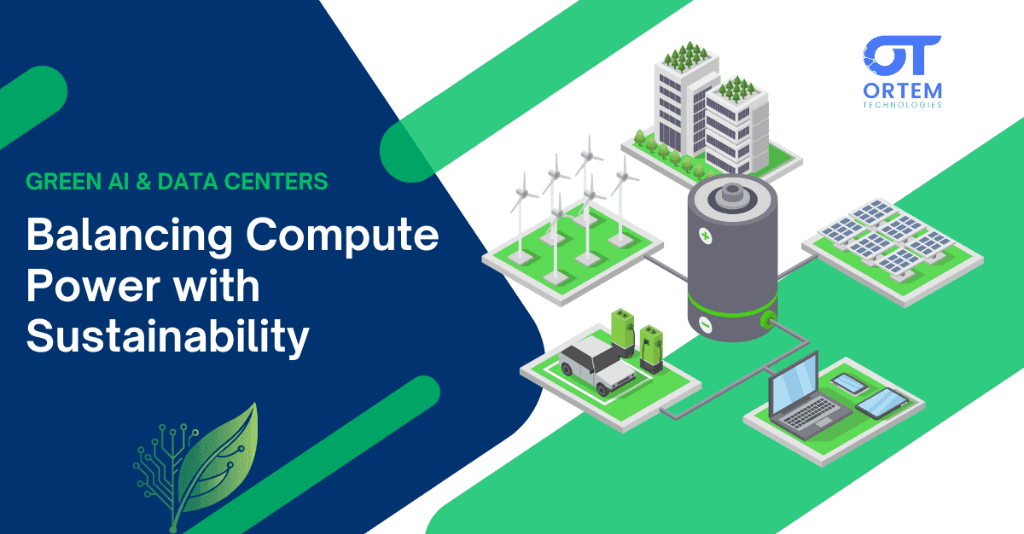
AI energy consumption now rivals the airline industry's carbon footprint - training a single large model emits as much CO₂ as five cars over their lifetimes. The most effective Green AI strategies in 2026 are: deploying fine-tuned Small Language Models (SLMs) instead of large foundation models for domain-specific tasks (99% energy reduction), liquid cooling in GPU clusters, and carbon-aware computing that schedules AI jobs during renewable energy windows.
Next Best Reads
Continue your research on Emerging Tech
These links are chosen to move readers from general education into service understanding, proof, and buying-context pages.
Ortem Innovation Lab
See how Ortem prototypes emerging AI and frontier tech for early-stage product bets.
Visit innovation labAI Agent Development
Build autonomous AI agents, tool-using workflows, and human-in-the-loop systems with Ortem.
View agent serviceTalk Through Your Idea
Free 30-minute session to scope an emerging-tech concept into a buildable roadmap.
Book free consultationThe environmental footprint of artificial intelligence is one of the most significant sustainability challenges in the technology sector. Training GPT-4 consumed an estimated 50 gigawatt-hours of electricity — equivalent to the annual electricity consumption of 5,000 US households. A single ChatGPT query consumes approximately 10x the energy of a Google Search.
As AI inference scales to billions of queries daily and model training runs become larger, the combined energy consumption of AI computing is projected to exceed that of small countries by 2027.
This reality is driving two parallel developments: a genuine engineering effort to reduce AI's energy intensity through more efficient models, hardware, and infrastructure; and a growing regulatory and customer expectation landscape that requires organizations to account for and reduce their AI carbon footprint.
Why AI Energy Consumption Is Growing
Training runs are getting larger: GPT-4's estimated 50GWh training energy consumption is already being exceeded by next-generation models. Frontier AI labs are investing in training clusters with 100,000+ GPUs consuming hundreds of megawatts of power. Each new model generation is roughly 10x the compute of the previous generation.
Inference at scale is the larger factor: Training happens once; inference happens billions of times. As AI-powered features become ubiquitous — search, email drafting, code completion, customer service — the inference energy consumption dwarfs the training energy.
Data center water consumption: AI data centers require significant cooling. Training a GPT-4-scale model consumed an estimated 700,000 liters of water for cooling. Microsoft disclosed in 2023 that their water consumption increased 34% year-over-year, substantially driven by AI workloads.
Efficient AI Models: The Hardware and Architecture Improvements
Model architecture efficiency: Mixture of Experts (MoE) models — where only a subset of the model's parameters are activated for each input — achieve comparable performance to dense models at a fraction of the compute cost. Mistral's MoE architecture delivers competitive performance to much larger dense models. State Space Models like Mamba process sequences more efficiently than transformers for certain tasks.
Quantization and model compression: A 70-billion-parameter model in full FP32 precision requires 280GB of GPU memory and substantial compute per inference. Quantizing to INT4 reduces this to 35GB and dramatically reduces compute per inference with minimal quality degradation for most tasks. Libraries like bitsandbytes and GPTQ enable 4-bit and 8-bit quantization of open-source models.
Purpose-specific small models: GPT-4 is a generalist model optimized to perform well across thousands of task types. For a specific business task — classifying customer support tickets into categories, extracting structured data from invoices, generating product descriptions in a specific brand voice — a small model fine-tuned on that specific task outperforms GPT-4 on the task while consuming 1-2% of the energy per inference.
Efficient inference infrastructure: NVIDIA's TensorRT inference framework optimizes model execution for specific GPU hardware, reducing inference latency and energy consumption 2-4x compared to naive PyTorch serving. vLLM (PagedAttention) significantly improves GPU memory utilization for LLM inference, allowing more concurrent requests per GPU and reducing per-request energy cost.
Green Data Center Infrastructure
Renewable energy procurement: The major cloud providers have made commitments to renewable energy. Microsoft committed to 100% renewable energy by 2025, Google has operated on 100% renewable electricity since 2017 (through power purchase agreements and RECs), and AWS is on track to 100% renewable energy by 2025.
24/7 carbon-free energy commitments — where Google is the pioneer — are the most rigorous standard: ensuring that every hour of energy consumption is matched by a renewable generation certificate from the same grid region.
Data center location and cooling efficiency: Data center energy efficiency is measured by Power Usage Effectiveness (PUE) — total facility energy divided by IT equipment energy. A PUE of 1.0 is perfect (all energy goes to computing); a PUE of 2.0 means half the energy is overhead (cooling, lighting, power conversion). Modern hyperscale data centers achieve PUEs of 1.1-1.2; legacy colocation facilities often run at 1.5-2.0.
Locations with cold climates reduce cooling energy. Iceland, Norway, and northern Sweden have attracted significant data center investment due to cold climate cooling and abundant renewable hydroelectric power. Microsoft's underwater data center project (Project Natick) in Scottish waters used the cold seawater for cooling.
Waste heat utilization: Some facilities are beginning to capture waste heat for district heating systems — a Microsoft data center in Helsinki provides heat to 10% of the city's district heating network.
Building Sustainable AI Applications: What Developers Can Do
Right-size model to task: Using Claude Opus or GPT-4 for every query when Haiku or GPT-4o-mini would suffice is a 10-50x energy difference per query at scale. Profile task requirements and use the appropriate model tier.
Implement semantic caching: Many production LLM applications receive semantically similar queries repeatedly. Semantic caching (using embeddings to match incoming queries to cached responses) reduces redundant inference, cutting both cost and energy consumption 40-70% for repetitive query patterns.
Batch processing over real-time where acceptable: Real-time inference requires provisioned capacity that is often underutilized between requests — wasting energy on idle GPU compute. Batch inference dramatically reduces energy per processed item for non-latency-sensitive workflows.
Choose efficient deployment infrastructure: Serverless GPU platforms (Modal, Replicate) that scale GPU compute to zero when not in use eliminate the energy waste of idle provisioned GPU servers. For applications with significant variance in inference volume, serverless reduces both cost and energy consumption.
Measure and report AI carbon footprint: The CodeCarbon library (Python) measures the carbon footprint of ML workloads based on compute time, hardware type, and grid carbon intensity of the deployment region.
At Ortem Technologies, sustainability considerations are part of our AI architecture decisions — we recommend the smallest adequate model for each task, implement caching for repetitive inference patterns, and prefer cloud regions with high renewable energy percentages for AI workloads. Talk to our AI development team | Discuss sustainable AI architecture for your project
The Business Case for Sustainable AI
Beyond regulatory compliance and reputational considerations, sustainable AI practices make financial sense. The same techniques that reduce AI's environmental footprint — smaller models, efficient inference, semantic caching, batch processing — also reduce cost. A $0.03/query LLM cost at 10 million queries per day is $300,000/month in API costs; a right-sized model at $0.003/query is $30,000/month. The 90% cost reduction comes with a 90% energy reduction.
Organizations that adopt AI efficiency as an engineering discipline — measuring energy per useful output, right-sizing models to tasks, implementing caching, and choosing energy-efficient deployment infrastructure — consistently find that sustainability and cost efficiency are aligned rather than in tension.
Talk to our AI team about efficient AI deployment | Discuss sustainable AI architecture for your project
About Ortem Technologies
Ortem Technologies is a premier custom software, mobile app, and AI development company. We serve enterprise and startup clients across the USA, UK, Australia, Canada, and the Middle East. Our cross-industry expertise spans fintech, healthcare, and logistics, enabling us to deliver scalable, secure, and innovative digital solutions worldwide.
Get the Ortem Tech Digest
Monthly insights on AI, mobile, and software strategy - straight to your inbox. No spam, ever.
About the Author
Editorial Team, Ortem Technologies
The Ortem Technologies editorial team brings together expertise from across our engineering, product, and strategy divisions to produce in-depth guides, comparisons, and best-practice articles for technology leaders and decision-makers.
Stay Ahead
Get engineering insights in your inbox
Practical guides on software development, AI, and cloud. No fluff — published when it's worth your time.
Ready to Start Your Project?
Let Ortem Technologies help you build innovative software solutions for your business.
You Might Also Like

UI/UX Design Trends 2025: Creating Exceptional Digital Experiences

Wearable App Development 2025: Building for Smartwatches and Beyond