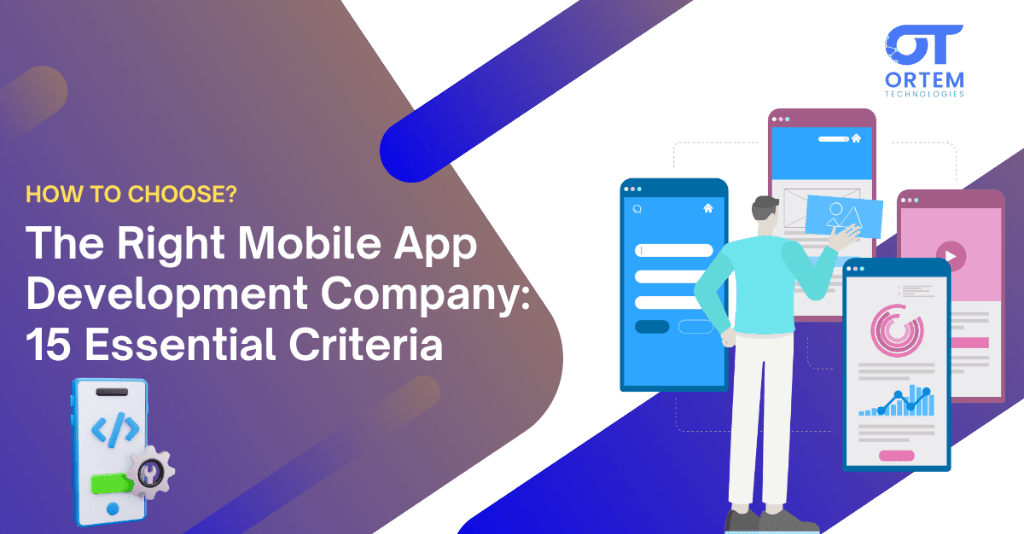
How to Choose the Right Mobile App Development Company: 15 Essential Criteria
To choose the right mobile app development company, evaluate their verified portfolio of shipped apps, their experience with your target platform (iOS/Android/Flutter), their communication process, post-launch support policy, and whether they offer a Discovery phase before full development. Always ask for references from clients in your industry.
Commercial Expertise
Need help with Mobile App Development?
Ortem deploys dedicated Enterprise Mobile Solutions squads in 72 hours.
Next Best Reads
Continue your research on Mobile App Development
These links are chosen to move readers from general education into service understanding, proof, and buying-context pages.
Mobile App Development Services
See how Ortem scopes, designs, and ships iOS, Android, Flutter, and React Native products.
See service detailsReact Native vs Flutter Path
Compare cross-platform approaches before you choose a stack, team shape, and launch timeline.
Compare frameworksMobile App Case Study
Review a real mobile product build with delivery scope, platform choices, and outcome signals.
Read case studyChoosing a mobile app development company is one of the highest-stakes vendor decisions a product company or founder makes. A wrong choice costs 6-18 months and $50,000-$500,000+ in rework, delays, or complete restarts. The market is opaque — there are 50,000+ mobile development agencies globally, and the quality variance between the best and worst is enormous. This guide gives you a concrete evaluation framework based on the patterns that distinguish successful development partnerships from failed ones.
The Real Differences That Matter
Team stability and dedication: Many agencies quote a team configuration but deliver using whichever engineers happen to be available. A dedicated team — engineers assigned exclusively to your project, not split across 5 clients simultaneously — develops product context that directly improves code quality and feature implementation accuracy. Ask specifically: "Will these engineers work exclusively on my project? What happens if one leaves?" Get the team composition guarantee in writing.
Communication model: The single largest predictor of outsourced project failure is communication breakdown — misunderstood requirements, delayed responses to questions, decisions made without client input. Successful development partnerships have: direct Slack or Teams access to engineers (not mediated through a sales/account manager), a daily or every-other-day standup or async update, and a product owner on the vendor side who absorbs project context.
Quality engineering practices: Code quality is invisible until it is not. Ask to see GitHub repositories from similar past projects. Look for: TypeScript or typed languages (typed code is significantly easier to maintain), meaningful unit test coverage on business logic, code review history showing thoughtful review comments, and clean commit history with descriptive messages.
Technical leadership access: A solution architect or technical lead who can discuss your application's architecture, identify risks in your requirements, and recommend alternatives to your initial design adds enormous value. Agencies that assign only execution engineers without technical leadership produce technically correct implementations that do not account for non-functional requirements.
Reference verification: References are universally positive in proposals and universally honest in phone calls. Call every reference you receive. Ask specifically: "Were there any periods where you felt the team was not communicating transparently about progress or problems?" "Did the final project cost match the initial estimate, and if not, why?" "Would you hire this company again for a similar project?"
The Evaluation Process Step by Step
Step 1 — Define your requirements before approaching vendors: The most common mistake is approaching agencies with vague requirements ("we need a mobile app like Airbnb") and expecting them to scope the project. Vendors who scope from vague requirements produce wildly varying proposals that cannot be compared. Define: target platforms (iOS, Android, or both), primary user type and their key workflow, the 5 core features the MVP must have, required integrations, and your timeline and budget range.
Step 2 — Build a shortlist of 5-8 candidates using multiple signals: Clutch.co and G2 provide third-party verified reviews — filter by your technology (Flutter, React Native, native iOS/Android), your project budget range, and your industry. Ask in startup Slack communities and LinkedIn networks for specific recommendations from founders who have completed similar projects.
Step 3 — Screen with a technical questionnaire: Before investing in a discovery call, send a written technical questionnaire: "What is your standard test coverage requirement for business logic code? Do you use TypeScript for React Native projects? How do you handle breaking changes to a third-party API during a project? Walk me through your code review process." Responses reveal technical culture quickly.
Step 4 — Evaluate proposals on total cost of ownership, not initial price: A $60,000 proposal from a junior-heavy offshore team is more expensive than a $100,000 proposal from a senior-heavy team with strong QA if the junior team produces 40% rework, requires 2x as many revision cycles, and delivers a codebase that costs $50,000/year more to maintain.
Step 5 — Run a paid discovery phase before a full commitment: Reputable agencies will agree to a paid 2-4 week discovery phase before committing to a full project. Discovery produces: detailed technical specification, architecture decision records, API design, UI/UX wireframes, and a revised project estimate based on actual requirement clarity. A discovery phase costs $5,000-$20,000 but saves multiples of that in avoided scope misalignment.
Red Flags in the Evaluation Process
Unrealistically low estimates: If the market rate for a given scope is $80,000-$120,000 and one proposal comes in at $25,000, the quote is not better — it reflects either a misunderstanding of the scope or a business model that relies on change orders. Low initial quotes followed by constant scope-expansion negotiations are one of the most common patterns in failed outsourced projects.
Vague team composition: "A team of senior developers" without naming specific engineers, specifying their years of experience, or providing LinkedIn profiles for review is a signal that the team presented in the proposal is not the team that will work on the project.
No portfolio of similar projects: Every agency has a portfolio. If their portfolio shows no projects in your industry vertical, at your scale, or with your technical requirements, their experience gap represents real risk.
No clear process for handling scope changes: Scope changes are inevitable. How does the agency handle them? A clear process — written change request, impact assessment (timeline, cost, priority), client approval before implementation — protects both parties.
What to Look For in the Contract
Intellectual property assignment: You must own the source code. The contract must include an explicit IP assignment clause that transfers all work product to you upon payment.
Milestone-based payment: Payment milestones tied to delivered, accepted work protect you from paying for work that was not completed. Never pay 100% upfront for any development project.
Warranty period: A warranty period of 30-90 days post-launch during which the vendor fixes bugs in delivered functionality at no additional cost is standard and reasonable.
Source code access from day one: You should have access to the git repository from the first day of development — not at project completion.
Ortem Technologies operates with dedicated engineering teams, US-based project management and architecture, full source code access from day one, and TypeScript on all projects. Our standard engagement includes a paid discovery phase, milestone-based payment, and a 60-day post-launch warranty. Talk to our team about your project | See case studies of completed projects
Red Flags That Indicate Poor Vendor Quality
If the market rate for a given scope is $80,000–$120,000 and one proposal comes in at $25,000, the quote is either missing scope, using junior resources who will require significant supervision and revision cycles, or the company will find reasons to expand the scope mid-project. Budget-driven vendor selection is the most expensive decision you can make in software development.
Vague technical answers: Ask technical questions and evaluate the quality of answers. "We use the latest technologies" is not an answer. "We default to Flutter for cross-platform projects where the UI complexity doesn't require platform-specific components, and React Native when the client has existing React web development capability they want to extend" is an answer. Technical specificity signals genuine expertise.
No fixed-scope option: Reputable agencies offer both time-and-materials and fixed-scope engagements for well-defined projects. Agencies that only offer time-and-materials for projects with clear requirements are protecting themselves from accountability at your expense.
No IP assignment clause in the standard contract: Your code is your asset. Any agency whose standard contract does not include full IP assignment to the client is not structured for your interests.
Contract Structure: What to Negotiate
The project contract defines your protection when things go wrong. Review these terms carefully:
Milestone-based payment schedule: Never pay more than 25% upfront. Structure remaining payments around specific deliverables — working feature delivery, UAT sign-off, production deployment — not calendar dates. Calendar-based payments do not protect you if the team falls behind.
Intellectual property: The contract must explicitly state that all work product — code, documentation, designs, data models — is assigned to you upon payment. This is standard in most agency contracts but must be explicit.
Source code access: You should have continuous Git repository access throughout the project, not just at the end. This protects you if the relationship ends mid-project.
Warranty period: A reasonable post-launch warranty (30–90 days) where the agency fixes bugs in delivered work at no additional charge. This aligns the agency's incentive to ship quality code, not just working code.
Termination clauses: What happens if you need to terminate the engagement mid-project? You should own all work produced to date upon payment through the termination date, with a transition assistance period (2–4 weeks) where the agency helps your new team understand the codebase.
Confidentiality: Standard NDA provisions. Ensure the NDA covers all employees and subcontractors working on your project.
The Team Structure That Delivers Results
The optimal team structure for a mobile app project varies by budget and complexity, but the following roles are non-negotiable for production-quality work:
Product owner (your side): A single decision-maker with authority to approve designs, prioritize features, and sign off on deliverables. Projects without a designated product owner generate delays as decisions require internal consensus.
Technical lead / solution architect (vendor side): Defines the overall architecture, makes key technology decisions, and ensures code quality standards are met across the team. This person should be directly accessible to you — not filtered through a project manager.
Mobile developer(s): 1–3 mobile engineers depending on project scope. More engineers on a mobile project is not always faster — adding engineers to a team that does not have a defined architecture causes coordination overhead that slows delivery.
Backend developer: Most mobile apps require a backend API. The mobile team and backend team must coordinate on API contract definition from day one — misaligned API contracts are the most common cause of rework in mobile app development.
QA engineer: Manual and/or automated QA. On-device testing across multiple devices (minimum: latest iPhone, latest Android flagship, and an older mid-range Android device) is required for mobile QA. Emulator-only testing misses device-specific rendering bugs that appear in production.
UI/UX designer: If the agency provides design services, ensure the designer understands platform-specific conventions (iOS Human Interface Guidelines, Material Design for Android). Cross-platform UIs that try to be identical on iOS and Android violate both platform's conventions and feel wrong to experienced users on each platform.
After the Project: Preparing for Long-Term Ownership
The best mobile app development engagements are designed from the start with eventual internal team ownership in mind.
Documentation requirements: Require architecture documentation (a decision log explaining why key technology choices were made, not just what they are), API documentation (OpenAPI spec for all backend endpoints), and deployment documentation (step-by-step guide to deploying the app and backend to production environments).
Testing infrastructure: Require a CI/CD pipeline (GitHub Actions or equivalent) that runs unit tests and builds the app automatically on every commit. Without automated testing and CI, adding new engineers to the codebase is slow and risky.
Knowledge transfer sessions: Schedule a 2–4 week knowledge transfer period at the end of the project. Record sessions for future reference. The goal is that a new engineer can understand the codebase without asking the original agency.
Frequently Asked Questions
Q: Should I hire a boutique agency or a large agency for my mobile app? For projects under $200,000: boutique agencies (5–30 people) consistently outperform large agencies. You get senior engineers on your project rather than being handed to junior teams after the sales pitch. For projects above $500,000 requiring multiple simultaneous workstreams: large agencies provide capacity that boutiques cannot.
Q: Is it safe to hire an agency I found only online, with no referrals? With proper due diligence: yes. Clutch.co provides third-party verified reviews that are harder to fabricate than testimonials. A paid discovery phase before a full project commitment provides a low-risk way to evaluate working relationship quality before major financial commitment. An NDA protects your IP during the evaluation process.
Q: How do I protect myself if the agency delivers low-quality code? Code review by an independent third party (a freelance senior engineer) at the end of each sprint or major milestone is the most effective protection. Budget $1,000–$3,000 for a third-party code review. Findings from the review give you documented evidence for contract remedies if quality is consistently below standard.
Q: What should my role be during development? Active product ownership, not passive observation. Weekly sprint reviews where you approve or reject delivered features, rapid feedback on designs (under 24 hours for design approvals, not 2 weeks), and clear written documentation of any requirement changes with acknowledgment from the agency. The most successful development partnerships have highly engaged clients who understand that their participation directly affects delivery quality.
Work with Ortem Technologies on your mobile app → | Mobile app development → | Android app development → | iOS app development → | Our delivery model → | See our case studies →
About Ortem Technologies
Ortem Technologies is a premier custom software, mobile app, and AI development company. We serve enterprise and startup clients across the USA, UK, Australia, Canada, and the Middle East. Our cross-industry expertise spans fintech, healthcare, and logistics, enabling us to deliver scalable, secure, and innovative digital solutions worldwide.
Get the Ortem Tech Digest
Monthly insights on AI, mobile, and software strategy - straight to your inbox. No spam, ever.
Sources & References
- 1.Top Mobile App Development Companies 2025 - Clutch
- 2.App Market Outlook: Worldwide Revenue Forecast - Statista
- 3.How to Evaluate and Select Digital Service Providers - Gartner Research
About the Author
Private 1:1 AI Tutor · Director of Sales & Business Development, Moksh Tech
Praveen Jha is a private 1:1 AI tutor and enterprise AI sales leader based in Ahmedabad, India. He teaches executives, founders and engineers to ship real work with ChatGPT, Claude, Cursor and Claude Code, and is an Oracle Certified Generative AI Professional and AWS Certified Solutions Architect. He wrote his articles here while Director of AI Product Strategy, Sales & Business Development at Ortem Technologies.
Stay Ahead
Get engineering insights in your inbox
Practical guides on software development, AI, and cloud. No fluff — published when it's worth your time.
Ready to Start Your Project?
Let Ortem Technologies help you build innovative software solutions for your business.
You Might Also Like

E-commerce App Development Cost in 2025: Complete Breakdown

AR/VR App Development 2025: Creating Immersive Experiences