AI-Powered Application Modernization: Migrating Legacy Systems with LLMs in 2026

AI-powered application modernization uses LLMs to accelerate four tasks that traditionally bottleneck legacy migration: (1) code comprehension — generating documentation and business logic summaries for undocumented legacy code, (2) test generation — automatically writing unit and integration tests before refactoring, (3) incremental code translation — converting COBOL, VB6, or legacy Java to modern equivalents, (4) dependency mapping — tracing cross-system data flows that manual analysis misses. LLM-assisted migration teams report 40–60% reduction in analysis phase duration and 30–50% faster test coverage achievement.
Commercial Expertise
Need help with Cloud & DevOps?
Ortem deploys dedicated Cloud Infrastructure squads in 72 hours.
Next Best Reads
Continue your research on Cloud & DevOps
These links are chosen to move readers from general education into service understanding, proof, and buying-context pages.
Cloud & DevOps Services
Turn infrastructure content into a delivery plan for cloud migration, CI/CD, Kubernetes, and platform engineering.
Explore cloud serviceCloud Cost Optimisation
Use this if your main search intent is FinOps, GPU efficiency, or cloud spend reduction.
View optimisation serviceCloud Platform Case Study
Review a production SaaS build with modern stack choices, compliance depth, and operational scale.
Read case study
Legacy application modernization is the most expensive, most delayed, and most misunderstood initiative in enterprise IT. A 2025 Gartner survey found that 73% of application modernization projects run over schedule and 45% over budget. The primary cause is not technical complexity — it is the time required to understand what the legacy system actually does.
LLMs change this equation fundamentally.
The Legacy Modernization Bottleneck
A typical enterprise legacy system has:
- 500,000–5,000,000 lines of code
- Documentation last updated in 2008
- 3–5 engineers who understand it — all approaching retirement
- Business logic buried in 30-year-old COBOL or undocumented Java stored procedures
- No meaningful test coverage
Traditionally, Phase 1 (analysis and documentation) takes 6–18 months before a single line of new code is written. LLMs compress this phase dramatically.
How LLMs Accelerate Each Modernization Phase
Phase 1: Code Comprehension (60% faster with LLMs)
Feed legacy code to an LLM with a structured comprehension prompt:
Analyze this COBOL program segment. Explain:
1. What business function does it perform?
2. What are the inputs and outputs?
3. What are the key business rules encoded in the logic?
4. What external systems does it depend on?
5. What would break if this code were removed?

COBOL code: [paste segment]
Claude Opus 4.7 and GPT-4o both handle COBOL, PL/I, VB6, and legacy Java with high accuracy. Teams report generating in 2 weeks what previously took 6 months of manual documentation.
Phase 2: Automated Test Generation (50% faster)
Before touching any legacy code, generate a test suite that captures current behavior:
# Claude Code generates tests from legacy code analysis
prompt = f"""
Given this Java method, generate:
1. Unit tests covering all code paths
2. Edge case tests for boundary conditions
3. Integration test stubs for external dependencies
4. Test data factory for each input type

Method: {legacy_method_code}
"""
These "behavior-capturing tests" become your safety net during refactoring — they pass against the legacy system and must continue passing against the modernized version.
Phase 3: Incremental Translation
Do not attempt a "big bang" rewrite. Use the strangler fig pattern with LLM-assisted translation:
- Identify a discrete, bounded legacy module
- Use an LLM to generate a modern equivalent with the same interface
- Deploy behind a feature flag — route 1% of traffic to new version
- Validate behavior matches using the test suite from Phase 2
- Gradually increase traffic; decommission legacy module when confidence is 100%
# LLM translation prompt
prompt = f"""
Convert this COBOL procedure to Python 3.12.
Requirements:
- Preserve exact business logic and calculation rules
- Use type hints throughout
- Generate docstrings explaining each business rule
- Flag any logic that is ambiguous or potentially incorrect
- Note any COBOL idioms that have no direct Python equivalent

COBOL: {cobol_code}
"""
Phase 4: Dependency Mapping
Legacy systems have implicit dependencies that manual analysis misses. LLMs parse call graphs, database schemas, and message queue configurations to generate dependency maps:
- Which services write to this database table?
- What happens downstream if this batch job fails?
- Which modules share this global variable?
Tools: GitHub Copilot Workspace, Claude Code with file system access, or custom LLM pipelines with static analysis output.
LLM-Assisted Modernization Stack (2026)
| Layer | Tool | Purpose |
|---|---|---|
| Code comprehension | Claude Opus 4.7 | Undocumented legacy analysis |
| Test generation | GitHub Copilot / Claude Code | Behavior-capturing test suite |
| Translation | GPT-4o / Codex 5.3 | COBOL/VB6/legacy Java → modern |
| Dependency mapping | Custom LLM + call graph analysis | Cross-system data flows |
| Validation | Claude Code + test runner | Verify translation correctness |
Real-World Results
Teams using LLM-assisted modernization in 2026 report:
- 40–60% reduction in Phase 1 (analysis) duration
- 50% faster test coverage achievement
- 30–40% reduction in total migration timeline
- Significant reduction in "unknown unknowns" — hidden logic that only surfaces in production
The Codex 5.3 vs Claude Opus 4.7 benchmark we ran on a real Java monolith (read the case study) showed Claude Opus 4.7 producing more accurate multi-file refactoring with better preservation of business logic edge cases.
Frequently Asked Questions
Q: Can LLMs fully automate legacy migration? No. LLMs automate the comprehension, documentation, test generation, and translation drafts — but every generated output must be reviewed by engineers who understand the business domain. LLMs make engineers 3–5x more productive in migration projects; they do not replace them.
Q: Is COBOL-to-Python/Java translation reliable? For well-structured COBOL with clear business logic: 70–85% of generated code is production-ready after review. The remaining 15–30% requires manual correction, typically around complex data type handling and performance-critical sections.
Q: How do I handle undocumented database stored procedures? Feed stored procedure SQL to an LLM with a comprehension prompt, generate documentation, then generate equivalent application-layer code. Run both in parallel in production to validate output matches before decommissioning the stored procedure.
Ortem Technologies delivers custom software development and AI integration services including LLM-assisted legacy modernization engagements. Related: Cloud & DevOps Best Practices | Custom Software vs SaaS | AI Agents vs Traditional Automation
About Ortem Technologies
Ortem Technologies is a premier custom software, mobile app, and AI development company. We serve enterprise and startup clients across the USA, UK, Australia, Canada, and the Middle East. Our cross-industry expertise spans fintech, healthcare, and logistics, enabling us to deliver scalable, secure, and innovative digital solutions worldwide.
Get the Ortem Tech Digest
Monthly insights on AI, mobile, and software strategy - straight to your inbox. No spam, ever.
Sources & References
- 1.Application Modernization Pervasive Player Recognition - MarketsandMarkets
About the Author
Director – AI Product Strategy, Development, Sales & Business Development, Ortem Technologies
Praveen Jha is the Director of AI Product Strategy, Development, Sales & Business Development at Ortem Technologies. With deep expertise in technology consulting and enterprise sales, he helps businesses identify the right digital transformation strategies - from mobile and AI solutions to cloud-native platforms. He writes about technology adoption, business growth, and building software partnerships that deliver real ROI.
Stay Ahead
Get engineering insights in your inbox
Practical guides on software development, AI, and cloud. No fluff — published when it's worth your time.
Ready to Start Your Project?
Let Ortem Technologies help you build innovative software solutions for your business.
You Might Also Like

How to Implement DevOps in 2026: A Practical Guide for Engineering Teams
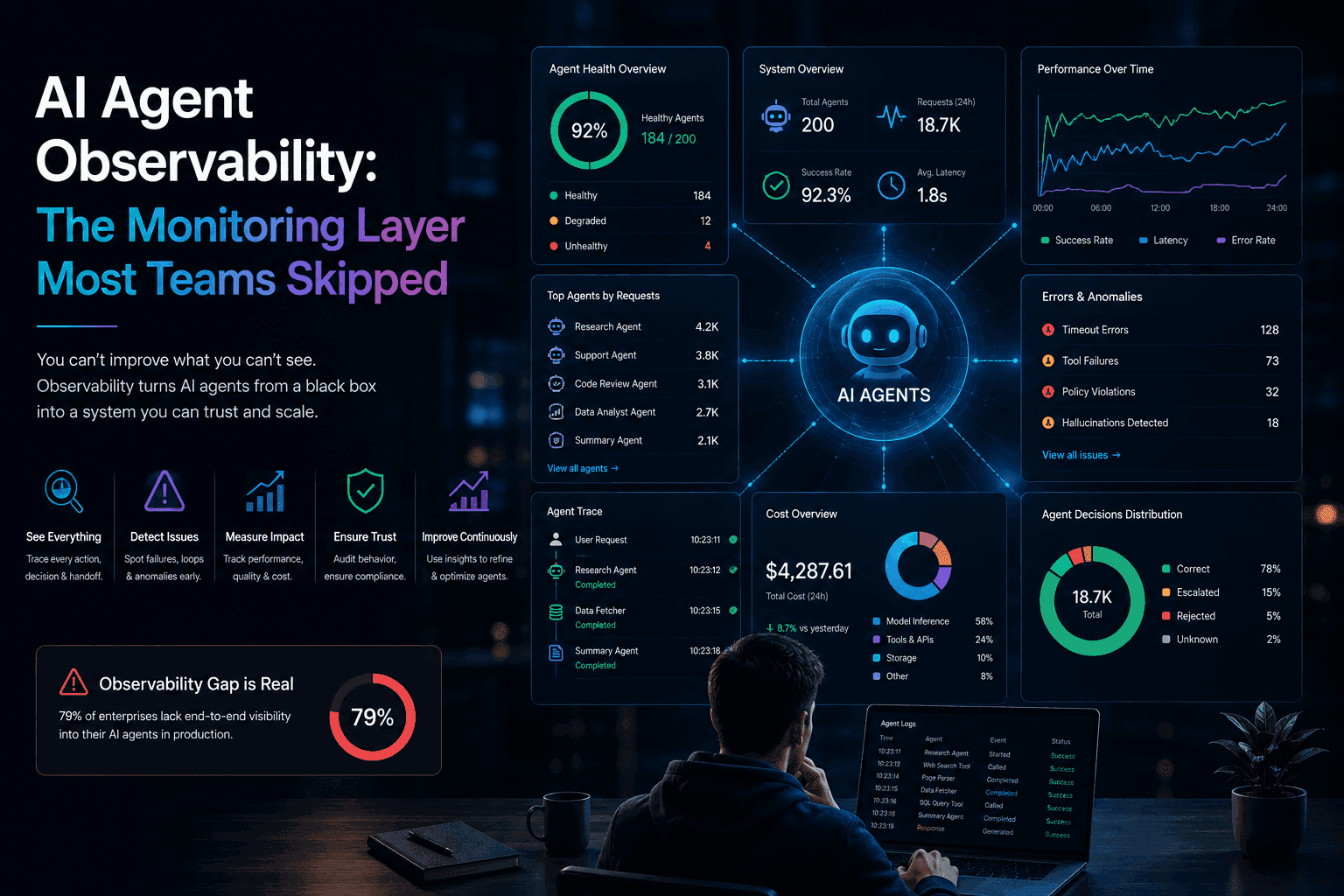
AI Agent Observability: The Monitoring Layer Most Teams Skipped