Data Sovereignty & Local LLMs: Why the Middle East & Europe are Building "Sovereign AI"
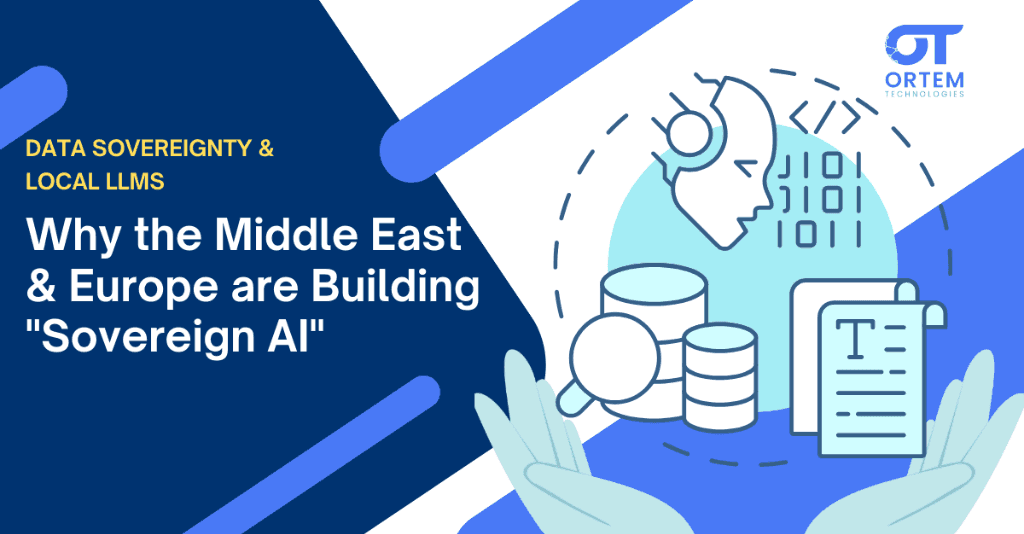
Sovereign AI means nations and enterprises owning their AI infrastructure, models, and data - rather than depending on US hyperscalers. In 2026, the UAE (Falcon LLM), Saudi Arabia, and EU member states are building sovereign AI stacks to comply with the EU AI Act, GDPR, and local data residency laws. The enterprise approach is a "Multi-Model Strategy": use global LLMs for non-sensitive tasks and locally deployed open-source models (Llama, Mistral, Falcon) for PII and regulated data.
Commercial Expertise
Need help with Business Strategy?
Ortem deploys dedicated Custom Software Development squads in 72 hours.
Next Best Reads
Continue your research on Business Strategy
These links are chosen to move readers from general education into service understanding, proof, and buying-context pages.
Custom Software Planning
Convert strategy reading into a delivery brief for architecture, scope, timeline, and commercial fit.
Plan your buildOrtem Delivery Model
See how Ortem structures communication, IP ownership, oversight, and execution for global clients.
Review delivery modelUS Market Delivery Page
Helpful if your buying journey is US-led and you want to understand timezone, compliance, and engagement fit.
View US delivery pageSovereign AI — the principle that nations and organizations should maintain control over their own AI systems, the data they train on, and the infrastructure they run on — has moved from geopolitical theory to procurement reality in 2026. Government agencies, healthcare systems, financial institutions, and defense contractors across the EU, Middle East, and Asia-Pacific are actively requiring that AI systems processing sensitive data operate entirely within their own borders, on their own infrastructure, under their own regulatory frameworks.
Why Sovereign AI Is Accelerating
Regulatory pressure: The EU AI Act entered into force on 1 August 2024, but its main obligations only became applicable on 2 August 2026 — including the Article 50 transparency requirements, breach of which carries fines of up to €15 million or 3% of worldwide annual turnover, whichever is higher.
It establishes compliance requirements by risk classification, with high-risk AI systems subject to mandatory conformity assessment, transparency requirements, and human oversight obligations. Data used to train high-risk AI systems must meet GDPR data residency and processing requirements. See our EU AI Act compliance guide for what changed on that date.
China's AI governance framework requires that AI products offered in China be registered with the Cyberspace Administration of China, that training data not include content prohibited by law, and that AI-generated content be labeled. International AI products operating in China face significant compliance burden.
India's Digital Personal Data Protection Act (DPDPA, effective 2025) restricts cross-border transfer of personal data, which affects AI systems that process Indian citizens' data on infrastructure outside India. Financial services, healthcare, and government AI applications are most immediately affected.
US federal AI policy has changed direction since this guide was first written, and it matters for anyone planning sovereign infrastructure around it.
Executive Order 14110 on AI safety (October 2023) was revoked on 20 January 2025 and replaced three days later by Executive Order 14179, "Removing Barriers to American Leadership in Artificial Intelligence," which shifted federal posture from oversight and risk mitigation toward deregulation.
America's AI Action Plan (July 2025) is now the directional roadmap, though it is policy guidance rather than enforceable law. What survived the change is the NIST AI Risk Management Framework, which remains the reference standard for accountability and oversight in government and critical-infrastructure AI, and federal procurement rules that in practice still require US-hosted infrastructure for federal AI deployments.
The planning implication: build sovereignty around the procurement requirements and NIST, not around an executive order that can be reversed on a single day.
The Middle East AI sovereignty push: Saudi Arabia, UAE, and Qatar are each investing heavily in national AI infrastructure — sovereign compute, national language models, and domestic cloud providers. The Saudi Data and AI Authority (SDAIA) has established data residency requirements for government-adjacent AI deployments. UAE's AI regulation framework requires that sensitive data not leave UAE borders for processing.
Data Residency vs. Sovereignty: The Practical Distinction
Data residency means that data is stored and processed within specified geographic boundaries. A data residency requirement is satisfied by ensuring your database and compute are in a specific country or region — for example, AWS eu-west-1 (Ireland) or Azure Germany North for EU data residency.
Data sovereignty goes further: not just where the data physically resides, but who has legal access to it. US cloud providers operating in the EU are subject to US legal demands (CLOUD Act) that can compel disclosure of data stored in European data centers to US authorities — a compliance risk that some EU regulators consider incompatible with GDPR.
Operational sovereignty is the most demanding form: the organization not only owns the data but controls and can audit the AI system itself — knowing what data it was trained on, how it makes decisions, and what it has been exposed to. This requires on-premises or private cloud deployment with full access to model weights, training pipelines, and inference logs.
Technical Architecture for Sovereign AI
Private cloud deployment of open-source LLMs: Organizations requiring operational sovereignty can deploy open-source language models (Llama 3.1, Mistral, Qwen) on their own infrastructure — on-premises data centers, private cloud environments, or dedicated (non-shared) cloud instances. The model weights are owned by the organization, the training data can be controlled, and inference logs are accessible only to authorized parties. Providers like Scale AI, Cohere For AI, and Mistral AI offer enterprise-grade support for private deployments of open-source models.
On-premises GPU clusters: For organizations requiring full data isolation, on-premises GPU infrastructure (NVIDIA H100 or A100 clusters) enables AI workloads to run entirely within the organization's physical boundaries. Dell, HPE, and Supermicro offer AI-ready server configurations. The cost is significant — a minimal H100 cluster capable of running 70B parameter models costs $500,000-$2M — but for large enterprises with strict sovereignty requirements, the compliance value justifies the investment.
Confidential computing: Microsoft Azure Confidential Computing, AWS Nitro Enclaves, and Google's Confidential VMs use hardware security modules to encrypt data during processing — not just at rest or in transit. Even the cloud provider's infrastructure team cannot access data being processed in a confidential enclave. This approach can satisfy some sovereignty requirements without full on-premises deployment.
Federated learning: Trains AI models across distributed data sources without the raw data ever leaving each source's controlled environment. The model weights are updated based on local computation at each site, and only the weight updates (not the underlying data) are shared. Healthcare AI trained across hospital networks without centralizing patient records, and financial AI trained across banks without exposing transaction data, are canonical federated learning applications.
Data localization with regulatory mapping: For organizations that must meet specific national data residency requirements across multiple countries, data architecture must map data classifications to geographic processing and storage requirements. A multinational with operations in UAE, Saudi Arabia, France, and Singapore needs data classification (what data is subject to which country's requirements), storage mapping (which database instances are in which regulatory zone), and routing logic (ensuring each type of data is processed only in compliant regions).
Procurement Considerations for Enterprise AI Buyers
Organizations procuring AI products increasingly need to ask vendors: Where is our data processed? Where is it stored? Who has legal access to it? What happens to our data if we cancel the contract? Can we audit the model's training data? Can we run the model on our own infrastructure?
Vendors who can answer these questions with specific technical documentation — data processing agreements, sub-processor lists, data deletion procedures, infrastructure region documentation — are positioned to win enterprise and government contracts in regulated industries. Vendors who cannot answer them are increasingly disqualified from procurement processes in the EU, Middle East, and regulated US sectors.
At Ortem Technologies, we build AI applications that can be deployed in sovereign configurations — private cloud, on-premises, or designated-region cloud with explicit data residency guarantees. Our architecture documentation supports the procurement requirements of enterprise and government clients in regulated sectors. Talk to our AI team about sovereign deployment | Contact us about data residency requirements
About Ortem Technologies
Ortem Technologies is a premier custom software, mobile app, and AI development company. We serve enterprise and startup clients across the USA, UK, Australia, Canada, and the Middle East. Our cross-industry expertise spans fintech, healthcare, and logistics, enabling us to deliver scalable, secure, and innovative digital solutions worldwide.
Get the Ortem Tech Digest
Monthly insights on AI, mobile, and software strategy - straight to your inbox. No spam, ever.
Sources & References
About the Author
Editorial Team, Ortem Technologies
The Ortem Technologies editorial team brings together expertise from across our engineering, product, and strategy divisions to produce in-depth guides, comparisons, and best-practice articles for technology leaders and decision-makers.
Stay Ahead
Get engineering insights in your inbox
Practical guides on software development, AI, and cloud. No fluff — published when it's worth your time.
Ready to Start Your Project?
Let Ortem Technologies help you build innovative software solutions for your business.
You Might Also Like
The End of SaaS? The Rise of "Service-as-a-Software" in 2026

H1B Visa Fee Hike: A Golden Opportunity for India's IT Sector
