Fleet Management Software Development: Features, Architecture & Build vs Buy Guide (2026)
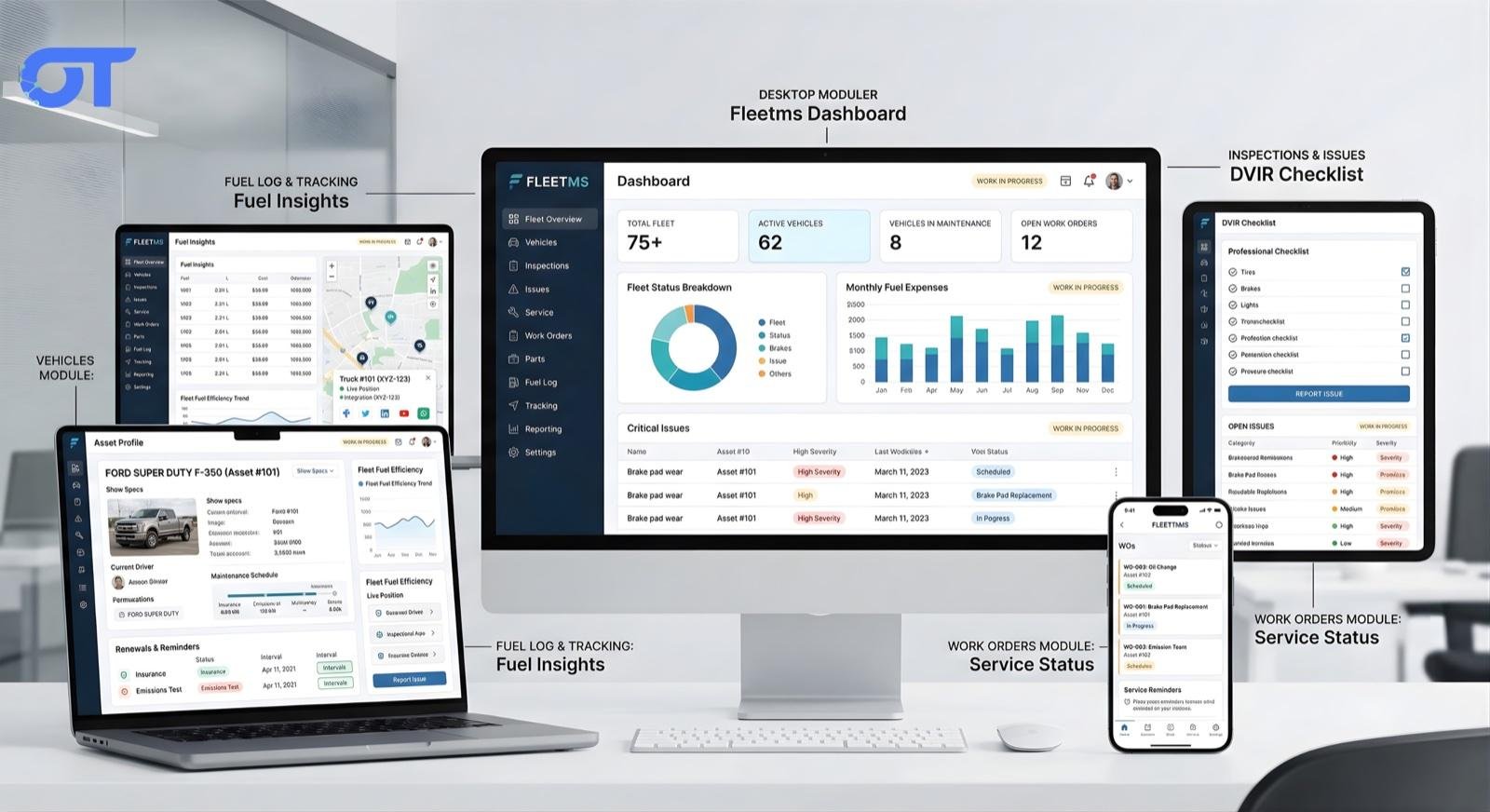
Modern fleet management software must cover six core modules: vehicle lifecycle management, DVIR inspection checklists, work orders and maintenance tracking, fuel log analytics, parts inventory, and automated renewal reminders. The best technology choices in 2026 are Elixir/Phoenix for real-time concurrency, PostgreSQL for relational fleet data, and a responsive Tailwind UI that works on desktop, tablet, and driver mobile — all deployable via Docker Compose without an IT department.
The global fleet management software market is expected to exceed $52 billion by 2030, growing at 11.4% CAGR. Behind that number is a simple, persistent problem: most fleet operators — from logistics companies to construction firms to municipal services — are still running their operations on spreadsheets, physical clipboards, and memory. Missed inspections, invisible fuel costs, and unplanned breakdowns are not engineering failures. They are data failures.
This guide walks through what fleet management software actually needs to do, how to build it the right way, and when building custom is smarter than buying an off-the-shelf system.
What Fleet Management Software Actually Needs to Solve
Before discussing features or technology, it helps to understand the real pain points that fleet managers deal with every single day.
Problem 1: Inspection records live on paper. During a roadside compliance check, a driver needs to produce their last DVIR (Driver Vehicle Inspection Report). If it is in the truck's glovebox as a carbon copy form — or worse, missing — the fine starts at $16,000 per violation under FMCSA rules. Digital inspection checklists with timestamped submissions eliminate this risk entirely.
Problem 2: Service reminders get missed. A vehicle that needs an oil change every 5,000 miles will not remind anyone. When the maintenance finally happens — after a breakdown — it costs 3–5x more than scheduled maintenance would have. Automated service reminders tied to odometer readings or calendar intervals fix this.
Problem 3: Fuel costs are invisible. Fuel is typically the second-largest operating cost for any fleet (after labour). But most operators cannot tell you cost-per-mile per vehicle, which drivers are over-idling, or which routes have the worst fuel consumption. A fuel log module with per-vehicle efficiency analytics changes the economics entirely.
Problem 4: Work orders exist in mechanics' heads. When a vehicle goes in for repair, the mechanic knows what was done. Nobody else does — not the fleet manager, not the accountant, not the next mechanic who works on the same vehicle in six months. Digital work orders create a permanent, searchable maintenance audit trail.
Problem 5: Document renewals are reactive. Insurance lapsing on an active vehicle is a liability nightmare. Emissions certificates expiring in a roadside check means the vehicle is pulled from service immediately. Automated renewal reminders with 30/60/90 day advance warnings prevent these entirely.
The Six Core Modules of Modern Fleet Management Software
1. Vehicle Lifecycle Management (Vehicles Module)
The vehicle profile is the hub. Every other module — work orders, inspections, fuel logs, renewals — radiates outward from a single vehicle record. A well-built vehicle profile contains:
- Specifications: Make, model, year, VIN, registration, capacity, odometer
- Photos and documents: Insurance certificate, registration, MOT/inspection certificates
- Driver assignment: Current assigned driver with contact details and assignment history
- Asset attributes: Custom fields for vehicle-specific data (refrigeration unit serial number, lift gate capacity, trailer hitch type)
- Renewal reminders: Insurance, Emissions Test, licence plate renewal — each with configurable advance warning intervals
The vehicles module needs flexible attribute storage (JSONB in PostgreSQL is ideal) because no two fleets have identical data requirements.
2. DVIR Inspection Checklists (Inspections Module)
DVIR stands for Driver Vehicle Inspection Report. Under FMCSA regulations in the US, commercial drivers must complete pre-trip and post-trip vehicle inspections and report any defects. Similar requirements apply under DVSA regulations in the UK.
A production-grade inspections module needs:
- Custom checklist templates: Admins define inspection items (Tyres, Brakes, Lights, Transmission, Safety Equipment, Fire Extinguisher) per vehicle type
- Digital submission: Drivers complete inspections on mobile, with pass/fail status per item
- Issue escalation: Failed items automatically create issues with severity classification (High/Medium/Low)
- Work order linkage: High-severity issues auto-generate work orders assigned to the next available mechanic
- Audit trail: Every submission is timestamped, GPS-tagged, and immutably stored — producible instantly for compliance checks
The DVIR module alone can justify an entire fleet management software build for any commercial fleet operating under federal or state DOT regulations.
3. Issues and Maintenance Tracking (Issues Module)
Issues are the operational nervous system of fleet management. They capture defects reported by drivers (via DVIR or direct report), identified during scheduled maintenance, or flagged by telematics alerts. An issues module needs:
- Priority classification: High, Medium, Low with SLA-driven escalation
- Assignment workflow: Issue → assigned mechanic → accepted → in-progress → resolved
- Vehicle status impact: Vehicles with open High-severity issues should be flagged as "In Maintenance" on the fleet dashboard
- Reporting: Issues by vehicle, by type, by mechanic, by resolution time
4. Work Orders Module
Every repair, part replacement, and scheduled service generates a work order. Work orders are the accounting record of fleet maintenance — they connect vehicle downtime to cost.
A complete work orders module captures:
- Labour: Mechanic assignment, time started, time completed, labour hours
- Parts used: Linked directly to parts inventory (automatically adjusts stock levels)
- Cost total: Labour cost + parts cost = total work order cost, rolled up to per-vehicle and fleet-wide maintenance cost reports
- Status tracking: Scheduled → In Progress → Awaiting Parts → Completed
- Service reminders: Closed work orders can automatically reset odometer-based service interval timers
5. Fuel Log and Analytics (Fuel Log Module)
Fuel is where fleet operators lose money silently. A fuel log module should capture:
- Per-fill entries: Date, vehicle, fuel type, quantity (litres or gallons), cost per unit, odometer reading, location
- Calculated metrics: Cost per kilometre/mile, fuel efficiency (MPG or L/100km), monthly cost trend
- Per-vehicle efficiency charts: Trend lines showing whether a vehicle's efficiency is improving or degrading over time
- Fleet-wide aggregates: Total fuel spend by month, by vehicle class, by driver
Fuel analytics on their own can identify a vehicle that needs an engine tune-up months before it fails — visible only as a gradual efficiency decline in the charts.
6. Parts and Inventory Module
Unplanned downtime often happens because a needed part is not in stock. A parts module tracks:
- Part catalogue: Name, part number, supplier, unit cost, current stock level
- Reorder thresholds: Automatic alerts when stock falls below minimum
- Work order linkage: Parts consumed by a work order are deducted from stock in real time
- Purchase tracking: Purchase orders with cost history for accurate parts pricing over time
Technology Stack for Fleet Management Software in 2026
Backend: Why Elixir + Phoenix is the Right Choice
Fleet management software has a specific concurrency challenge: dozens of mechanics, drivers, and fleet managers updating records simultaneously across web browsers and mobile devices, with a dashboard that needs to reflect those changes in real time.
Most web frameworks handle this with polling (expensive) or WebSocket libraries bolted onto Rails or Django (works, but adds complexity). Elixir's BEAM VM was designed for exactly this problem. Every HTTP connection, every WebSocket channel, every background job runs as a lightweight process — the BEAM routinely handles 2 million+ concurrent connections on modest hardware.
Phoenix LiveView takes this further: it enables real-time, server-rendered UI updates over WebSocket without writing any client-side JavaScript. When a mechanic updates a work order status, every fleet manager's dashboard reflects it in under 100ms — with zero client-side state management complexity.
Ash Framework provides a declarative resource layer that defines business logic, authorization, and data validation once — and generates consistent APIs, admin interfaces, and change-tracking across all modules automatically. For a platform with 8+ modules, this eliminates thousands of lines of boilerplate CRUD code and ensures authorization rules cannot be accidentally bypassed.
Database: PostgreSQL with JSONB
PostgreSQL is the right choice for fleet management data:
- Relational integrity: Foreign keys between vehicles → work orders → parts consumption → mechanic assignments cannot be violated
- JSONB columns: Vehicle-specific attributes that vary by fleet type (construction equipment specs vs. refrigerated van settings) store cleanly in JSONB without requiring schema migrations for every new attribute type
- Full-text search: Drivers, parts, vehicle descriptions searchable without a separate search service
- Audit logging: PostgreSQL's row-level change triggers capture complete history for compliance
Frontend: Tailwind CSS + LiveView
Fleet management software is used in three contexts: fleet manager at a desk, mechanic at a workbench (tablet), driver on a phone. All three require the same data with different UI density.
Tailwind CSS with responsive breakpoints handles all three in a single codebase. Combined with Phoenix LiveView, UI updates are server-rendered and pushed — no separate React/Vue frontend to maintain, build, or keep synchronized with API changes.
For mobile-specific workflows (driver DVIR submissions, mechanic work order updates), a Progressive Web App (PWA) shell gives drivers an add-to-home-screen experience without requiring App Store distribution.
Deployment: Docker Compose for Self-Hosting
Enterprise fleet management software (Samsara, Verizon Connect, Fleetio) starts at $25–$50 per vehicle per month. For a 100-vehicle fleet, that is $30,000–$60,000 per year — before any customisation.
A self-hostable platform deployed via Docker Compose runs on a $20/month VPS for small fleets, or on-premises for organisations with data sovereignty requirements. The deployment surface is a single docker-compose up command with environment variables for database credentials and SMTP configuration.
Build vs Buy: When Custom Fleet Management Software Makes Sense
Buy (Use an Off-the-Shelf Platform) When:
- Your fleet is under 20 vehicles and your operations are standard
- You have no IT resources and need a solution this week
- Your data requirements fit within the standard vehicle/driver/fuel model
- You are comfortable paying $25–$50/vehicle/month indefinitely
Good off-the-shelf options: Fleetio (user-friendly, SaaS), Samsara (IoT telematics included), Verizon Connect (enterprise scale).
Build Custom When:
- Your operations are non-standard: municipal vehicles with compliance reporting, refrigerated transport with temperature logging, construction equipment with attachment tracking
- Data sovereignty matters: You cannot send vehicle location data to a US-based SaaS (EU GDPR, government contracts, defence adjacent)
- Integration requirements are deep: Your ERP, maintenance system, and dispatch software need bidirectional real-time integration that off-the-shelf platforms do not support
- You are scaling past 200 vehicles: Per-vehicle SaaS pricing becomes painful — a 500-vehicle fleet pays $150,000/year at $25/vehicle/month
- You want competitive differentiation: If fleet efficiency is a core business capability (logistics operators, fleet-as-a-service providers), owning the software is owning the advantage
How We Built FleetMS: A Case Study
We recently built FleetMS — a production-grade, open-source fleet maintenance and management platform — using exactly this architecture.
The problem we solved: Fleet operators across logistics, construction, and municipal operations were using 3–6 disconnected tools to manage their vehicles. Inspection records were on clipboards. Work orders were in mechanics' notebooks. Fuel costs were unknown. Insurance renewals were reactive.
What we built: An Elixir + Phoenix + Ash Framework platform with 8 integrated modules — Vehicles, Inspections (DVIR), Issues, Work Orders, Parts & Inventory, Fuel Log, Service Reminders, and a real-time LiveView dashboard showing active vehicles, open work orders, and vehicles in maintenance.
The outcome: Fleet managers can deploy the platform in under 60 minutes via Docker Compose, begin entering vehicles immediately, and have full operational visibility — DVIR compliance, fuel efficiency trends, maintenance cost-per-vehicle — within the first week of use. The dashboard supports 75+ vehicles per deployment with 62 active in real-time, tracking open work orders live without page refreshes.
The platform is open source and available on GitHub as a self-hostable alternative to expensive SaaS fleet management subscriptions.
Read the full technical breakdown in the FleetMS case study.
Real-Time Tracking: The Next Frontier
The FleetMS README lists real-time vehicle tracking as a future implementation — and this is the right prioritisation. Adding IoT-based GPS tracking to a fleet management platform requires:
- Hardware layer: Cellular-connected GPS trackers (CalAmp, Samsara CM31, or open-source options like Traccar) installed in each vehicle
- Data ingestion: MQTT or HTTP endpoints processing location pings every 10–30 seconds per vehicle
- Stream processing: At 30-second intervals across 100 vehicles, that is 288,000 data points per day — requiring a time-series approach (InfluxDB, TimescaleDB) rather than row-per-ping in PostgreSQL
- Map rendering: Mapbox GL JS or Leaflet.js with vehicle icon clustering for fleet-wide view
- Geofencing: Zone entry/exit alerts for depot boundaries, customer sites, and restricted areas
The Phoenix PubSub + Channels architecture in FleetMS is already designed for this integration — adding real-time tracking is a module addition, not an architectural rewrite.
For IoT-connected fleet deployments, see our work on IoT Solutions for Industry 4.0.
Compliance Considerations for Fleet Software
Fleet management software sits at the intersection of transportation regulation, data privacy, and financial accounting. Key compliance areas:
DOT/FMCSA (USA): Commercial vehicles require ELD (Electronic Logging Device) compliance for Hours of Service tracking. DVIR submissions must be retained for 3 months minimum.
DVSA (UK): Operator Licence holders must maintain maintenance records for 15 months. Digital records are accepted provided they are tamper-evident.
GDPR (EU/UK): Driver location data is personal data under GDPR. Lawful basis for processing must be established (legitimate interest with DPA documentation), and data retention limits must be enforced.
Emissions compliance: Emissions test certificates are a renewal reminder item — but fleet operators in low-emission zones (London ULEZ, Dutch LEZ) also need software to track which vehicles are compliant and route planning that avoids LEZ penalties.
Summary: What Great Fleet Management Software Looks Like
The best fleet management platforms share five characteristics:
- Single source of truth for every vehicle: All modules — inspections, work orders, fuel, renewals — radiate from one vehicle record
- Real-time operational dashboard: Fleet managers should know their fleet status in 30 seconds, not after running three reports
- Digital DVIR compliance: Paper inspection checklists are a compliance liability — digital submissions with issue escalation eliminate it
- Automated reminders that actually fire: Service intervals, insurance, emissions — the system should be more reliable than human memory
- Maintenance cost accounting: Work orders linked to parts consumption linked to labour time = per-vehicle total cost of ownership
If your fleet operations are non-standard, data-sovereign, or scaling past where per-vehicle SaaS pricing makes sense — custom fleet management software built on Elixir, Phoenix, and PostgreSQL delivers a platform your business owns and controls.
Talk to our team about building or extending a fleet management platform for your logistics or transportation operations.
Get the Ortem Tech Digest
Monthly insights on AI, mobile, and software strategy - straight to your inbox. No spam, ever.
Sources & References
- 1.Global Fleet Management Market Report 2026 - Grand View Research
- 2.FMCSA DVIR Requirements - Federal Motor Carrier Safety Administration
- 3.State of Fleet Technology 2026 - Automotive Fleet
About the Author
Director – AI Product Strategy, Development, Sales & Business Development, Ortem Technologies
Praveen Jha is the Director of AI Product Strategy, Development, Sales & Business Development at Ortem Technologies. With deep expertise in technology consulting and enterprise sales, he helps businesses identify the right digital transformation strategies - from mobile and AI solutions to cloud-native platforms. He writes about technology adoption, business growth, and building software partnerships that deliver real ROI.
Stay Ahead
Get engineering insights in your inbox
Practical guides on software development, AI, and cloud. No fluff — published when it's worth your time.
Ready to Start Your Project?
Let Ortem Technologies help you build innovative solutions for your business.
You Might Also Like
Top Fintech Software Development Companies in 2026
Fintech App Development Guide 2025: Features, Regulations, and Best Practices