IoT in Industry 4.0 delivers ROI across three primary use cases: predictive maintenance (vibration sensors detect bearing failures weeks before breakdown, eliminating unplanned downtime), cold-chain asset tracking (GPS + temperature sensors give real-time pallet visibility for pharma and food logistics), and remote patient monitoring (wearables stream ECG data enabling "Hospital at Home"). Key technical building blocks: MQTT for lightweight device messaging, LoRaWAN/NB-IoT for long-range low-power connectivity, edge computing for on-device AI inference, and mTLS device authentication.
Next Best Reads
Continue your research on IoT
These links are chosen to move readers from general education into service understanding, proof, and buying-context pages.
IoT Development Services
Take the next step into connected devices, telemetry pipelines, edge logic, and operational dashboards.
Explore IoT serviceFleet Software Guide
If your intent is operations or logistics, this guide extends the topic into fleet-specific product requirements.
Read supporting guideIoT Logistics Case Study
See how Ortem implemented high-volume real-time tracking and IoT product infrastructure.
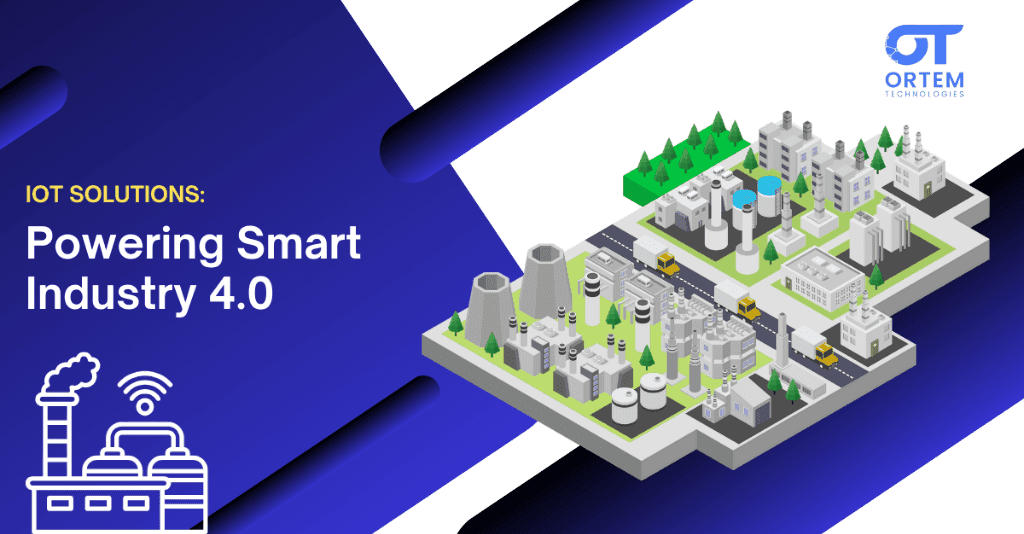
Read case studyIoT (Internet of Things) solutions are transforming industrial operations, supply chains, and commercial buildings at a pace that makes the "smart factory" concept of five years ago look understated. The number of connected IoT devices globally passed 18.8 billion in 2024 and is projected to reach 30 billion by 2027.
The economic value being generated: McKinsey estimates that IoT applications create $5.5-$12.6 trillion in annual economic value — primarily in manufacturing, where predictive maintenance and process optimization deliver ROI that traditional operational improvements cannot.
This guide covers the Industry 4.0 use cases delivering the largest ROI, the technical architecture of production IoT systems, platform selection considerations, and the implementation challenges that most IoT guides understate.
Predictive Maintenance: The Highest-Value Industrial IoT Application
Unplanned equipment downtime is one of the most expensive operational problems in manufacturing, logistics, and energy. A single unplanned outage of a critical production line costs a typical automotive manufacturer $1.3 million per hour. Unplanned compressor failures in oil and gas processing facilities cost $250,000-$2 million per incident.
Predictive maintenance uses continuous sensor data — vibration frequency, temperature, acoustic emission, oil particle counts, current draw — to detect degradation patterns weeks before failure. The economics are compelling: a predictive maintenance system costs $150,000-$500,000 to implement on a production line and delivers ROI measured in months from the first avoided failure event.
The technical implementation requires vibration sensors (accelerometers) with sampling rates of 25,600-100,000 samples per second for bearing defect detection. The sensor data is processed at the edge (an industrial PC or embedded computer at the machine) for fast-frequency feature extraction (FFT analysis to identify bearing defect frequencies, gear mesh frequencies, shaft imbalance). Extracted features — not raw waveforms — are transmitted to the cloud for trend analysis and anomaly detection against equipment-specific baseline models.
The machine learning component is simpler than it appears: most predictive maintenance models use anomaly detection (unsupervised learning) trained on normal-operating data, raising alerts when current sensor signatures deviate significantly from the learned normal. The data problem (collecting enough labeled failure examples) is typically harder than the model problem.
Supply Chain Visibility and Cold Chain Monitoring
End-to-end supply chain visibility — knowing the location, condition, and custody status of every pallet, container, or asset in real time — was a multi-million-dollar capability available only to the largest shippers a decade ago. IoT-connected tracking tags have commoditized it.
Modern asset trackers (Wiliot, Samsara, Impinj) combine GPS/GNSS for coarse location, BLE beacons for indoor positioning within facilities, cellular connectivity for real-time cloud reporting, and environmental sensors for temperature, humidity, shock, and tilt — all in a form factor that attaches to a pallet and runs on a battery for 6-24 months.
For pharmaceutical and food supply chains, temperature excursion documentation is both a regulatory requirement and a liability issue. A cold chain tracking system that automatically logs temperature throughout the journey — from manufacturing facility to distribution center to pharmacy shelf — provides the continuous temperature record that FDA's FSMA and EU GDP regulations require, and eliminates the paper-based temperature logs that are easily falsified and impossible to audit at scale.
Smart Building Automation and Energy Management
Commercial buildings account for approximately 40% of global energy consumption. IoT-based building automation — integrating HVAC, lighting, access control, and occupancy sensing into a unified building management system — typically reduces energy consumption by 20-40%.
The ROI calculation for smart building systems is straightforward: a 50,000 square foot office building spending $200,000 annually on energy can expect $50,000-$80,000 in annual savings from a smart building system costing $100,000-$200,000 to implement — a 1.5-4 year payback period.
The technical stack: occupancy sensors (PIR motion, CO2 sensors as a proxy for occupancy density), IoT gateways that aggregate sensor data from BACnet, Modbus, and LonWorks building automation protocols, a building operations platform that applies ML-based setpoint optimization (pre-cooling based on weather forecast and occupancy prediction, rather than static schedules), and integration with utility time-of-use pricing signals to shift load away from peak rate periods.
IoT Architecture: The Four-Layer Model
The device layer comprises the physical sensors and actuators that interface with the physical world. Selection criteria: measurement range and accuracy for the physical parameter being monitored, environmental rating (IP67 for outdoor/wet environments, ATEX rating for explosive atmospheres), power requirements (battery life versus wired, solar viability), and output interface (4-20mA analog for industrial standards, I2C/SPI for embedded integration, Modbus for industrial control networks).
The connectivity layer translates sensor data into network-transmissible packets. Selection is driven by the trade-off between data rate, range, and power consumption:
| Protocol | Range | Data Rate | Power | Best For |
|---|---|---|---|---|
| LoRaWAN | 2–15 km | 0.25–50 kbps | Ultra-low | Rural asset tracking, smart meters |
| NB-IoT | 10 km+ | 26–127 kbps | Low | Urban utility monitoring, smart cities |
| Cellular (4G/5G) | Global | Up to 1 Gbps | High | Mobile assets, high-data-rate devices |
| WiFi 6 | 30–100m | Up to 9.6 Gbps | Medium-high | Factory floor sensors near AP |
| Zigbee/Thread | 10–100m | 250 kbps | Very low | Smart building sensors, mesh networks |
| Industrial Ethernet | 100m | 100Mbps–1Gbps | High | High-precision control systems |
The edge computing layer processes data locally at or near the device, before transmission to the cloud. Edge processing handles tasks that require low latency (real-time control feedback must be <10ms for servo control systems), high-bandwidth data reduction (a vibration sensor generating 100,000 samples/second transmits derived features — RMS, FFT peaks — rather than raw waveforms, reducing bandwidth by 99%), and offline operation capability (sensors in remote locations without reliable connectivity buffer data locally and sync when connectivity is available).
The cloud platform layer aggregates data from all edge nodes, stores historical data, runs long-horizon ML models, and provides the dashboards and alert systems that operational teams interact with.
IoT Platform Selection: Build vs Buy
Industrial IoT platform options:
AWS IoT (Greengrass + IoT Core): The most comprehensive managed option. IoT Core handles device connection and message routing at scale. Greengrass runs Lambda functions at the edge for local processing. Strong integration with the rest of AWS (S3 for data lake, SageMaker for ML, QuickSight for visualization). Best for organizations already on AWS.
Azure IoT Hub + Azure Digital Twins: Microsoft's approach centers on Digital Twins — a real-time virtual model of your physical assets that mirrors sensor data and enables simulation and optimization. Strong integration with Power BI and the Microsoft ecosystem. Best for organizations using Office 365/Azure.
Google Cloud IoT (now merged into Pub/Sub and Vertex AI): Google's IoT offering is less prescriptive — it uses Pub/Sub for device messaging and Vertex AI for ML. Better for organizations building custom analytics rather than using off-the-shelf industrial dashboards.
Purpose-built industrial platforms (PTC ThingWorx, Siemens MindSphere, GE Predix): Pre-built connectors to industrial equipment, built-in OEE calculation, native support for industrial protocols (OPC-UA, MQTT, AMQP). Higher cost ($50,000–$200,000/year licensing), but faster time-to-value for manufacturing use cases where the platform provides the analytical models out-of-the-box.
Custom platform: Building a custom IoT platform makes sense when your use case has requirements not met by existing platforms, when data sovereignty prevents cloud hosting, or when integration requirements with legacy systems make commercial platforms impractical. Budget 12–18 months and $400,000–$1,200,000 for a production-grade custom IoT platform.
Security Architecture for Industrial IoT
Industrial IoT security has a different threat model than enterprise IT security. The consequences of a breach include not just data theft but potential physical damage to equipment, process disruption, and safety incidents.
Device security fundamentals:
- Hardware security modules (HSM) or Trusted Platform Module (TPM) for cryptographic key storage on devices — prevents key extraction even with physical device access
- Secure boot — ensures only signed firmware runs on the device
- Device identity certificates (X.509) issued from a private certificate authority — each device has a unique cryptographic identity
- Certificate rotation — device certificates expire and must be renewed without requiring manual physical access
Network segmentation: OT (Operational Technology) networks controlling physical equipment must be air-gapped or strictly segmented from IT networks. The 2010 Stuxnet attack, the 2021 Oldsmar water treatment attack (attacker remotely increased lye concentration to dangerous levels), and numerous ransomware attacks on manufacturing facilities all exploited IT-OT network connections that should have been isolated.
OTA (Over-the-Air) update security: Firmware updates must be cryptographically signed by the device manufacturer's private key. Devices verify the signature before applying any update. An unsigned or incorrectly signed update is rejected. This prevents firmware replacement attacks where an attacker pushes malicious firmware to devices.
ROI Calculation Framework
Use this framework to build the business case for any industrial IoT investment:
Step 1 — Quantify the problem being solved:
- For predictive maintenance: average cost per unplanned failure event × estimated failures prevented per year
- For energy monitoring: current energy spend × expected reduction percentage
- For supply chain visibility: annual loss from theft, damage, or expired goods + labor cost of manual tracking
Step 2 — Total implementation cost:
- Sensors and edge hardware
- Connectivity infrastructure (gateways, SIMs, network changes)
- Platform licensing or development
- Integration with existing systems
- Installation and commissioning labor
Step 3 — Ongoing operational cost (annual):
- Platform licensing
- Connectivity (SIM/data costs)
- Maintenance and calibration
- IT/OT support time
Step 4 — Simple payback calculation: Total implementation cost ÷ (Annual benefit − Annual operating cost) = Payback period in years
For most industrial predictive maintenance applications, payback periods of 12–24 months are achievable. Energy monitoring ROI is typically 18–36 months. Supply chain visibility ROI varies widely by industry.
Frequently Asked Questions
Q: How do I get started with industrial IoT without committing to a large program? Start with a pilot on a single production line or building zone. Choose one high-value problem (predictive maintenance on your most critical machine, energy monitoring for your highest-cost facility).
Run the pilot for 3 months, measure actual results versus baseline, and use real ROI data to build the case for broader rollout. This approach reduces risk and generates the evidence needed to secure budget for expansion.
Q: What is the difference between SCADA and IoT? SCADA (Supervisory Control and Data Acquisition) is a traditional industrial control system architecture designed for real-time process control. IoT adds connectivity, cloud processing, and analytics capabilities that traditional SCADA lacks. Modern implementations often integrate SCADA for real-time control with IoT platforms for analytics and long-term trend analysis — using OPC-UA as the bridge between the two layers.
Q: Can legacy equipment be retrofit with IoT sensors? Yes — most industrial equipment can be retrofit without modification to the machine. Vibration sensors clamp to bearing housings externally. Power analyzers clip onto electrical supply cables. Temperature sensors attach to equipment surfaces. The exception is tight-tolerance precision equipment where any attachment risks measurement interference — consult the equipment manufacturer before installing sensors.
Q: What happens to IoT data when the cloud platform is discontinued or changes pricing? Design your data architecture to prevent vendor lock-in. Store raw time-series data in an open format (Parquet, CSV) in cloud object storage (S3, Azure Blob) independently of the IoT platform. This ensures you own your historical data regardless of platform changes. Avoid ingesting data exclusively into proprietary formats that cannot be exported.
Build your IoT solution → | IoT development services → | Custom software development →
About Ortem Technologies
Ortem Technologies is a premier custom software, mobile app, and AI development company. We serve enterprise and startup clients across the USA, UK, Australia, Canada, and the Middle East. Our cross-industry expertise spans fintech, healthcare, and logistics, enabling us to deliver scalable, secure, and innovative digital solutions worldwide.
Get the Ortem Tech Digest
Monthly insights on AI, mobile, and software strategy - straight to your inbox. No spam, ever.
About the Author
Editorial Team, Ortem Technologies
The Ortem Technologies editorial team brings together expertise from across our engineering, product, and strategy divisions to produce in-depth guides, comparisons, and best-practice articles for technology leaders and decision-makers.
Stay Ahead
Get engineering insights in your inbox
Practical guides on software development, AI, and cloud. No fluff — published when it's worth your time.
Ready to Start Your Project?
Let Ortem Technologies help you build innovative software solutions for your business.