The Physical AI Revolution 2026: Merging Robotics, IoT, and Intelligence
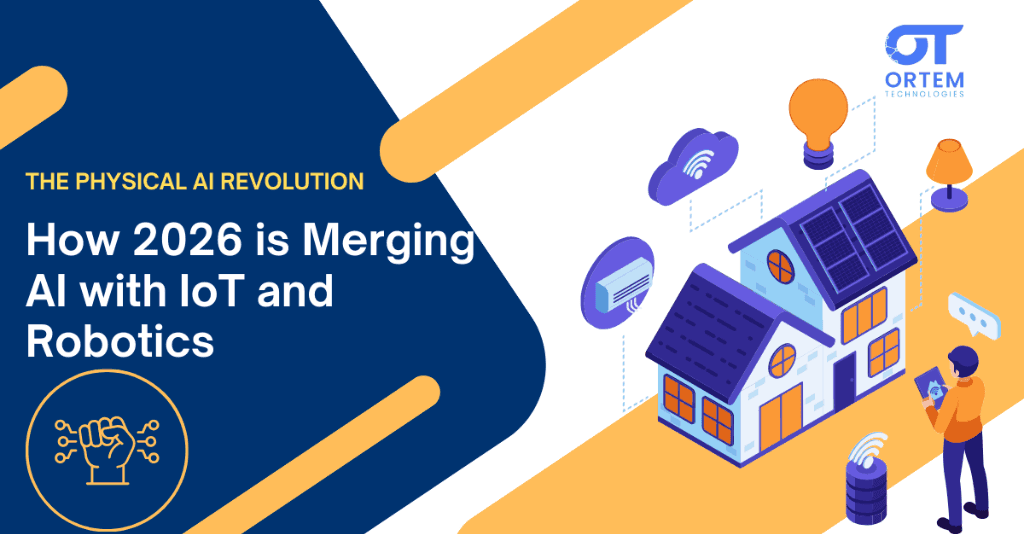
Physical AI is the convergence of robotics, IoT sensors, and Vision-Language Models (VLMs) that gives AI a body in the physical world. In 2026, it powers fully autonomous "Dark Factories" in the USA and Germany, Australia's autonomous mining fleets, and smart city infrastructure in NEOM. The technical stack is: VLMs (GPT-4o Vision) for vision-guided robotics that navigate dynamically, Edge AI on Nvidia Jetson for on-device inference without internet dependency, industrial protocols (Modbus, OPC-UA, MQTT) for legacy machine connectivity, and Digital Twins for simulation before physical deployment.
Next Best Reads
Continue your research on IoT
These links are chosen to move readers from general education into service understanding, proof, and buying-context pages.
IoT Development Services
Take the next step into connected devices, telemetry pipelines, edge logic, and operational dashboards.
Explore IoT serviceFleet Software Guide
If your intent is operations or logistics, this guide extends the topic into fleet-specific product requirements.
Read supporting guideIoT Logistics Case Study
See how Ortem implemented high-volume real-time tracking and IoT product infrastructure.
Read case studyPhysical AI — the application of artificial intelligence to systems that perceive, reason about, and act on the physical world — is transitioning from research laboratories to commercial deployment at a pace that is surprising even veteran technology observers.
The convergence of three maturing capabilities: computer vision at human-level performance in constrained domains, large language models with physical world reasoning, and cost-effective actuator hardware including robotic arms, mobile platforms, and dexterous hands — is enabling a new generation of AI systems that operate in the physical world with meaningful autonomy.
The Physical AI Technology Stack
Physical AI systems share a common architectural pattern: perception (understanding what is in the physical environment), reasoning (determining what to do given the current state and goals), and actuation (physically executing the decided action). Each of these layers has seen significant capability improvements in the past three years.
Perception: Computer vision models trained on billions of images can recognize objects, understand spatial relationships, and interpret complex scenes in real time. The CLIP and SAM (Segment Anything Model) architectures have made zero-shot object recognition practical — a physical AI system can identify and locate objects it has never explicitly been trained to recognize.
Depth cameras (Intel RealSense, Azure Kinect, Structure Sensor) provide real-time 3D point cloud data that enables precise spatial reasoning. LIDAR sensors, standard in autonomous vehicles, are now available at price points that make them viable for warehouse robots and service robots.
Reasoning: Large language models (Claude, GPT-4, Gemini) have demonstrated the ability to reason about physical tasks when provided with scene descriptions, object lists, and task specifications. Physical AI systems increasingly use LLMs as the "brain" for high-level task planning, with specialized models or traditional algorithms handling lower-level motion planning and control.
Actuation: Industrial robot arms (Universal Robots, FANUC, KUKA) have been a mature technology for decades, but they required expert programming for each task. The new generation of collaborative robots (cobots) with AI-powered control can be retrained for new tasks with demonstration-based learning — an operator guides the robot through the task once, and the AI learns to replicate it.
Humanoid robots (Figure, Boston Dynamics, Agility Robotics, Tesla Optimus) represent the most ambitious form factor, designed to perform human tasks in environments designed for humans.
The Highest-ROI Physical AI Applications in 2025
Industrial inspection: AI vision systems mounted on fixed cameras, mobile robots, or drones inspect industrial equipment, infrastructure, and products for defects, wear, corrosion, and safety issues. Autonomous inspection reduces the frequency of shutdowns for human inspection, identifies issues earlier (before they become failures), and eliminates the safety risk of humans inspecting hazardous environments.
Pipelogix and similar platforms deploy AI-powered autonomous inspection for oil and gas pipelines, tunnels, and confined spaces. Utility companies use drone-based AI inspection for power lines and substations.
Warehouse automation: Goods-to-person robotic systems (Locus Robotics, 6 River Systems, Fetch Robotics) deploy mobile robots that navigate warehouse floors autonomously, bringing shelving units to human pickers rather than having humans walk to pick locations. Amazon's Kiva system (now Amazon Robotics) demonstrated at scale that warehouse robot systems reduce picker travel by 40-60%, increasing throughput per square foot.
Pick robots (Osaro, Kindred, Plus One Robotics) use computer vision and robotic arms to pick individual items from bins and place them in shipping containers — automating the most labor-intensive step in warehouse operations.
Agricultural robotics: Labor shortages in agricultural harvesting have created strong economic pull for harvesting robots. Agrobot, Harvest CROO Robotics, and similar companies deploy robot systems that use computer vision to identify ripe fruit, machine learning to optimize harvest timing, and robotic arms to pick without bruising. Autonomous tractors (CNH Industrial, AGCO's Fendt brand) navigate fields using GPS and computer vision, enabling precision agriculture at scale.
Healthcare and surgical robotics: Intuitive Surgical's da Vinci system has performed over 10 million surgical procedures as of 2024. The next generation of surgical robots adds AI-assisted guidance — flagging anatomical structures to avoid, suggesting optimal instrument trajectories, and monitoring for early signs of surgical complications. Exoskeletons for rehabilitation (Ekso Bionics, ReWalk Robotics) use AI to adapt their movement patterns to each patient's specific recovery trajectory.
Construction and infrastructure: Robotic systems for rebar tying (Toggle), bricklaying (Construction Robotics), and concrete finishing (Somero Enterprises) automate specific high-labor, repetitive construction tasks. Autonomous construction equipment (Buildots, Dusty Robotics) combines computer vision with heavy machinery to execute construction plans with greater precision than human operators.
IoT and Edge AI: The Sensing Layer
Physical AI requires continuous sensing of the physical environment — and the IoT infrastructure to process that sensing data at the edge, close to where it is generated, rather than sending everything to the cloud for processing.
Edge AI chips (NVIDIA Jetson, Google Coral, Hailo-8) enable neural network inference at the edge with power consumption in the range of 5-25 watts — viable for battery-powered devices, embedded systems, and applications where network connectivity is unreliable or where latency requirements are too tight for cloud round-trips.
The MQTT protocol has become the standard for IoT device-to-cloud communication — lightweight, designed for unreliable networks, and supporting publish-subscribe messaging patterns that scale efficiently to millions of connected devices. AWS IoT Core, Azure IoT Hub, and Google Cloud IoT Core provide managed MQTT brokers with device authentication, message routing, and cloud integration built in.
Digital twin platforms (Azure Digital Twins, AWS IoT TwinMaker, NVIDIA Omniverse) create virtual replicas of physical systems that update in real time as sensor data arrives. A digital twin of a manufacturing plant shows the current state of every machine in a virtual environment — enabling AI systems to simulate changes, identify optimization opportunities, and predict failures before they occur in the physical plant.
At Ortem Technologies, our IoT practice has built fleet tracking platforms, industrial monitoring systems, and connected device backends for clients across manufacturing, logistics, and healthcare. Talk to our IoT and connected systems team | Discuss your physical AI requirements with us
Building Applications for Physical AI Systems
Developing software for physical AI systems requires specific engineering skills beyond standard software development. Real-time operating system (RTOS) concepts, hardware communication protocols (CAN bus, MQTT, OPC-UA, Modbus), sensor data processing, and edge computing architecture are all required to build reliable physical AI applications.
The most critical design consideration: physical AI systems operate in the physical world where failures have physical consequences. A software bug in a consumer app causes frustration; a software bug in an autonomous warehouse robot or surgical assistant can cause physical harm or property damage. Safety-critical design principles — fail-safe defaults, redundant sensors, hardware interlocks, human override mechanisms, and thorough testing under edge conditions — must be embedded from the architecture stage.
At Ortem Technologies, our IoT practice has delivered connected device platforms for industrial, healthcare, and logistics applications. Talk to our IoT team | Discuss your physical AI requirements
About Ortem Technologies
Ortem Technologies is a premier custom software, mobile app, and AI development company. We serve enterprise and startup clients across the USA, UK, Australia, Canada, and the Middle East. Our cross-industry expertise spans fintech, healthcare, and logistics, enabling us to deliver scalable, secure, and innovative digital solutions worldwide.
Get the Ortem Tech Digest
Monthly insights on AI, mobile, and software strategy - straight to your inbox. No spam, ever.
About the Author
Editorial Team, Ortem Technologies
The Ortem Technologies editorial team brings together expertise from across our engineering, product, and strategy divisions to produce in-depth guides, comparisons, and best-practice articles for technology leaders and decision-makers.
Stay Ahead
Get engineering insights in your inbox
Practical guides on software development, AI, and cloud. No fluff — published when it's worth your time.