Building AI That Assists but Never Decides: A Framework for Human-in-the-Loop Healthcare Software
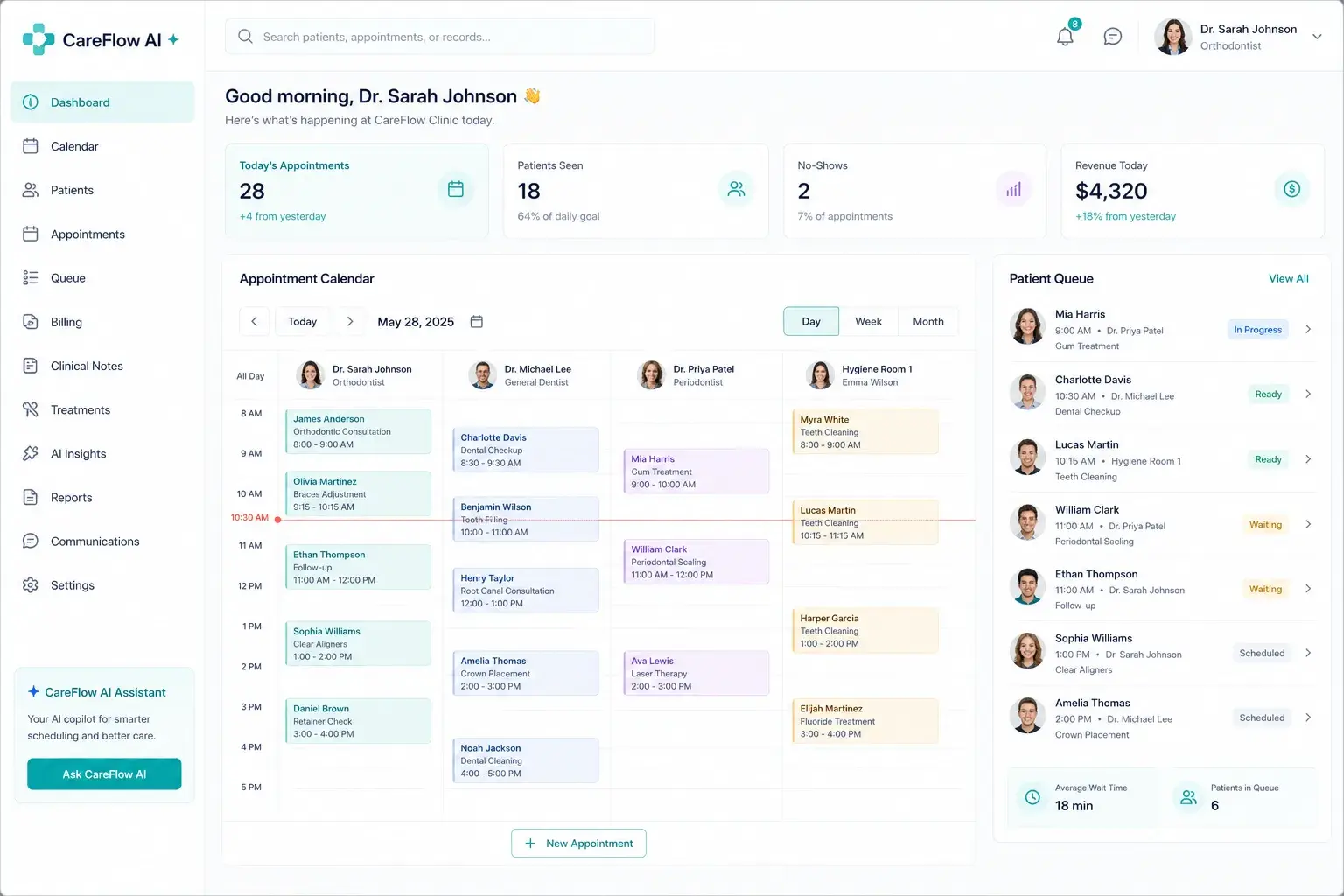
Design every AI-touching feature in clinical software around one rule: the system drafts, flags, or suggests, and a clinician confirms before anything becomes real — a note is signed, a prescription issued, a message sent, or money spent. Source safety checks from licensed reference data rather than model memory, design note-drafting to leave gaps instead of guessing, and roll out new AI features in a "watch-only" mode before letting them act.
Next Best Reads
Continue your research on Healthcare Tech
These links are chosen to move readers from general education into service understanding, proof, and buying-context pages.
HIPAA-Compliant Development
Build HIPAA-compliant healthcare software with audit-ready architecture and end-to-end encryption.
View HIPAA serviceHealthcare Industry Page
See Ortem's full healthcare tech scope — EHR, telehealth, wearables, and clinical data systems.
View healthcare pageRegulated App Case Study
A compliance-critical product build with security controls, data privacy, and high availability.
Read case study
Healthcare is one of the few domains where "just add AI automation" is actively the wrong instinct. An assistant that overreaches on a diagnosis, quietly invents a detail in a clinical note, or acts on billing without sign-off does not just create a bad user experience — it creates liability that can outweigh whatever time it saved. Here is a framework for building AI-assisted clinical software that stays firmly on the right side of that line.
The Governing Rule: Assists, Never Decides
Every AI feature in a clinical product should be designed against one non-negotiable constraint: the system drafts, flags, or suggests — a clinician confirms before anything becomes real. A consultation note is not final until signed. A prescription is not issued until confirmed. A patient message is not sent until approved. A purchase order is not placed until a human taps "approve."
This is not a compliance checkbox bolted on afterward — it needs to be the organizing principle behind every feature spec, from day one. Products that treat it as an afterthought end up retrofitting approval gates onto features that were designed to act autonomously, which is a much harder problem than designing the gate in from the start.
Ambient Scribes: Leave a Gap, Don't Guess
Ambient documentation — an AI assistant that listens to (or transcribes) a consultation and drafts a structured note — is one of the highest-value applications of AI in a clinical setting, and one of the easiest to get wrong. The failure mode is a model that fills in plausible-sounding details that were never actually discussed, because that's what generative models are statistically inclined to do when information is incomplete.
Design against this explicitly: if something was not discussed in the consultation, the draft note should leave that section blank or flagged, never fill it with a plausible guess. This keeps the clinician as the actual author of record and makes every line in the note traceable back to something that was genuinely said — which matters both for accuracy and for how the note holds up under any kind of review.
Source Safety Checks from Reference Data, Not Model Memory
Allergy checks, duplicate-medication checks, dose-range warnings, and any clinical guideline suggestions should be sourced from a licensed, dated medical reference database — not generated from a language model's own training data. A model's "memory" of a drug interaction is not a citable, auditable source; a structured reference database entry is.
Show the source for every flag the system raises. This does two things: it lets the clinician verify the flag against something authoritative in seconds, and it keeps the AI's role honest — it's surfacing structured data, not exercising clinical judgment.
Consent as a First-Class Object
Any feature that touches recording, ambient listening, or PHI processing needs consent modeled explicitly, not implied. Record consent per purpose (this specific type of processing, not a blanket "I agree" at signup), make it revocable in one step, and log which system — including which specific AI feature — accessed a given record and when.
This matters for compliance, but it also matters for trust: patients and clinicians both need a straightforward, honest answer to "what happens if I say no" or "what happens if I stop this recording right now." The honest answer should be simple: it stops, and if it was a recording, it's deleted.
Progressive Rollout: Watch-Only Mode First
Before any AI feature is allowed to act — even in the constrained, human-approved sense described above — give it a watch-only rollout phase. The system observes and generates its suggestions, but nothing surfaces to the clinician as an actionable item yet, or it surfaces clearly labeled as "not yet live." This lets you validate suggestion quality against real clinical data before a single clinician workflow depends on it.
This is a meaningfully different rollout pattern than typical SaaS feature flags — it's specifically about building trust incrementally in a domain where a bad first impression (a note that clearly hallucinated something, a claim flag that was obviously wrong) can permanently sour adoption, even after the underlying issue is fixed.
Design for Multi-Region Compliance From Day One
If a healthcare product has any ambition beyond a single country, do not architect data handling, consent models, and audit logging around one region's regulatory framework and hope it generalizes. Data residency requirements, consent granularity expectations, and audit-trail specifics vary meaningfully between, for example, US HIPAA and EU/UK GDPR-aligned regimes. Building the consent and audit-logging layer as a configurable, region-aware system from the start is significantly cheaper than retrofitting it once you have production data in a single hardcoded model.
Common Mistakes
- Letting an ambient scribe fill gaps with plausible-sounding invented details. Design it to leave a visible gap instead — the clinician needs to know what was actually said versus what the system is guessing.
- Sourcing safety-check logic from a language model's general knowledge instead of a licensed, dated reference database. Not auditable, not citable, and a real liability in a clinical context.
- Letting any AI feature act (send a message, submit a claim, place an order) without an explicit human approval step. The one rule this entire framework rests on.
- Treating consent as a single signup-time checkbox instead of a per-purpose, revocable, logged object. Regulators and patients both expect more granularity than that.
- Launching a new AI feature directly into an actionable state instead of a watch-only validation period. One bad early suggestion can cost you adoption trust that takes far longer to rebuild than the validation period would have taken.
Building AI-assisted clinical software and need the human-in-the-loop guardrails designed in from the start, not retrofitted? Ortem Technologies' AI & ML solutions practice has designed consent models, sourced safety-check architectures, and progressive AI rollout patterns for healthcare platforms. For the broader landscape of healthcare build partners and compliance requirements, see our healthcare software development company guide. See our related case study on a human-in-the-loop clinic operating system or book an architecture review →.
About Ortem Technologies
Ortem Technologies is a premier custom software, mobile app, and AI development company. We serve enterprise and startup clients across the USA, UK, Australia, Canada, and the Middle East. Our cross-industry expertise spans fintech, healthcare, and logistics, enabling us to deliver scalable, secure, and innovative digital solutions worldwide.
Get the Ortem Tech Digest
Monthly insights on AI, mobile, and software strategy - straight to your inbox. No spam, ever.
About the Author
Editorial Team, Ortem Technologies
The Ortem Technologies editorial team brings together expertise from across our engineering, product, and strategy divisions to produce in-depth guides, comparisons, and best-practice articles for technology leaders and decision-makers.
Frequently Asked Questions
- No — the time savings come from turning a blank-page task (writing a note from scratch, drafting a claim, checking every medication for interactions manually) into a review-and-confirm task, which is dramatically faster even with a human firmly in the loop. The goal is reducing clinician workload, not removing clinician judgment.
- Design an explicit, deterministic fallback for every AI-dependent feature — for example, a scheduled summary email that still sends with plain metrics if an AI-generated suggestions section fails to generate in time. The feature should degrade gracefully, never fail silently or block a workflow entirely.
- The audit and sourcing requirements. General-purpose AI features can often get away with "the model said so." Clinical features need every consequential output traceable to either an explicit clinician confirmation or a citable, structured data source — not model inference alone.
- It means the system drafts, flags, or suggests, and a clinician must explicitly confirm before anything becomes real — a note is signed, a prescription issued, a message sent, or a purchase order placed. No diagnosis, prescription, patient message, or spend happens autonomously.
Stay Ahead
Get engineering insights in your inbox
Practical guides on software development, AI, and cloud. No fluff — published when it's worth your time.
Ready to Start Your Project?
Let Ortem Technologies help you build innovative software solutions for your business.
You Might Also Like
HIPAA-Compliant App Development in 2026: Checklist, Architecture and Cost Drivers

Healthcare AI Compliance in 2026: Where HIPAA and the EU AI Act Collide