Designing Multi-Tenant SaaS for Nonprofits: SSO, Row-Level Security & Metadata-Driven Verticals
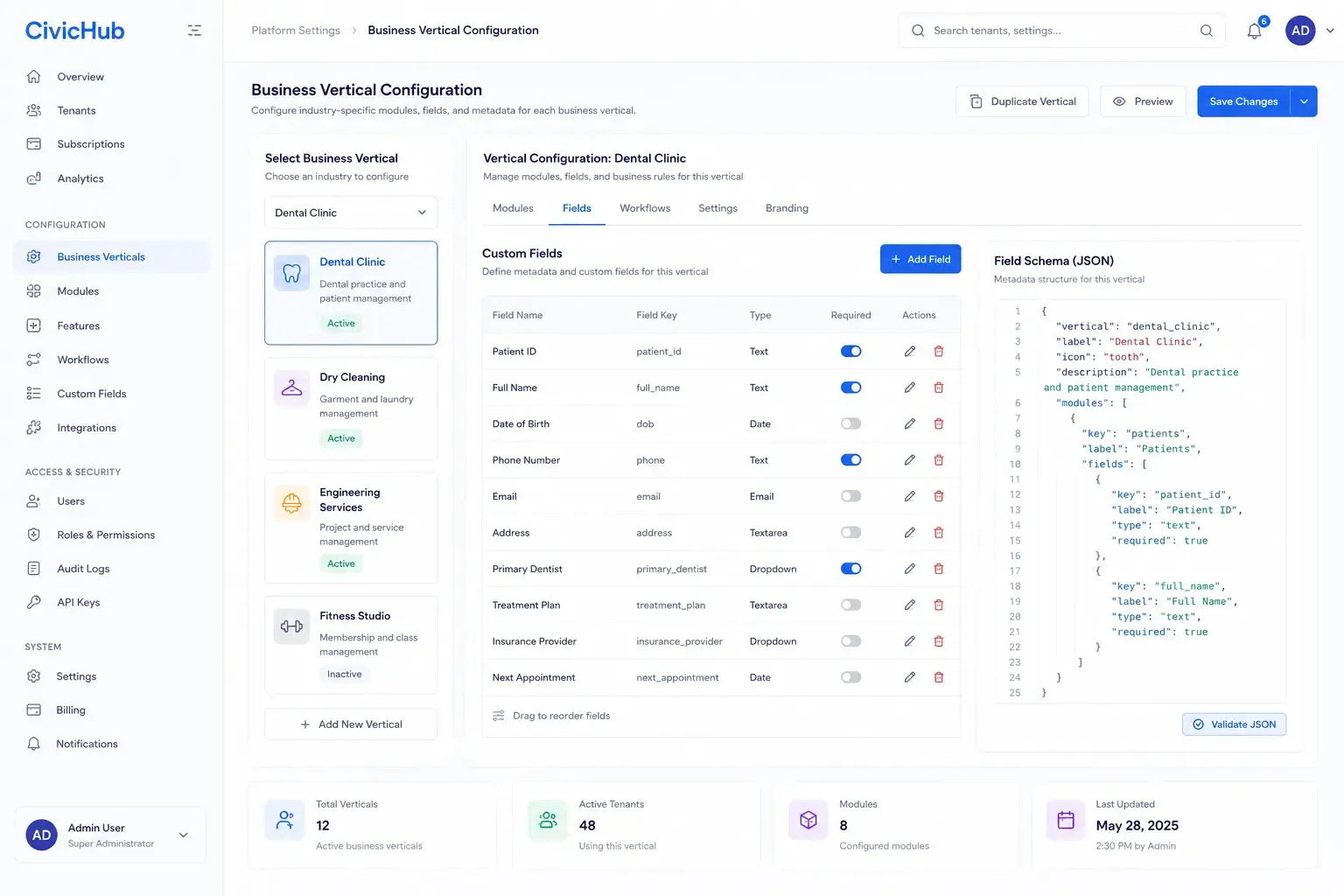
Use Auth0 (or a similar IdP) as the single master identity source with the community tool federating in via SAML SSO, PostgreSQL Row-Level Security for tenant data isolation, and JSONB-stored metadata templates so a new business vertical is a configuration change, not a code deploy.
Next Best Reads
Continue your research on Custom Software
These links are chosen to move readers from general education into service understanding, proof, and buying-context pages.
Custom Software Development
Move from research mode to scoping for dashboards, workflows, SaaS platforms, and internal systems.
Explore software serviceMVP Development
Use this path if your intent is validation, phased scope control, or faster launch for a new product.
See MVP serviceCustom Platform Case Study
Review how Ortem shipped a multi-tenant production platform with real operational requirements.
Read case study
Nonprofit consortiums, regional group-purchasing organizations, and multi-vertical membership platforms keep running into the same architecture problem: they want the fast, out-of-the-box community features a licensed platform gives them (directories, forums, job boards, course sales), but they also need custom business logic — subscription tiers, role-gated dashboards, vertical-specific workflows — that no off-the-shelf tool provides.
Bolt the two together carelessly and you get two separate user identities that drift out of sync, a codebase with per-industry if/else branches that gets harder to extend with every new vertical, and a data model with no real tenant boundary. Here is the pattern that avoids all three.
The Core Problem: Two Identity Stores
The moment you pair a licensed community platform with a custom-built business layer, you have two systems that both think they own "the user." The community platform has its own login. Your business layer needs its own login. Left alone, a member's role change, subscription upgrade, or account suspension in one system has no way to propagate to the other.
The fix is to pick exactly one master system of record for identity and make everything else a consumer of it.
Pattern 1: One Identity Source, Federated via SSO
Route every login through a single identity provider (Auth0, Okta, or similar) and have the community platform federate in via SAML 2.0 SSO rather than maintaining its own separate account store. The member authenticates once; both systems trust the same token.
This is not a cosmetic convenience. It eliminates an entire class of bugs — the "why does this member see the wrong role in the community tool" ticket — before it can exist, because there is only ever one place role and tier data lives.
Two things to verify before you commit to this pattern with a specific vendor:
- Does the licensed platform's plan actually include SAML SSO, or is it an add-on? Vendor entitlement pages are not always accurate — get it confirmed in writing or via a sandbox test.
- Who provisions the account in the licensed platform when a member signs up on your side — a just-in-time SAML provisioning flow, an explicit API call, or a manual step? This decision affects your onboarding flow more than almost anything else in the build.
Pattern 2: Metadata-Driven Verticals, Not Code Branches
If your platform serves multiple industries — dental practices, professional services, logistics firms, whatever your membership spans — resist the urge to hardcode each vertical's fields and workflow as its own code path. That approach works for the first two verticals and becomes unmaintainable by the fifth.
Instead, model each vertical as a stored template — a JSONB column in PostgreSQL describing its fields, required workflow steps, and permission rules. Your application code reads the template and renders accordingly. Adding a new vertical becomes: write a new JSON template, not open a pull request and redeploy.
This pattern pays for itself the moment the client's second industry vertical shows up mid-build, which — for consortium and marketplace platforms — is basically guaranteed.
Pattern 3: Row-Level Security for Real Tenant Isolation
Application-layer tenant filtering (a WHERE tenant_id = ? clause you have to remember to add to every query) is a liability. One missed filter in one endpoint and you have a cross-tenant data leak.
PostgreSQL Row-Level Security (RLS) moves that guarantee into the database itself. You define a policy once per table; the database enforces it on every query regardless of which application code path runs it. Combined with the metadata-template pattern above, this gives you two independent layers — the database enforces who can see which rows, the template layer controls what those rows look like and what workflow governs them.
Pattern 4: Webhook-First Sync, Not Polling
When your business layer needs to react to events happening in the licensed community platform (a member gets approved, a member gets suspended), do not poll. Build a dedicated webhook receiver that:
- Verifies the payload authenticity and checks idempotency (has this exact event already been processed?) before doing anything else.
- Publishes the event onto a durable queue (Redis pub/sub, SQS, or similar) instead of processing it inline in the HTTP handler.
- Lets a separate consumer worker process the event asynchronously, so a slow downstream operation never blocks the webhook response and never causes the sender to retry unnecessarily.
Add a low-frequency reconciliation poll running alongside this flow as a safety net — not the primary mechanism, but a fallback that catches anything the webhook delivery might have missed. Third-party platforms rarely publish hard delivery guarantees, and building around "it usually arrives" without a fallback is how you end up debugging a silent data-drift bug six months post-launch.
Infrastructure as Code, From Day One
None of the above matters if your staging environment quietly diverges from production. Define your infrastructure in code (AWS CDK, Terraform, Pulumi — the tool matters less than the discipline) from the first sprint, not as a cleanup task before launch. On a compressed build timeline, environment drift is one of the most common causes of "it worked in staging" incidents, and it is entirely avoidable.
Common Mistakes
- Maintaining two separate user tables and trying to keep them in sync manually. This always drifts eventually. Pick one master identity source and make everything else federate.
- Hardcoding vertical-specific logic in application code. Works for two verticals, breaks down by the fifth. Use metadata templates.
- Filtering tenant data only in application code. One missed
WHEREclause is a data breach. Enforce isolation at the database layer with RLS. - Polling a third-party platform for changes instead of consuming its webhooks. Slower, more fragile, and harder to scale. Webhooks with a reconciliation-poll safety net cover both the common case and the edge case.
Building a multi-tenant platform that needs to unify a licensed tool with custom business logic? Ortem Technologies' custom software development practice has shipped multi-tenant SaaS architectures with SSO federation, Row-Level Security, and metadata-driven configuration for consortium, marketplace, and vertical-SaaS platforms. See our related case study on a nonprofit consortium platform or book an architecture review →.
About Ortem Technologies
Ortem Technologies is a premier custom software, mobile app, and AI development company. We serve enterprise and startup clients across the USA, UK, Australia, Canada, and the Middle East. Our cross-industry expertise spans fintech, healthcare, and logistics, enabling us to deliver scalable, secure, and innovative digital solutions worldwide.
Get the Ortem Tech Digest
Monthly insights on AI, mobile, and software strategy - straight to your inbox. No spam, ever.
About the Author
Editorial Team, Ortem Technologies
The Ortem Technologies editorial team brings together expertise from across our engineering, product, and strategy divisions to produce in-depth guides, comparisons, and best-practice articles for technology leaders and decision-makers.
Frequently Asked Questions
- Verify this before architecture decisions are finalized, not after. Some platforms gate SSO, webhooks, and API access behind specific tiers — get written confirmation or run a sandbox test with the vendor's support team before committing to the pattern.
- Properly indexed RLS policies add negligible overhead for typical multi-tenant workloads. The alternative — remembering to filter correctly in every application code path — carries far more risk than the marginal query cost.
- If you're building for more than two industry verticals, or expect to add verticals after launch, build the template layer from the start. Retrofitting it after several verticals are hardcoded is a substantially larger rewrite than building it correctly the first time.
- Identity drift — the community platform and the business layer each maintaining their own user record, with role and subscription-tier changes failing to propagate between them. Picking one master identity source (Auth0 or similar) with the other system federating in via SSO eliminates this risk architecturally rather than relying on manual sync.
Stay Ahead
Get engineering insights in your inbox
Practical guides on software development, AI, and cloud. No fluff — published when it's worth your time.
Ready to Start Your Project?
Let Ortem Technologies help you build innovative software solutions for your business.
You Might Also Like

Custom Software Development Cost for Small Businesses in 2026
Custom Software Development Approach for Growing Businesses: A Complete Guide