AI Chatbot vs AI Agent: The Difference That Decides Your Budget in 2026
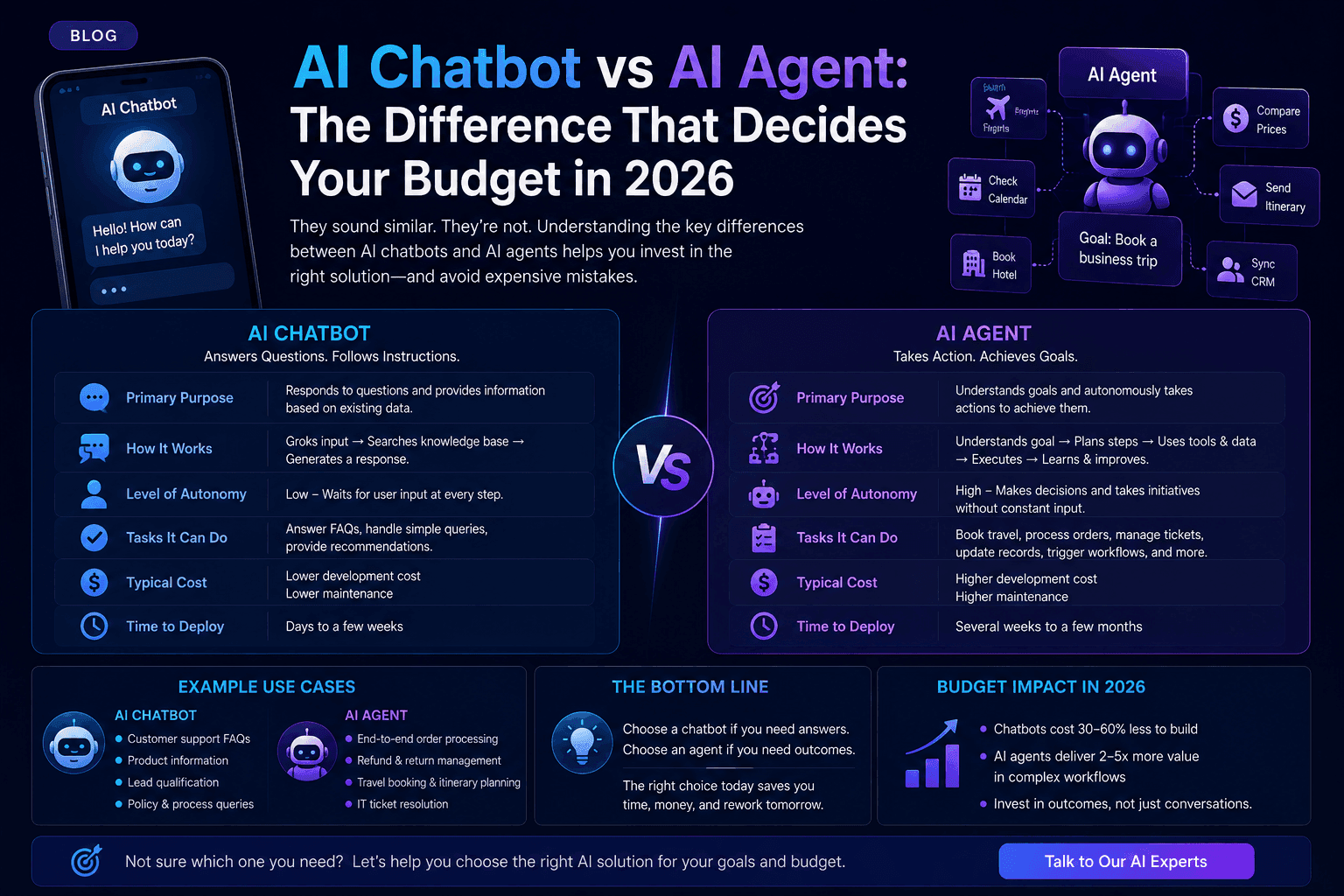
An AI chatbot answers questions using your knowledge base — it talks. An AI agent completes tasks across your systems — it acts: looking up orders, issuing refunds, booking appointments, updating records. Chatbots cost $15,000-50,000 and deflect informational tickets; agents cost $50,000-150,000 and remove entire workflows. Start with a chatbot when most inquiries are questions; build an agent when most inquiries require someone to do something. Ortem Technologies LLC builds both, usually as one system that escalates from answers to actions.
The functional difference: a chatbot retrieves and explains information, while an AI agent plans and executes multi-step tasks using tools — APIs, databases, business systems — with reasoning between steps. Every agent contains a chatbot; almost no chatbot can become an agent without re-architecture.
Commercial Expertise
Need help with AI & Machine Learning?
Ortem deploys dedicated AI & ML Engineering squads in 72 hours.
Next Best Reads
Continue your research on AI & Machine Learning
These links are chosen to move readers from general education into service understanding, proof, and buying-context pages.
AI & ML Solutions
Move from concept articles to real implementation planning for copilots, RAG, automation, and analytics.
Explore AI servicesAI Agent Development
See how Ortem builds autonomous workflows, tool-using agents, and human-in-the-loop systems.
View agent serviceAI Product Case Study
Study a production AI platform with architecture, launch scope, and operating model context.
Read case studyTwo companies buy "an AI assistant" this quarter. One pays $30,000 and watches support tickets drop 40%. The other pays $30,000 and discovers their "assistant" can explain the refund policy but cannot issue a refund — which is what 70% of their tickets actually require. Same budget, opposite outcomes, one distinction: chatbot versus agent.
Chatbot vs agent at a glance
| AI chatbot | AI agent | |
|---|---|---|
| What it does | Answers questions from a knowledge base | Plans and executes multi-step tasks |
| Typical cost | $15,000-50,000 | $50,000-150,000 |
| Timeline | 4-8 weeks | 8-16 weeks |
| Output | Words | Completed work |
| Measures success by | Ticket deflection rate | Workflow hours eliminated |
| Risk profile | Low — informational only | Higher — needs confirmation gates, limits, audit logs |
What each one actually is
A chatbot retrieves and explains. Your documentation, policies, and product data get indexed; the bot answers questions grounded in that knowledge with citations. Modern LLM chatbots are genuinely good — a long way from the decision trees of 2020 — but their output is words.
An agent plans and acts. Given "cancel my subscription and refund last month," an agent authenticates the user, reads the account, checks refund eligibility against policy, executes the refund through your billing API, confirms, and logs the interaction. Its output is completed work. The architecture behind this — tool use, planning loops, state — is what our production agent guide covers in depth.
The line matters commercially because everything hard about agents — integrations, permissions, failure recovery, testing irreversible actions — is absent from chatbots. Hence the 2-3x cost difference.
The decision framework: audit your queue
Pull one week of support tickets or inbound calls and tag each: did resolution end with an explanation or an action in another system?
- Mostly explanations → chatbot. $15,000-50,000, live in 4-8 weeks, immediate deflection. Costs detailed in our chatbot cost guide.
- Mostly actions → agent. $50,000-150,000, 8-16 weeks. Compare that against the loaded cost of the team currently doing those workflows — the ROI math is usually decisive, as our enterprise AI agents ROI analysis shows.
- Mixed → the escalation architecture: chatbot layer answers, agent layer acts, human layer handles exceptions. This is what we deploy most often in 2026.
What reliable agents look like in production
The agents that work in 2026 are narrow and deep. Five actions executed reliably with guardrails — confirmation on irreversible steps, spend limits, full audit logs, human escalation — beat fifty actions executed hopefully. Voice makes the same architecture answer phones: our voice AI support agent case study shows the pattern handling real customer calls end to end, including the moments where a caller's request falls outside the agent's scope and it hands off cleanly rather than guessing.
The upgrade path from chatbot to agent
Most companies do not need to choose once and live with it forever. The common, lower-risk path: launch a chatbot that answers the informational majority of your queue, instrument which questions it cannot resolve, and use that data to scope the first two or three agent actions worth building.
This sequencing de-risks the larger agent investment by proving demand for specific actions before paying to build them, and it only works if the chatbot was architected on an agent-ready foundation from day one — retrofitting tool use onto a pure retrieval pipeline is close to a rebuild.
Common mistakes when choosing between the two
Building an agent because it sounds more impressive than a chatbot, when the queue audit clearly shows informational questions dominate — this wastes 2-3x the budget on capability nobody uses. The opposite mistake: building a chatbot for a workflow-heavy queue and being surprised when deflection numbers disappoint, because the tool was never capable of doing what most tickets actually needed.
Both mistakes trace back to skipping the queue audit and buying based on a vendor's default recommendation instead of your own ticket data.
Where to start
Run the queue audit this week — it takes an afternoon and removes all the guesswork from vendor conversations. If you want a second pair of eyes, Ortem Technologies will review your ticket sample and tell you honestly which system your numbers justify — including when the answer is "a chatbot is enough." Start the conversation.
Chatbots and agents are one piece of the picture — see our complete guide to AI development services for the other six categories.
About Ortem Technologies
Ortem Technologies is a premier custom software, mobile app, and AI development company. We serve enterprise and startup clients across the USA, UK, Australia, Canada, and the Middle East. Our cross-industry expertise spans fintech, healthcare, and logistics, enabling us to deliver scalable, secure, and innovative digital solutions worldwide.
Get the Ortem Tech Digest
Monthly insights on AI, mobile, and software strategy - straight to your inbox. No spam, ever.
Sources & References
- 1.Voice AI Support Agent (Case Study) - Ortem Technologies
- 2.AI Agent Development - Ortem Technologies
About the Author
Editorial Team, Ortem Technologies
The Ortem Technologies editorial team brings together expertise from across our engineering, product, and strategy divisions to produce in-depth guides, comparisons, and best-practice articles for technology leaders and decision-makers.
Frequently Asked Questions
- A chatbot answers questions from a knowledge base — order policies, product info, troubleshooting steps. An AI agent takes actions: it can check the order status in your system, process the return, send the confirmation email, and update the CRM. Chatbots inform; agents execute multi-step tasks with reasoning between steps.
- Roughly 2-3x. A production chatbot grounded in your documentation runs $15,000-50,000. An agent runs $50,000-150,000 because each connected system adds integration work, permission handling, failure recovery, and testing. The payback differs too: chatbots deflect tickets, agents eliminate workflows.
- Only if it was architected for it. A chatbot built as a simple retrieval pipeline needs significant rework to add tool use, state management, and action guardrails. If you expect to want actions within a year, build on an agent-ready architecture from the start and enable actions incrementally.
- Yes, with guardrails: constrained action spaces, confirmation steps for irreversible operations, spend and rate limits, and human escalation paths. The pattern that works is narrow and deep — an agent that does five things reliably beats one that attempts fifty. Reliability comes from scoping and evaluation, not from the model alone.
- A well-designed agent fails safely: confirmation gates catch most errors before an irreversible action executes, spend and rate limits cap the damage of any single mistake, and every action is logged so a human can review and reverse if needed. The engineering discipline is designing for the failure case explicitly, not assuming the model will always be right.
- Usually the same frontier model — Claude, GPT, or Gemini — powers both. The difference is architectural, not which model is rented: a chatbot is a retrieval-and-response loop, while an agent adds a planning loop, tool definitions, state management across multiple steps, and guardrails around action execution.
- Chatbot ROI is measured in ticket deflection rate and reduced average handle time — how many questions never reach a human. Agent ROI is measured in workflow elimination — hours of manual work removed per week, multiplied by loaded labor cost. Agents typically show a clearer, larger ROI number because they replace work rather than just answering questions about it.
Stay Ahead
Get engineering insights in your inbox
Practical guides on software development, AI, and cloud. No fluff — published when it's worth your time.
Ready to Start Your Project?
Let Ortem Technologies help you build innovative software solutions for your business.
You Might Also Like
How to Add AI Features to an Existing SaaS Product Without Breaking It
Intelligent Document Processing in 2026: LLMs Ended the OCR Era