
Intelligent Document Processing in 2026: LLMs Ended the OCR Era
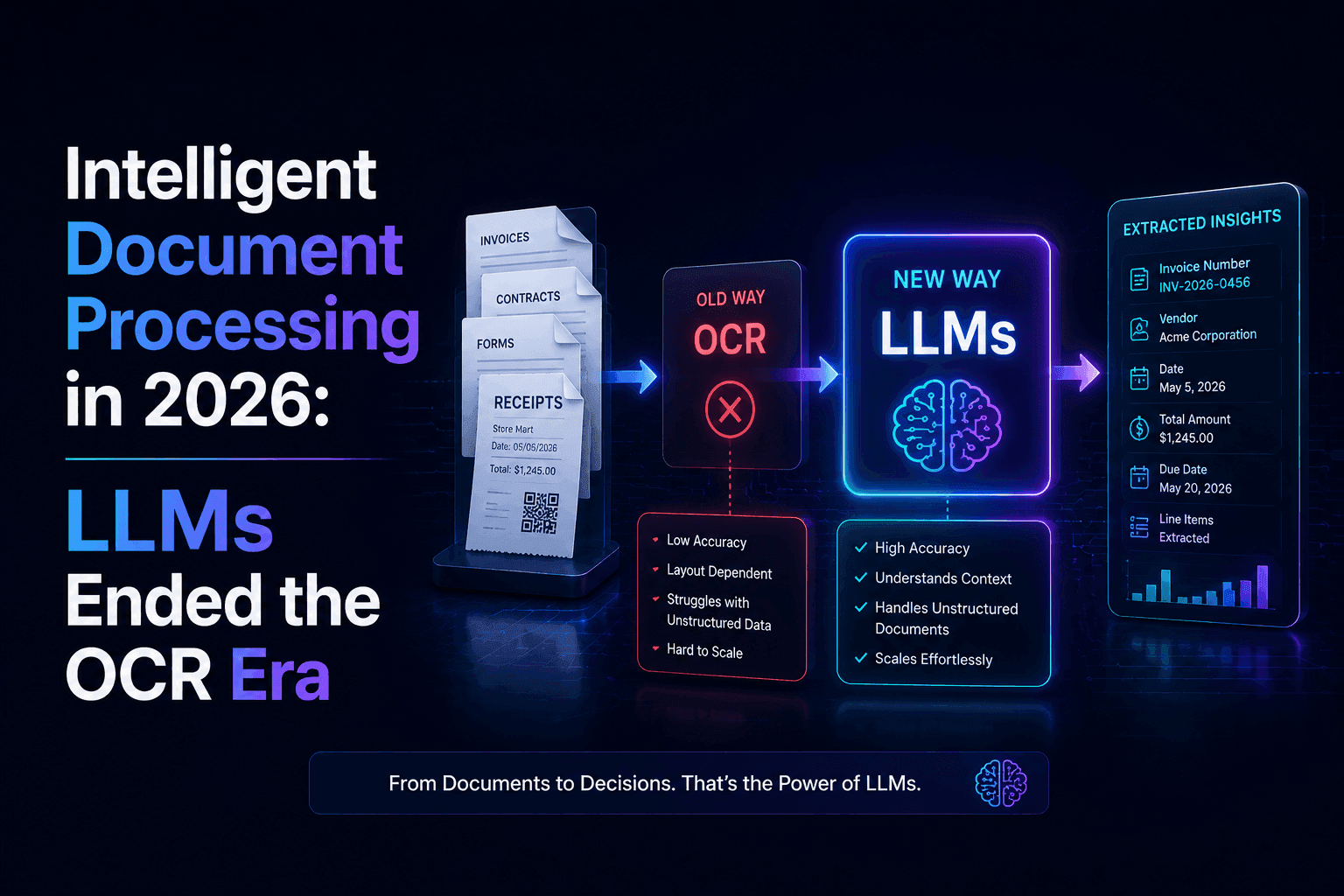
Intelligent document processing in 2026 uses multimodal LLMs to read documents the way a trained clerk does — handling layout variation, handwriting, and context that template-based OCR never could. Typical implementations cost $30,000-100,000, process invoices, contracts, claims, and onboarding packets, and pay back through straight-through processing rates of 70-90%. The design centerpiece is confidence-based routing: high-confidence extractions flow through automatically, low-confidence ones queue for human review. Ortem Technologies LLC builds IDP pipelines integrated directly into client ERPs and workflows.
Intelligent document processing (IDP) is the automated conversion of unstructured documents — PDFs, scans, emails, images — into validated, structured data inside business systems. The 2026 generation is built on multimodal LLMs that comprehend document content and layout together, replacing the brittle template-and-zone approach of legacy OCR tools.
Commercial Expertise
Need help with AI & Machine Learning?
Ortem deploys dedicated AI & ML Engineering squads in 72 hours.
Next Best Reads
Continue your research on AI & Machine Learning
These links are chosen to move readers from general education into service understanding, proof, and buying-context pages.
AI & ML Solutions
Move from concept articles to real implementation planning for copilots, RAG, automation, and analytics.
Explore AI servicesAI Agent Development
See how Ortem builds autonomous workflows, tool-using agents, and human-in-the-loop systems.
View agent serviceAI Product Case Study
Study a production AI platform with architecture, launch scope, and operating model context.
Read case studyEvery operations team has a keying-and-checking function nobody loves: invoices into the ERP, claims into the adjudication system, customer documents into onboarding. It is expensive, slow, error-prone — and in 2026 it is the highest-certainty AI ROI available, because multimodal LLMs finally read documents the way people do.
IDP cost and accuracy at a glance
| Metric | Legacy OCR era | 2026 LLM-based IDP |
|---|---|---|
| Field-level accuracy on varied documents | 60-80% | 90-98% |
| New vendor format handling | Requires new template | Handled natively |
| Cost per document processed | $2-8 (manual) | $0.01-0.15 (runtime) |
| Implementation cost | $30,000-100,000 | Same range, faster to configure |
| Straight-through processing (invoices) | Rarely above 50% | 70-90% within one quarter |
Why the OCR era actually ended
Legacy document tools worked in two brittle steps: OCR extracted characters, then templates mapped zones to fields — "the invoice number lives in the top right." Every new vendor layout broke the template. Handwriting broke everything. Teams bought "automation" and hired people to fix its output.
Multimodal LLMs collapsed those steps: the model reads the document — layout, labels, context, even a handwritten adjustment in the margin — and produces structured fields with reasoning. A never-seen invoice format is just Tuesday. Field-level accuracy on messy real-world documents moved from the 60-80% of the OCR era to 90-98%. That shift, more than any other single capability, is what our multimodal AI applications guide called the quiet revolution of the past two years.
The architecture that makes it safe: confidence routing
The design centerpiece of a production IDP pipeline is not extraction — it is knowing when not to trust it:
- Ingest from email, upload, scanner, or API.
- Classify the document type, splitting multi-document packets.
- Extract fields with a multimodal LLM, each carrying a confidence score.
- Validate against business rules and reference data — does the PO exist, do line items sum to the total, is the IBAN checksum valid?
- Route by confidence. Clean, validated extractions flow straight into the ERP. Anything uncertain queues for a human with a pre-filled review screen — verify two highlighted fields, not re-key forty.
- Learn from corrections. Recurring exceptions become new validation rules; straight-through rates climb quarter over quarter.
This human-in-the-loop layer is what separates systems that finance departments trust from black boxes they audit by hand anyway.
The ROI math
Manual document handling costs $2-8 per document loaded; LLM pipeline processing costs $0.01-0.15 at runtime. At 5,000 documents a month with an 80% straight-through rate, implementations in the $40,000-80,000 range routinely pay back inside 6-12 months — before counting error reduction and cycle-time gains. This is the same thin-slice logic we apply everywhere: start with your highest-volume document type, prove the rate, widen.
Where it lands first
Accounts payable invoices, insurance claims, KYC and onboarding packets, logistics documents, and contract data extraction — anywhere volume is high and formats vary. For regulated data, the LLM security controls around retention and provider training terms apply in full.
Choosing your first document type
Start with the document type that combines the highest monthly volume with the most standardized structure — invoices and purchase orders are the most common first choice because both conditions are usually true, and the business case is easy to quantify against current keying cost.
Contracts and free-text claims are viable but should come second, once the confidence-routing pipeline and validation rules have already proven themselves on a simpler document type. Picking the hardest document type first is the most common reason IDP pilots take longer than planned to show results.
What changes at the six-month mark
Straight-through processing rates climb meaningfully after the first two to three months, as the review queue surfaces recurring exception patterns that become new validation rules — a supplier that always formats dates unusually, a claim type that needs a specific cross-reference check. Teams that treat the review queue as a source of continuous improvement rather than a permanent cost center see the steepest gains; teams that ignore the queue's patterns plateau at whatever accuracy the system launched with.
If your team keys documents into systems by hand, the automation case in 2026 is no longer speculative. Ortem Technologies will benchmark extraction accuracy on a sample of your actual documents before you commit to anything. Send us a sample batch.
Document processing is one of seven AI service categories — see our complete guide to AI development services for the rest.
About Ortem Technologies
Ortem Technologies is a premier custom software, mobile app, and AI development company. We serve enterprise and startup clients across the USA, UK, Australia, Canada, and the Middle East. Our cross-industry expertise spans fintech, healthcare, and logistics, enabling us to deliver scalable, secure, and innovative digital solutions worldwide.
Get the Ortem Tech Digest
Monthly insights on AI, mobile, and software strategy - straight to your inbox. No spam, ever.
Sources & References
- 1.Multimodal AI Business Applications 2026 - Ortem Technologies
- 2.AI & ML Solutions - Ortem Technologies
About the Author
Editorial Team, Ortem Technologies
The Ortem Technologies editorial team brings together expertise from across our engineering, product, and strategy divisions to produce in-depth guides, comparisons, and best-practice articles for technology leaders and decision-makers.
Frequently Asked Questions
- IDP is software that reads business documents — invoices, contracts, claims, ID packets — and turns them into structured, validated data in your systems without manual keying. Modern IDP uses multimodal LLMs that understand content and layout together, so new vendor formats and messy scans no longer break extraction the way they broke template-based OCR.
- Legacy OCR extracts characters, then brittle templates guess meaning by position — every new layout needs new configuration. LLMs read semantically: they find the total on an invoice format they have never seen, interpret handwritten notes, and flag internal inconsistencies. Accuracy on varied real-world documents typically jumps from 60-80% to 90-98% field-level.
- A single-document-type pipeline (one invoice or claim workflow) runs $30,000-60,000. Multi-document processing with ERP integration, validation rules, and human review tooling runs $60,000-150,000. Per-document processing costs at runtime are typically $0.01-0.15 depending on complexity — compare that to $2-8 per document for manual keying.
- For semi-structured documents like invoices: 70-90% straight-through within the first quarter, meaning no human touches them. Complex documents like contracts sit lower, 40-70%, with humans reviewing extracted clauses rather than reading full documents — still a 5-10x throughput gain. The rate climbs over time as validation rules absorb the recurring exception patterns.
- Yes — this is one of the clearest improvements over legacy OCR. Multimodal LLMs read handwritten annotations, signatures, stamps, and low-quality scans with meaningfully better accuracy than template-based tools, because they interpret content in context rather than matching character shapes against a fixed dictionary. Extremely poor scan quality still degrades accuracy, but the failure mode is graceful — confidence scores drop and the document routes to human review instead of silently extracting wrong data.
- Through the ERP's native API where one exists (most modern ERPs — NetSuite, SAP, Dynamics — expose one), or through a scheduled batch sync for older systems without a real-time API. Validated extractions post directly as draft records for a human to approve, or fully automatically once straight-through processing rates are proven, whichever fits the client's risk tolerance.
- In every implementation we have shipped, the team shifts from keying to reviewing — working the confidence-routed exception queue instead of every document. This is typically a better job (judgment work instead of repetitive data entry) and frees headcount for higher-value work as volume grows, rather than eliminating the role outright in the first year.
Stay Ahead
Get engineering insights in your inbox
Practical guides on software development, AI, and cloud. No fluff — published when it's worth your time.
Ready to Start Your Project?
Let Ortem Technologies help you build innovative software solutions for your business.
You Might Also Like
Computer Vision Development Services in 2026: What to Build and What It Costs
Conversational AI for Lead Generation: Turning Website Traffic into Pipeline in 2026
