
Fintech App Development in 2026: Compliance, Cost, and Architecture for US and Global Markets

Next Best Reads
Continue your research on FinTech
These links are chosen to move readers from general education into service understanding, proof, and buying-context pages.
Cybersecurity Services
Turn compliance-awareness content into a concrete programme for app security, audits, and remediation.
Explore security serviceCompliance & Security
Review how Ortem handles security controls, governance, and regulated software delivery requirements.
View compliance pageFinTech Case Study
Study a security-sensitive banking product build where reliability, payments, and trust were central.
Read case studyFintech app development has a higher floor cost than most categories of software because compliance is not optional. A payment app that is not PCI-DSS compliant, a lending platform that violates state lending laws, or a crypto application that does not address money transmission requirements can result in regulatory action, fraud liability, and loss of banking relationships. This guide breaks down what fintech development actually costs, what drives the complexity, and what you need to think about before you start building.
The Compliance Landscape You Are Building In
Fintech regulation in the United States is fragmented across federal and state jurisdictions, and it changes. The relevant regulatory frameworks depend on what your product does:
Payment processing and money transmission: If your product moves money — even facilitating payments between two parties — you may be a money transmitter under state law, which requires licenses in 49 states (FinCEN's MSB registration is federal, but state licenses are separate and complex). Most fintech startups solve this by partnering with a licensed payment processor or bank — Stripe, Square, Braintree — rather than obtaining their own licenses.
Banking services (accounts, cards, deposits): If your product looks like a bank account, it needs to be backed by an FDIC-insured bank. Banking-as-a-Service (BaaS) providers — Stripe Treasury, Column, Synapse, Unit — provide the banking rails that let fintech products offer accounts and cards without obtaining a banking charter.
Lending: Consumer lending is regulated by the Truth in Lending Act (TILA), state usury laws, and the Equal Credit Opportunity Act (ECOA). Small business lending has different requirements. Lending products are among the most regulated in fintech — plan for significant legal costs alongside development costs.
Investment and brokerage: SEC and FINRA regulation applies to investment products, broker-dealers, and investment advisors. Crypto products have additional complexity under evolving SEC and CFTC frameworks.
Data security (PCI-DSS): Any application that processes, stores, or transmits cardholder data must comply with PCI-DSS. Level 1 compliance (the highest, applicable to large merchants and service providers) requires an annual audit by a Qualified Security Assessor. Most fintech startups aim for PCI-DSS Level 4 initially, which requires an annual self-assessment questionnaire.
Understanding your regulatory requirements is step 0 — before you write any code or get any development estimates. Get this wrong and your product cannot legally operate.
Fintech App Development Cost by Product Type
Payment Processing Integration
What it is: Adding payment acceptance to an existing product — credit/debit card, ACH, digital wallets. Not building a payment product from scratch. Cost: $15,000–$45,000 (integration work only) Typical approach: Stripe, Braintree, or Adyen integration with webhook handling, refund flows, and basic reconciliation.
Digital Wallet / Stored Value Application
What it is: A product that holds a balance on behalf of users and enables them to pay, receive, or transfer funds. Cost: $150,000–$350,000 including BaaS integration Timeline: 18–32 weeks
Complexity drivers: KYC/AML implementation (identity verification, sanctions screening), transaction monitoring, BaaS provider integration, regulatory compliance documentation, fraud detection.
Mobile Banking App (via BaaS)
What it is: A consumer-facing banking experience (checking account, debit card, savings, transfers) built on top of Banking-as-a-Service infrastructure. Cost: $200,000–$500,000 Timeline: 24–40 weeks
The BaaS provider (Column, Synapse, Unit, Stripe Treasury) handles the actual banking operations. You are building the consumer experience on top. Complexity: KYC onboarding, card management, transaction history, push notifications for transactions, customer support tooling, dispute management.
Lending Platform
What it is: A platform that originates, underwrites, or services loans — consumer, small business, or BNPL. Cost: $250,000–$600,000+ Timeline: 6–14 months
Complexity: credit decisioning models (or integration with credit bureau APIs), loan origination workflow, servicing and payment processing, regulatory compliance documentation, and in most cases, a partnership with a licensed lender or bank sponsor.
Investment / Brokerage Platform (via API)
What it is: A consumer investing experience built on top of a brokerage API — Alpaca, DriveWealth, Apex Clearing. Cost: $180,000–$400,000 Timeline: 20–36 weeks
Complexity: brokerage API integration, account opening with identity verification, order management, portfolio display and performance calculation, regulatory disclosures, and the compliance review process.
The Four Cost Drivers That Surprise Fintech Buyers
1. KYC/AML implementation
Know Your Customer (KYC) and Anti-Money Laundering (AML) requirements are mandatory for financial products. Identity verification, sanctions screening (OFAC), and transaction monitoring are not features you build from scratch — you integrate a vendor (Persona, Alloy, Sardine, Jumio) and build the workflow around it. KYC/AML infrastructure adds $25,000–$60,000 to development cost and requires ongoing compliance processes after launch.
2. Fraud detection and chargeback management
Fraud is a cost of doing business in fintech. Your fraud detection strategy — rules-based, ML-based, or hybrid — needs to be designed before launch, not after your first fraud incident. Budget $20,000–$50,000 for initial fraud tooling, and expect ongoing operational costs.
3. Reconciliation and ledgering
Financial products require accurate, auditable records of every transaction. A proper double-entry ledger that reconciles with your BaaS or payment processor's records is foundational. Building this correctly takes more time than buyers expect — $20,000–$40,000 for a basic ledger, more for complex multi-currency or multi-party transactions.
4. Regulatory legal costs
Legal review of your product — terms of service, privacy policy, compliance policies, regulatory analysis — runs $15,000–$50,000 for a simple fintech product. For licensed products, ongoing compliance counsel is an operational cost. These are real costs that belong in your project budget.
Technical Architecture Principles for Fintech
Immutability first. Financial transaction records should be immutable — append-only. Updates to financial state should be expressed as new records, not modifications to existing ones. This creates an audit trail and simplifies reconciliation.
Idempotency everywhere. Payment operations must be idempotent — sending the same request twice should produce the same result, not a double charge. This requires idempotency keys at every payment API call and careful handling of retries and failures.
Separation of financial logic from application logic. Your ledger and transaction processing should be a separate service layer that your product features call, rather than intermingled with your product business logic. This makes compliance auditing and testing dramatically simpler.
Monitoring and alerting from day one. Operational issues in fintech — failed transactions, reconciliation discrepancies, fraud signals — need to surface immediately, not at end of day. Build monitoring before launch.
Ortem Technologies is a US fintech app development company with PCI-DSS compliant development practices, BaaS integration experience, and production fintech applications in digital banking, payments, and investment platforms. Book a free fintech consultation → | Fintech app development → | HIPAA and compliance development →
About Ortem Technologies
Ortem Technologies is a premier custom software, mobile app, and AI development company. We serve enterprise and startup clients across the USA, UK, Australia, Canada, and the Middle East. Our cross-industry expertise spans fintech, healthcare, and logistics, enabling us to deliver scalable, secure, and innovative digital solutions worldwide.
Get the Ortem Tech Digest
Monthly insights on AI, mobile, and software strategy - straight to your inbox. No spam, ever.
About the Author
Director – AI Product Strategy, Development, Sales & Business Development, Ortem Technologies
Praveen Jha is the Director of AI Product Strategy, Development, Sales & Business Development at Ortem Technologies. With deep expertise in technology consulting and enterprise sales, he helps businesses identify the right digital transformation strategies - from mobile and AI solutions to cloud-native platforms. He writes about technology adoption, business growth, and building software partnerships that deliver real ROI.
Stay Ahead
Get engineering insights in your inbox
Practical guides on software development, AI, and cloud. No fluff — published when it's worth your time.
Ready to Start Your Project?
Let Ortem Technologies help you build innovative software solutions for your business.
You Might Also Like

Financial Software Development Company: What Fintech Builds Require in 2026
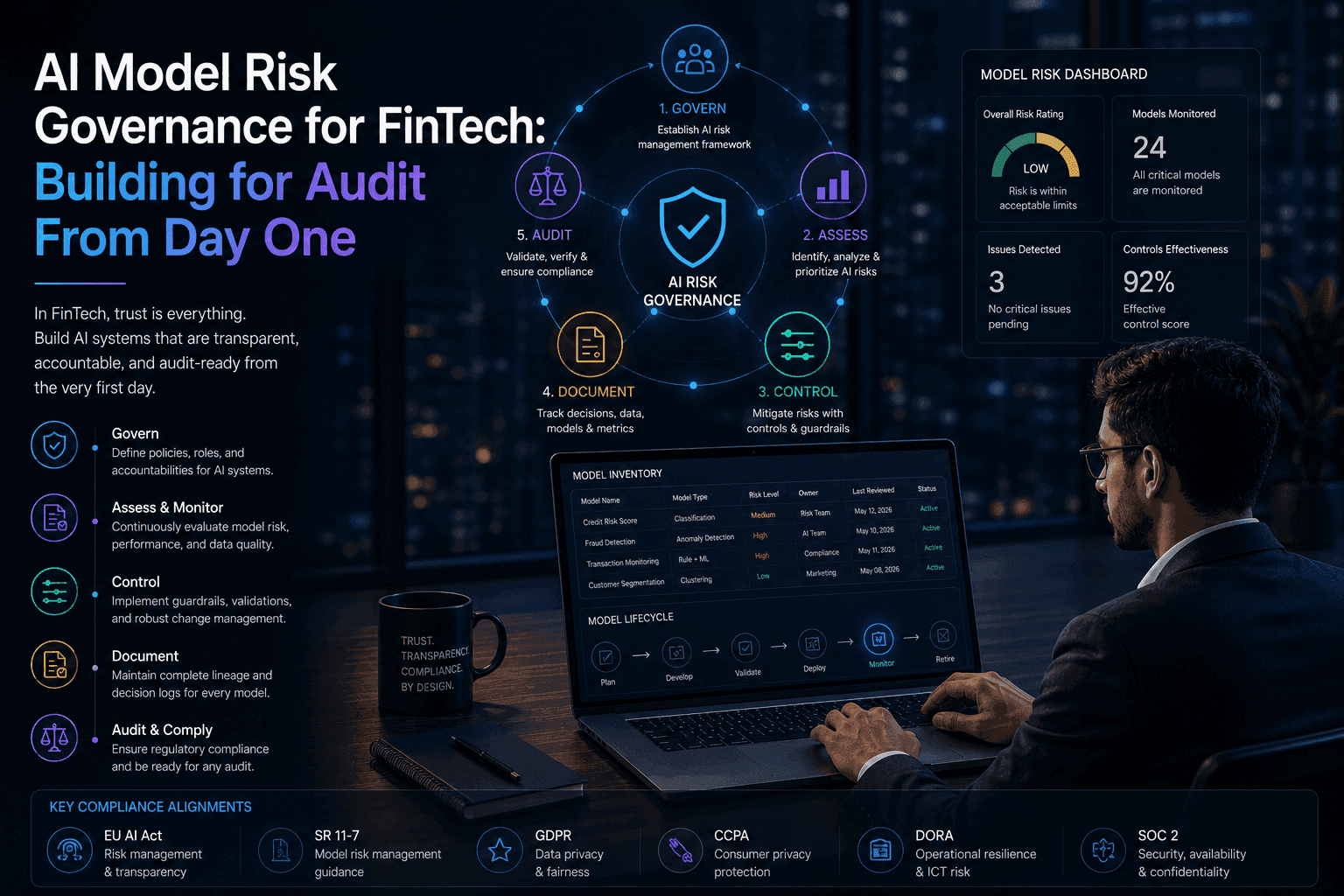
AI Model Risk Governance for FinTech: Building for Audit From Day One
