
Financial Software Development Company: What Fintech Builds Require in 2026

Financial software development requires: PCI DSS compliance for any payment card data handling (Level 1–4 depending on transaction volume), SOC 2 Type II for enterprise B2B fintech, open banking API integration (Plaid, MX, or direct bank APIs), real-time payment rail support (RTP, FedNow, SEPA Instant), and fraud detection infrastructure. Development cost adds 25–50% over standard software for compliance architecture, security auditing, and penetration testing. Fintech companies that launch without compliance in place face regulatory action and enterprise sales blockers.
Next Best Reads
Continue your research on FinTech
These links are chosen to move readers from general education into service understanding, proof, and buying-context pages.
Cybersecurity Services
Turn compliance-awareness content into a concrete programme for app security, audits, and remediation.
Explore security serviceCompliance & Security
Review how Ortem handles security controls, governance, and regulated software delivery requirements.
View compliance pageFinTech Case Study
Study a security-sensitive banking product build where reliability, payments, and trust were central.
Read case studyFinancial software development combines standard engineering complexity with a compliance and regulatory layer that significantly affects architecture decisions, timelines, and cost. A generalist agency can build the UI and basic backend — the fintech-specific compliance and integration work requires specialized experience.
Compliance Requirements by Fintech Type
Payment Processing: PCI DSS
Any application that stores, processes, or transmits payment card data must comply with PCI DSS (Payment Card Industry Data Security Standard). The scope varies by how card data is handled:
SAQ A (simplest scope): Card data fully handled by a third-party payment processor (Stripe, Braintree, Square). Your application never touches raw card numbers. Compliance is mostly about ensuring your hosted payment form is served correctly.
SAQ A-EP: E-commerce site where the checkout page is on your domain but card processing is outsourced. Requires server security controls, vulnerability scanning, and network monitoring.
SAQ D (most complex): You store, process, or transmit cardholder data directly. Requires a full suite of controls: encryption, access controls, network segmentation, penetration testing, quarterly ASV scans, and either annual QSA assessment (for Level 1 merchants, 6M+ transactions/year) or self-assessment.
Engineering implication: The best PCI compliance strategy is to minimize scope — use Stripe Elements or Stripe Payment Intents so card data never touches your servers. This dramatically reduces compliance overhead and is the right architecture choice in almost all cases.
B2B Fintech: SOC 2 Type II
If you are selling a fintech product to enterprise buyers — banks, insurance companies, large employers — they will require SOC 2 Type II before signing a contract. This is table stakes for enterprise fintech sales.
SOC 2 Type II audits your security controls (Trust Service Criteria) over a 6–12 month observation period. Getting SOC 2 Type II requires: 6+ months of operating with documented security controls in place, annual penetration testing, vulnerability management program, access control reviews, incident response plan, and vendor risk management.
Timeline: Start SOC 2 readiness on day 1 if enterprise sales are in your plan. A typical path: implement controls (2–3 months) → observation period (6 months) → audit (2 months) → report (1 month). Total: 11–12 months minimum.
Tools that accelerate SOC 2: Drata, Vanta, and Secureframe automate evidence collection and controls monitoring for $10,000–$30,000/year.
Money Transmission: MTL Licensing
If your application moves money between parties — payments marketplace, digital wallet, peer-to-peer transfers, foreign exchange — you may need a Money Transmitter License (MTL) in each US state where you operate. 50 state licenses is a multi-year, multi-million dollar undertaking.
Alternatives to full licensing:
- Partner with a licensed money transmitter (Stripe Treasury, Marqeta, Galileo) that provides the transmission infrastructure under their license
- Limit to a single state initially, then expand
- Use a payments facilitator model (PayFac) under a payment processor's MTL
Most early-stage fintech companies should not attempt independent money transmission licensing. Partner with a licensed BaaS provider until scale justifies direct licensing.
Core Technical Requirements for Fintech
Payment rail integrations: Stripe and Braintree for card payments. ACH via Stripe, Dwolla, or ModernTreasury for bank-to-bank. RTP (Real-Time Payments) and FedNow for instant US payments. SEPA Instant for EU. SWIFT for international wires.
Open banking: Plaid, MX, or Yodlee for account aggregation and verification. Direct integrations for major US banks via their published APIs (Chase, Wells Fargo, Bank of America all have developer portals).
Fraud detection: Rules-based fraud scoring for transaction monitoring, ML-based anomaly detection for unusual patterns, device fingerprinting, velocity checks. At minimum: integrate with a fraud scoring API (Sardine, Sift, Kount) before launching any payment feature.
Data security: Financial data encryption at rest (AES-256) and in transit (TLS 1.3), tokenization for sensitive values (account numbers, card PAN), secure key management (AWS KMS or HashiCorp Vault), and immutable audit logs for all financial transactions.
Ortem's Fintech Work
Ortem Technologies has built production fintech applications including SunCrypto — a crypto trading platform handling $100M+ in trading volume with 500,000+ users — and Fintrust — a biometric banking application delivered 100% on time. Our fintech development practice covers trading platforms, payment processing integrations, banking-as-a-service implementations, and financial data analytics.
Discuss your fintech project → | Custom software development services → | AI agent development →
What Separates a Financial Software Development Company from a General-Purpose Dev Shop
Building software for financial services is architecturally different from building for other industries — not because financial software is more complex in general, but because the failure modes are different, the regulatory obligations are stricter, and the data security requirements are more demanding.
A general-purpose development company focuses on features, performance, and user experience. A financial software development company needs to focus on those three things plus:
Regulatory compliance architecture. Software for US financial institutions must navigate GLBA data security requirements, PCI DSS for any card payment processing, SOX internal controls for public company financial reporting, and BSA/AML compliance for transaction monitoring. Each regulatory framework has specific technical requirements — encryption standards, audit logging, access controls, data retention policies — that must be designed into the architecture from day one.
Audit trail and data integrity. Financial transactions are immutable — you cannot delete or modify a payment record after the fact. Financial software must implement append-only transaction ledgers, cryptographic receipts for every state change, and audit logs that satisfy both internal and external audit requirements.
Third-party financial system integration. Financial software rarely exists in isolation — it integrates with banking APIs (Plaid, MX, TrueLayer), payment processors (Stripe, Adyen, PayPal), accounting systems (QuickBooks, Xero, Sage), and core banking platforms. Each of these integrations has its own data formats, authentication models, rate limits, and error handling requirements.
Security architecture that exceeds standard best practices. Financial applications are high-value targets. Security requirements go beyond OWASP Top 10 basics: field-level encryption for PII and financial data at rest, TLS mutual authentication for service-to-service communication, token rotation policies for long-lived API credentials, and penetration testing before production launch.
The Technology Stack Decisions That Matter Most in Financial Software
Database choice and data integrity guarantees Financial applications require ACID-compliant databases — PostgreSQL is the dominant choice in modern fintech (Stripe runs PostgreSQL), with MySQL and SQL Server common in enterprise and legacy contexts. NoSQL databases can be appropriate for specific use cases (audit logs, session data, event streams) but should not be the primary transaction store for financial data where consistency guarantees are critical.
Event sourcing for financial ledgers Traditional CRUD-based data models allow records to be modified directly, which creates audit trail gaps. Event-sourced architectures record every state change as an immutable event (PaymentInitiated, PaymentAuthorised, PaymentSettled, PaymentRefunded), with current state derived by replaying events. This approach provides a complete, tamper-evident history of every state change — the financial industry standard for transaction ledgers.
Cryptographic verification Financial software should apply cryptographic verification to high-value operations: digital signatures on transactions (proving who authorized the transaction), HMAC verification on webhook payloads (proving the payload came from the payment processor and was not tampered with), and certificate pinning on mobile applications (preventing man-in-the-middle attacks on financial API connections).
Secrets management Financial applications integrate with many external APIs — each with credentials that must be stored securely. Hard-coded credentials in source code are a security vulnerability. Production financial software uses a secrets management service (AWS Secrets Manager, HashiCorp Vault, GCP Secret Manager) with rotation policies and access logging for all financial system credentials.
Regulatory Frameworks Your Financial Software Must Address
For US fintech companies, GLBA applies to companies providing financial products or services to consumers and requires a written information security program with specific technical requirements strengthened in December 2022. PCI DSS v4.0 (effective March 2025) is required for any software that processes, stores, or transmits cardholder data.
For UK fintech companies, FCA Consumer Duty (effective July 2023) requires financial services firms to demonstrate that their digital products produce good consumer outcomes — creating UX and transparency obligations that must be designed into the product, not added after launch.
For EU fintech companies, DORA (Digital Operational Resilience Act, effective January 2025) applies to financial institutions and their ICT service providers and mandates ICT risk management frameworks, incident reporting within 4 hours of major incidents, and threat-led penetration testing.
Questions to Ask Before Hiring a Financial Software Development Company
"What is your experience with [specific regulation]?" A credible answer includes specific technical implementations — not "we understand compliance." Ask them to describe how they implemented audit logging for SOX or data residency for GDPR in a prior project.
"How do you handle secrets and credential management?" The answer should reference specific tools (Vault, AWS Secrets Manager) and processes (rotation schedules, least-privilege access). Any answer involving environment variables in code repositories is a red flag.
"What is your penetration testing process before launch?" Financial applications require pre-launch penetration testing. The agency should have a process, not an afterthought.
View fintech case studies → | Financial software services →
Why Financial Software Requires a Specialist Partner
General-purpose development agencies can build the features — the forms, the dashboards, the API integrations. What they typically cannot provide is the regulatory architecture review, the security threat modelling specific to financial applications, or the audit trail patterns that satisfy external auditors. These are not features — they are architectural decisions made in the first sprint that determine whether the product passes its first compliance audit or fails it.
Ortem Technologies has delivered production fintech applications across payments, lending, wealth management, and regulatory reporting. Our engagements include pre-launch security review, compliance architecture documentation, and ongoing regulatory monitoring as frameworks evolve.
Sources and Further Reading
- PCI Security Standards Council — PCI DSS v4.0 full standard and SAQ documentation. Effective March 2025. pcisecuritystandards.org
- FFIEC Information Security Handbook — GLBA technical safeguards requirements updated December 2022. ffiec.gov
- FCA Consumer Duty Final Rules — PS22/9, effective July 31, 2023. Consumer outcome requirements for digital financial services. fca.org.uk
- DORA Regulation (EU) 2022/2554 — Digital Operational Resilience Act, applicable from January 17, 2025. eur-lex.europa.eu
- OWASP Top 10 for Financial Services — Extended OWASP coverage specific to financial application vulnerabilities. owasp.org
- Plaid Developer Documentation — Financial data API integration reference, OAuth flows, and data field coverage by institution. plaid.com/docs
About Ortem Technologies
Ortem Technologies is a premier custom software, mobile app, and AI development company. We serve enterprise and startup clients across the USA, UK, Australia, Canada, and the Middle East. Our cross-industry expertise spans fintech, healthcare, and logistics, enabling us to deliver scalable, secure, and innovative digital solutions worldwide.
Get the Ortem Tech Digest
Monthly insights on AI, mobile, and software strategy - straight to your inbox. No spam, ever.
About the Author
Director – AI Product Strategy, Development, Sales & Business Development, Ortem Technologies
Praveen Jha is the Director of AI Product Strategy, Development, Sales & Business Development at Ortem Technologies. With deep expertise in technology consulting and enterprise sales, he helps businesses identify the right digital transformation strategies - from mobile and AI solutions to cloud-native platforms. He writes about technology adoption, business growth, and building software partnerships that deliver real ROI.
Frequently Asked Questions
- Financial software requires regulatory compliance architecture (PCI DSS, GLBA, SOX, DORA), immutable audit trails for every transaction, field-level encryption for PII and financial data, and integration with certified financial data providers (Plaid, Stripe, banking APIs). These are architectural decisions made early — retrofitting compliance into a non-compliant codebase costs 3-5x building it correctly from the start.
- Key US regulations: GLBA (Gramm-Leach-Bliley Act) for companies offering financial products to consumers; PCI DSS v4.0 for any card payment processing (effective March 2025); SOX for public company financial reporting systems; BSA/AML for transaction monitoring and suspicious activity reporting. State-level regulations (New York DFS Part 500, California CCPA) add additional requirements for data security and consumer privacy.
- Financial software development costs range from $80,000-$200,000 for a compliant payment processing integration or lending origination MVP, to $500,000-$2,000,000+ for a full core banking platform or regulated trading system. Compliance architecture, security review, penetration testing, and regulatory documentation add 20-35% to standard development cost estimates.
- PostgreSQL is the dominant production choice for financial data — ACID compliant, well-supported, and proven at scale (Stripe, Robinhood, and most major fintechs run PostgreSQL). For transaction ledgers, event-sourced architectures (immutable append-only event log, current state derived from replaying events) provide the complete tamper-evident audit trail required by financial regulators.
Stay Ahead
Get engineering insights in your inbox
Practical guides on software development, AI, and cloud. No fluff — published when it's worth your time.
Ready to Start Your Project?
Let Ortem Technologies help you build innovative software solutions for your business.
You Might Also Like
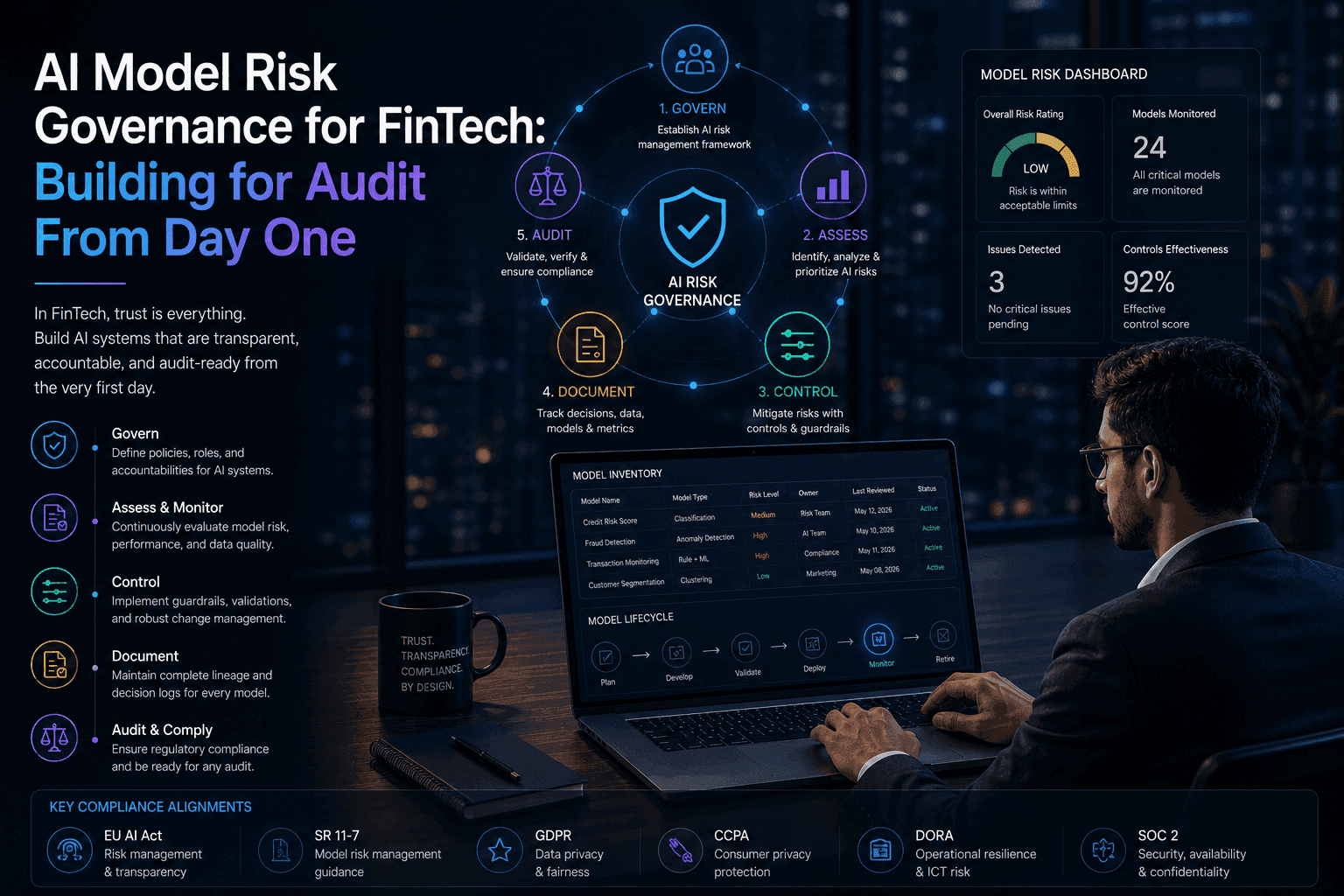
AI Model Risk Governance for FinTech: Building for Audit From Day One
Fintech App Development in 2026: Compliance, Cost, and Architecture for US and Global Markets
