
Outsourcing Software Development: Real Cost by Country in 2026
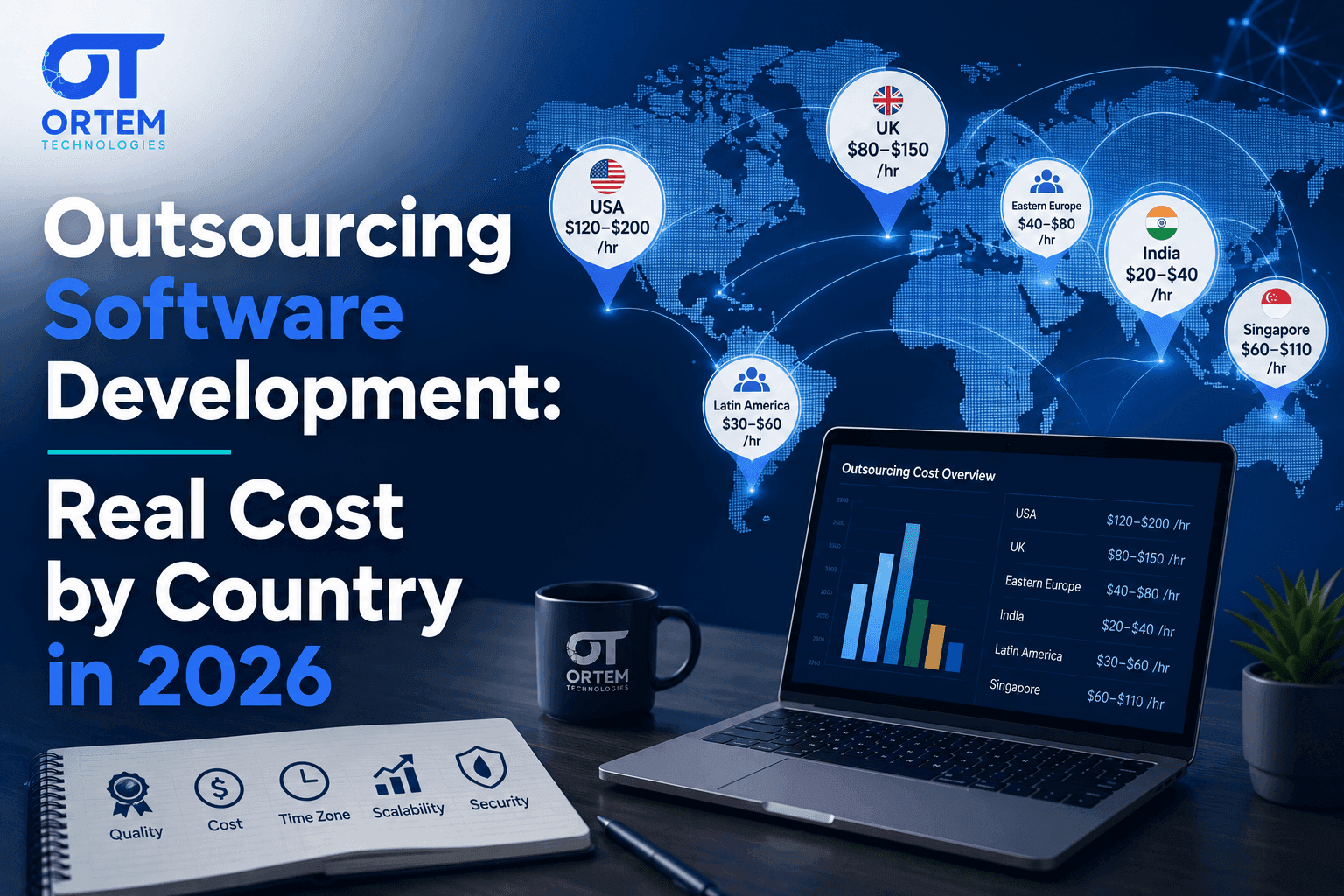
Blended hourly rates for outsourced software development in 2026 run roughly $25-$45/hr in India, $35-$60/hr in Eastern Europe, $30-$55/hr in Latin America, and $120-$200+/hr for equivalent US agency talent. The commonly quoted "40-60% savings" figure is real but only holds when you compare like-for-like scope — a quote that excludes project management, QA, and post-launch support isn't actually 40-60% cheaper, it's incomplete. A properly scoped MVP through an outsourcing partner typically lands between $30,000 and $120,000 depending on complexity, with ongoing dedicated teams running $18,000-$35,000/month.
Software development outsourcing cost is the total price to deliver a scoped product through an external partner, which varies by the engineering region's labor market, the engagement model (project-based, dedicated team, or staff augmentation), and — critically — which roles the quoted rate actually includes. A rate that covers only developer hours and excludes PM, QA, and deployment is not directly comparable to one that bundles the full delivery team.
Commercial Expertise
Need help with Software Development?
Ortem deploys dedicated Custom Software Development squads in 72 hours.
Next Best Reads
Continue your research on Software Development
These links are chosen to move readers from general education into service understanding, proof, and buying-context pages.
Custom Software Development
Build exactly what you need — dashboards, platforms, SaaS, and internal tools with dedicated squads.
Explore software serviceMVP Development
Launch faster with a scoped MVP that proves your concept before full product investment.
See MVP serviceCustom Platform Case Study
Multi-tenant SaaS built with production-grade architecture, compliance, and operational scale.
Read case studyEvery outsourcing pitch leads with "40-60% cost savings," and the figure is directionally real — but it's also the single most gamed number in the industry, because it depends entirely on what gets compared to what. Compare a bundled US agency quote (developer + PM + QA + deployment) against an unbundled offshore developer-only rate, and you'll get a spectacular-looking savings number that evaporates the moment you actually need someone to manage the sprint or test the build.
Here's a real, country-by-country breakdown, and the line items vendors routinely leave off the first quote.
Blended rates by region, 2026
"Blended rate" means the average hourly cost across a mixed-seniority team — a more honest comparison point than headline "starting from $15/hr" numbers that describe junior talent only.
| Region | Blended rate | Typical strengths | Timezone (vs. US East) |
|---|---|---|---|
| India | $25-$45/hr | Broad talent pool, strong at scale, mature outsourcing infrastructure | 9.5-10.5 hrs ahead |
| Eastern Europe (Poland, Ukraine, Romania) | $35-$60/hr | Strong engineering fundamentals, good for EU-facing clients | 5-7 hrs ahead |
| Latin America (Brazil, Argentina, Colombia) | $30-$55/hr | Real-time overlap with US hours, strong for fast iteration | 0-3 hrs difference |
| US agency (fully loaded) | $120-$200+/hr | Native-language nuance, in-person availability | Same |
The pattern that matters more than any single number: the gap between regions is smaller than the gap between "bundled" and "unbundled" quotes within the same region. A developer-only rate from any region will always beat a bundled rate from the same region — that's not a regional advantage, it's an apples-to-oranges comparison.
What "40-60% savings" actually requires to be true
For the savings figure to hold, you need to compare like-for-like scope: same roles included, same QA rigor, same PM overhead, same post-launch support terms. When we quote against a US agency baseline, the comparison only works because our rate includes the full delivery team — PM, developers, QA, and deployment — not just developer hours. If a vendor's quote is silent on any of the four items below, ask before you compare numbers.
The four line items vendors leave off the first quote
1. Project management. Some vendors bundle it; many quote it as a separate 10-20% add-on once you ask, or assume you'll manage sprints yourself. If PM isn't explicitly itemized, ask directly — "is project management included in this rate, or a separate cost?"
2. QA and testing. "QA is part of our development process" is sometimes true and sometimes a euphemism for developers testing their own code. Ask what QA specifically means: dedicated QA engineer hours, automated test coverage targets, or manual regression testing before each release.
3. DevOps and deployment. CI/CD setup, staging environments, and production deployment are sometimes scoped as a separate engagement entirely — a real cost that shows up after you've already committed to the development quote.
4. Post-launch support. Some vendors treat the relationship as over once the build ships, with a new contract required for any bug fixes or iteration. Ask for the bug-fix window and support terms explicitly, in the same document as the build quote.
What a properly scoped project actually costs
Once you account for all four items, a fully scoped MVP — core features, web or mobile, PM and QA included — typically runs $30,000-$120,000 through an outsourcing partner, depending on feature complexity and platform count, versus $150,000-$400,000+ for equivalent scope through a fully-loaded US agency. For ongoing development past the initial build, a dedicated team running $18,000-$35,000/month is usually more cost-effective than restarting project-based quotes for every new feature set — see our breakdown of when a dedicated team beats staff augmentation or project outsourcing.
If you want a rough number before a scoping call, our app cost calculator itemizes cost by feature set so you can see where the budget actually goes.
How to compare vendor quotes honestly
When you're evaluating multiple outsourcing quotes side by side, normalize them against four questions before comparing the headline number: Does this rate include PM? Does it include a named QA function, not just "testing"? Is DevOps/deployment scoped in or separate? What's the post-launch support window? A vendor unwilling to answer all four clearly, in writing, before contract is telling you something about how the rest of the engagement will go.
We've also written detailed comparisons of the outsourcing model against individual-hire marketplaces — see Ortem vs Turing, Ortem vs Andela, and Ortem vs BairesDev — since "cheaper per hour" and "cheaper to actually ship a product" are frequently different numbers.
The bottom line
The savings from outsourcing software development are real, but the 40-60% figure only means something once you've confirmed both quotes cover the same scope. Get every vendor to itemize PM, QA, DevOps, and post-launch support before you compare a single dollar figure — the vendor who itemizes clearly upfront is usually the one who won't surprise you later.
Ready for a scoped, itemized quote? See our outsource software development service or book a free consultation — we respond within one business day with an honest read on scope and cost, PM and QA included in the number, not added after.
About Ortem Technologies
Ortem Technologies is a premier custom software, mobile app, and AI development company. We serve enterprise and startup clients across the USA, UK, Australia, Canada, and the Middle East. Our cross-industry expertise spans fintech, healthcare, and logistics, enabling us to deliver scalable, secure, and innovative digital solutions worldwide.
Get the Ortem Tech Digest
Monthly insights on AI, mobile, and software strategy - straight to your inbox. No spam, ever.
Sources & References
- 1.Outsource Software Development Services - Ortem Technologies
- 2.App Cost Calculator - Ortem Technologies
About the Author
Director – AI Product Strategy, Development, Sales & Business Development, Ortem Technologies
Praveen Jha is the Director of AI Product Strategy, Development, Sales & Business Development at Ortem Technologies. With deep expertise in technology consulting and enterprise sales, he helps businesses identify the right digital transformation strategies - from mobile and AI solutions to cloud-native platforms. He writes about technology adoption, business growth, and building software partnerships that deliver real ROI.
Frequently Asked Questions
- India's blended rates ($25-$45/hr) typically run 20-35% lower than Eastern Europe ($35-$60/hr) for comparable seniority, mainly reflecting cost-of-living differences rather than skill differences. Eastern European teams often have a timezone advantage for European clients and marginally stronger English-language parity for some client-facing roles, which is why the rate gap persists despite talent quality being broadly comparable at the senior level in both regions.
- For US clients, often yes — the real-time overlap (2-4 hour difference vs. 9.5-13 hours for India) means daily standups and same-day iteration are practical without either side working unusual hours. Latin American blended rates ($30-$55/hr) sit between India and Eastern Europe, and the timezone value frequently justifies the premium for projects needing tight, fast-turnaround collaboration.
- The single biggest variable is what's bundled into the rate. A quote covering only developer hours will always look cheaper than one bundling PM, QA, DevOps, and deployment — but the second quote is the one that reflects your total cost to actually ship. Always ask each vendor to itemize: is PM included? Is QA a separate line item or a percentage add-on? Is post-launch support and bug-fix window included or billed separately?
- A properly scoped MVP with core features, covering web or mobile, typically runs $30,000-$120,000 through an outsourcing partner depending on feature complexity and platform count, versus $150,000-$400,000+ for equivalent scope through a US-based agency at fully-loaded rates. Ongoing dedicated teams for continued development run $18,000-$35,000/month.
- The four most common: (1) project management, often billed as a separate percentage rather than included; (2) QA and testing, sometimes assumed to be "part of development" but actually thin or absent; (3) DevOps and deployment setup, frequently scoped as a distinct engagement; (4) post-launch support and bug-fix windows, which some vendors treat as a new contract once the initial build ships. Ask for all four explicitly before comparing quotes.
Stay Ahead
Get engineering insights in your inbox
Practical guides on software development, AI, and cloud. No fluff — published when it's worth your time.
Ready to Start Your Project?
Let Ortem Technologies help you build innovative software solutions for your business.
You Might Also Like
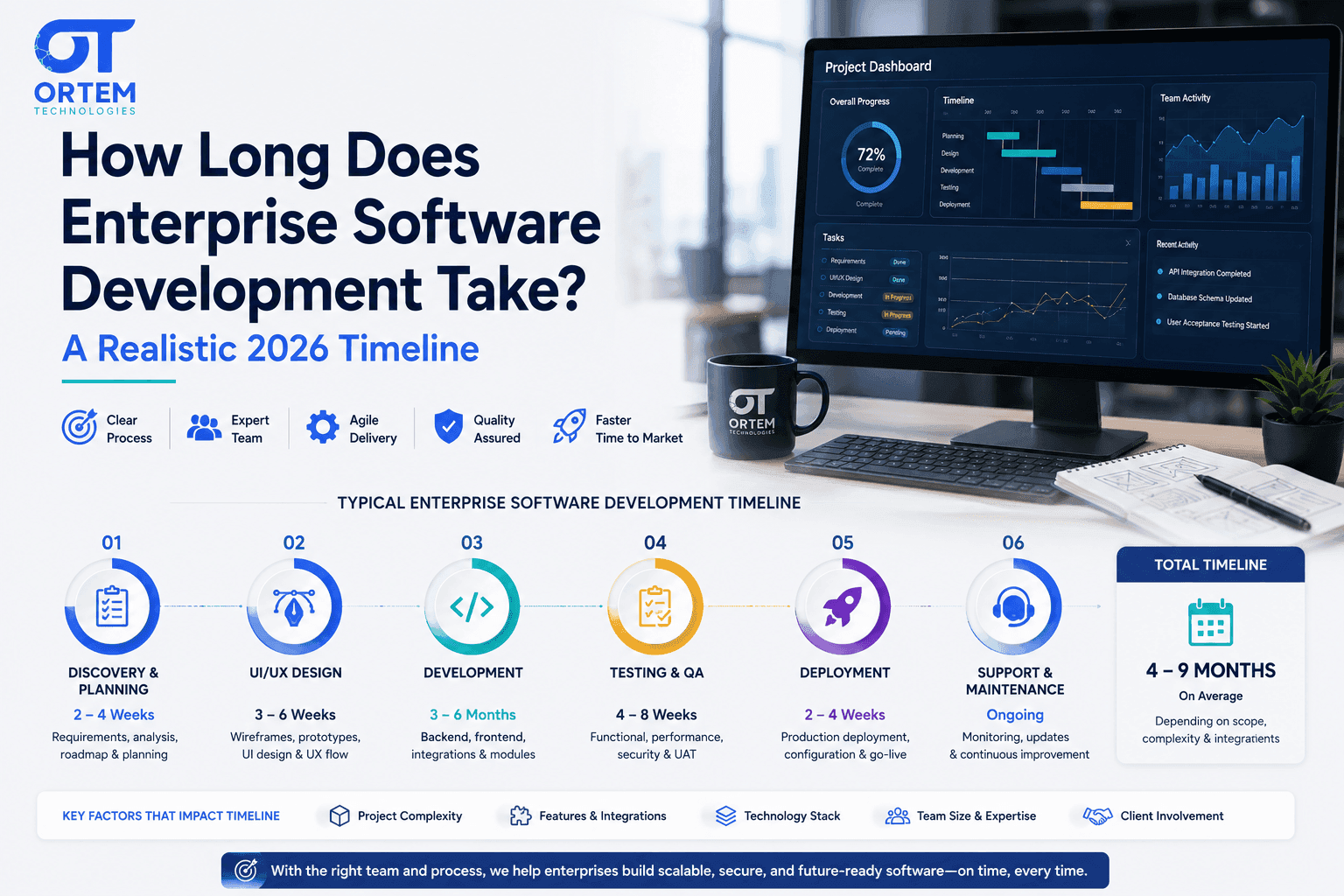
How Long Does Enterprise Software Development Take? A Realistic 2026 Timeline
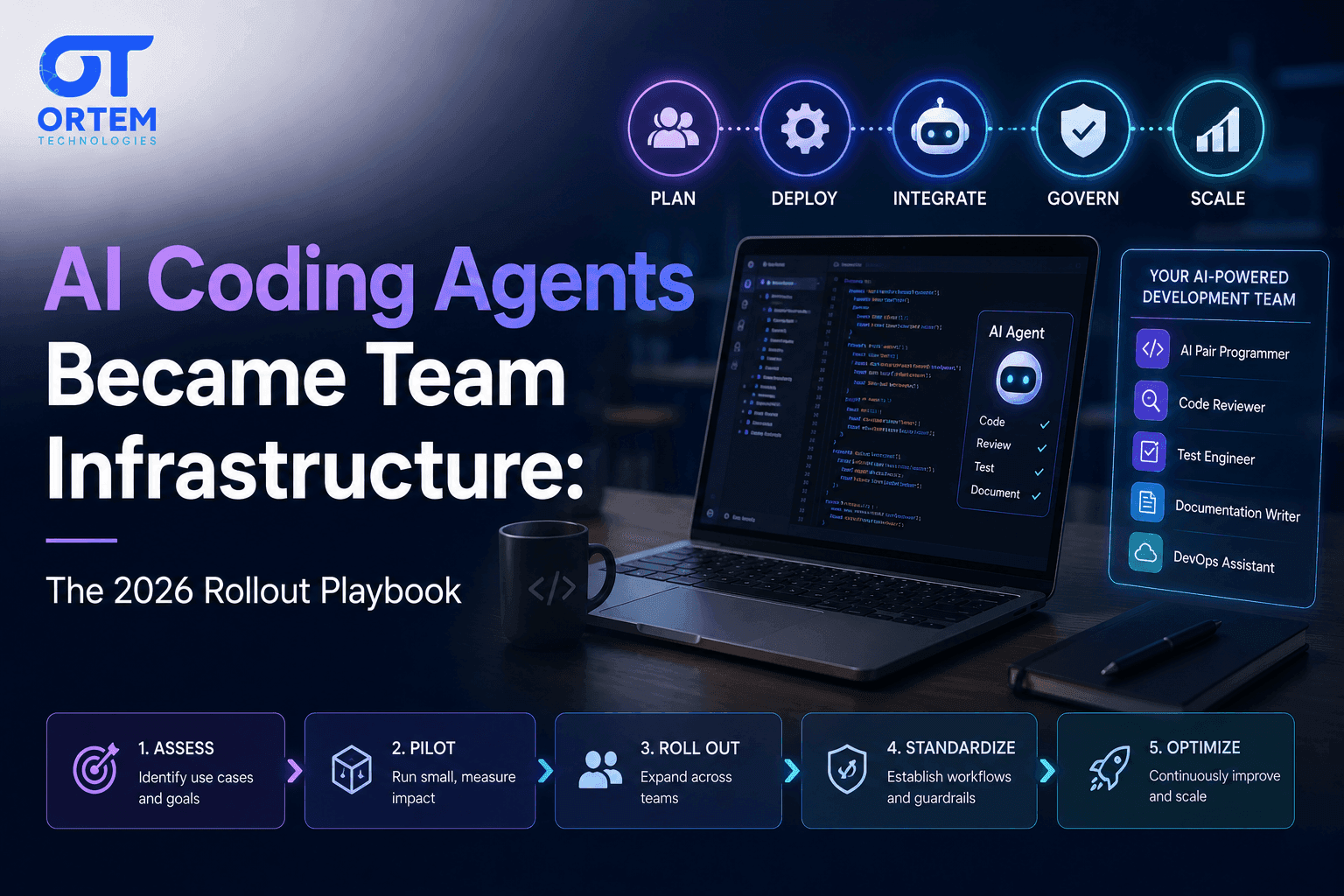
AI Coding Agents Became Team Infrastructure: The 2026 Rollout Playbook
