
White-Label AI Solutions for Agencies: How to Sell AI Without Building a Team
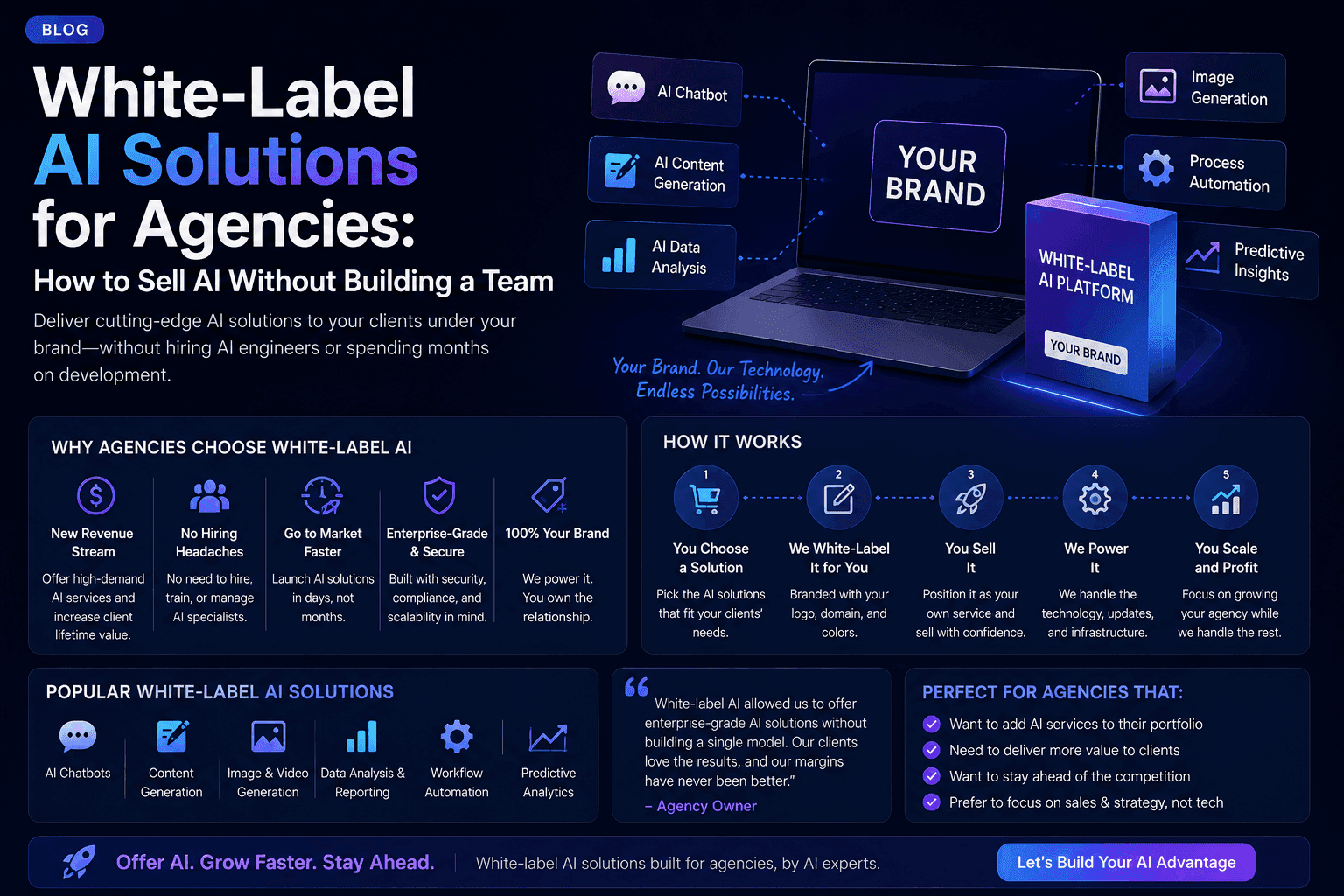
White-label AI solutions let agencies sell AI development — chatbots, support agents, document automation, custom AI apps — under their own brand while a partner engineering team delivers the work. Typical agency margins run 30-50% on project fees plus recurring margin on maintenance. The model works when the partner is production-grade: evaluation discipline, security practices, and white-label deliverables including documentation. Ortem Technologies LLC runs a white-label AI and app development program built for agencies.
White-label AI development is a partnership where a specialized engineering firm builds AI products that an agency sells and delivers under its own brand. The client relationship, pricing, and account management stay with the agency; architecture, engineering, and maintenance sit with the partner.
Commercial Expertise
Need help with Business Strategy?
Ortem deploys dedicated Custom Software Development squads in 72 hours.
Next Best Reads
Continue your research on Business Strategy
These links are chosen to move readers from general education into service understanding, proof, and buying-context pages.
Custom Software Planning
Convert strategy reading into a delivery brief for architecture, scope, timeline, and commercial fit.
Plan your buildOrtem Delivery Model
See how Ortem structures communication, IP ownership, oversight, and execution for global clients.
Review delivery modelUS Market Delivery Page
Helpful if your buying journey is US-led and you want to understand timezone, compliance, and engagement fit.
View US delivery pageThe most common conversation in agency Slack channels this year: a retainer client asks "can you build us an AI chatbot?", the agency says "let me check," and three weeks later the client found someone else — who is now also quoting on the website rebuild. AI competence has become an account-defense requirement for agencies, and white-labeling is the fastest way to acquire it.
White-label AI economics at a glance
| Layer | Typical range | Who books the revenue |
|---|---|---|
| Build fee (wholesale to retail) | 30-50% agency markup | Agency, one-time per project |
| Maintenance retainer | 20-30% agency margin | Agency, recurring monthly |
| Example: $40,000 wholesale chatbot | Retails $55,000-65,000 | Agency margin: $15,000-25,000 |
Why 2026 is the white-label AI moment
Client demand for AI outstrips agency delivery capacity by a wide margin. Hiring an in-house AI team costs $400,000+ per year before the first sale, and the talent market is brutal. Meanwhile the projects clients want — support chatbots, voice agents, document automation, AI features in existing apps — are well-understood builds for a team that ships them weekly. That asymmetry is the entire white-label case: rent a production AI team, keep the client, keep the margin.
What the model looks like in practice
You sell, we build. The agency scopes with its client at retail rates; the partner delivers at wholesale. Typical agency margin: 30-50% on build fees, 20-30% on recurring maintenance and inference management.
Everything ships unbranded. Code repositories, documentation, staging links, status reports — clean of partner branding. On calls, partner engineers can join under your domain when needed.
The recurring layer is the prize. Every AI system needs ongoing evaluation, model updates, and cost management. That maintenance retainer is recurring revenue the agency books monthly, delivered by the partner. Our LLMOps and maintenance guide explains what that work involves.
The service menu that sells
From our own white-label program, the four offers agencies close most:
- Grounded support chatbot — client documentation in, deflection rate out. Retail $50,000-70,000.
- Voice agent for intake and booking — clinics, home services, restaurants. See the voice AI implementation guide.
- Document intelligence pipeline — invoices, contracts, claims into structured data.
- AI feature retrofit — semantic search, summarization, or a copilot inside the client app the agency already maintains. This one defends the account directly.
Choosing the partner: the six-point checklist
Shipped production references you can actually call. Evaluation discipline — golden test sets, regression checks run before every release, not just at launch. Per-client data isolation with contractual no-training guarantees, so one client's data never influences another client's system. Unbranded deliverables as standard practice, not a favor you have to negotiate. US-registered entity for enforceable IP assignment and NDAs. And transparent wholesale pricing so your margin math is stable from quote to invoice, without surprise change orders eating your markup.
What a first white-label engagement typically looks like
The agency brings a client conversation and a rough budget range. The partner runs a scoped discovery call — usually free, unbranded, and framed as the agency's own process to the client — that turns the conversation into an itemized wholesale quote.
The agency marks it up, presents it as their own proposal, and the partner delivers on the agreed timeline with status updates the agency can forward or relay verbatim.
First projects typically run four to twelve weeks depending on scope, and successful partnerships almost always lead to a second and third project within the same client relationship, because the agency now has proof it can deliver AI without visible risk.
Why the maintenance retainer matters more than the build fee
The build fee is a one-time win; the maintenance retainer is the business. Every AI system needs ongoing evaluation, model version migrations, and cost management — recurring work that a client will pay for monthly once the initial build proves its value. Agencies that treat white-label AI as a project business capture the build margin and move on.
Agencies that treat it as a recurring-revenue business layer the retainer on top of every build and compound their margin quarter over quarter. Our LLMOps and maintenance guide explains what that ongoing work actually involves, so you can price the retainer accurately rather than guessing.
Ortem Technologies runs a dedicated white-label app and AI development program — US LLC, delivery team of 50+ engineers, and production AI systems like our enterprise RAG assistant behind it. If your agency needs to scope and price client work faster, Azimuth, our own AI project-estimation platform, is built for exactly that. If your clients are asking for AI and your bench cannot answer, talk to us about the partner program. First scoping call is free and unbranded, obviously.
For the full menu of AI service categories agencies can white-label, see our complete guide to AI development services.
Further reading: White-Label Software to Resell in 2026
About Ortem Technologies
Ortem Technologies is a premier custom software, mobile app, and AI development company. We serve enterprise and startup clients across the USA, UK, Australia, Canada, and the Middle East. Our cross-industry expertise spans fintech, healthcare, and logistics, enabling us to deliver scalable, secure, and innovative digital solutions worldwide.
Get the Ortem Tech Digest
Monthly insights on AI, mobile, and software strategy - straight to your inbox. No spam, ever.
Sources & References
- 1.White-Label App Development - Ortem Technologies
- 2.Enterprise RAG Knowledge Assistant (Case Study) - Ortem Technologies
About the Author
Private 1:1 AI Tutor · Director of Sales & Business Development, Moksh Tech
Praveen Jha is a private 1:1 AI tutor and enterprise AI sales leader based in Ahmedabad, India. He teaches executives, founders and engineers to ship real work with ChatGPT, Claude, Cursor and Claude Code, and is an Oracle Certified Generative AI Professional and AWS Certified Solutions Architect. He wrote his articles here while Director of AI Product Strategy, Sales & Business Development at Ortem Technologies.
Frequently Asked Questions
- The agency owns the client relationship and sells AI work at its own rates. The white-label partner scopes, builds, and maintains the systems, delivering everything unbranded — code, documentation, staging environments — so the agency presents it as in-house work. Communication runs through the agency or through the partner under the agency domain.
- Typical structure: the partner quotes wholesale, the agency marks up 30-50% on build fees. A $40,000 wholesale AI chatbot build retails at $55,000-65,000. Ongoing maintenance and inference management add recurring margin — often 20-30% monthly — which is where the durable profit sits.
- The high-demand set in 2026: customer support chatbots grounded in client documentation, voice agents for booking and intake, document processing pipelines, AI features inside existing web and mobile apps, and internal copilots. All are provable, scoped deliverables — not open-ended research.
- Ask for shipped production systems with references, their evaluation and monitoring practices, security posture (data isolation per client, no training on client data), and true white-label operations — unbranded deliverables and communication under your domain. A US-registered partner adds enforceable NDAs and IP assignment.
- No, but someone on the agency side needs to translate client business problems into scoping questions the partner can quote against — data availability, integration targets, success metrics. Agencies that succeed longest with white-label AI usually designate one account lead per client to own this translation layer, rather than routing every client directly to the partner.
- Support routes through the agency first-line — most client questions are usage or expectation questions a trained account manager can answer without engineering. Genuine bugs or model degradation route to the partner under an SLA defined in the maintenance retainer, typically 24-48 hour response for non-critical issues and same-day for anything customer-facing and broken.
- Yes, with a partner that has shipped in those verticals before — compliance requirements (HIPAA, data residency, audit logging) need to be designed into the architecture from day one, not retrofitted. Ask any prospective partner directly for a regulated-industry reference before selling into that vertical.
Stay Ahead
Get engineering insights in your inbox
Practical guides on software development, AI, and cloud. No fluff — published when it's worth your time.
Ready to Start Your Project?
Let Ortem Technologies help you build innovative software solutions for your business.
You Might Also Like
How to Write an AI Project RFP in 2026: Template and Red-Flag Detector

Software Development Company in London: What to Look for in 2026
