Hire AI Developers in 2026: Rates, Vetting, and Engagement Models That Work
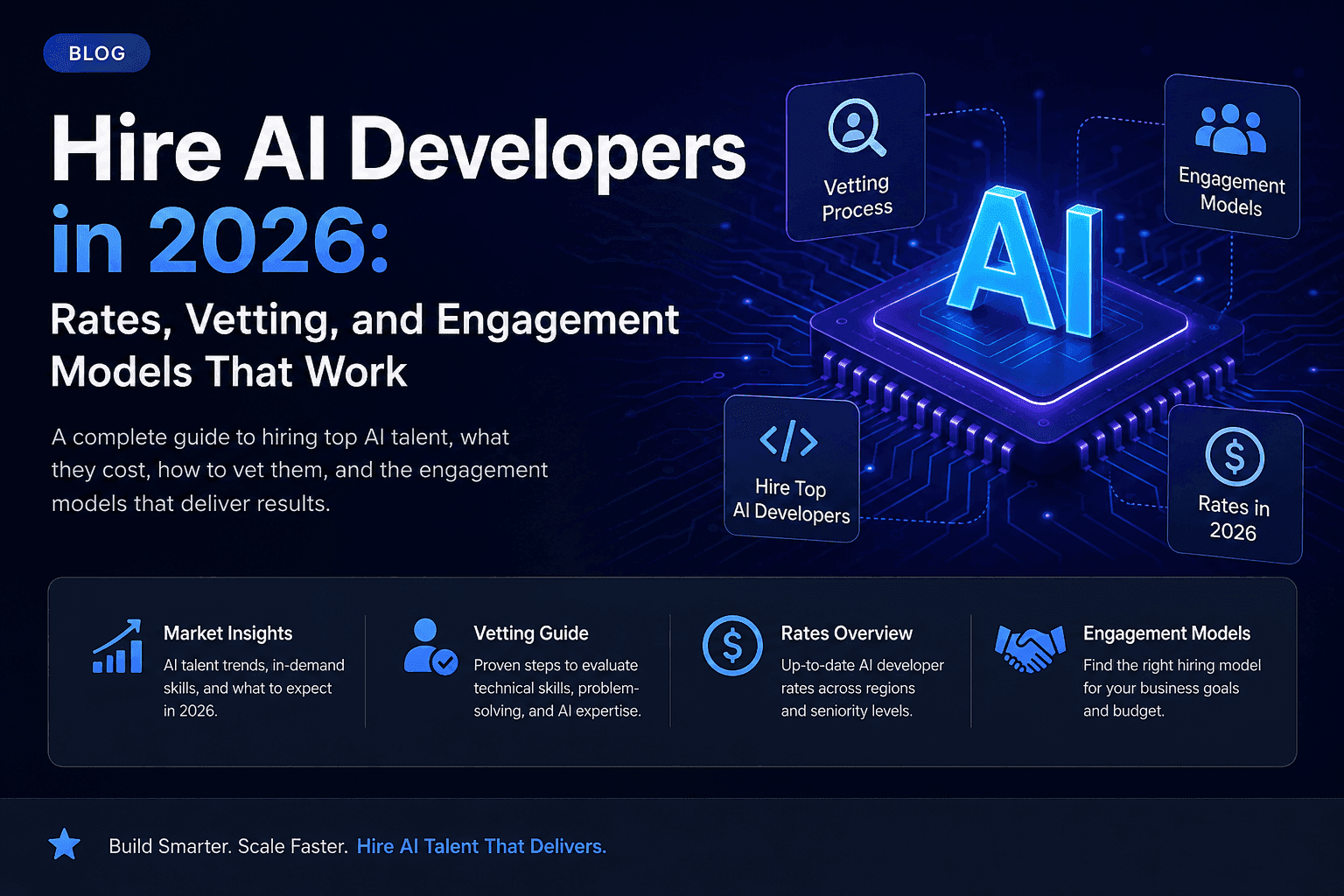
Hiring AI developers in 2026 costs $25-60/hour through vetted offshore teams, $80-150/hour for US-based contractors, and $180,000-320,000 per year for senior in-house hires. For most companies building their first AI product, a dedicated offshore team with a US-registered partner is the fastest path: senior engineers start within two weeks at roughly one-third the cost of domestic hiring, with IP protection under a US contract. Ortem Technologies LLC provides vetted AI engineering teams under exactly this model.
Hiring AI developers means bringing on engineers who can ship production AI systems — LLM applications, RAG pipelines, agent workflows, and custom models — not just call an API from a notebook. The market in 2026 splits into three tiers: in-house hires, US contractors, and dedicated offshore teams, with a 3-5x cost spread between them for comparable output.
Next Best Reads
Continue your research on AI Engineering
These links are chosen to move readers from general education into service understanding, proof, and buying-context pages.
AI & ML Solutions
Move from architecture reading into real model deployment, MLOps, and production AI pipelines.
Explore AI servicesLLM Integration
Integrate large language models into your product — RAG, fine-tuning, copilots, and APIs.
Explore LLM serviceAI Platform Case Study
See a production AI system with real data architecture, model integration, and launch outcomes.
Read case studyEvery company is now an AI company on its careers page, and every developer is an AI developer on LinkedIn. That combination makes hiring genuinely hard: demand for engineers who have shipped production AI far exceeds supply, and the resume signal is drowned in noise. This guide gives you the 2026 market rates, the three engagement models, the vetting process we use ourselves, and the mistakes that turn a promising hire into a stalled project.
Quick reference: 2026 AI developer rates by engagement type
| Engagement type | Typical cost | Start time | Best for |
|---|---|---|---|
| In-house senior hire (US) | $180,000-320,000/year | 3-4 months | AI as core product, multi-year build |
| US-based contractor | $80-150/hour | 1-3 weeks | Short bursts, tight oversight |
| Dedicated offshore team | $25-60/hour | 1-2 weeks | First AI product, ongoing roadmap |
| Freelance marketplace | $20-80/hour | Days | Small, well-defined tasks only |
A three-person AI pod — senior AI engineer, ML engineer, backend developer — runs roughly $18,000-30,000 per month through a vetted offshore team, versus $70,000-100,000 per month for the equivalent US-contractor bench, and $45,000-80,000 per month in loaded in-house salary. The spread is real, and it compounds: a six-month first build costs $110,000-180,000 offshore versus $420,000-600,000 in-house before the product has proven itself.
The 2026 market: three tiers, one big spread
In-house hires. Senior AI engineers in the US command $180,000-320,000 base, and the interview-to-start timeline averages three to four months given how few candidates have genuine production experience. Worth it when AI is the product and you are building a durable team that will still be shipping in three years. Overkill for a first AI feature or a single proof of concept.
US contractors. $80-150 per hour for genuinely senior people. Fast to start, expensive to keep for more than a quarter, and quality varies wildly — the best independent contractors are excellent, but the title "AI consultant" has no floor in a market this hot. Reference checks matter more here than anywhere else in the hiring funnel.
Dedicated offshore teams. $25-60 per hour for senior engineers through an established firm, with the team typically embedded as a pod rather than individual freelancers. The catch is variance: the gap between a disciplined engineering team and a body shop reselling junior labor is enormous, and it is invisible from a resume or a rate card.
The fix is choosing a partner with verifiable shipped systems, named references, and US-enforceable contracts — see our full breakdown of US-registered offshore development for the legal and quality-control mechanics.
Freelance marketplaces. Cheapest on paper, riskiest in practice for anything beyond a narrowly scoped task. No shared accountability across a team, no bench to cover illness or attrition, and evaluation discipline is almost always absent unless you specify it explicitly in the contract.
The three engagement models, compared
Staff augmentation puts their engineers under your management and your architecture decisions. Best when you already have technical leadership in-house and simply need more hands — the partner is a capacity lever, not a decision-maker.
Weakest when nobody on your side can review AI-specific architecture choices like retrieval design or evaluation methodology; augmented engineers will build what they are told, including bad ideas. Our staff augmentation service covers this model end to end, including how we screen for the specific skills a given engagement needs.
Dedicated team is a stable pod — typically a senior AI engineer, a backend engineer, and a part-time architect — that owns a roadmap rather than a ticket queue. This is the best balance of cost, speed, and accountability for most companies shipping their first AI product, because the team carries context forward from sprint to sprint instead of re-learning your system every engagement.
Project-based engagement means fixed scope, fixed price, fixed timeline. Right for well-defined builds where requirements are already clear — a support agent with known integrations, a document pipeline against a known document set. Wrong for exploratory work where scope is likely to move, because fixed-price contracts create incentive to resist the change your product actually needs.
Seven vetting questions that expose weak candidates
- "How did you evaluate the last AI system you shipped?" — the single strongest filter in this list. Listen for test sets, accuracy thresholds, and regression checks run before every release. Engineers who have run production AI answer with specifics; everyone else describes the demo.
- "What did it cost to run in production, and how did you reduce it?" — production people talk token budgets, caching, and model routing without prompting. See our guide to LLM cost optimization for the vocabulary a real practitioner uses.
- "When did you choose NOT to use an LLM?" — mature engineers have a specific story about a problem where a simpler, deterministic solution won. Enthusiasts do not, because to them every problem looks like a prompt.
- "Walk me through a RAG pipeline you built — what broke?" — chunking strategy, retrieval quality tuning, and embedding staleness are the tells that separate someone who has operated a retrieval system from someone who has only read about one.
- "How do you handle hallucinations in a customer-facing system?" — grounding, citations, output guardrails, and human escalation paths, in that order. A candidate who answers "better prompting" alone has not shipped anything customer-facing.
- "What is in your monitoring dashboard?" — latency, cost per request, and accuracy drift, not just uptime. Uptime monitoring is standard software practice; the other three are AI-specific and reveal whether someone has actually operated a system after launch.
- "Show me something in production." — a live URL beats a GitHub repo, a repo beats a slide deck, and a slide deck beats nothing. This single request eliminates more weak candidates than the other six combined.
Red flags that outweigh a strong resume
A resume listing every major LLM framework but no shipped production system. Case studies described entirely in terms of technology used rather than business outcome achieved. An inability to name what broke in a past project — everyone who has shipped production AI has a war story, and its absence is itself a signal.
And rates dramatically below the offshore band above: sub-$15/hour AI engineering almost always means either misrepresented seniority or an unsustainable business model that will surface as turnover mid-project.
What a real engagement looks like
When a client engages Ortem Technologies for AI development, week one is discovery against a business metric — hours saved, tickets deflected, conversion lifted. Weeks two through four ship a thin end-to-end slice into a staging environment: real data, real integration, measured accuracy against the metric set in week one.
From there the working rhythm is two-week increments with the metric reviewed every cycle, adjusting scope based on what the data shows rather than what the original plan assumed. That is the cadence that produced systems like our enterprise RAG knowledge assistant and voice AI support agent — both scoped, evaluated, and shipped inside a single quarter.
The bottom line
Hire in-house if AI is your moat and you can wait a quarter to start building a team that will still be there in three years.
Otherwise, a dedicated team from a US-registered partner gets senior AI engineers working on your product within one to two weeks at roughly a third of domestic cost, with the vetting discipline above already applied on your behalf — the same discipline we built into Skill Gauge for teams that want to run it themselves.
Talk to us about scoping your first sprint — the first conversation is free and will tell you within thirty minutes whether the fit is right.
For the full picture of what an AI engagement covers beyond hiring — strategy, model work, integration, and ops — see our complete guide to AI development services.
About Ortem Technologies
Ortem Technologies is a premier custom software, mobile app, and AI development company. We serve enterprise and startup clients across the USA, UK, Australia, Canada, and the Middle East. Our cross-industry expertise spans fintech, healthcare, and logistics, enabling us to deliver scalable, secure, and innovative digital solutions worldwide.
Get the Ortem Tech Digest
Monthly insights on AI, mobile, and software strategy - straight to your inbox. No spam, ever.
Sources & References
- 1.Staff Augmentation Services - Ortem Technologies
- 2.AI & ML Solutions - Ortem Technologies
About the Author
Private 1:1 AI Tutor · Director of Sales & Business Development, Moksh Tech
Praveen Jha is a private 1:1 AI tutor and enterprise AI sales leader based in Ahmedabad, India. He teaches executives, founders and engineers to ship real work with ChatGPT, Claude, Cursor and Claude Code, and is an Oracle Certified Generative AI Professional and AWS Certified Solutions Architect. He wrote his articles here while Director of AI Product Strategy, Sales & Business Development at Ortem Technologies.
Frequently Asked Questions
- Senior AI engineers cost $180,000-320,000 per year in-house in the US, $80-150 per hour as US contractors, or $25-60 per hour through vetted offshore teams. A three-person AI pod (senior engineer, ML engineer, backend developer) runs roughly $18,000-30,000 per month offshore versus $70,000-100,000 per month with US contractors.
- Hire in-house when AI is your core product and you are funded for a multi-year effort. Use a partner when you need to ship an AI product or feature in the next one to two quarters — a partner team arrives with established evaluation practices, infrastructure templates, and prior production experience, which typically saves two to three months of setup.
- Beyond Python and one major framework, look for production LLM experience: RAG pipeline design, prompt evaluation harnesses, vector database selection, agent orchestration, cost optimization, and observability. The differentiator is evaluation discipline — knowing how to measure whether the system is actually working after launch, not just in the demo.
- Contract with a US-registered entity, not individual freelancers. A US LLC is bound by US contract law, enforceable NDAs, and clean IP assignment. Ortem Technologies LLC is US-registered with delivery teams in India, which gives clients US legal protection at offshore rates.
- A vetted dedicated team through an established partner typically starts within one to two weeks of contract signature — the partner has already screened and benched candidates. In-house hiring through a full interview loop averages three to four months from job posting to start date, longer for senior roles in a market where demand outstrips supply.
- In practice the titles overlap heavily in 2026. "AI developer" more often signals application-layer work — LLM integration, RAG pipelines, agent orchestration, prompt engineering. "ML engineer" more often signals model training, fine-tuning, and MLOps. Most production AI teams need both skill sets; a strong generalist AI engineer can usually cover 80% of a first project alone.
- A single strong AI engineer can ship a scoped feature — a grounded chatbot, a document extraction pipeline — in four to eight weeks. Anything touching multiple business systems, requiring an evaluation harness, or needing ongoing operation benefits from at least a three-person pod: one engineer alone becomes a single point of failure for both delivery speed and production support.
Stay Ahead
Get engineering insights in your inbox
Practical guides on software development, AI, and cloud. No fluff — published when it's worth your time.
Ready to Start Your Project?
Let Ortem Technologies help you build innovative software solutions for your business.
You Might Also Like
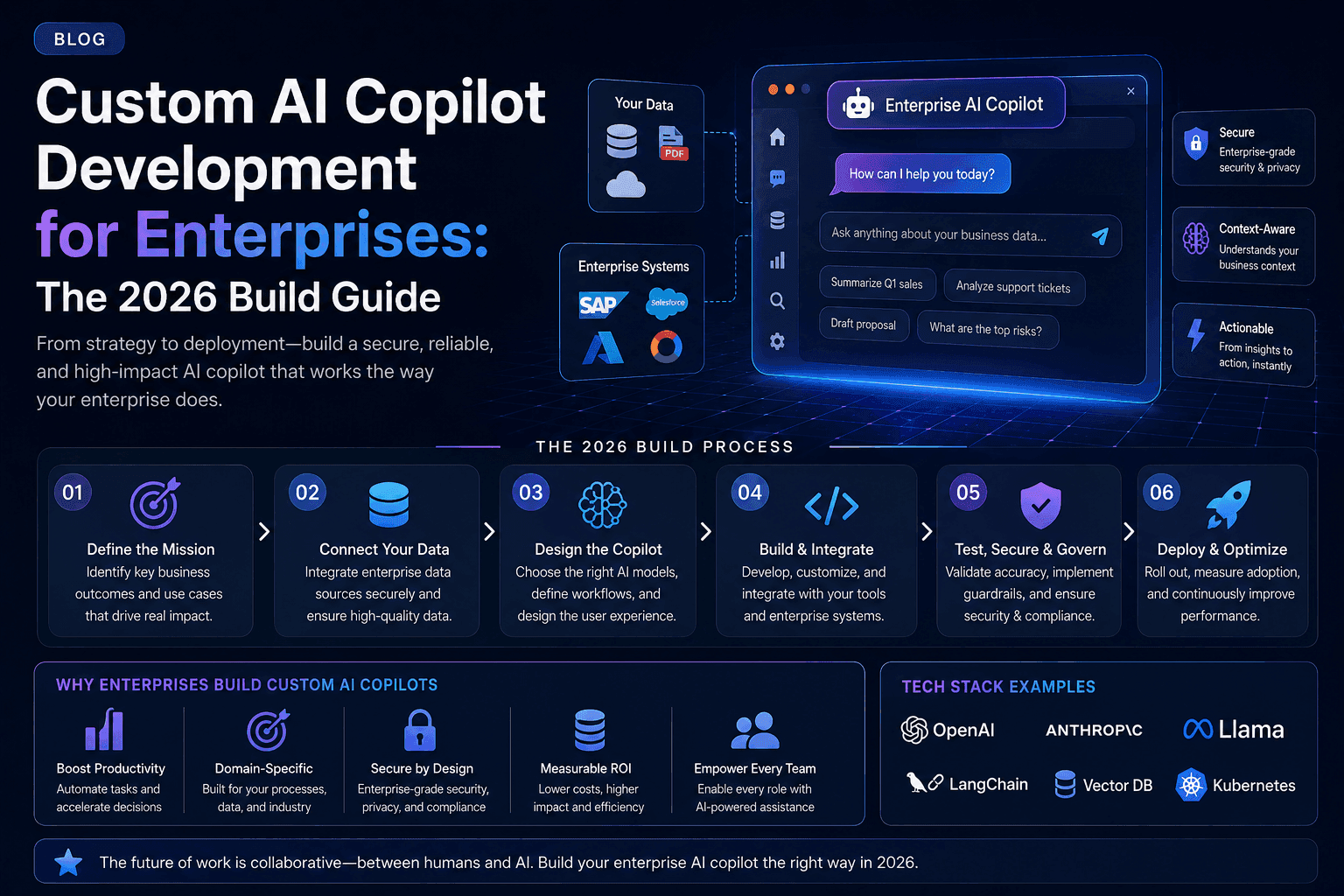
Custom AI Copilot Development for Enterprises: The 2026 Build Guide
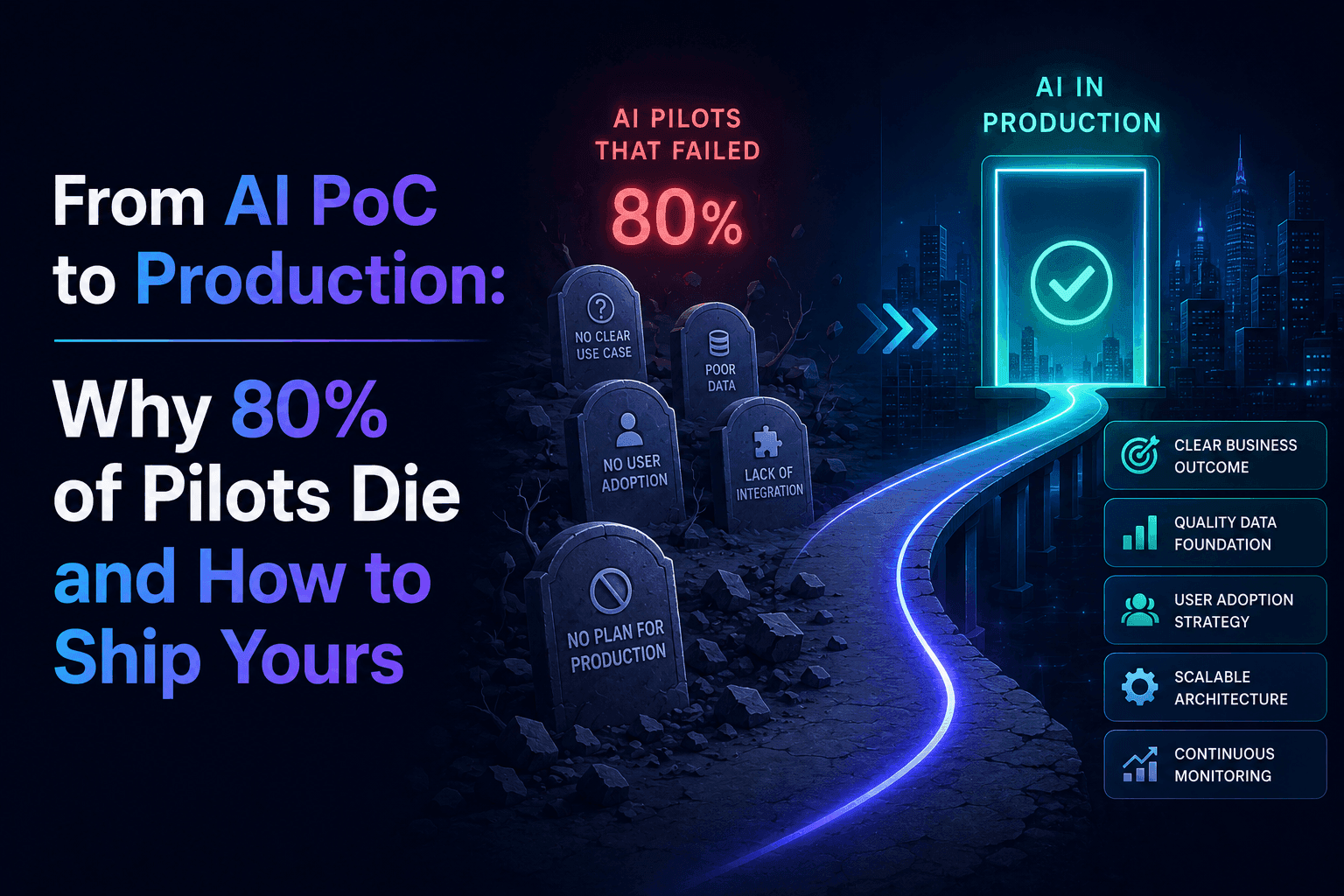
From AI PoC to Production: Why 80% of Pilots Die and How to Ship Yours