AI Agent Development Services in 2026: What Agents Can Do, What They Cost, and How to Build One

AI agent development in 2026 costs: simple single-task agents (customer FAQ handling, document summarization) $15,000–$40,000; multi-step workflow agents (research + draft + review + send) $40,000–$120,000; enterprise multi-agent systems with tool integration and human-in-the-loop controls $100,000–$300,000+. The gap between a demo and a production agent is reliability engineering — handling edge cases, implementing fallback logic, adding human escalation paths, and monitoring agent behavior in production.
Commercial Expertise
Need help with AI & Machine Learning?
Ortem deploys dedicated AI & ML Engineering squads in 72 hours.
Next Best Reads
Continue your research on AI & Machine Learning
These links are chosen to move readers from general education into service understanding, proof, and buying-context pages.
AI & ML Solutions
Move from concept articles to real implementation planning for copilots, RAG, automation, and analytics.
Explore AI servicesAI Agent Development
See how Ortem builds autonomous workflows, tool-using agents, and human-in-the-loop systems.
View agent serviceAI Product Case Study
Study a production AI platform with architecture, launch scope, and operating model context.
Read case studyAI agents moved from demo territory to production deployment in 2024–2025. In 2026, enterprise teams run agents for customer service, sales research, document processing, code review, and operational workflows. The question for most businesses is not whether agents can handle their use case — but what production deployment actually requires and costs.
What Production AI Agents Actually Do
Customer service and support agents: Handle tier-1 customer inquiries end-to-end. Look up account information, process simple requests, answer product questions from a knowledge base, escalate to humans when confidence is low or the request exceeds agent scope. Deployed at scale: these agents handle 40–60% of incoming support volume without human involvement.
Document processing agents: Read incoming documents (contracts, invoices, applications, reports), extract structured data, classify documents, trigger downstream workflows, and flag exceptions for human review. Process thousands of documents per day with accuracy exceeding 97% on clean inputs.
Sales research and outreach agents: Given a target company or list, research the organization (funding, technology stack, recent news, job postings), identify relevant pain points, draft personalized outreach, and schedule follow-up. Compress 2–3 hours of manual SDR research into 5 minutes of agent execution.
Operational workflow agents: Execute multi-step internal processes — generating reports from multiple data sources, monitoring systems and alerting, processing approval workflows, coordinating cross-system data updates. These replace the "I'll check five different dashboards and compile a summary" workflows that take humans 30–60 minutes.
Code assistance agents: Review pull requests, summarize changes, identify potential issues, generate documentation, answer codebase questions. Engineering teams with code agents report 20–30% reduction in PR review time.
The Gap Between Demo and Production
Every AI agent demo looks impressive. Production deployment is harder — here is where projects fail:
Edge case handling. LLMs produce unexpected outputs. A production agent needs deterministic fallback logic for every failure mode: what happens when the LLM returns malformed JSON? When the API tool call fails? When the user's request is ambiguous? When the agent's confidence is low? Demos skip this. Production code handles all of it.
Tool reliability. Agents call external tools — APIs, databases, search systems. Each tool can fail. Production agents implement retry logic, circuit breakers, graceful degradation, and human escalation when tool failures block task completion.
Cost management. LLM API costs scale with usage. An agent that runs 10,000 tasks/day at $0.05/task costs $500/day — $182,500/year. Production agents implement token budgets, caching of tool results, and model tiering (use cheaper models for simple subtasks, expensive models for complex reasoning).
Monitoring and observability. You need to know when agents are failing, making wrong decisions, or drifting in behavior over time. Production agents log every action, decision, and outcome. Agent behavior is monitored for anomalies and reviewed periodically.
Human-in-the-loop design. Identify which decisions require human approval. High-value transactions, customer-facing communications above a certain sensitivity threshold, actions that are difficult to reverse. Design escalation paths into the agent architecture from the beginning.
AI Agent Tech Stack (2026)
LLM layer: GPT-4o (OpenAI), Claude 3.7 Sonnet (Anthropic), or Gemini 2.5 Pro (Google) depending on task requirements. Most production agents use multiple models — strong reasoning model for complex decisions, faster/cheaper model for simple tasks.
Orchestration: LangGraph for complex stateful workflows, OpenAI Assistants API for simpler tool-using agents. Custom orchestration for agents requiring maximum control.
Memory: Short-term (conversation context), long-term (user/entity facts stored in vector database), episodic (past interaction summaries). Pinecone, Weaviate, or pgvector for vector storage.
Tool integrations: REST API calls to your systems, database queries, web search (Tavily, Brave), code execution, file processing. Each tool is a TypeScript/Python function with defined input/output schema.
Monitoring: LangSmith for LangChain agents, custom logging pipelines for others. Arize AI for production LLM observability.
Development Cost by Agent Type
| Agent type | Complexity | Cost range | Timeline |
|---|---|---|---|
| Single-task RAG agent (Q&A over documents) | Low | $15,000–$30,000 | 4–6 weeks |
| Customer service agent (multi-turn, tool use) | Medium | $40,000–$80,000 | 8–14 weeks |
| Multi-step workflow agent (research → draft → send) | Medium-High | $60,000–$120,000 | 10–18 weeks |
| Enterprise multi-agent system | High | $100,000–$300,000+ | 3–6 months |
Ortem Technologies has built production AI agents for enterprise clients across sales automation, document processing, and operational workflows. We build on LangGraph and direct Anthropic/OpenAI APIs depending on requirements, with full production hardening: monitoring, fallback logic, cost controls, and human escalation paths.
Discuss your AI agent project → | AI and ML development services → | Enterprise AI ROI guide →
What Makes an AI Agent Different from an AI Integration
The meaningful technical distinction is this: an AI integration calls an LLM to transform one input into one output (summarize this document, classify this ticket, generate this email). An AI agent calls an LLM that can decide which tools to use, in what sequence, and iterate on the result until the goal is achieved.
The architectural difference has significant practical consequences. An AI integration is deterministic — given the same input, it produces essentially the same output through the same steps. An AI agent is non-deterministic — the LLM decides the path, and different prompts or tool results may lead to different execution sequences.
When to use an AI integration (not an agent):
- The task is well-defined with a clear input to output structure
- The steps are always the same regardless of input variation
- Latency requirements are tight (under 2 seconds)
- The cost of the task is low enough that agent-level orchestration overhead is not justified
When to use an AI agent:
- The task requires multiple sequential steps where earlier steps determine later ones
- The task involves external data retrieval (web search, database queries, API calls) based on intermediate findings
- The goal is defined but the path to achieve it varies based on the specific inputs
- The task benefits from self-correction: checking its own output and revising if the result does not meet criteria
Five Production AI Agent Patterns That Work in 2026
Pattern 1: Research and Synthesis Agent Goal: Given a research question, retrieve relevant information from multiple sources and produce a structured synthesis. Tools: Web search, document retrieval, vector store queries, citation formatter. Architecture: Plan to search to retrieve to synthesize to validate citations to output. Typical use: Market research, competitive intelligence, due diligence support, literature review.
Pattern 2: Data Analysis and Reporting Agent Goal: Given a business question, query data sources, perform analysis, generate visualizations, and produce a report. Tools: SQL execution, Python code interpreter, charting library, report formatter. Typical use: Automated analytics reports, anomaly investigation, KPI explanation.
Pattern 3: Customer Support Resolution Agent Goal: Resolve customer support requests autonomously using available tools. Tools: CRM read/write, order management API, knowledge base retrieval, escalation function. Architecture: Classify intent to retrieve relevant context to determine resolution path to execute resolution or escalate to confirm outcome to log action. Typical use: E-commerce order support, software product support, financial services account inquiries.
Pattern 4: Business Process Orchestration Agent Goal: Execute a multi-step business process (onboarding, procurement, compliance review) based on conditional logic. Tools: CRM write, document generation, email send, approval routing, notification dispatch. Typical use: Contract lifecycle management, employee onboarding, vendor onboarding, compliance workflows.
The Non-Negotiable Architecture Requirements for Production AI Agents
Observability from day one Every agent action — tool call made, input provided, output returned, LLM decision made — must be logged with full context. Without observability, debugging production agent failures is nearly impossible. Use structured logging with trace IDs that link all steps of a single agent run.
Deterministic fallbacks for non-deterministic agents Define the conditions under which an agent should stop and escalate to a human rather than continuing to try. Token budget exceeded? Escalate. Tool call failed 3 times? Escalate. Agent looped to the same state twice? Escalate. Non-deterministic systems without defined failure modes produce unexpected behaviors in production at the worst possible time.
Tool call authorization controls Every tool an agent can call should be authorized based on the requesting user's permissions, not just the agent's capabilities. An agent that can write to a CRM should only be able to write to records the requesting user is authorized to modify — enforced at the tool function level, not just the UI level.
Cost monitoring and budget limits Agents make multiple LLM calls per task execution. Without per-task token budgets and real-time cost monitoring, a single malformed input can trigger an agent loop that burns thousands of API tokens before anyone notices. Set hard token limits per agent run and alert immediately when costs exceed expected parameters.
Evaluating an AI Agent Development Partner
Look for agencies with production deployments, not just prototypes. Ask: "Show me a production agent that has run for six months. What is its success rate, escalation rate, and average tokens-per-task?" An agency that cannot answer these questions has built demos, not production systems.
The evaluation criteria that matter: agent evaluation framework (how do they measure agent quality beyond manual testing), observability stack (what logging and monitoring tools they instrument from day one), and failure mode inventory (what conditions trigger graceful degradation rather than silent failure).
See AI agent case studies → | Discuss your agent requirements →
Sources and Further Reading
- Anthropic Claude API Documentation — Tool use (function calling) reference, context window specifications, and system prompt guidelines for production agent development. docs.anthropic.com
- LangChain Documentation — Agent executor patterns, tool definitions, memory implementations, and evaluation frameworks. python.langchain.com
- OpenAI Assistants API — Thread-based agent architecture, tool call handling, and run lifecycle management. platform.openai.com/docs/assistants
- Chip Huyen: AI Engineering (O'Reilly, 2024) — Production AI system design including evaluation, deployment, and monitoring. Covers agentic system patterns in chapters 8-10.
- Harrison Chase (LangChain): Cognitive Architectures for Language Agents — Survey of ReAct, Reflexion, AutoGPT, and BabyAGI patterns with production implementation notes. arxiv.org/abs/2309.02427
About Ortem Technologies
Ortem Technologies is a premier custom software, mobile app, and AI development company. We serve enterprise and startup clients across the USA, UK, Australia, Canada, and the Middle East. Our cross-industry expertise spans fintech, healthcare, and logistics, enabling us to deliver scalable, secure, and innovative digital solutions worldwide.
Get the Ortem Tech Digest
Monthly insights on AI, mobile, and software strategy - straight to your inbox. No spam, ever.
About the Author
Director – AI Product Strategy, Development, Sales & Business Development, Ortem Technologies
Praveen Jha is the Director of AI Product Strategy, Development, Sales & Business Development at Ortem Technologies. With deep expertise in technology consulting and enterprise sales, he helps businesses identify the right digital transformation strategies - from mobile and AI solutions to cloud-native platforms. He writes about technology adoption, business growth, and building software partnerships that deliver real ROI.
Frequently Asked Questions
- An AI agent is an LLM-powered system that can autonomously plan actions, use tools (APIs, databases, code execution), observe results, and iterate until a goal is achieved. Unlike a single LLM API call (one input to one output), an agent runs in a loop: think → act → observe → repeat. Agents are appropriate when the path to achieving a goal varies based on intermediate findings and when the task benefits from self-correction.
- AI agent development cost in 2026: Simple single-purpose agent (research, data extraction, report generation) $15,000-$40,000. Multi-tool production agent with observability and human escalation $40,000-$100,000. Enterprise agentic platform with multiple specialized agents, evaluation framework, and compliance controls $100,000-$400,000+. Ongoing API costs: $0.50-$5.00 per agent task execution depending on LLM model and task complexity.
- LangChain/LangGraph is the most widely deployed framework for Python-based agents with strong ecosystem support. Anthropic's Claude with tool use API is the best choice for agents requiring careful reasoning and complex multi-step planning. OpenAI Assistants API provides managed thread and run state. For production systems, framework choice matters less than evaluation methodology, observability instrumentation, and failure mode design — these determine production reliability regardless of framework.
- Production AI agent risks: Non-deterministic execution (same prompt may produce different tool call sequences). Cascading errors (early agent mistake compounds through subsequent steps). Cost runaway (poorly scoped agents in retry loops burn large API budgets). Authorization scope creep (agent takes actions beyond intended permissions). Mitigation: define explicit success and failure criteria, set per-run token budgets, instrument every tool call with structured logging, and implement authorization controls at the tool function level — not just the system prompt.
Stay Ahead
Get engineering insights in your inbox
Practical guides on software development, AI, and cloud. No fluff — published when it's worth your time.
Ready to Start Your Project?
Let Ortem Technologies help you build innovative software solutions for your business.
You Might Also Like
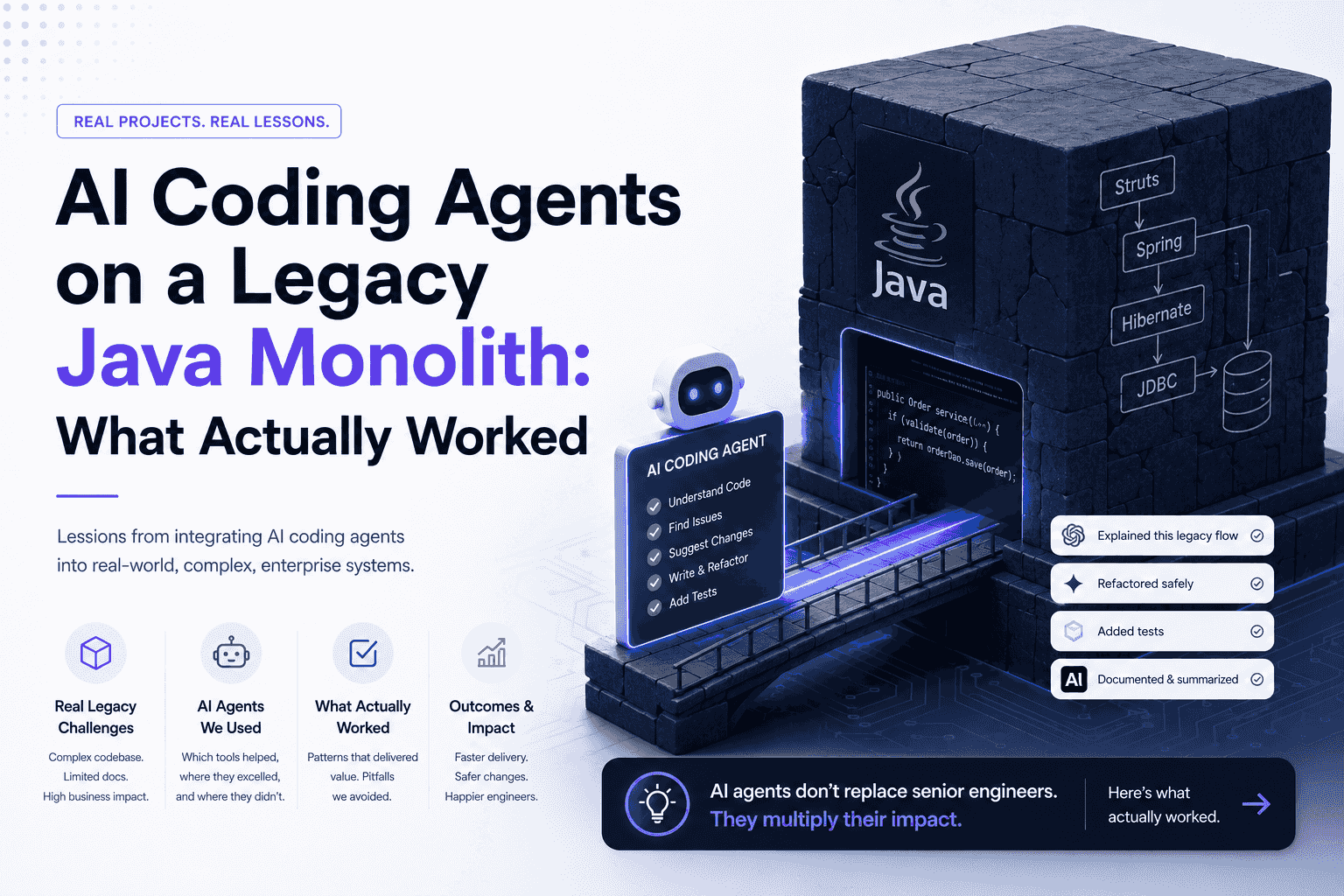
AI Coding Agents on a Legacy Java Monolith: What Actually Worked
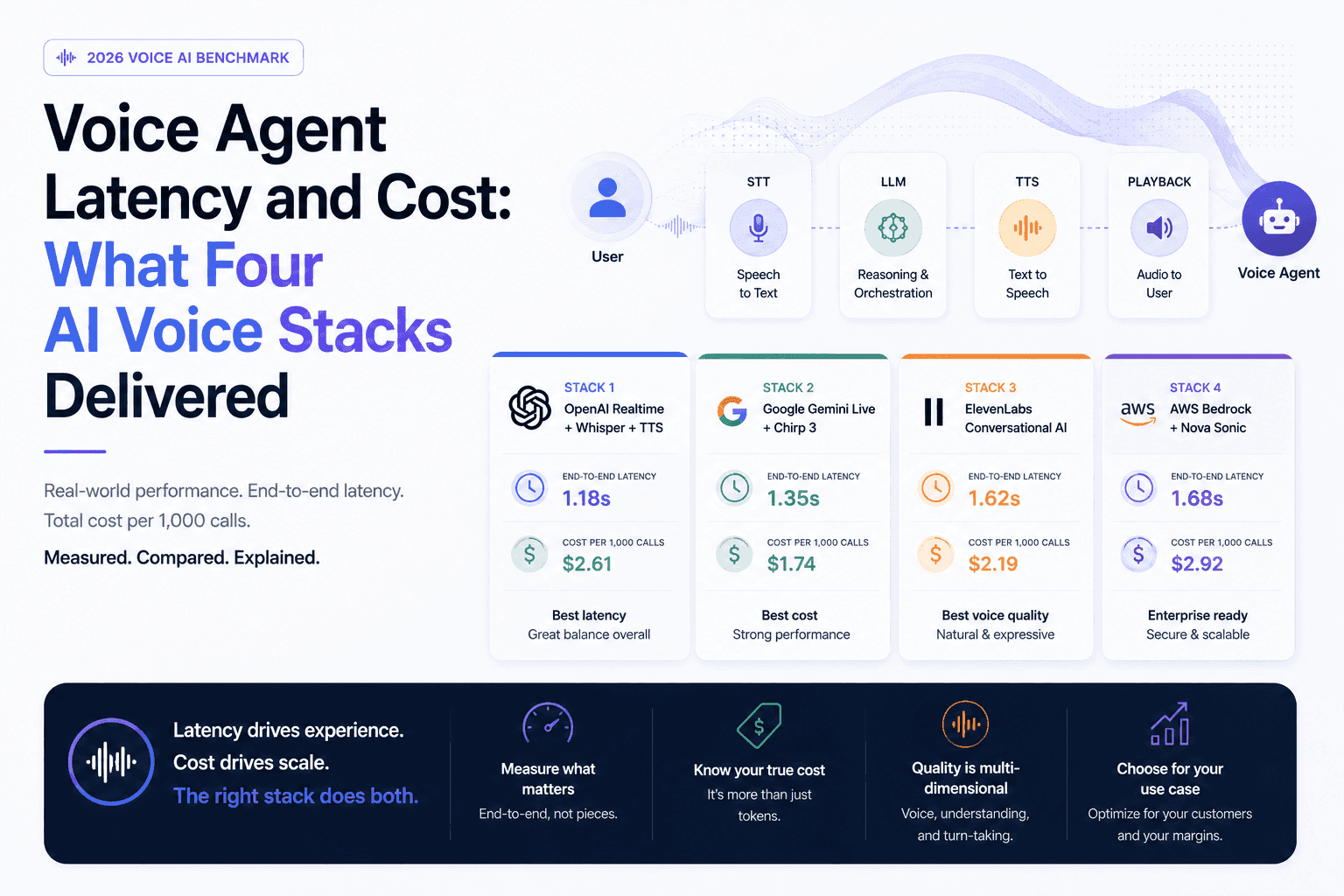
Voice Agent Latency and Cost: What Four AI Voice Stacks Delivered