
AI Website Builders vs Custom Development in 2026: Where the Line Actually Is
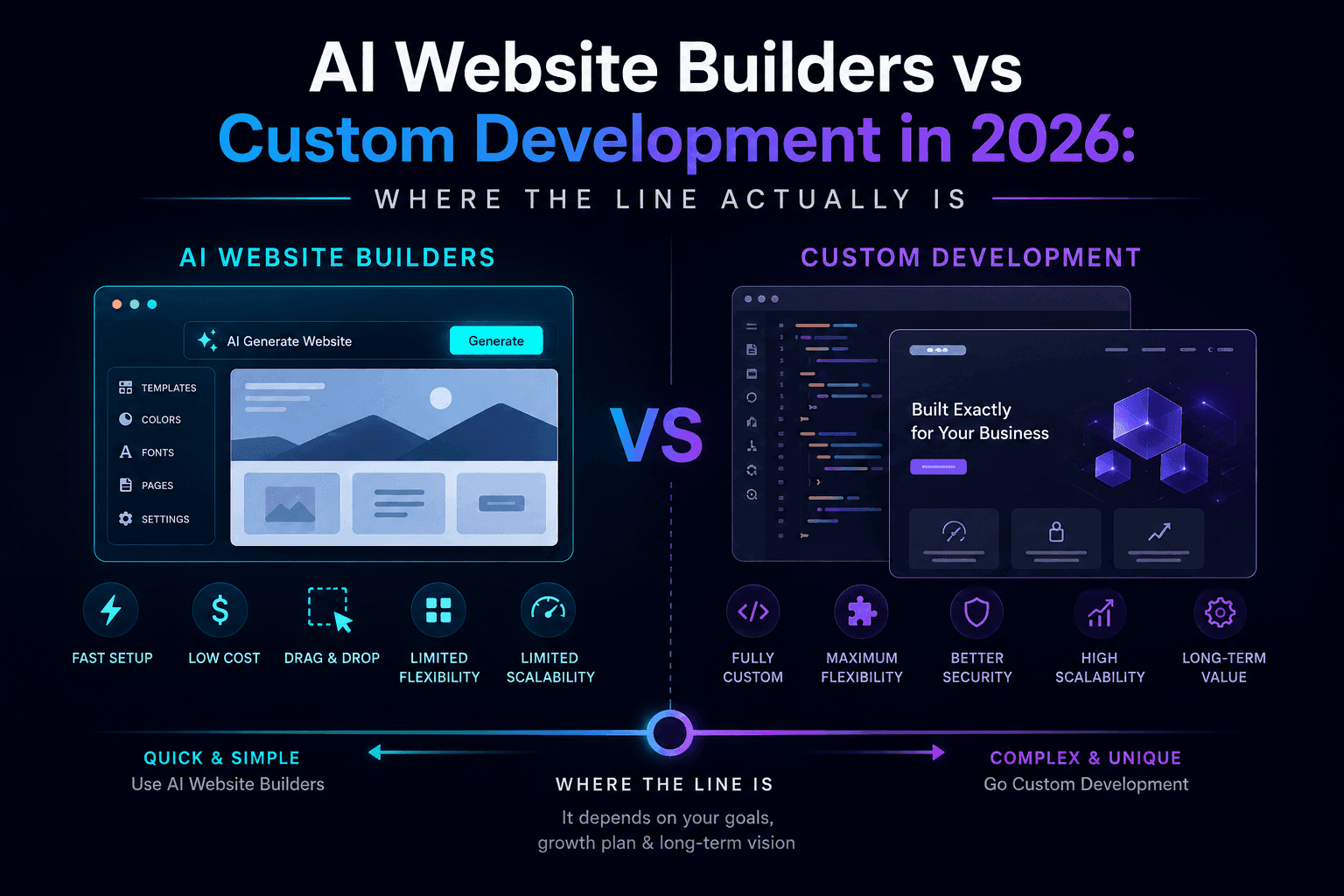
AI website builders in 2026 are the right choice for brochure sites, landing pages, and early validation — live in days for under $1,000. Custom development wins when the site IS the business: complex integrations, multi-tenant products, performance-critical SEO at scale, or workflows builders cannot express. The dividing question: does your site mainly present information, or run business logic? Ortem Technologies LLC builds custom platforms and also rescues teams that outgrew their builder mid-growth.
AI website builders generate and host sites from prompts and templates with AI-assisted copy, design, and layout. Custom development builds the site as software — owned code, arbitrary integrations, engineered performance. The 2026 market question is not which is better, but at what point a business crosses from one to the other.
Commercial Expertise
Need help with Web Development?
Ortem deploys dedicated High-Performance Web squads in 72 hours.
Next Best Reads
Continue your research on Web Development
These links are chosen to move readers from general education into service understanding, proof, and buying-context pages.
Web Application Development
Map this topic to platform architecture, frontend performance, and scalable web delivery.
See web serviceNext.js Development
Go deeper if your search intent is specifically around React SSR, performance, and enterprise Next.js delivery.
View Next.js serviceWeb Platform Case Study
See how a large-scale marketplace platform was built and structured for operational growth.
Read case studyThe AI website builder demo is genuinely impressive: describe your business, watch a decent site assemble itself, publish before lunch. For a real slice of businesses that is the complete, correct answer. For another slice it is a ceiling they will hit mid-growth, at the worst possible time. The skill is knowing which slice you are in before you commit.
Builder vs custom at a glance
| AI website builder | Custom development | |
|---|---|---|
| Cost | $200-1,000/year | $10,000-30,000 (marketing site), $30,000-150,000+ (application) |
| Time to launch | Days | 5-16 weeks (AI-accelerated) |
| Best for | Brochure sites, early validation | Business logic, integrations, SEO at scale |
| Ceiling | Templates, mainstream integrations only | None — arbitrary code and architecture |
| Ownership | Locked to platform | Fully owned code |
What AI builders honestly solve in 2026
Brochure sites, portfolios, event pages, early-stage validation, local service sites with booking — builders handle these well now. Design quality that required an agency in 2022 comes out of a prompt. Hosting, SSL, and basic SEO hygiene are handled. Cost: hundreds per year.
If your site presents the business and the heavy lifting happens elsewhere, a builder is not the budget option — it is the correct option. We tell prospects this regularly; our website vs web application explainer draws the same line.
Where the ceiling is — and why teams hit it mid-growth
The ceiling is never appearance. It is capability:
Integrations. The builder connects to mainstream tools; your business runs on an industry ERP, a niche CRM, or your own database. The Zapier chains multiply until someone admits the site cannot do its job.
Business logic. Custom quoting rules, inventory-aware pricing, role-based portals, multi-step workflows. Builders express templates, not logic.
SEO at scale. Structured data control, page-speed engineering, and programmatic landing pages by city, service, or product — the architecture decisions that competitive organic growth requires are exactly what builders abstract away.
Product ambitions. The moment the site takes accounts, payments, and tenants, it is a web application wearing a website costume — and it needs application engineering.
The pattern we see in rescue projects: the builder was right at launch, growth arrived, and eighteen months of content, SEO equity, and integrations now live inside a platform that cannot take the next step. Migration under time pressure costs more than building right at the decision point would have.
The 2026 hybrid: AI-accelerated custom
The twist this year: AI moved the breakeven. Custom development itself is now AI-accelerated — our teams use AI coding tools throughout, and build timelines have compressed 30-50% (the honest version of the vibe coding story). A custom marketing site with full CMS lands at $10,000-30,000 in weeks, not months.
The practical playbook by stage: validate on a builder, and the moment traction demands capability, move to owned code — bringing your content and SEO equity across cleanly with a proper migration.
Deciding in one afternoon
List the ten things your site must do eighteen months from now. If they are all "present information," stay on a builder and spend the savings on marketing. If three or more are "run logic" or "integrate deeply," start the custom conversation now — before the ceiling has a deadline attached.
What a clean migration actually involves
When the decision is made, the migration itself is a discrete, scoped project: audit every existing URL and its ranking signals, map old URLs to new ones with 301 redirects, rebuild content and structured data on the new architecture without losing the SEO equity already earned, and stage the cutover so DNS changes happen during a low-traffic window with rollback available.
Businesses that treat this as a rushed weekend project are the ones who show up in our rescue-project inbox months later asking why their organic traffic never recovered.
Ortem Technologies will give you a straight answer either way; telling a founder to keep their builder for another year costs us nothing and earns the future project. Ask us.
About Ortem Technologies
Ortem Technologies is a premier custom software, mobile app, and AI development company. We serve enterprise and startup clients across the USA, UK, Australia, Canada, and the Middle East. Our cross-industry expertise spans fintech, healthcare, and logistics, enabling us to deliver scalable, secure, and innovative digital solutions worldwide.
Get the Ortem Tech Digest
Monthly insights on AI, mobile, and software strategy - straight to your inbox. No spam, ever.
Sources & References
- 1.Web Development Services - Ortem Technologies
- 2.Website vs Web Application Difference 2026 - Ortem Technologies
About the Author
Digital Marketing Head, Ortem Technologies
Mehul Parmar is the Digital Marketing Head at Ortem Technologies, leading the marketing team under the direction of Praveen Jha. A seasoned digital marketing expert with 15 years of experience and 500+ projects delivered, he specialises in SEO, SEM, SMO, Affiliate Marketing, Google Ads, and Analytics. Certified in Google Ads & Analytics, he is proficient in CMS platforms including WordPress, Shopify, Magento, and Asp.net. Mehul writes about growth marketing, search strategies, and performance campaigns for technology brands.
Frequently Asked Questions
- For presenting a business — services, portfolio, contact, booking — yes, genuinely. Modern AI builders produce professional design and acceptable performance in days. The honest ceiling appears when the site must run logic: custom quoting, inventory rules, user accounts with roles, deep CRM/ERP integration, or SEO architectures with thousands of programmatic pages.
- Three reliable triggers: you are building workarounds outside the builder (spreadsheets and Zapier chains doing what the site should do), integrations you need do not exist or cost more than development would, or organic growth demands site architecture the builder cannot express — page speed at scale, structured data control, programmatic landing pages.
- AI builders: $200-1,000 per year plus your time. Custom marketing sites with CMS: $10,000-30,000. Web applications with accounts, payments, and integrations: $30,000-150,000+. The comparison only makes sense against what the site must do — a builder cannot deliver the application tier at any price, and custom is wasteful for a five-page brochure.
- They have narrowed the gap dramatically. AI-assisted development in 2026 cuts custom build timelines 30-50%, which lowered the breakeven point where custom becomes rational. A custom marketing site that took twelve weeks in 2023 ships in five to six weeks now — with all the ownership and flexibility benefits intact.
- Yes, with a proper migration: URL structure mapped and 301-redirected page by page, metadata and structured data carried across, and a pre-launch crawl comparing every indexed URL against its new counterpart. Traffic dips of a few percent for two to four weeks are normal even in a clean migration as search engines re-crawl; unplanned migrations that skip redirect mapping can lose the bulk of accumulated organic rankings.
- Modern builders handle basic SEO hygiene — meta tags, sitemaps, mobile responsiveness — competently. They fall short on programmatic page generation at scale, granular structured data control, and page-speed engineering beyond the builder's own performance ceiling. For a handful of pages this rarely matters; for a content or SEO-driven growth strategy across hundreds of pages, it becomes the deciding factor.
- Not the builder's subscription fee — it is the compounding cost of workarounds: manual data entry the site should automate, a growing stack of disconnected tools (Zapier, spreadsheets, a separate booking system) each with their own subscription and failure points, and the eventual migration project that has to untangle all of it simultaneously instead of one clean build.
Stay Ahead
Get engineering insights in your inbox
Practical guides on software development, AI, and cloud. No fluff — published when it's worth your time.
Ready to Start Your Project?
Let Ortem Technologies help you build innovative software solutions for your business.
You Might Also Like
Web Application Development Services: Building Scalable Platforms in 2026

Progressive Web Apps (PWA) Guide 2025: The Future of Web Applications
