Custom AI Copilot Development for Enterprises: The 2026 Build Guide
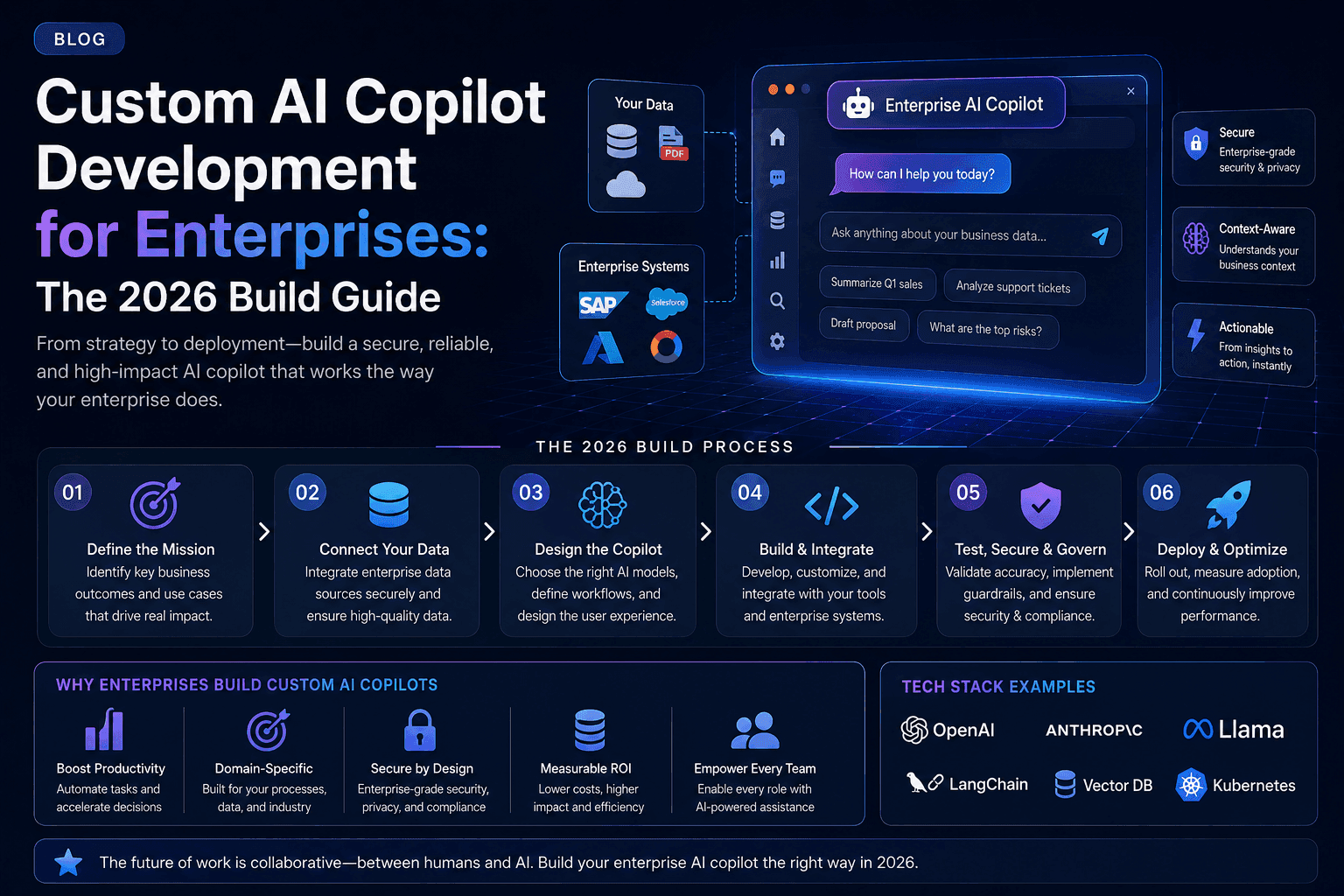
A custom enterprise AI copilot in 2026 costs $60,000-200,000 to build and ships in 10-16 weeks. The proven architecture is retrieval-grounded: a frontier LLM, a permission-aware retrieval layer over your internal systems, and tool connections for the actions employees repeat daily. Fine-tuning is rarely needed. The projects that fail skip permission mapping and evaluation. Ortem Technologies LLC builds copilots grounded in client systems with role-based access enforced at the retrieval layer.
A custom AI copilot is an internal assistant grounded in your company data and systems — answering employee questions, drafting documents in your formats, and executing routine actions across your tools — with access control that mirrors what each employee is already allowed to see.
Next Best Reads
Continue your research on AI Engineering
These links are chosen to move readers from general education into service understanding, proof, and buying-context pages.
AI & ML Solutions
Move from architecture reading into real model deployment, MLOps, and production AI pipelines.
Explore AI servicesLLM Integration
Integrate large language models into your product — RAG, fine-tuning, copilots, and APIs.
Explore LLM serviceAI Platform Case Study
See a production AI system with real data architecture, model integration, and launch outcomes.
Read case studyThe internal copilot has become the default first enterprise AI project of 2026 — and for good reason. It compresses onboarding, deflects internal support tickets, and puts institutional knowledge one question away. It is also where we see the most expensive failures. This guide covers the architecture that works, real costs, the three failure modes to design against, and the rollout sequence that gets adoption instead of a launch-day demo nobody uses again.
Custom copilot cost and timeline at a glance
| Copilot type | Cost | Timeline | Systems touched |
|---|---|---|---|
| Single-department Q&A copilot | $60,000-90,000 | 10 weeks | Documentation, one wiki or knowledge base |
| Cross-system copilot with actions | $120,000-200,000 | 14-16 weeks | CRM, ticketing, HR systems, SSO, audit logging |
| Monthly run cost | $2,000-8,000 | Ongoing | Inference, retrieval hosting, evaluation runs |
The architecture that works: grounded, permissioned, tool-connected
Every successful enterprise copilot we have shipped shares the same skeleton:
A frontier LLM via API. Claude, GPT, or Gemini. You are not training anything; you are renting reasoning. Model choice matters less than everything below it — see our enterprise model comparison.
Permission-aware retrieval. Your documents, wikis, tickets, and databases are indexed into a vector store, and every retrieval carries the user identity so search only touches what that user could already open. This is the load-bearing wall. Our agentic RAG architecture guide covers the retrieval patterns.
Tool connections. The step that turns answers into outcomes: creating tickets, drafting quotes from the price book, updating CRM records. Start with two or three high-frequency actions; expand from usage data.
Evaluation and audit. A golden test set run on every change, plus a log of every question, retrieved source, and action. Compliance will ask for this; build it on day one, not when the first audit request arrives.
What it costs and how long it takes
Documentation-grounded Q&A copilot for one department: $60,000-90,000, ten weeks. Cross-system copilot with write actions, SSO, and audit logging: $120,000-200,000, fourteen to sixteen weeks. Running costs land at $2,000-8,000 per month at mid-size-enterprise usage — with model routing sending easy questions to small models, the lower end is achievable. The full economics follow the same pattern as our AI app cost breakdown, because a copilot is, structurally, a retrieval-grounded application with an action layer bolted on.
The three failure modes
1. Permissions as an afterthought. The team indexes everything into one vector store, demos it to applause, then legal asks what happens when an intern asks about executive compensation. Retrofitting access control means rebuilding retrieval from the ground up, because permission checks have to happen at query time, not as a post-hoc filter on results.
Design it first — every retrieval call carries the requesting user's identity, and the index itself is partitioned or filtered by what that identity is entitled to see.
2. No evaluation harness. The copilot launches, answers drift as documents change, employees quietly stop trusting it, and adoption dies within a quarter — not from a dramatic failure, but from a slow accumulation of small wrong answers nobody was measuring. A weekly evaluation run against a golden set of real questions catches degradation while it is still cheap to fix, and gives you a defensible number when someone asks "is this thing actually working?"
3. Boiling the ocean. Copilots scoped as "answers anything about the company" fail because the retrieval and evaluation surface is unbounded and impossible to trust fully. Copilots scoped as "answers the 200 questions sales asks operations every week" succeed, then expand from a position of proven value. Pick a department with measurable, recurring pain first, prove the number, and widen.
The rollout sequence that gets adoption
Launch to a pilot group of 10-20 power users first, not the whole department. Instrument every question and every thumbs-up/thumbs-down. Use the first two weeks of real usage data to fix the retrieval gaps a demo never surfaced — real employees ask questions in ways your test set did not anticipate.
Only then roll out company-wide, with the pilot group as internal champions who already trust the system and can vouch for it. Copilots that skip the pilot phase and launch to everyone at once see markedly slower adoption, because the first bad answer an employee gets becomes their permanent opinion of the tool.
Proof it works
Our enterprise RAG knowledge assistant deflected the majority of internal support questions within its first quarter, grounded in thousands of documents with role-based access intact from launch. The same underlying architecture — permission-aware retrieval, tool connections, continuous evaluation — powers customer-facing deployments like our voice AI support agent, which is the strongest proof that the pattern holds under real, unpredictable user input rather than just internal, forgiving employees.
If your team is fielding the same internal questions every week, a scoped copilot pays for itself measurably within a quarter. Book a discovery call and we will size it against your actual ticket volume before you commit to a number.
Copilots are one of seven AI service categories — see our complete guide to AI development services for the rest.
About Ortem Technologies
Ortem Technologies is a premier custom software, mobile app, and AI development company. We serve enterprise and startup clients across the USA, UK, Australia, Canada, and the Middle East. Our cross-industry expertise spans fintech, healthcare, and logistics, enabling us to deliver scalable, secure, and innovative digital solutions worldwide.
Get the Ortem Tech Digest
Monthly insights on AI, mobile, and software strategy - straight to your inbox. No spam, ever.
Sources & References
- 1.Enterprise RAG Knowledge Assistant (Case Study) - Ortem Technologies
- 2.Agentic RAG vs Standard RAG Architecture Guide - Ortem Technologies
About the Author
Technical Lead, Ortem Technologies
Ravi Jadhav is a Technical Lead at Ortem Technologies with 13+ years of experience leading development teams and managing complex software projects. He brings a deep understanding of software engineering best practices, agile methodologies, and scalable system architecture. Ravi is passionate about building high-performing engineering teams and delivering technology solutions that drive measurable results for clients across industries.
Frequently Asked Questions
- Enterprise copilots run $60,000-200,000 depending on how many systems it connects to and how strict the security requirements are. A copilot grounded in documentation and one or two systems sits at the low end; one with write actions across CRM, ticketing, and HR systems with SSO and audit logging sits at the top.
- Usually no. Retrieval-augmented generation over your documents and systems delivers company-specific answers with citations, updates instantly when documents change, and respects permissions. Fine-tuning bakes knowledge into weights where it goes stale and cannot be access-controlled. Fine-tune only for style conformity or narrow classification tasks.
- Enforce permissions at the retrieval layer: every query carries the user identity, and the retriever only searches documents that user could already open. Add output guardrails for PII patterns and an audit log of every question and source retrieved. Never rely on the model itself to decide what is confidential.
- Buy Microsoft 365 Copilot for generic productivity inside Office documents. Build custom when the value is in your proprietary systems and workflows — quoting from your price book, answering from your product database, executing actions in your internal tools. Most enterprises that deploy both use M365 Copilot for documents and a custom copilot for operations.
- Adoption typically ramps over four to eight weeks post-launch, driven less by training and more by trust: employees test it on low-stakes questions first, and adoption accelerates once it correctly answers something the intranet search never could. Copilots that launch without a visible source citation on every answer see slower adoption because employees cannot verify the response.
- Customer support and sales operations typically show the fastest measurable payback because their question volume is high and repetitive, and answers are checkable against a documented knowledge base. HR and IT helpdesk are close seconds. Legal and finance are viable but need the strictest permission and audit controls before launch, which extends timeline.
- Yes, through a connector layer that exposes the legacy system via API or a scheduled data sync into the retrieval index — direct database access is possible but adds security review. Most enterprise copilot projects budget two to four extra weeks specifically for legacy integration, since older systems rarely expose clean APIs out of the box.
Stay Ahead
Get engineering insights in your inbox
Practical guides on software development, AI, and cloud. No fluff — published when it's worth your time.
Ready to Start Your Project?
Let Ortem Technologies help you build innovative software solutions for your business.
You Might Also Like
From AI PoC to Production: Why 80% of Pilots Die and How to Ship Yours
How Long Does AI Development Take in 2026? Honest Timelines by Project Type