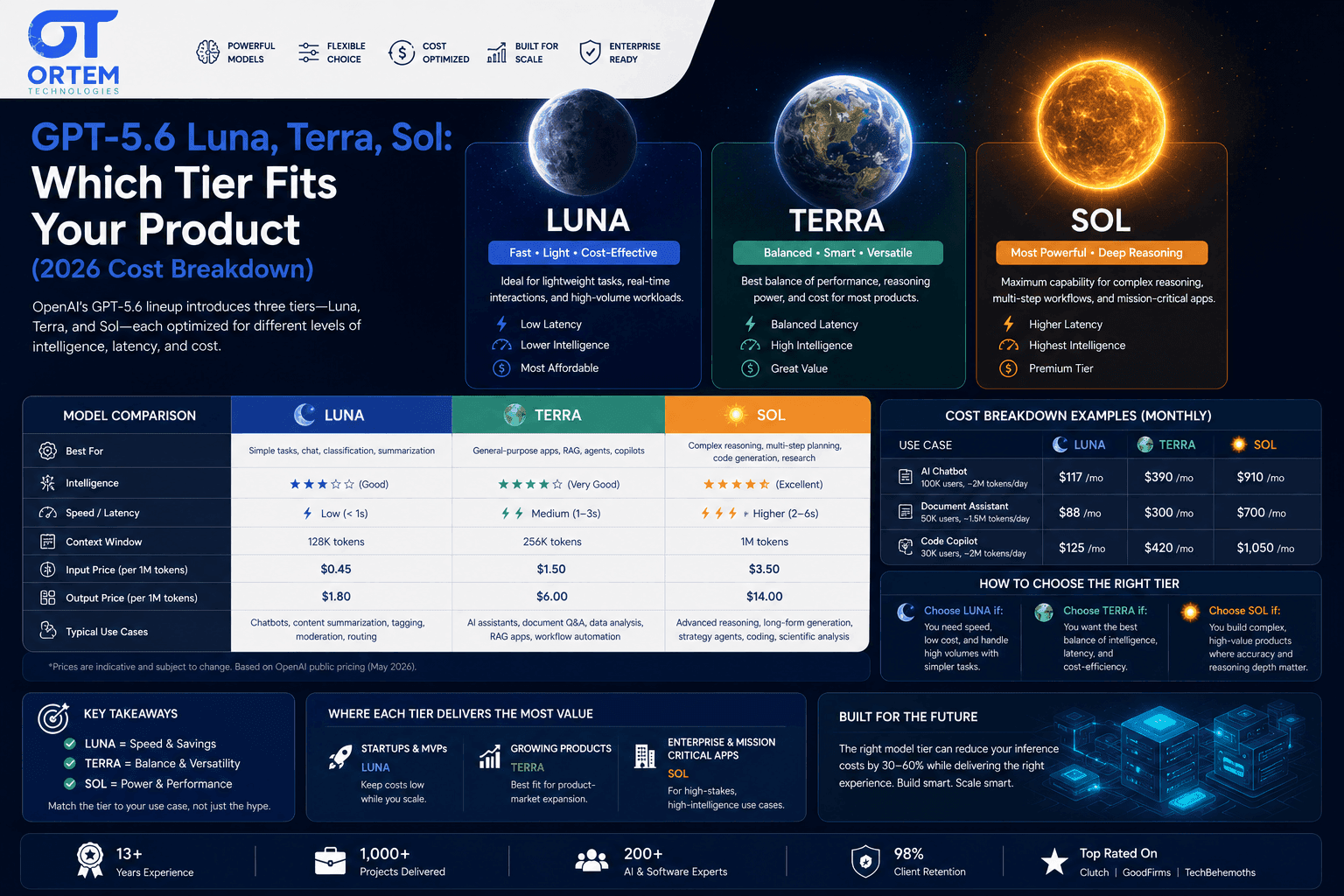
MCP vs the New Enterprise Agent Protocol: What CTOs Should Build On in 2026
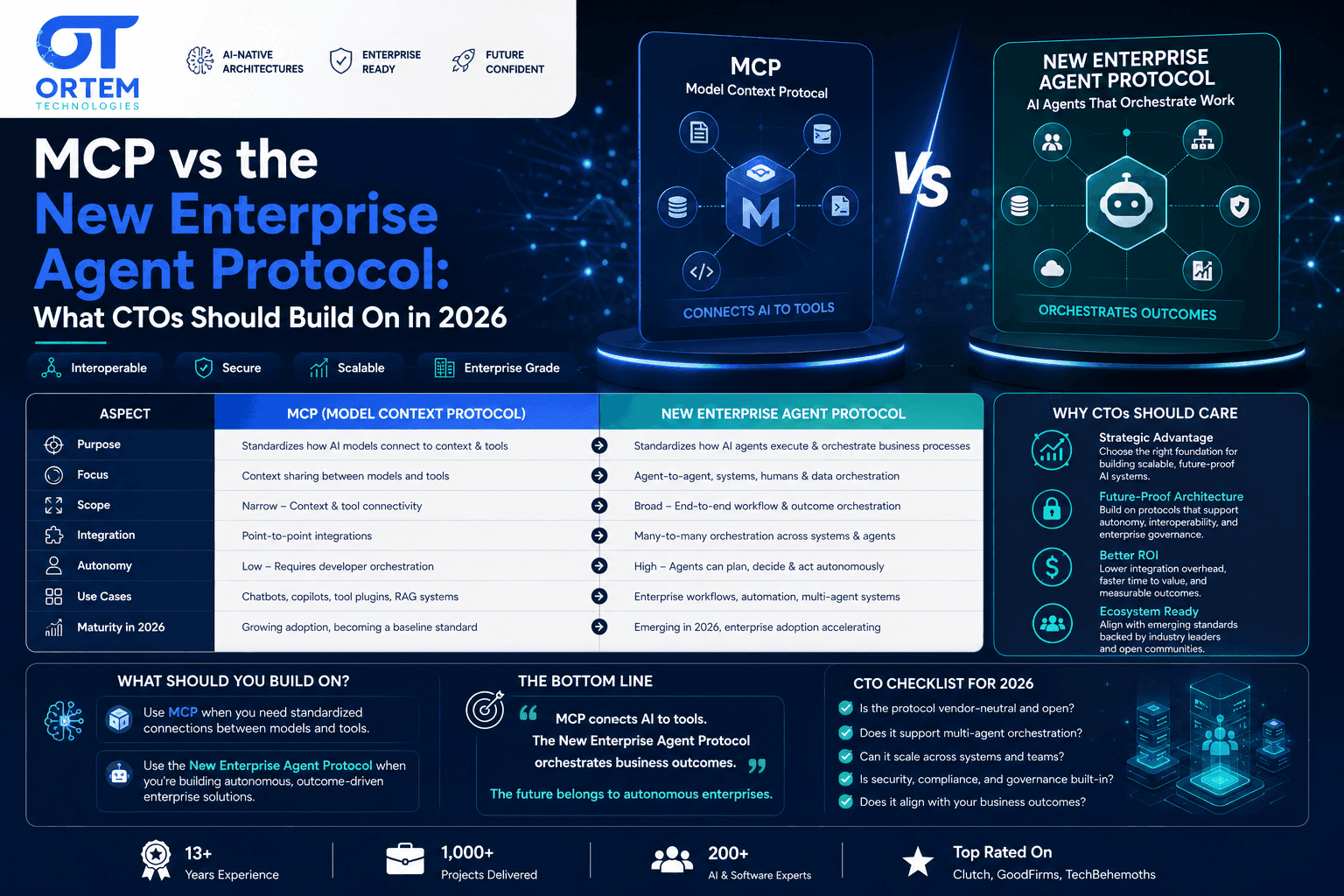
In July 2026, Google, Microsoft, Salesforce, Snowflake and ServiceNow agreed to back a shared enterprise agent protocol positioned against Anthropic's Model Context Protocol (MCP), which has been the de facto tool-connection standard for 18 months. For most companies the right move is not to pick a winner: build agent integrations behind a thin adapter layer so the transport protocol is swappable, keep business logic out of protocol-specific code, and default to MCP today because its tooling and server ecosystem are the most mature. Ortem Technologies builds agent systems with exactly this protocol-agnostic architecture.
An agent protocol is the standard that defines how AI agents connect to enterprise data, tools, and other agents — the plumbing layer of agentic AI. In July 2026 this layer became contested ground: Anthropic's Model Context Protocol (MCP) is the incumbent standard, and a Google/Microsoft/Salesforce-led alliance announced a rival aimed at enterprise backends.
Next Best Reads
Continue your research on AI Engineering
These links are chosen to move readers from general education into service understanding, proof, and buying-context pages.
AI & ML Solutions
Move from architecture reading into real model deployment, MLOps, and production AI pipelines.
Explore AI servicesLLM Integration
Integrate large language models into your product — RAG, fine-tuning, copilots, and APIs.
Explore LLM serviceAI Platform Case Study
See a production AI system with real data architecture, model integration, and launch outcomes.
Read case studyThe most important AI story of July 2026 is not a model launch. It is a plumbing fight. Google, Microsoft, Salesforce, Snowflake and ServiceNow agreed to back a shared protocol for connecting AI agents to enterprise systems — announced, unmistakably, as a counter to Anthropic's Model Context Protocol. When five vendors who compete with each other on everything else agree on one standard, they are not being generous; they are trying to stop a rival's standard from becoming the default rail their products run on.
If you are a CTO or founder planning agent capability, this fight is now an architecture input. Here is how to read it and what to do.
What actually happened
Anthropic released MCP in late 2024. Over 18 months it did what successful standards do: accumulated an ecosystem. Thousands of MCP servers now exist — community-built and vendor-shipped — exposing everything from Postgres and GitHub to Salesforce and Slack. Model vendors beyond Anthropic adopted client support because refusing meant their models arrived at customer sites unable to reach tools everyone else could reach.
That is precisely the position enterprise software vendors cannot tolerate on the backend. If agents reach enterprise data primarily through MCP, Anthropic holds influence over the layer where Microsoft, Google, Salesforce and ServiceNow monetize. The alliance protocol is their answer: a standard they co-govern for how agents talk to enterprise backends and to each other.
The strategic read: ecosystems beat announcements
Standards fights are won by deployed base, not press releases. Consider the scoreboard honestly:
| Factor | MCP | Alliance protocol |
|---|---|---|
| Age | 18+ months in production | Announced July 2026 |
| Tooling | Mature SDKs, thousands of servers | Not yet shipped |
| Governance | Anthropic-led, open spec | Five-vendor consortium |
| Distribution | Developer-led adoption | Enterprise sales channels |
| Likely stronghold | Dev tools, startups, mixed stacks | Microsoft 365, Salesforce, ServiceNow estates |
The alliance's real weapon is distribution: they can bundle protocol support into platforms enterprises already pay for. The likely end state is not a winner-take-all but a bilingual world — MCP dominant in developer-facing tooling, the alliance protocol embedded in the big enterprise suites, with bridges between them. We have seen this movie: SOAP vs REST, OpenID vs SAML. The companies that suffered were the ones who welded their business logic to one transport.
The architecture answer: adapters, not allegiance
You do not need to predict the winner. You need to make the question cheap. The pattern we use in every AI agent build at Ortem:
- Keep business logic protocol-free. The code that decides what an agent may do, which data it may see, and how results are validated should not import any protocol SDK.
- Wrap tool access in a thin adapter layer. Each internal capability (query CRM, create ticket, fetch document) is defined once in your own interface; MCP is one adapter behind it. If the alliance protocol matures, it becomes a second adapter — days of work.
- Default to MCP today. It is what works now. Every week waiting for protocol clarity is a week of agent capability your competitors are shipping.
- Watch two signals, not the press. First shipped SDK from the alliance, and first bridge implementation between the protocols. Until both exist, there is nothing to migrate to.
What this means by company size
Startups and mid-market: build on MCP without hesitation. Your stack is mixed, your speed matters more than vendor politics, and the adapter pattern above caps your downside.
Enterprises deep in Microsoft/Salesforce/ServiceNow: still build on MCP now, but assign someone to track the alliance spec — your vendors will eventually push their protocol through license bundles, and you will want bridge leverage rather than a forced rewrite.
Agencies and ISVs: bilingual support will become a selling point. Architect for it now and you can charge for it later.
The bottom line
The agent protocol war is real, but it is a war over rails — and rails reward whoever builds the trains. Companies that ship working agents this year, behind a swappable adapter layer, win under every outcome. Companies that wait for standards clarity ship nothing and inherit whichever standard wins anyway.
We build production agent systems — protocol-agnostic by design — for companies from seed-stage to enterprise. See our AI agent development services and our portfolio of 12 in-house AI agents, or talk to us about scoping your first agent sprint. If you need the capability in-house instead, we can place production AI engineers on your team in 5–10 days.
About Ortem Technologies
Ortem Technologies is a premier custom software, mobile app, and AI development company. We serve enterprise and startup clients across the USA, UK, Australia, Canada, and the Middle East. Our cross-industry expertise spans fintech, healthcare, and logistics, enabling us to deliver scalable, secure, and innovative digital solutions worldwide.
Get the Ortem Tech Digest
Monthly insights on AI, mobile, and software strategy - straight to your inbox. No spam, ever.
Sources & References
- 1.Top Tech News, July 17 2026 - Tech Startups
- 2.AI Agent Development Services - Ortem Technologies
About the Author
Director – AI Product Strategy, Development, Sales & Business Development, Ortem Technologies
Praveen Jha is the Director of AI Product Strategy, Development, Sales & Business Development at Ortem Technologies. With deep expertise in technology consulting and enterprise sales, he helps businesses identify the right digital transformation strategies - from mobile and AI solutions to cloud-native platforms. He writes about technology adoption, business growth, and building software partnerships that deliver real ROI.
Frequently Asked Questions
- MCP is an open protocol created by Anthropic that standardizes how AI agents and assistants connect to external tools, data sources, and services. Instead of writing custom integration code per model and per tool, you expose capabilities once through an MCP server and any MCP-compatible client can use them. Over the past 18 months it has become the de facto standard, with thousands of community and vendor MCP servers.
- In mid-July 2026, Google, Microsoft, Salesforce, Snowflake and ServiceNow announced support for a shared agent backend protocol, framed explicitly as an enterprise-grade alternative to MCP for connecting agents to enterprise data and to each other. Details are still emerging; as of the announcement, no production tooling comparable to the MCP ecosystem has shipped.
- Build on MCP now, behind an adapter layer. MCP has mature SDKs, thousands of servers, and production track record. The alliance protocol has no shipped ecosystem yet. If you isolate protocol-specific code in a thin integration layer, migrating later is days of work, not a rewrite — and waiting costs you two or more quarters of shipped agent capability.
- Unlikely to fully replace it. The most probable outcome mirrors past standards fights: coexistence with bridges between them, where MCP dominates developer tooling and the alliance protocol gets traction inside the vendors' own clouds (Microsoft 365, Salesforce, ServiceNow workflows). Enterprises with heavy footprints in those platforms will end up speaking both — which is exactly why an adapter architecture matters.
- A single MCP server exposing one internal system (CRM, database, ticketing) typically takes 1–3 weeks of engineering, roughly $5,000–$15,000 through a development partner. A full agent deployment with 4–6 tool integrations, evaluation, and access controls typically lands between $40,000 and $120,000 depending on security and compliance scope.
Stay Ahead
Get engineering insights in your inbox
Practical guides on software development, AI, and cloud. No fluff — published when it's worth your time.
Ready to Start Your Project?
Let Ortem Technologies help you build innovative software solutions for your business.
You Might Also Like
Gemini 3.5 Delayed: How to Build an AI Stack That Doesn't Depend on One Vendor
What AI Agents Really Cost to Run in Production: 2026 Inference Budget Guide