What AI Agents Really Cost to Run in Production: 2026 Inference Budget Guide
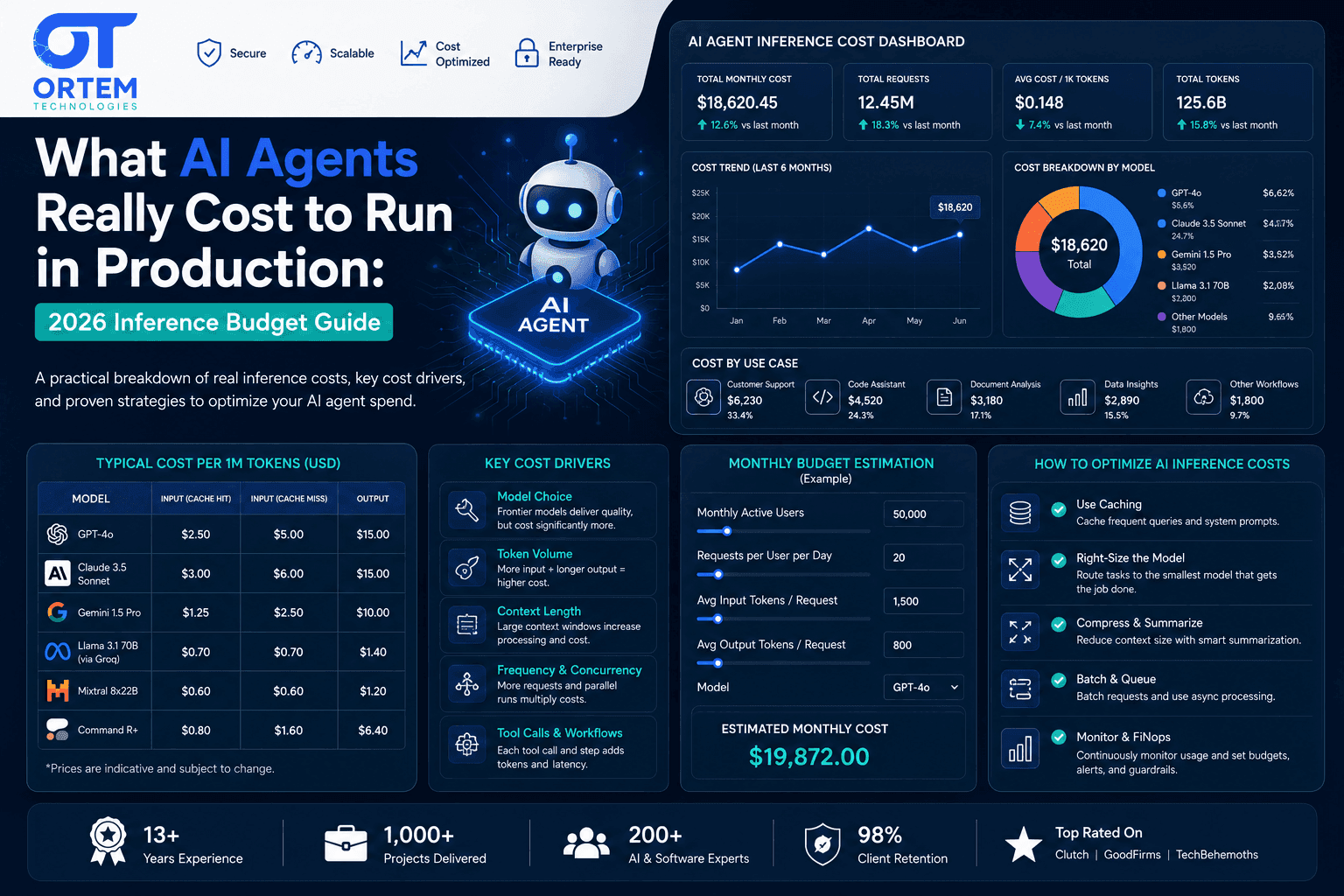
A production AI agent in 2026 typically costs $500–$5,000 per month in inference for departmental workloads (support triage, document processing at mid-volume), and $5,000–$50,000+ per month for customer-facing agents at scale. The bill is dominated by four line items: model tokens (50–70%), retrieval and embedding calls, tool-call overhead from multi-step loops, and observability. Routing, caching, and prompt discipline reliably cut spend 40–70%. Ortem Technologies scopes running costs alongside build costs in every agent engagement — the number that matters is cost per resolved task, not cost per token.
Agent inference cost is the ongoing spend required to run an AI agent in production — model API tokens, retrieval infrastructure, tool-call loops, and monitoring — as distinct from the one-time cost of building it. In 2026, with vendors moving agent features to usage-based billing industry-wide, inference cost has become the number that determines whether an agent deployment survives its first budget review.
Next Best Reads
Continue your research on AI Engineering
These links are chosen to move readers from general education into service understanding, proof, and buying-context pages.
AI & ML Solutions
Move from architecture reading into real model deployment, MLOps, and production AI pipelines.
Explore AI servicesLLM Integration
Integrate large language models into your product — RAG, fine-tuning, copilots, and APIs.
Explore LLM serviceAI Platform Case Study
See a production AI system with real data architecture, model integration, and launch outcomes.
Read case studyThe agent industry quietly repriced itself this year. Flat per-seat pricing for AI agent features is giving way to usage-based inference billing across vendors — because flat pricing made heavy agent workloads unprofitable to sell. For buyers, the consequence is simple and underappreciated: your agent's running cost is now a variable operating expense, and it will be reviewed by someone in finance who does not care how impressive the demo was.
This guide gives you the real numbers we see across production deployments, the four line items that dominate the bill, and the tactics that reliably cut it.
The real numbers
| Deployment type | Typical monthly inference | Cost per task |
|---|---|---|
| Internal departmental agent (triage, docs, research) | $500–$5,000 | $0.05–$0.30 |
| Customer-facing support agent, mid-volume | $2,000–$15,000 | $0.10–$0.60 per conversation |
| High-volume customer-facing agent | $15,000–$50,000+ | $0.08–$0.40 at scale |
| Agentic document pipeline (extraction, processing) | $1,000–$10,000 | $0.02–$0.25 per document |
Why agents cost multiples of chatbots: a chatbot is one model call per message; an agent is a loop. Plan, pick a tool, process the result, check the work, synthesize — 5 to 30+ calls per task, each carrying context (tool definitions, retrieved documents, history) as input tokens. Input tokens, not output, are where agent budgets die.
The four line items that dominate the bill
1. Model tokens (50–70%). Driven by loop depth and context size. The most common waste we find in audits: agents re-sending full conversation history and every tool definition on every step. Context discipline — each step gets only what it needs — routinely cuts this line 30–50% with zero quality loss.
2. Retrieval infrastructure. Vector database hosting plus embedding calls. Modest at low volume, meaningful at scale, and frequently duplicated — teams embedding the same documents repeatedly because nobody built idempotent ingestion.
3. Tool-call overhead. Every tool round-trip re-enters the model with accumulated context. Deep loops compound cost quadratically-ish; a capped loop depth with human escalation is both a cost control and a quality control.
4. Observability. Tracing, logging, evaluation runs. The line item teams cut first and regret first — without per-step traces you cannot see which of the other three lines is bloated.
Five tactics that cut spend 40–70%
- Route by difficulty. Only genuinely hard reasoning needs a frontier model. Classification, extraction, formatting, and summarization run fine on models 10–20x cheaper. Most single-model agent stacks overspend 40–70% on this alone — the multi-model architecture in our vendor-independence guide is the same architecture that enables routing.
- Cache aggressively. Prompt caching on stable prefixes — system prompt, tool definitions — cuts input token cost dramatically on every provider that supports it. This is configuration, not engineering.
- Trim context per step. Summarize history, pass tool results not raw dumps, load tool definitions selectively.
- Cap loops, escalate humans. A max-step budget per task with graceful human handoff caps worst-case cost and stops runaway loops.
- Batch offline work. Anything not user-facing (nightly document processing, enrichment) goes to batch APIs at discounted rates.
The metric that actually matters
Cost per token is an engineering metric. Cost per resolved task is a business metric, and it is the only one your budget review cares about. A support agent costing $0.40 per conversation against a human queue costing $6 per ticket is not an expense — it is the best-performing line in the department. Instrument it from day one: tasks attempted, tasks resolved without human help, cost per resolution, trend per week.
This is also the honest lens for build-vs-buy: a vendor agent at usage-based pricing may beat a custom build at low volume and lose badly at high volume, where routing and caching you control determine the economics. We model both curves in every agent scoping engagement.
The bottom line
Usage-based agent billing is here to stay, and it rewards teams that treat inference as an engineered cost, not a fixed subscription. Routing, caching, context discipline, and loop caps are each individually boring — together they are the difference between an agent program that scales and one that gets cancelled at the first budget review.
We build agents with cost instrumentation included, and we audit existing deployments whose bills grew faster than their value. See our AI agent development services, our earlier deep-dive on LLM maintenance costs, or book a free consultation for a cost model of your specific workload.
About Ortem Technologies
Ortem Technologies is a premier custom software, mobile app, and AI development company. We serve enterprise and startup clients across the USA, UK, Australia, Canada, and the Middle East. Our cross-industry expertise spans fintech, healthcare, and logistics, enabling us to deliver scalable, secure, and innovative digital solutions worldwide.
Get the Ortem Tech Digest
Monthly insights on AI, mobile, and software strategy - straight to your inbox. No spam, ever.
Sources & References
- 1.AI Coding Agents: July 2026 developments - ChatGPT AI Hub
- 2.LLM Integration Services - Ortem Technologies
About the Author
Director – AI Product Strategy, Development, Sales & Business Development, Ortem Technologies
Praveen Jha is the Director of AI Product Strategy, Development, Sales & Business Development at Ortem Technologies. With deep expertise in technology consulting and enterprise sales, he helps businesses identify the right digital transformation strategies - from mobile and AI solutions to cloud-native platforms. He writes about technology adoption, business growth, and building software partnerships that deliver real ROI.
Frequently Asked Questions
- Departmental agents (internal support triage, document processing, research assistants) typically run $500–$5,000/month in inference at realistic volumes. Customer-facing agents at scale run $5,000–$50,000+/month depending on conversation volume and complexity. A single agent conversation with 5–15 model calls typically costs $0.05–$0.60 with current-generation model pricing.
- A chatbot makes roughly one model call per user message. An agent makes 5–30+ calls per task: planning, tool selection, tool-result processing, self-checking, and final synthesis. Each loop multiplies token consumption, and long agent contexts (tool definitions, retrieved documents, conversation history) mean each call carries more input tokens than a simple chat turn.
- Four line items dominate: model tokens (typically 50–70% of the bill, driven heavily by input-token-heavy agent loops), retrieval infrastructure (vector database plus embedding calls), tool-call overhead (each step re-sends context), and observability tooling. The hidden multiplier is context bloat — agents that carry full history and all tool definitions into every call can double or triple token spend for zero quality gain.
- Five tactics, in order of typical impact: route sub-tasks to cheaper models (only hard reasoning needs a frontier model), cache aggressively (prompt caching on stable system prompts and tool definitions alone can cut input costs 50%+), trim context per step (pass only what the step needs), cap loop depth with escalation to humans, and batch offline work to off-peak or batch APIs at discounted rates. Together these reliably cut spend 40–70%.
- Yes. Through 2026 vendors have been shifting agent features from flat per-seat pricing to usage-based models that track inference consumption, because flat pricing made heavy agent workloads unprofitable for vendors. For buyers this means agent costs are becoming variable operating expenses — which makes cost-per-task measurement and routing discipline a budgeting requirement, not an optimization.
Stay Ahead
Get engineering insights in your inbox
Practical guides on software development, AI, and cloud. No fluff — published when it's worth your time.
Ready to Start Your Project?
Let Ortem Technologies help you build innovative software solutions for your business.
You Might Also Like
GPT-5.6 Luna, Terra, Sol: Which Tier Fits Your Product (2026 Cost Breakdown)
GPT-Live and Full-Duplex Voice AI: What It Changes for Customer-Facing Businesses