Gemini 3.5 Delayed: How to Build an AI Stack That Doesn't Depend on One Vendor
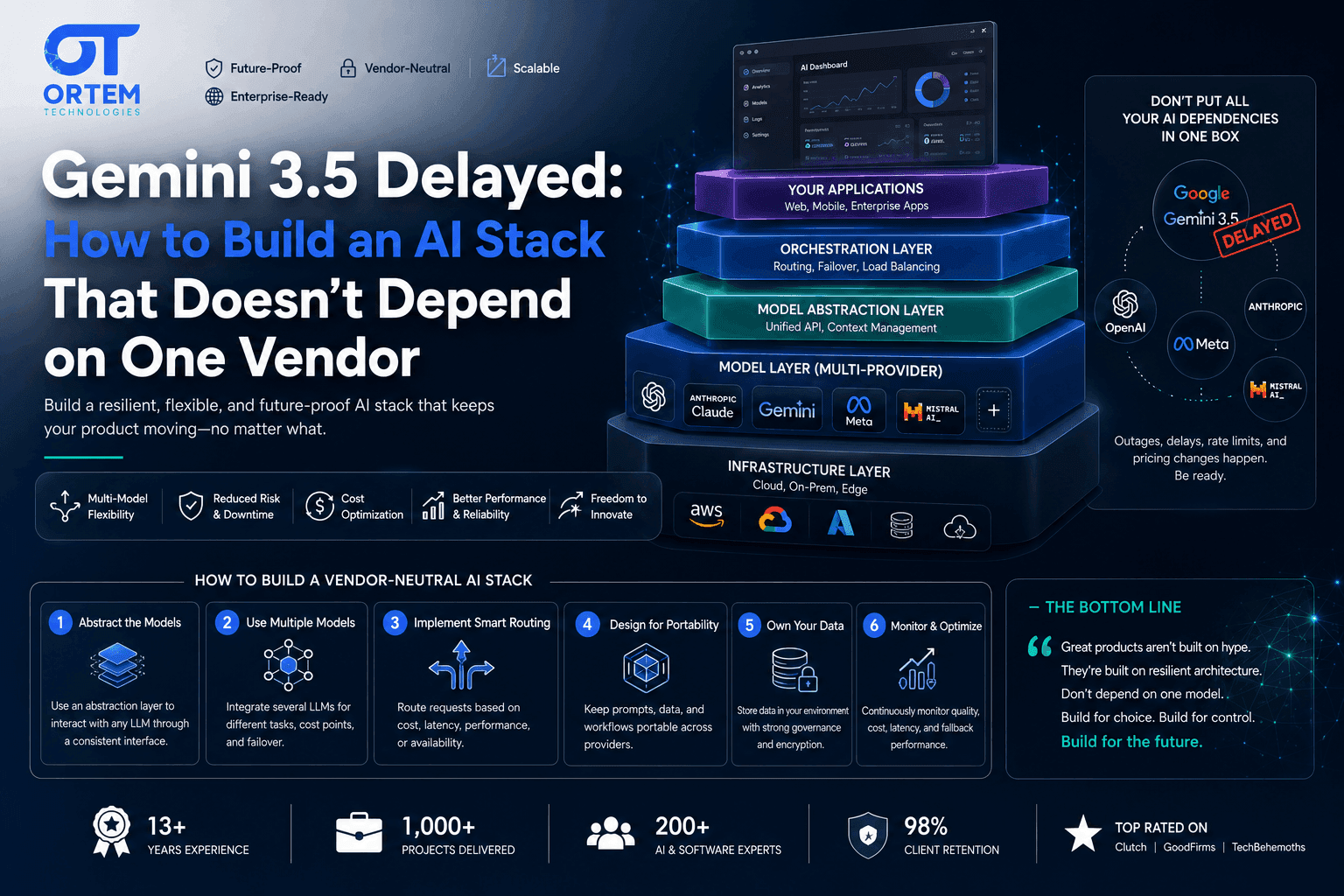
Google delayed the broad release of Gemini 3.5 Pro by several months in July 2026 after internal testing showed it falling short on coding and long-horizon reasoning. For businesses, the practical lesson is architectural: never hard-wire your product to a single model vendor. A multi-model stack — an abstraction layer, task-based routing, and a tested fallback model — costs roughly 1–2 extra weeks of engineering upfront and eliminates the single point of failure. Ortem Technologies builds LLM integrations with this architecture by default.
A multi-model AI strategy means architecting your product so it can route requests across several LLM providers — OpenAI, Anthropic, Google, or open-weight models — and switch between them without code rewrites. In July 2026, Google's delay of Gemini 3.5 Pro after internal performance misses made the case for this architecture better than any whitepaper could.
Next Best Reads
Continue your research on AI Engineering
These links are chosen to move readers from general education into service understanding, proof, and buying-context pages.
AI & ML Solutions
Move from architecture reading into real model deployment, MLOps, and production AI pipelines.
Explore AI servicesLLM Integration
Integrate large language models into your product — RAG, fine-tuning, copilots, and APIs.
Explore LLM serviceAI Platform Case Study
See a production AI system with real data architecture, model integration, and launch outcomes.
Read case studyGoogle delayed Gemini 3.5 Pro this week — several months, reportedly, after internal testing showed it missing the bar on coding performance and long-horizon reasoning. Cue the hot takes about Google falling behind. Most of them miss the point.
The point: every frontier lab slips. OpenAI has delayed models. Anthropic has retired models developers loved. Google has now done both. If your product's roadmap silently assumes one vendor's roadmap, you have inherited their risk with none of their information. The companies that shrug at news like this all share one architectural decision, and it costs about two weeks to make.
What single-vendor dependency actually costs
We audit AI products regularly as part of our LLM integration practice. The single-vendor pattern shows up three ways, in ascending order of pain:
Price exposure. Vendor changes pricing; your unit economics change with it, and your only lever is negotiation you have no leverage for.
Deprecation forced-march. Vendor sunsets the model version you tuned prompts against. You get a migration deadline you did not choose, and evaluation debt comes due all at once — teams routinely discover their prompts were load-bearing in ways nobody documented.
Capability stall. The scenario Gemini 3.5 just illustrated: you planned features around a model generation that slipped. If your architecture can only speak to one vendor, your roadmap just slipped too.
The architecture that makes vendor news boring
Four components, none exotic:
- Abstraction layer. Application code calls your internal interface — never a vendor SDK directly. Model identity, parameters, and prompt variants live in configuration.
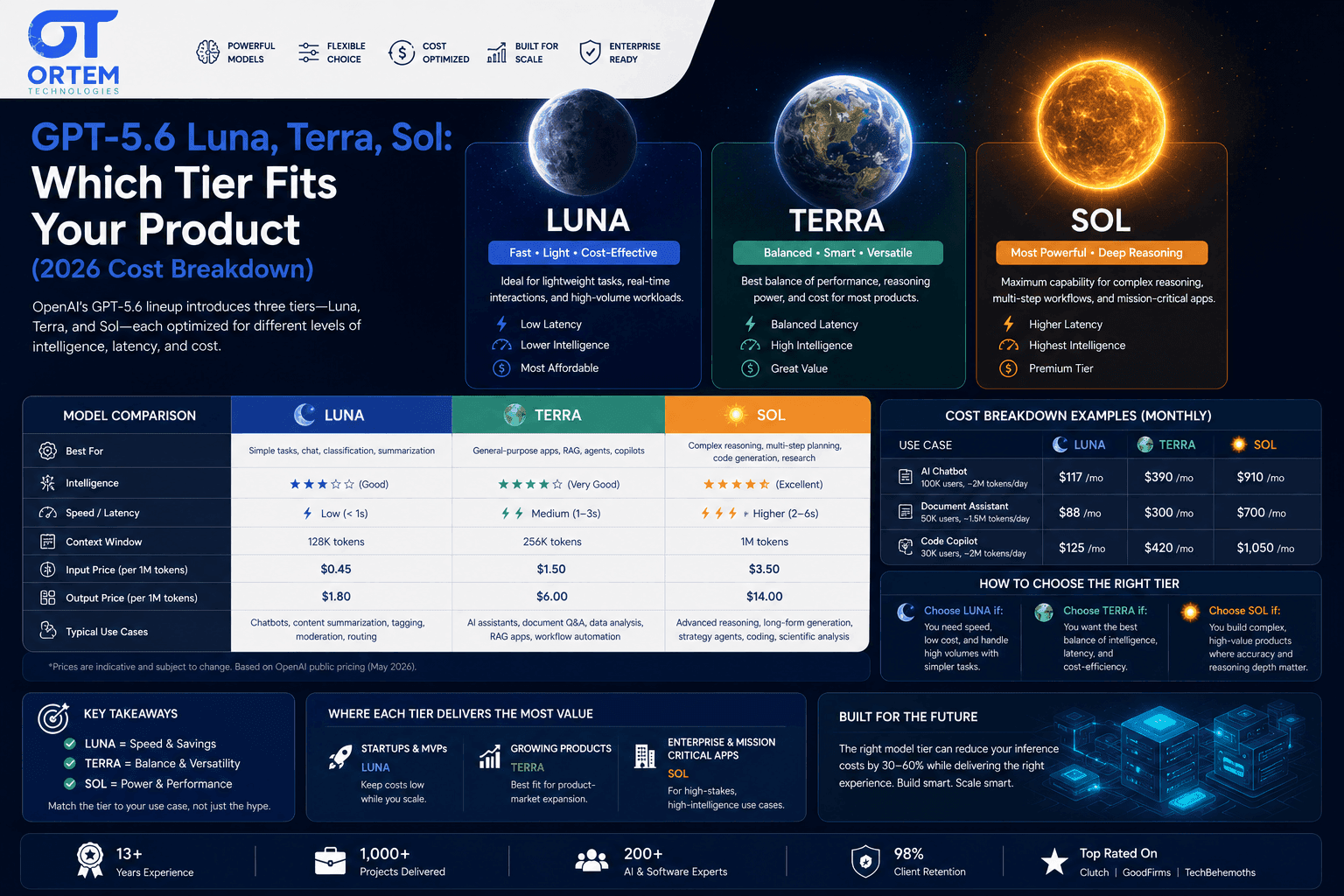
- Task-based routing. Classify each call by difficulty and route accordingly. Complex reasoning goes to a frontier model; classification, extraction and summarization go to models 10–20x cheaper. Routing is where multi-model pays for itself — most single-model systems overspend 40–70% by sending everything to the flagship.
- Tested fallback. A second provider wired and evaluated before you need it. Not "we could switch" — a fallback that runs in CI against your evaluation set, so switching is a config change with known quality impact.
- Evaluation harness. A test set of real tasks from your product, scored automatically against every model and prompt change. This is the piece that turns "can we switch models?" from a research project into a report you already have. It is also the discipline that separates production AI teams from demo teams — something we screen for when clients hire AI developers through us.
"Doesn't that double the work?"
It adds roughly 1–2 weeks to a typical integration. What it removes: emergency migrations (4–8 weeks, done under pressure, with customers watching), pricing captivity, and roadmap coupling. It also unlocks an immediate benefit unrelated to risk: routing cheap tasks to cheap models usually cuts inference spend enough to pay for the extra build time inside the first quarter.
For teams already deep in a single-vendor codebase, retrofitting is a contained project: introduce the abstraction layer around existing calls first, add the evaluation harness second, wire the fallback third. We typically deliver the full retrofit in 3–5 weeks alongside normal feature work.
The bottom line
Gemini 3.5 will ship eventually, and it will probably be good. The lesson survives either way: model roadmaps are weather, and you build for weather with an umbrella, not a forecast. Two weeks of architecture buys you indifference to headlines like this week's — permanently.
We design and build multi-model LLM integrations, routing, and evaluation harnesses for products at every stage. See our LLM integration services or book a free consultation — we can audit an existing single-vendor integration and give you a retrofit plan in one call.
About Ortem Technologies
Ortem Technologies is a premier custom software, mobile app, and AI development company. We serve enterprise and startup clients across the USA, UK, Australia, Canada, and the Middle East. Our cross-industry expertise spans fintech, healthcare, and logistics, enabling us to deliver scalable, secure, and innovative digital solutions worldwide.
Get the Ortem Tech Digest
Monthly insights on AI, mobile, and software strategy - straight to your inbox. No spam, ever.
Sources & References
- 1.Top Tech News, July 17 2026 - Tech Startups
- 2.LLM Integration Services - Ortem Technologies
About the Author
Director – AI Product Strategy, Development, Sales & Business Development, Ortem Technologies
Praveen Jha is the Director of AI Product Strategy, Development, Sales & Business Development at Ortem Technologies. With deep expertise in technology consulting and enterprise sales, he helps businesses identify the right digital transformation strategies - from mobile and AI solutions to cloud-native platforms. He writes about technology adoption, business growth, and building software partnerships that deliver real ROI.
Frequently Asked Questions
- According to reporting in mid-July 2026, Google pushed back the broader release of Gemini 3.5 Pro by several months after internal testing showed the model underperforming the company's own expectations on coding tasks and complex, long-horizon reasoning. Delays of this kind are normal in frontier AI development — which is exactly why product architectures should not assume any vendor's roadmap.
- An architecture where your application talks to an internal abstraction layer instead of directly to one vendor's API. Behind that layer, a router sends each task to the best-fit model — for example, a frontier model for complex reasoning, a cheaper fast model for classification — and a fallback model activates automatically if the primary fails, degrades, or gets deprecated.
- Roughly 1–2 additional engineering weeks on a typical integration — $5,000–$15,000 through a development partner. That buys the abstraction layer, routing config, and a tested fallback path. Compare that with the cost of an emergency migration under pressure, which typically runs 4–8 weeks with product risk attached, when a vendor deprecates a model or shifts pricing.
- It usually reduces them. Task-based routing sends only genuinely hard tasks to expensive frontier models and routes high-volume simple tasks (classification, extraction, summarization) to models that cost 10–20x less per token. Most production systems we audit overspend by 40–70% by sending everything to one flagship model.
- The honest answer is: at least two. Pick a primary based on your dominant workload — current-generation options include GPT-5.x, Claude Opus 4.8/Sonnet 5, Gemini 3, and Llama 4 for self-hosting — then wire a second as a tested fallback. The specific pair matters less than the ability to change the answer in configuration rather than in a rewrite.
Stay Ahead
Get engineering insights in your inbox
Practical guides on software development, AI, and cloud. No fluff — published when it's worth your time.
Ready to Start Your Project?
Let Ortem Technologies help you build innovative software solutions for your business.
You Might Also Like
What AI Agents Really Cost to Run in Production: 2026 Inference Budget Guide
GPT-5.6 Luna, Terra, Sol: Which Tier Fits Your Product (2026 Cost Breakdown)