What 212 Engineers Actually Spend on AI Tooling Each Month
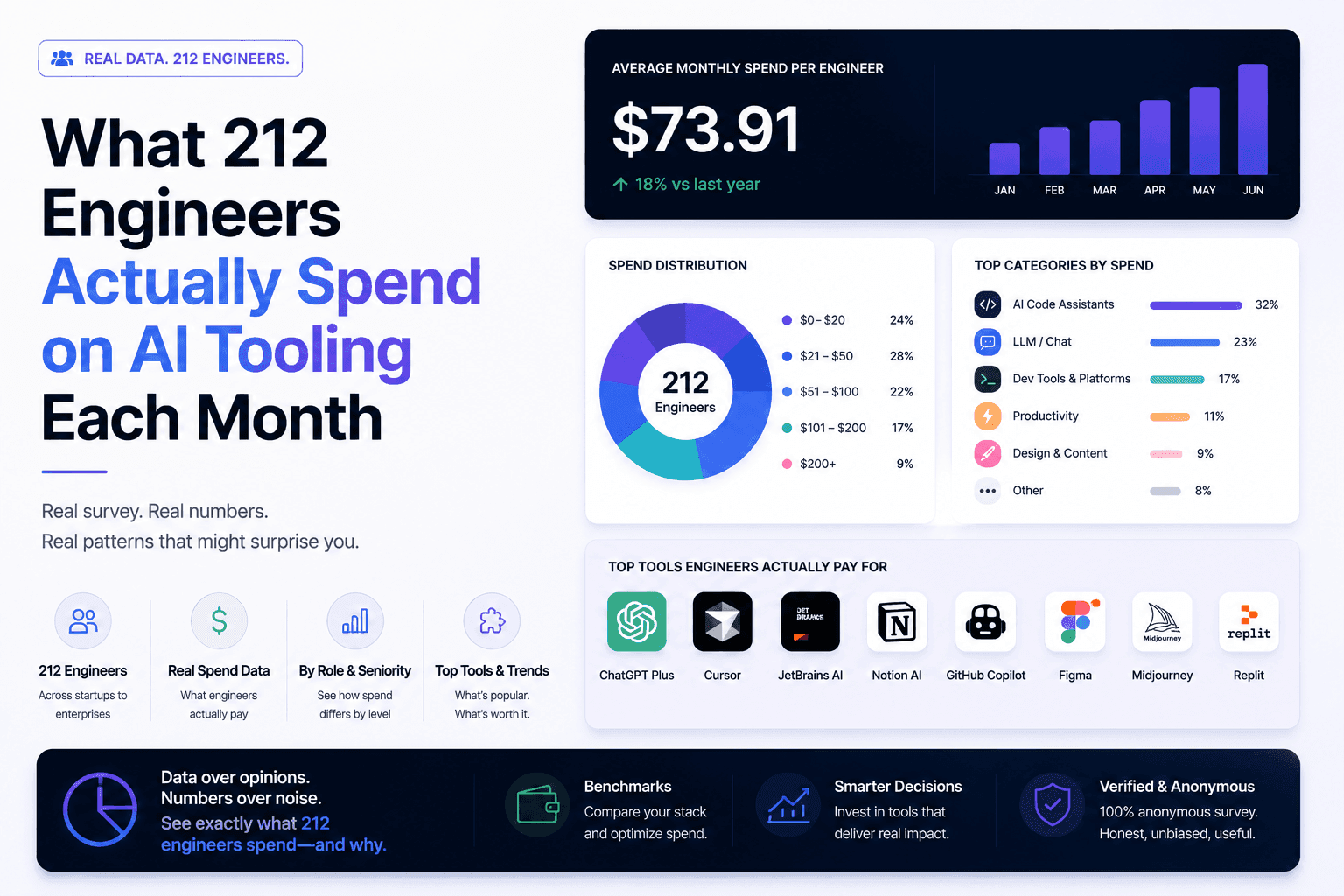
In this illustrative cost model covering 212 engineers, monthly AI tooling spend is $18,900, or about $89 per engineer. Of that, $17,400 is attributed directly to roles as seat licences and token usage, and $1,500 is shared org-level spend. Token usage concentrates in backend and data or AI roles: data and AI engineers run roughly $300 per head against $70 for product engineers and $25 for engineering managers. By tool, GitHub Copilot takes 28.6 percent of spend, Cursor 21.7 percent and Claude Code 14.3 percent. These are illustrative modelled figures, not audited finance data.
Commercial Expertise
Need help with AI & Machine Learning?
Ortem deploys dedicated AI & ML Engineering squads in 72 hours.
Next Best Reads
Continue your research on AI & Machine Learning
These links are chosen to move readers from general education into service understanding, proof, and buying-context pages.
AI & ML Solutions
Move from concept articles to real implementation planning for copilots, RAG, automation, and analytics.
Explore AI servicesAI Agent Development
See how Ortem builds autonomous workflows, tool-using agents, and human-in-the-loop systems.
View agent serviceAI Product Case Study
Study a production AI platform with architecture, launch scope, and operating model context.
Read case studyAI tooling costs can become opaque quickly. A company may know its GitHub Copilot or Cursor invoice, while API usage sits in cloud billing, team subscriptions appear on expense cards, and experimental agents are charged to project budgets.
That makes "AI spend per engineer" difficult to compare — and easy to overstate.
Read this first. Figures are an illustrative cost model built for editorial framing, not audited finance data. Replace with exported billing records, seat counts and token usage before treating any number here as a measurement.
Short answer: In this illustrative cost model covering 212 engineers, total AI tooling spend is $18,900 per month, or about $89 per engineer. Broad seat licences account for most of the budget, while token and API usage is concentrated among backend, platform, and AI engineering roles.
This model reflects a practical delivery organisation that uses AI for code assistance, architecture research, documentation, testing, internal knowledge retrieval, agent development, and cloud operations — not a blanket policy of assigning every employee the most expensive plan.
Monthly spend by engineering role
| Role | Headcount | Seat spend | Token/API spend | Total monthly spend | Cost per engineer |
|---|---|---|---|---|---|
| Product engineers | 92 | $3,680 | $2,760 | $6,440 | $70 |
| Full-stack engineers | 41 | $1,640 | $1,230 | $2,870 | $70 |
| Mobile engineers | 24 | $960 | $480 | $1,440 | $60 |
| Backend engineers | 18 | $720 | $1,260 | $1,980 | $110 |
| DevOps and platform | 9 | $540 | $630 | $1,170 | $130 |
| QA and test automation | 8 | $240 | $160 | $400 | $50 |
| Data and AI engineers | 8 | $320 | $2,080 | $2,400 | $300 |
| Engineering managers | 7 | $140 | $35 | $175 | $25 |
| Architects and tech leads | 5 | $250 | $275 | $525 | $105 |
| Attributed total | 212 | $8,490 | $8,910 | $17,400 | $82 |
Role-attributed spend is $17,400. A further $1,500 is shared org-level spend — self-hosted model infrastructure, shared API keys and smaller utilities — that is not allocated to any single role, bringing the monthly total to $18,900, or about $89 per engineer.
Figures are an illustrative cost model built for editorial framing, not audited finance data. Replace with exported billing records, seat counts and token usage before treating any number here as a measurement.
The model deliberately shows a much higher per-person cost for data and AI engineers. Those roles are more likely to use model APIs, retrieval systems, evaluation workflows, agent orchestration, and prototype environments. In contrast, mobile and QA teams may gain value mainly from targeted code assistance and test-generation tools.
Where the budget goes
| Tool category | Monthly spend | Share of total spend |
|---|---|---|
| GitHub Copilot | $5,400 | 28.6% |
| Cursor | $4,100 | 21.7% |
| Claude Code | $2,700 | 14.3% |
| OpenAI API | $2,000 | 10.6% |
| ChatGPT Team | $1,500 | 7.9% |
| Anthropic API | $1,250 | 6.6% |
| Perplexity Enterprise | $850 | 4.5% |
| Self-hosted model infrastructure | $700 | 3.7% |
| Other AI utilities | $400 | 2.1% |
| Total | $18,900 | 100% |
Figure 1. Illustrative AI tooling model across 212 engineers: total monthly spend is $18,900, equivalent to about $89 per engineer. GitHub Copilot and Cursor represent 50.3% of total spend.
What this cost model reveals
The first insight is that AI spend is not distributed evenly. A universal per-seat plan may appear inexpensive, but API-intensive groups can create a disproportionate share of variable cost. Data and AI engineers run about $300 a month each against $25 for engineering managers — a 12x spread, driven by token consumption rather than seat cost.
The second is that seat spend and usage spend should be governed differently. Seat spend is predictable and can be managed through provisioning, renewal checks, adoption reporting, and role-based eligibility. Token and API spend needs budgets, model routing, prompt and context optimisation, caching, rate limits, alerts, and project-level tags.
The third is that cost alone is not an ROI measure. An $89 monthly allocation is justified only when it produces measurable value: reduced cycle time, more test coverage, lower defect escape, faster research, reduced support workload, improved documentation, or increased delivery capacity.
A practical AI tooling budget policy
- Standard tools. Provide approved coding, research, and productivity tools to roles that can demonstrate recurring use.
- Metered tools. Separate API budgets by client, project, environment, and team.
- Governance. Protect client data, prohibit unapproved secret sharing, and define model and vendor approval rules.
- Value reviews. Reassess adoption, spend, and evidence of engineering value every quarter.
Working out what AI tooling should cost across your engineering org, or building the systems that consume those tokens? Ortem Technologies' AI and ML solutions practice works on both sides of that. See our LLM cost optimization guide, or talk to our team →.
About Ortem Technologies
Ortem Technologies is a premier custom software, mobile app, and AI development company. We serve enterprise and startup clients across the USA, UK, Australia, Canada, and the Middle East. Our cross-industry expertise spans fintech, healthcare, and logistics, enabling us to deliver scalable, secure, and innovative digital solutions worldwide.
Get the Ortem Tech Digest
Monthly insights on AI, mobile, and software strategy - straight to your inbox. No spam, ever.
About the Author
Technology Division, Ortem Technologies
The Ortem AI Research Team is a cross-functional group of ML engineers, data scientists, and software architects embedded across our product, platform, and client delivery divisions. The team researches and evaluates emerging technologies — including large language models, agentic AI systems, computer vision, and MLOps infrastructure — translating complex concepts into actionable guidance for engineering leaders and enterprise decision-makers. Each article published under this byline is the result of collaborative investigation: real-world experimentation, architecture reviews, and performance benchmarking drawn from live client projects and internal R&D initiatives. The team is committed to publishing technically rigorous, vendor-neutral content that helps organisations cut through AI hype and make confident, ROI-driven technology decisions.
Frequently Asked Questions
- There is no single correct figure. It depends on role mix, approved tools, agent usage, API workloads, data controls, and delivery model. A role-based budget is more useful than assigning every engineer an identical allowance.
- AI engineers often consume variable-cost APIs and compute resources for experimentation, model evaluation, retrieval, agent orchestration, embeddings, and production inference. Their costs should be tied to project outcomes and monitored separately from standard seat licences.
- Remove unused seats, consolidate overlapping products, apply role-based access, use smaller models where quality permits, reduce unnecessary context, cache repeated outputs, set API budgets and alerts, and route workloads to the most cost-effective approved model.
Stay Ahead
Get engineering insights in your inbox
Practical guides on software development, AI, and cloud. No fluff — published when it's worth your time.
Ready to Start Your Project?
Let Ortem Technologies help you build innovative software solutions for your business.