
Answer Engine Optimization (AEO) in 2026: The Engineering Playbook for Getting Cited by AI
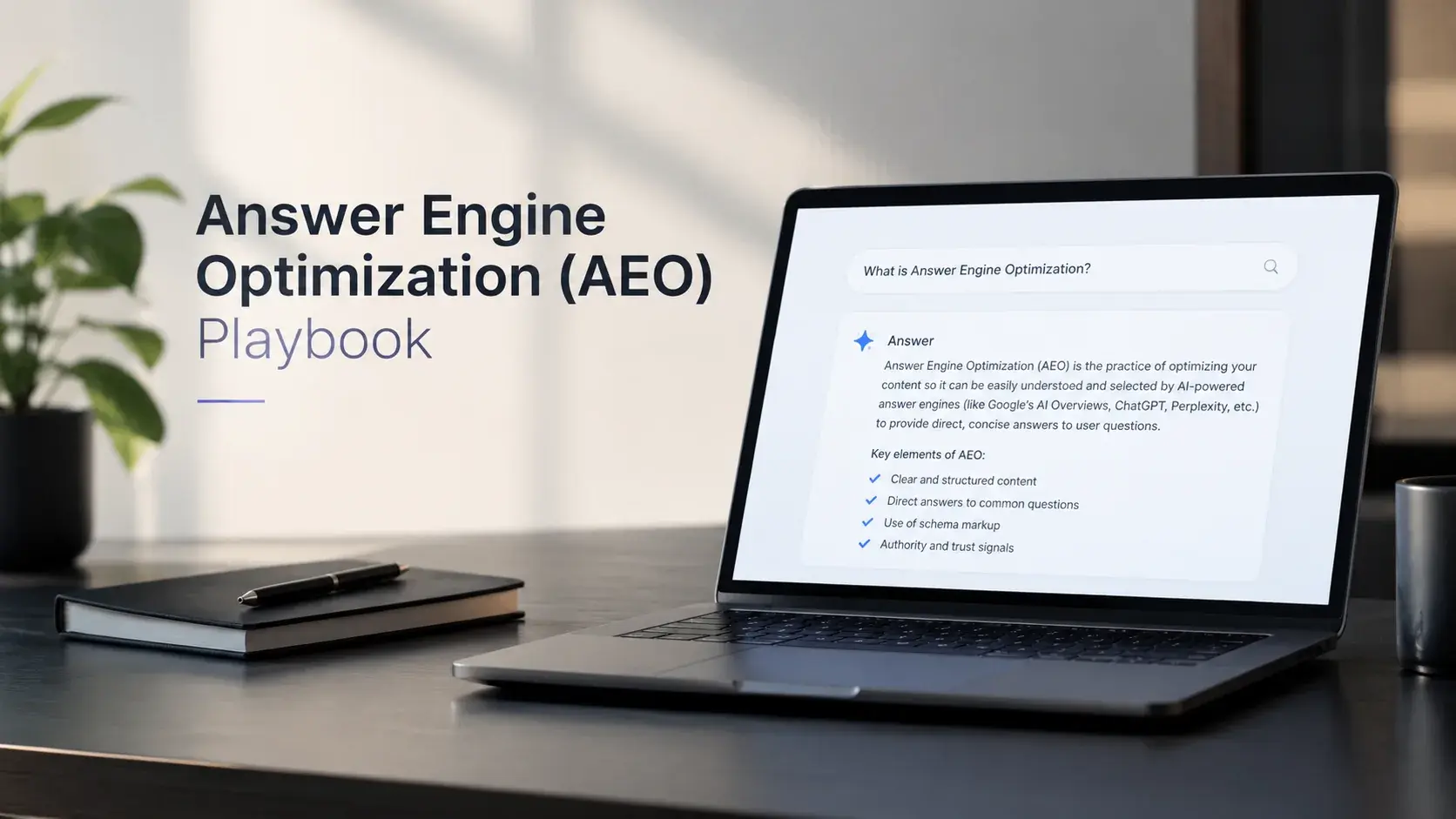
Answer engine optimization (AEO) is the practice of making your content easy for AI assistants such as ChatGPT, Perplexity, Claude and Google AI Overviews to retrieve, trust and cite. It rests on four things: crawl access for AI search bots, pages that are indexed and snippet-eligible, answer-first writing with clear evidence, and consistent facts about your brand across the web. Google states that no special markup is required to appear in its AI features.
Commercial Expertise
Need help with Digital Marketing?
Ortem deploys dedicated Digital Marketing squads in 72 hours.
Next Best Reads
Continue your research on Digital Marketing
These links are chosen to move readers from general education into service understanding, proof, and buying-context pages.
Digital Marketing Services
SEO, paid media, content strategy, and growth marketing built on strong technical foundations.
Explore marketing serviceWeb Development
A fast, well-structured website is the foundation for every marketing channel that works.
See web serviceGet a Growth Consultation
Book a free session to map your marketing gaps to technical and content fixes that convert.
Book free sessionAnswer engine optimization (AEO) is the work of making your pages easy for AI assistants to find, trust and quote. When someone asks ChatGPT, Perplexity, Claude or Google AI Mode a question, the assistant reads a handful of web pages and cites a few of them. AEO is how you become one of those few.
This guide is written for teams who build and run websites, not just for marketers. It covers how answer engines choose sources, nine practical steps, the tools that measure AI visibility, and the mistakes we see most often.
What Is Answer Engine Optimization?
Answer engine optimization is the practice of structuring and publishing content so AI assistants can retrieve it, trust it and cite it.
Classic SEO competes for a ranked position on a results page. AEO competes for a place inside the answer itself. The answer may quote one sentence from your page, list your brand among options, or link your page as a source.
You will also see the term generative engine optimization (GEO). It comes from a 2023 research paper that tested ways to raise a source's visibility in AI answers. In practice, AEO and GEO describe the same goal. AI search optimization is a third name for it.
| Term | Where it comes from | What it targets |
|---|---|---|
| SEO | Search marketing | Ranked links on a results page |
| AEO | Marketing and product teams | Citations and mentions inside AI answers |
| GEO | Academic research (Aggarwal et al., 2023) | Visibility of a source in generated answers |
How Answer Engines Choose What to Cite
Most answer engines work in three stages. Knowing them tells you where to focus.
1. Retrieval. The assistant runs one or more searches, often several rephrased versions of the user's question. It pulls candidate pages from a search index or from its own crawler. If your page is not crawlable or not indexed, nothing else matters.
2. Selection. The assistant reads the candidates and keeps the passages that answer the question best. Short, self-contained passages win here. A paragraph that needs three earlier paragraphs to make sense is hard to quote.
3. Synthesis. The model writes the answer and attaches citations. It favours facts that several sources agree on. A claim that appears only on your site, with no support elsewhere, is less likely to be repeated.
Google says the same thing in plainer words. Its documentation states that pages appearing in AI Overviews and AI Mode must be indexed and eligible to show a snippet, and that no additional technical requirements apply.
The AEO Playbook: 9 Steps That Matter
1. Open the door to AI search bots
Check your robots.txt first. Each assistant uses its own crawlers, and some separate search from training.
- OAI-SearchBot fetches pages for ChatGPT search. GPTBot collects training data. OpenAI documents them separately, so you can allow one and block the other.
- PerplexityBot indexes pages for Perplexity answers.
- ClaudeBot, Claude-SearchBot and Claude-User cover Anthropic's assistants.
A common mistake is a broad rule such as Disallow: /*? that quietly blocks these bots from useful pages. Test your rules against each user agent.
2. Make sure the page is indexed and snippet-eligible
If Google cannot show a snippet for a page, it cannot use that page in an AI Overview. Check for stray noindex tags, nosnippet directives and canonical tags that point elsewhere. Then confirm indexing in Search Console.
3. Lead with the answer
Put a direct answer of 40 to 60 words right under the heading that asks the question. Then add detail. This is the single most useful writing change for AEO.
Write the first sentence so it still makes sense if it is quoted alone. Repeat the subject instead of saying "it".
4. Use question-shaped headings
Users ask assistants full questions. Headings such as "How much does X cost?" or "What is the difference between X and Y?" map cleanly to those questions. Keep one idea per section.
5. Add evidence an assistant can repeat
The GEO paper tested several content changes. Adding citations to credible sources, adding quotations and adding statistics were among the most effective. The authors report visibility gains of up to 40% in their tests, with results varying by topic.
So give numbers with their source and date. Name the standard, the regulation or the study. Vague claims like "industry-leading" give a model nothing to quote.
6. Keep paragraphs short and self-contained
Aim for paragraphs under 80 words and sentences of about 15 words. Use tables for comparisons and numbered lists for steps. Every passage should be quotable on its own.
7. Use structured data where it fits
Google notes that structured data helps it understand what a page is about. Use the types that describe your page honestly: Article, FAQPage, HowTo, Product, Organization. Do not mark up content that users cannot see. Structured data is a clarity signal, not a ranking shortcut.
8. Make your brand facts consistent everywhere
Answer engines cross-check. Your company name, location, services, founding year and key numbers should match across your site, your Google Business Profile, directories such as Clutch and GoodFirms, LinkedIn and press coverage.
For "best company" and "top provider" questions, assistants often draw on listicles, directories and review sites. Being described accurately on those third-party pages matters as much as your own site.
9. Keep content fresh and dated
Show a visible "last updated" date and update facts that change, such as prices, versions and regulations. Assistants answering time-sensitive questions prefer recent sources.
What about llms.txt?
The llms.txt file is a proposal for a plain-text index that helps language models understand a site. It is cheap to add. There is no public evidence yet that major answer engines rely on it, so treat it as optional housekeeping, not a strategy.
AEO Tools: How to Measure AI Visibility
Answer engine optimization tools send a fixed set of prompts to AI assistants and record whether your brand is mentioned or cited. Most also show which URLs the assistant cited, and which competitors appeared instead.
Tools worth testing in 2026 include:
- Profound: AI visibility tracking aimed at larger brands.
- Peec AI: prompt tracking across several assistants with competitor comparisons.
- Otterly.AI: brand mention and citation monitoring.
- Scrunch: AI visibility and content insights.
- AthenaHQ: AI search monitoring and recommendations.
- Semrush AI Visibility Toolkit: AI visibility inside a wider SEO suite.
- Ahrefs Brand Radar: brand mentions in AI answers, tied to Ahrefs' index.
Pricing and coverage change often, so compare them on four points:
- Assistant coverage. Which assistants does it query: ChatGPT, Perplexity, Gemini, Claude, Google AI Overviews?
- Market coverage. Can it run prompts by country and language?
- Prompt volume. How many prompts can you track, and how often are they re-run?
- Citation detail. Does it show the exact cited URL, or only whether your brand was named?
How to measure AEO yourself
You can start without a paid tool.
- Write 30 to 50 prompts your buyers would ask, grouped by topic.
- Run each prompt several times. AI answers vary between runs, so one check proves little.
- Record citation share, meaning the percentage of runs in which your domain is cited.
- Track referral traffic from
chatgpt.com,perplexity.aiand similar sources in your analytics. - Re-run monthly and compare against your changes.
Common AEO Mistakes
- Blocking AI search bots by accident with broad robots.txt rules.
- Writing for keywords, not questions. Assistants respond to intent, not exact phrases.
- Burying the answer under a long introduction.
- Unsupported claims. Superlatives without data are rarely quoted.
- Inconsistent facts between your site and third-party profiles.
- Chasing a single prompt. Answers vary between runs, so measure trends across many prompts.
AEO Checklist
| Area | Check |
|---|---|
| Access | AI search bots allowed in robots.txt and not blocked by a firewall |
| Indexing | Page indexed, snippet-eligible, canonical points to itself |
| Structure | Question headings, 40 to 60 word answer first, short paragraphs |
| Evidence | Statistics and claims cite a named source and date |
| Markup | Honest structured data that matches visible content |
| Entity | Same company facts on site, directories and profiles |
| Freshness | Visible update date and current facts |
| Measurement | Fixed prompt set, multiple runs, citation share tracked monthly |
How Ortem Approaches AEO
We treat AEO as an engineering problem first. We audit crawl access and indexing, fix templates so every page leads with a quotable answer, add accurate structured data, and set up a repeatable prompt-tracking process. Content work comes after the foundations are sound.
If you want a second opinion on your AI visibility, see our answer engine optimization services. For a narrower look at one assistant, read how to rank in ChatGPT.
About Ortem Technologies
Ortem Technologies is a premier custom software, mobile app, and AI development company. We serve enterprise and startup clients across the USA, UK, Australia, Canada, and the Middle East. Our cross-industry expertise spans fintech, healthcare, and logistics, enabling us to deliver scalable, secure, and innovative digital solutions worldwide.
Get the Ortem Tech Digest
Monthly insights on AI, mobile, and software strategy - straight to your inbox. No spam, ever.
Sources & References
- 1.AI features and your website - Google Search Central
- 2.GEO: Generative Engine Optimization (Aggarwal et al.) - arXiv
- 3.Overview of OpenAI crawlers - OpenAI
- 4.Perplexity crawlers - Perplexity
- 5.Introduction to structured data markup in Google Search - Google Search Central
- 6.The /llms.txt file proposal - llmstxt.org
About the Author
Sales Head, Ortem Technologies LLC
Nirav B is the Sales Head at Ortem Technologies LLC. He works with businesses planning custom software, mobile and AI projects, helping them scope the work, choose an engagement model and plan delivery with Ortem's engineering team.
Frequently Asked Questions
- Answer engine optimization is the practice of structuring and publishing content so that AI assistants such as ChatGPT, Perplexity, Claude and Google AI Overviews can find it, trust it and cite it in their answers. It builds on SEO but focuses on being quoted inside an answer rather than ranking as a blue link.
- AEO depends on SEO. Answer engines still need to crawl and index your pages before they can cite them. The difference is the output. SEO competes for a ranked position, while AEO competes to be one of the few sources an AI answer quotes. That rewards short, direct, well-supported passages.
- Generative engine optimization (GEO) is the term used in academic research for the same goal: improving how often a source appears in AI-generated answers. In practice the two terms describe the same work. AEO is more common in marketing, while GEO comes from a 2023 research paper on the topic.
- No. Google states there are no additional requirements or special optimizations needed to appear in AI Overviews or AI Mode. Structured data still helps search engines understand a page, and llms.txt is a low-cost proposal, but neither is a requirement for being cited.
- Allow the search bots of the assistants you want to appear in, such as OAI-SearchBot for ChatGPT search and PerplexityBot for Perplexity. These are separate from training crawlers like GPTBot, so you can allow AI search while blocking model training if you prefer.
- AEO tools track how often AI assistants mention or cite your brand for a set of prompts. Options include Profound, Peec AI, Otterly.AI, Scrunch, AthenaHQ, the Semrush AI Visibility Toolkit and Ahrefs Brand Radar. Choose based on which assistants and countries they cover, how many prompts they run, and whether they show the cited URLs.
- Fixes to crawl access and indexing can show up within weeks, as soon as pages are recrawled. Gaining citations for competitive questions usually takes longer, because answer engines also weigh how widely your facts are confirmed by other sites.
Stay Ahead
Get engineering insights in your inbox
Practical guides on software development, AI, and cloud. No fluff — published when it's worth your time.
Ready to Start Your Project?
Let Ortem Technologies help you build innovative software solutions for your business.


