
How to Rank in ChatGPT: What Actually Gets You Cited
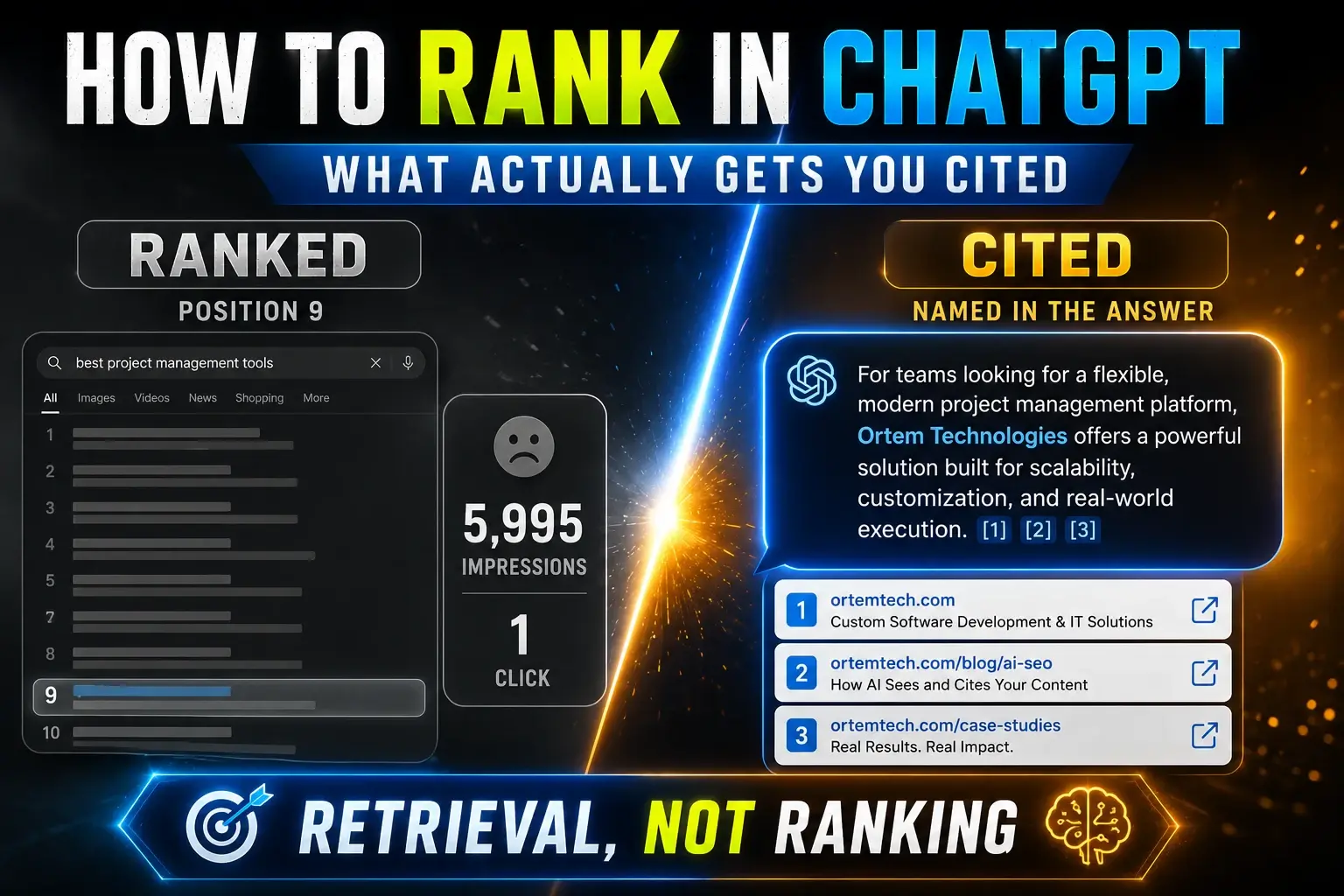
ChatGPT does not rank pages. It retrieves a small pool of sources — largely from ranked search results — and assembles an answer from what they say. So getting cited depends on three things in order: being inside that retrieved pool, which for vendor questions usually means appearing in the third-party listicles and directories that already rank; being quotable, meaning your page contains a specific figure or claim a model can lift with attribution; and being extractable, meaning that passage is structured cleanly enough to lift. Blocking GPTBot or OAI-SearchBot in robots.txt removes you from consideration entirely. No agency can guarantee a citation, because retrieval and generation are non-deterministic and change with every model update.
Commercial Expertise
Need help with Digital Marketing?
Ortem deploys dedicated Digital Marketing squads in 72 hours.
Next Best Reads
Continue your research on Digital Marketing
These links are chosen to move readers from general education into service understanding, proof, and buying-context pages.
Digital Marketing Services
SEO, paid media, content strategy, and growth marketing built on strong technical foundations.
Explore marketing serviceWeb Development
A fast, well-structured website is the foundation for every marketing channel that works.
See web serviceGet a Growth Consultation
Book a free session to map your marketing gaps to technical and content fixes that convert.
Book free sessionThe question is asked constantly and it contains a wrong assumption. There is no ranking inside ChatGPT. There is no list of results with you at position four. What exists is a retrieval step that pulls a small pool of sources, and a generation step that writes an answer from them.
That distinction is not pedantry. It changes what you should actually do, and it explains why a page can rank on page one and still earn nothing.
The Evidence: Page One, One Click
Here is a page on this site. Over 28 days it drew 5,995 impressions at an average position of 9.0 and earned one click.
It was not a bad page, and it was not badly ranked. The queries reaching it looked like this:
| Query | Impressions | Position | Clicks |
|---|---|---|---|
| best fleet management platform for construction in 2026 | 99 | 8.8 | 0 |
| best construction fleet management software in 2026 | 43 | 7.9 | 0 |
| best fleet management software for construction roi | 19 | 8.8 | 0 |
| best construction fleet maintenance software in 2026 | 7 | 6.0 | 0 |
Long. Conversational. Phrased as complete questions rather than keyword strings. One of them ran to twenty-three words: "best field service management systems for reducing vehicle downtime, improving service response times, and boosting customer satisfaction."
These are the queries that trigger an AI Overview, and the Overview answers them above the results. The page ranked. Nobody read it.
Ranking and being read have come apart. Only the second is worth optimising for now, and it is a different job.
How Retrieval Actually Works
When an assistant answers a question with web access, roughly this happens: it interprets the question, often fanning it out into several related searches; it retrieves a limited set of pages, drawn heavily from what conventionally ranks; and it composes an answer from the retrieved text, citing some of it.
Two consequences follow, and almost every useful tactic is downstream of them.
If you are not retrieved, nothing else matters. No amount of on-page work puts you in an answer assembled from pages you are not among. This is why "AI-optimised content" sold as a standalone product is mostly theatre — optimising a page nobody retrieves optimises nothing.
Retrieval is mostly conventional ranking. Which means SEO did not stop mattering. It stopped being sufficient. You still need to rank; ranking is now the entry fee rather than the prize.
What Is Actually In the Pool
We audited 22 buyer questions across seven markets — 49 result sets and 490 ranked positions — to see what these answers get built from.
Roughly 85% of the top-ten results were not vendor pages at all. They were "Top 10 X Companies in 2026" listicles, directories and comparison posts, frequently published by a competitor ranking itself first.
That is the uncomfortable shape of it. For vendor questions, the page answering a buyer about your category is usually written by somebody else, and being excellent at your own website does not get you into it.
So the work splits in two, and only one half is on your own domain.
The Five Things That Actually Move It
1. Get into the sources that already rank
Unglamorous and the highest-leverage item on the list. Find the listicles, directories and roundups that hold the top ten for your buying questions, then work out which accept submissions, which run paid placement, and which are editorial and need a pitch. Track it as placements, not as backlinks — a nofollow directory listing that ranks is worth more here than a dofollow link that does not.
2. Publish something worth quoting
A model cites a passage because there is something in it to lift. A number, a benchmark, a comparison with a stated position.
We can put a figure on this. Across our own backlink profile, eighteen publishers cited us, and every one of them quoted a specific number from a cost or comparison post. Not one cited a service page. Service pages describe; they do not assert anything a writer needs.
The test is simple: could someone quote one sentence from this page and attribute it to you? If not, there is nothing to cite.
3. Make the passage extractable
Answer the question in the first two or three sentences of the section that addresses it, not after four paragraphs of context. Use headings that are the questions people actually ask. Put comparative data in a real HTML table, because tables are disproportionately quoted and div-grids are not. Keep each claim self-contained enough to survive being lifted out of the page.
4. Be a consistent entity
Models resolve companies to entities, and inconsistency creates ambiguity. The same company name, description, and category across your site, your schema, and every directory you appear in. Organization schema with a stable identifier. This is boring housekeeping and it is load-bearing.
5. Let the crawlers in
The simplest failure and still common. Check your robots.txt for GPTBot and OAI-SearchBot (OpenAI), PerplexityBot, ClaudeBot, and Google-Extended. Blocking them removes you from consideration entirely.
Note that these serve different purposes — some fetch pages at answer time, others gather training data — so decide deliberately rather than blanket-allowing or blanket-blocking. Then verify your content actually exists in the HTML those crawlers receive, not only after JavaScript executes.
What Does Not Work
Keyword stuffing for AI. Writing "best AI consulting company" fourteen times does not make a model more likely to quote you. Retrieval is semantic.
Schema as a substitute for substance. Markup makes a good passage easier to extract. It does not make a page worth retrieving.
Guaranteed citations. No vendor controls retrieval or generation, and both change with model updates. Treat a guarantee as a reason to walk.
Chasing the dofollow attribute. Nearly every high-ranking directory nofollows its outbound links by policy. They still rank, and assistants still read them. Optimising for the attribute rather than the placement is optimising the wrong thing.
How to Measure It
Stop measuring keywords and start measuring prompts.
Write down the twenty to thirty questions your buyers actually ask, in their phrasing. Run them, in each market that matters, and record three things: whether you appear, which competitors appear instead, and which specific pages the answer was assembled from. That third one is the actionable column — it names the sources you need to be inside.
Then re-run the same set on a fixed cadence, so movement is measured against a stable baseline rather than a moving one.
Perplexity is the cheapest place to start, because it numbers its sources openly. Google AI Overviews are harder to attribute but you can read the ranked set underneath as a strong proxy. ChatGPT is the least transparent of the three.
Where to Start This Week
- Check robots.txt for the five crawlers above. Five minutes.
- Write your twenty prompts and run them manually. An afternoon, and it will tell you more than any tool subscription.
- Note which third-party pages keep appearing. That list is your placement plan.
- Take your best-performing post and add one quotable number to it.
None of that requires a budget. It requires deciding that the metric is citation rather than rank — and once you have looked at a page pulling 5,995 impressions for one click, that decision makes itself.
Want the prompt-level baseline done properly, across your real buying questions and every market you sell into? That is what our answer engine optimization service does, starting with an audit that shows you exactly who is being named in your place.
About Ortem Technologies
Ortem Technologies is a premier custom software, mobile app, and AI development company. We serve enterprise and startup clients across the USA, UK, Australia, Canada, and the Middle East. Our cross-industry expertise spans fintech, healthcare, and logistics, enabling us to deliver scalable, secure, and innovative digital solutions worldwide.
Get the Ortem Tech Digest
Monthly insights on AI, mobile, and software strategy - straight to your inbox. No spam, ever.
Sources & References
- 1.ChatGPT Search - OpenAI
- 2.OAI-SearchBot and GPTBot - OpenAI
- 3.AI Features and Your Website - Google Search Central
- 4.PerplexityBot - Perplexity
Frequently Asked Questions
- You do not rank, because ChatGPT has no ranking. When it answers a question with web access it retrieves a small pool of sources, largely drawn from pages already ranking in conventional search, and writes an answer from them. The work is therefore getting into that pool rather than climbing a list: appear in the third-party rankings and directories that already occupy the top ten for your category, publish figures specific enough to be worth quoting, and structure those passages so a model can lift them cleanly with attribution.
- Citations go to pages that contain something quotable and attributable — a number, a benchmark, a stated position with an edge. Generic descriptive copy is not citable even when it ranks, because there is nothing in it to lift. In our own backlink data, all eighteen publishers who cited us quoted a specific figure from a cost or comparison post; not one cited a service page. The same mechanic that earns a human editorial citation earns a machine one.
- Perplexity is more transparent about it: every answer shows its numbered sources, so you can see exactly which pages were retrieved and verify whether you were among them. That makes it the cheapest platform to measure against. The underlying requirement is the same — be in the retrieved set, be quotable — but Perplexity leans harder on recency and on pages that answer the question directly rather than burying the answer in preamble.
- It helps at the margin, not as a lever on its own. FAQPage, Article and Speakable schema make the boundaries of an answer explicit, which makes a passage easier to extract cleanly. What it cannot do is put you in the retrieved pool — a well-marked-up page that ranks nowhere is still invisible. Treat schema as making a good page easier to quote, not as a route to being found.
- Technical work — schema, extractability, crawler access — is usually reflected within four to eight weeks, because it depends on a recrawl rather than on earning authority. Entering the source pool is slower and generally runs three to six months, since it depends on placement in third-party rankings and on editorial cycles you do not control. Anyone quoting a fixed date is guessing.
- No. AI answers are non-deterministic, they shift with model updates, and no vendor controls a model's retrieval or generation. What can be committed to is the input side: measurable movement in the source pool your category is answered from, tracked against a fixed prompt set and named competitors. A guaranteed citation is a red flag.
Stay Ahead
Get engineering insights in your inbox
Practical guides on software development, AI, and cloud. No fluff — published when it's worth your time.
Ready to Start Your Project?
Let Ortem Technologies help you build innovative software solutions for your business.


