
How Long Does Enterprise Software Development Take? A Realistic 2026 Timeline
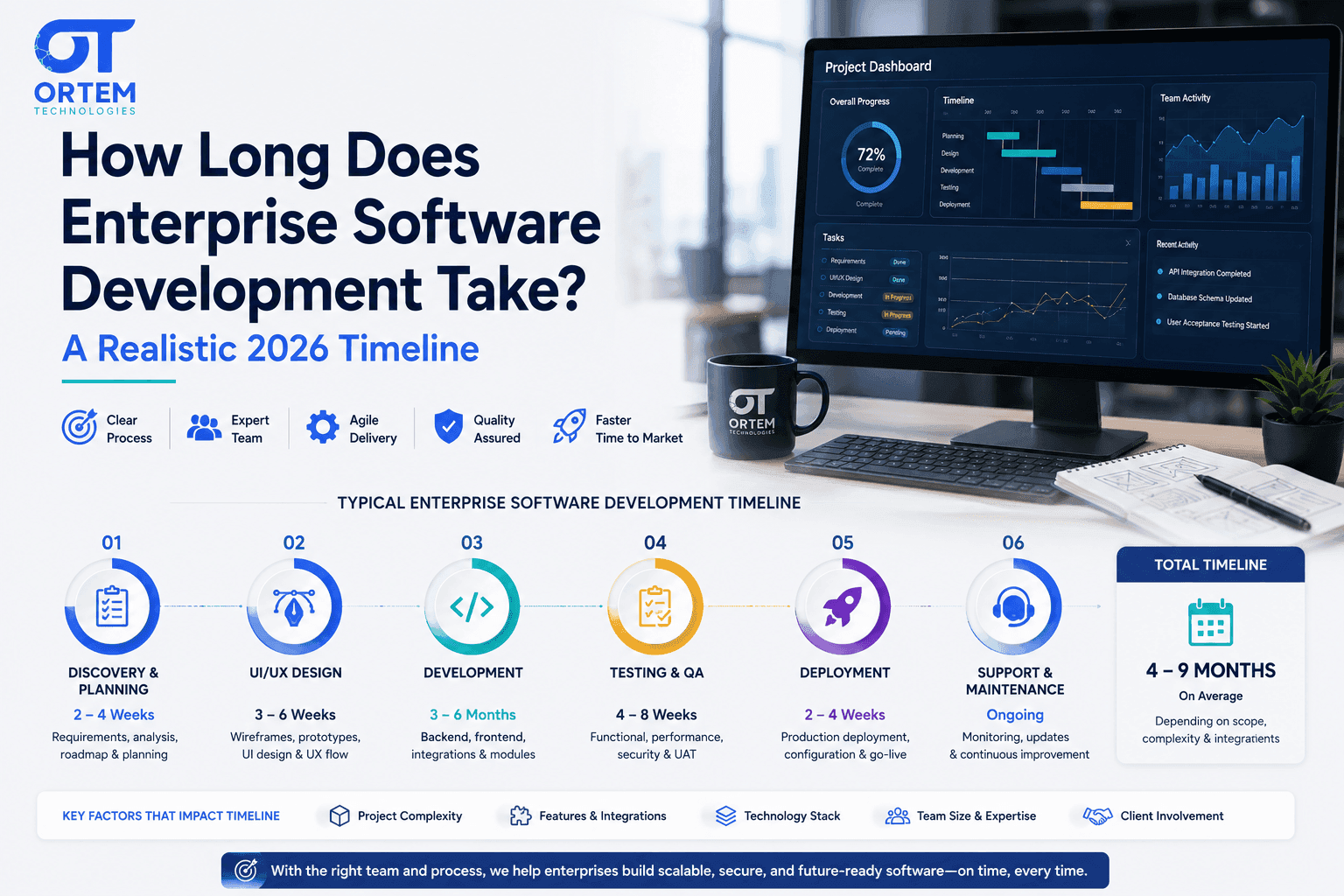
Enterprise software development timelines in 2026 range from 3-4 months for a focused internal tool with minimal integrations, to 6-9 months for a departmental platform with moderate system integration, to 12-14+ months for a multi-system platform with complex data migration and compliance requirements. The single biggest driver of timeline isn't feature count — it's integration surface: how many existing systems (ERP, CRM, identity provider, legacy databases) the new platform must talk to, and how clean that data is. Discovery that maps integration and compliance scope upfront is what separates an accurate timeline from an optimistic one.
Enterprise software development timeline refers to the elapsed time from discovery to production launch for a custom platform built for internal or B2B operational use, as distinct from consumer app timelines. It is driven primarily by integration complexity (the number and condition of existing systems the new software must connect to) and compliance scope, not by raw feature count — two platforms with similar feature lists can differ by 6+ months in timeline based on integration surface alone.
Commercial Expertise
Need help with Software Development?
Ortem deploys dedicated Custom Software Development squads in 72 hours.
Next Best Reads
Continue your research on Software Development
These links are chosen to move readers from general education into service understanding, proof, and buying-context pages.
Custom Software Development
Build exactly what you need — dashboards, platforms, SaaS, and internal tools with dedicated squads.
Explore software serviceMVP Development
Launch faster with a scoped MVP that proves your concept before full product investment.
See MVP serviceCustom Platform Case Study
Multi-tenant SaaS built with production-grade architecture, compliance, and operational scale.
Read case studyAsk three vendors "how long will our enterprise platform take?" and you'll get three confident answers that don't actually agree, because most vendors quote the timeline for the features without pricing in the thing that actually determines it: how many existing systems the new platform has to talk to, and how clean the data in them actually is.
Feature count is a rounding error next to integration surface. Here's how to tell which timeline tier your project is actually in.
The three timeline tiers
Tier 1 — Focused internal tool: 3-4 months. A single-purpose application with minimal external dependencies — think an internal approval workflow, a reporting dashboard pulling from one clean data source, or a departmental tool that doesn't need to write back into other systems. Discovery is short because there's not much to map.
Tier 2 — Departmental platform: 6-9 months. Integrates with 2-4 existing systems — an ERP, an identity provider, a CRM — with moderate data exchange in both directions. This is where most "enterprise" projects actually land, and where timeline estimates most commonly go wrong, because teams scope the new platform's features carefully but treat "integrate with the ERP" as a single line item rather than its own discovery exercise.
Tier 3 — Multi-system platform program: 12-14+ months. Five or more integration points, meaningful data migration from legacy systems, and typically multiple compliance requirements (HIPAA, SOC 2, industry-specific regulation) layered on top. These are less "a build" than a program with multiple workstreams running in parallel.
| Tier | Integrations | Typical timeline | Typical cost |
|---|---|---|---|
| Focused internal tool | 0-1 | 3-4 months | $75,000-$150,000 |
| Departmental platform | 2-4 | 6-9 months | $150,000-$300,000 |
| Multi-system platform program | 5+ | 12-14+ months | $300,000-$500,000+ |
Why integration surface dominates the timeline, not feature count
Two platforms can have nearly identical feature lists — user management, a dashboard, a workflow engine — and differ by six months in delivery time based entirely on what's behind the integrations. A well-documented, modern API with clean data is a few days of integration work. A legacy system with no API, inconsistent records, and business logic that lives only in someone's head requires reverse-engineering before you can even start building against it. That difference has nothing to do with your new software's feature complexity and everything to do with what it has to connect to.
Data migration is the other timeline killer. Legacy data is rarely as clean as the people who've worked with it for years believe. Duplicate records, schema drift accumulated over a decade, and undocumented edge cases all surface during migration — and they surface late, if migration is treated as a final-sprint task rather than something rehearsed early.
What a realistic process actually looks like
Discovery (2-4 weeks). This is where integration and compliance scope get mapped — which systems, what condition their APIs and data are in, which compliance regimes apply. A fixed-price discovery phase should produce a milestone-based quote, not a rough estimate. If a vendor skips this and jumps straight to a timeline, they're guessing.
Architecture (2-4 weeks). Identity and audit infrastructure get built first, because retrofitting authentication and audit logging into a system already in production is expensive and risky — far more expensive than building it correctly from the start.
Sprint development (the bulk of the timeline). Two-week sprints with demos to stakeholders, each milestone carrying written acceptance criteria you sign off before invoice — not a black box until the final delivery date.
Migration, training, and handover (final 4-8 weeks). Rehearsed data migration — meaning it's been run and validated against the source system before the cutover, not attempted live — plus admin and end-user training, runbooks, and either handover to your internal IT team or an ongoing SLA-backed support retainer.
Off-the-shelf vs. custom: a timeline question too
Off-the-shelf software wins when your process is standard — generic accounting, payroll, a common CRM workflow. Custom development wins when your process is the competitive advantage, when per-seat licensing costs are compounding painfully at your scale, or when you're stitching together three overlapping SaaS tools with spreadsheets — which is itself a hidden integration project that a custom platform can eliminate. If you're modernizing an existing legacy system rather than building new, the timeline math shifts again — see our application modernization service for what that process looks like specifically.
The bottom line
If a vendor gives you an enterprise timeline before mapping your integration surface and data condition, you have a guess, not a plan. Ask specifically: how many systems will this need to talk to, what's the API and data quality on each, and what compliance regimes apply? The answers to those three questions determine your actual tier — and your actual timeline — far more than the feature list does.
We scope enterprise builds with integration mapping and compliance review built into discovery from day one — see our enterprise software development service, or start a discovery conversation to get an honest read on which tier your project falls into before you commit to a launch date.
About Ortem Technologies
Ortem Technologies is a premier custom software, mobile app, and AI development company. We serve enterprise and startup clients across the USA, UK, Australia, Canada, and the Middle East. Our cross-industry expertise spans fintech, healthcare, and logistics, enabling us to deliver scalable, secure, and innovative digital solutions worldwide.
Get the Ortem Tech Digest
Monthly insights on AI, mobile, and software strategy - straight to your inbox. No spam, ever.
Sources & References
- 1.Enterprise Software Development Services - Ortem Technologies
- 2.Application Modernization Services - Ortem Technologies
About the Author
Director – AI Product Strategy, Development, Sales & Business Development, Ortem Technologies
Praveen Jha is the Director of AI Product Strategy, Development, Sales & Business Development at Ortem Technologies. With deep expertise in technology consulting and enterprise sales, he helps businesses identify the right digital transformation strategies - from mobile and AI solutions to cloud-native platforms. He writes about technology adoption, business growth, and building software partnerships that deliver real ROI.
Frequently Asked Questions
- Three broad tiers: a focused internal tool with minimal external integrations typically takes 3-4 months. A departmental platform integrating with 2-4 existing systems (e.g., an ERP, an identity provider) typically takes 6-9 months. A multi-system platform program with complex data migration, multiple compliance requirements, and 5+ integration points typically takes 12-14+ months. Most enterprise timeline overruns come from underestimating which tier a project actually falls into during initial scoping.
- Integration surface — the number of existing systems the new platform must connect to, and the condition of the data in them. A platform with clean, well-documented APIs to integrate against moves fast. A platform that has to reconcile data from a legacy system with inconsistent records, undocumented business logic, or no API at all can add months that have nothing to do with the new software's own feature complexity.
- Enterprise builds typically range from $75,000 for a focused internal tool to $500,000+ for a multi-system platform program, and cost generally does correlate with timeline since both are driven by the same variable: integration and compliance scope. The exception is compliance-heavy short builds — a 4-month HIPAA or SOC 2-scoped project can cost more per month than a longer, less-regulated build, because compliance work front-loads cost into discovery and architecture.
- Let the vendor handle it as part of the engagement, but insist migration is scoped and rehearsed in discovery, not treated as a late-stage task. Data migration is consistently where enterprise timelines slip because legacy data is rarely as clean as internal teams believe — reconciling duplicate records, resolving schema mismatches, and validating migrated data against the source system takes real time that a rushed handoff doesn't account for.
- Discovery (2-4 weeks): integration and compliance mapping, fixed-price scoping producing a milestone-based quote. Architecture (2-4 weeks): identity and audit infrastructure built first since retrofitting them later is expensive. Sprint development (bulk of the timeline): two-week sprints with stakeholder demos and written acceptance criteria per milestone. Migration, training, and handover (final 4-8 weeks): rehearsed data migration, admin/end-user training, and either an internal IT handover or an SLA-backed support retainer.
Stay Ahead
Get engineering insights in your inbox
Practical guides on software development, AI, and cloud. No fluff — published when it's worth your time.
Ready to Start Your Project?
Let Ortem Technologies help you build innovative software solutions for your business.
You Might Also Like
AI Coding Agents Became Team Infrastructure: The 2026 Rollout Playbook

The Best Team Collaboration Software in 2026