
AI Coding Agents Became Team Infrastructure: The 2026 Rollout Playbook
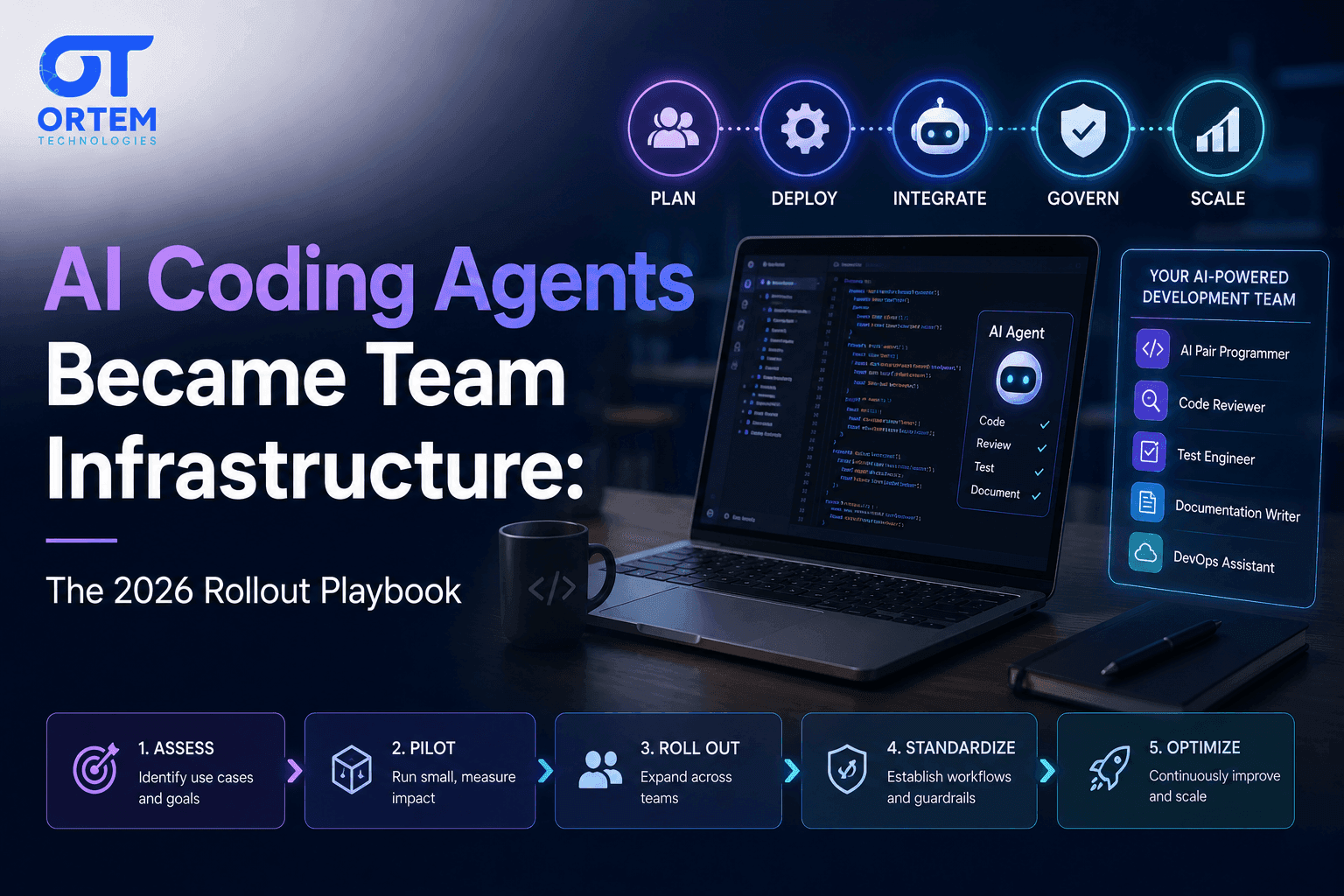
In July 2026, coordinated releases of coding-focused frontier models pushed AI coding agents from individual productivity tools to shared team infrastructure — with team workspaces, shared standards, governance controls, and usage-based billing. A successful team rollout needs four things: a written agent policy (what agents may touch, who reviews output), shared context files so agents follow team conventions, per-seat cost monitoring against usage-based pricing, and review discipline that treats agent code like junior-engineer code. Ortem Technologies runs agent-augmented delivery on its own teams and helps clients stand up the same playbook.
AI coding agents are autonomous or semi-autonomous systems that plan and execute multi-step programming tasks — writing features, fixing bugs, running tests across a repository — rather than autocompleting single lines. As of mid-2026 they have become team infrastructure: shared configuration, team-level governance, and usage-based billing, which makes rollout an engineering-management problem, not a tool preference.
Commercial Expertise
Need help with Software Development?
Ortem deploys dedicated Custom Software Development squads in 72 hours.
Next Best Reads
Continue your research on Software Development
These links are chosen to move readers from general education into service understanding, proof, and buying-context pages.
Custom Software Development
Build exactly what you need — dashboards, platforms, SaaS, and internal tools with dedicated squads.
Explore software serviceMVP Development
Launch faster with a scoped MVP that proves your concept before full product investment.
See MVP serviceCustom Platform Case Study
Multi-tenant SaaS built with production-grade architecture, compliance, and operational scale.
Read case studyMid-July brought coordinated releases of coding-tuned frontier models — built for repository-level reasoning and 30-to-60-step workflows — and with them a quieter shift that matters more to engineering leaders than any benchmark: coding agents are now team products. Shared workspaces, team standards, governance controls, usage-based billing. The vendor message is unambiguous: this is infrastructure, configure it like infrastructure.
Which means the interesting question is no longer "which agent is best?" It is "how do we roll this out across a team without shipping slop or tripling our tooling bill?" Here is the playbook we use on our own delivery teams.
The four-part rollout
1. Write the agent policy first. One page, checked into the repo. What agents may touch freely (tests, boilerplate, migrations, docs), what requires senior review before merge (auth, payments, data handling, infra config), what they may not touch (secrets, production credentials). Without a written line, every developer draws their own, and you discover the differences in incident review.
2. Ship shared context files. Agents follow the conventions they can see. A conventions file in the repo — architecture rules, naming, error-handling patterns, test expectations — turns agent output from generically plausible code into code that looks like your team wrote it. This is the highest-leverage hour of the entire rollout.
3. Meter the spend from day one. Usage-based billing means agent tooling behaves like production inference: $50–$300 per developer per month at realistic intensity, with heavy frontier-model workflows at the top. Per-seat dashboards, weekly review, and routing routine tasks to cheaper model tiers — the same discipline as our inference budget guide, applied to your own tooling. Unmonitored teams routinely triple their expected bill in month one.
4. Hold the review line. The only rule that decides whether agents help or hurt: agent code gets the same review bar as human code. An agent is a fast, tireless junior — productive under review, dangerous without it. Teams that relax review do not move faster; they relocate defect discovery from pull request to production incident.
What changes for team shape
Agents amplify unevenly. Seniors — who specify precisely and review sharply — get the biggest multiplier. Architects who can decompose a roadmap into well-bounded, agent-sized tasks become disproportionately valuable. Review capacity becomes the bottleneck long before writing capacity does.
Practical consequences: promote spec quality and review throughput to first-class metrics; expect junior development to need deliberate structure (juniors no longer learn by writing all the boilerplate themselves); and when you add external capacity, interrogate the partner's agent workflow — a 2026-grade staff augmentation or dedicated team engagement should arrive with agent-augmented delivery and review discipline built in, and you should ask to see it.
A note on the governance backstop
Policy and review are the primary controls, but wire the mechanical ones too: secret scanning and dependency checks in CI, branch protection on sensitive paths, and audit logs from the agent platform's team tier. The governance features vendors shipped this month exist because early adopters learned these lessons expensively.
The bottom line
Coding agents crossing into team infrastructure is good news for disciplined teams: the model releases this month genuinely handle multi-step engineering work. The gains, though, are process-gated — policy, shared context, cost metering, and an unmoved review bar. Teams that treat the rollout as engineering management, not tool adoption, compound the advantage every sprint.
We run agent-augmented delivery on every Ortem engagement and help clients stand up the same playbook internally. Need senior capacity that arrives with this discipline included? See our staff augmentation and dedicated development team services, or book a free consultation.
About Ortem Technologies
Ortem Technologies is a premier custom software, mobile app, and AI development company. We serve enterprise and startup clients across the USA, UK, Australia, Canada, and the Middle East. Our cross-industry expertise spans fintech, healthcare, and logistics, enabling us to deliver scalable, secure, and innovative digital solutions worldwide.
Get the Ortem Tech Digest
Monthly insights on AI, mobile, and software strategy - straight to your inbox. No spam, ever.
Sources & References
- 1.AI Coding Agents: what July 16's news means - ChatGPT AI Hub
- 2.Staff Augmentation Services - Ortem Technologies
About the Author
Director – AI Product Strategy, Development, Sales & Business Development, Ortem Technologies
Praveen Jha is the Director of AI Product Strategy, Development, Sales & Business Development at Ortem Technologies. With deep expertise in technology consulting and enterprise sales, he helps businesses identify the right digital transformation strategies - from mobile and AI solutions to cloud-native platforms. He writes about technology adoption, business growth, and building software partnerships that deliver real ROI.
Frequently Asked Questions
- Coordinated mid-July releases of coding-tuned frontier models — built for repository-level reasoning, long-context planning, and 30–60-step workflows — landed alongside vendor moves toward team workspaces, shared standards, governance features, and usage-based billing. The net effect: coding agents stopped being individual developer tools and became infrastructure that engineering teams configure, govern, and budget collectively.
- Yes, with variance that depends almost entirely on process. Well-run teams see the largest gains on well-specified tasks: boilerplate, test coverage, migrations, refactors, and first drafts of standard features. Gains shrink or reverse when teams skip review discipline (defects reach production) or hand agents ambiguous tasks (rework exceeds savings). The multiplier is the quality of specs, tests, and review — the same things that made human teams fast.
- Four controls: a written policy defining what agents may touch (and what they may not — secrets, auth code, production configs without senior review), shared context/convention files checked into the repo so agent output follows team standards, mandatory human review with the same bar as human code, and per-seat usage monitoring since billing is now usage-based. Add secret-scanning and dependency checks to CI as a backstop.
- With usage-based billing, realistic 2026 numbers run $50–$300 per developer per month depending on intensity and model tier — heavy agent workflows on frontier models sit at the top of that range. Cost discipline mirrors production inference: route routine tasks to cheaper tiers, cap loop depth, and monitor per-seat spend weekly. Unmonitored teams routinely triple their expected bill in month one.
- They change the mix more than the headcount math suggests. Agents amplify senior engineers (who specify and review well) more than juniors, raise the value of architects who can decompose work into agent-sized tasks, and make review capacity the new bottleneck. Teams still need engineers — they need proportionally more of the judgment tier. It also raises the bar for external partners: ask any agency you engage how their delivery process incorporates agent tooling and review discipline.
Stay Ahead
Get engineering insights in your inbox
Practical guides on software development, AI, and cloud. No fluff — published when it's worth your time.
Ready to Start Your Project?
Let Ortem Technologies help you build innovative software solutions for your business.
You Might Also Like

The Best Team Collaboration Software in 2026
Ortem Technologies vs Toptal vs Upwork: Which Gets You Better Software, Faster?
