ISO 42001 vs NIST AI RMF: Which AI Governance Framework Fits Your Company
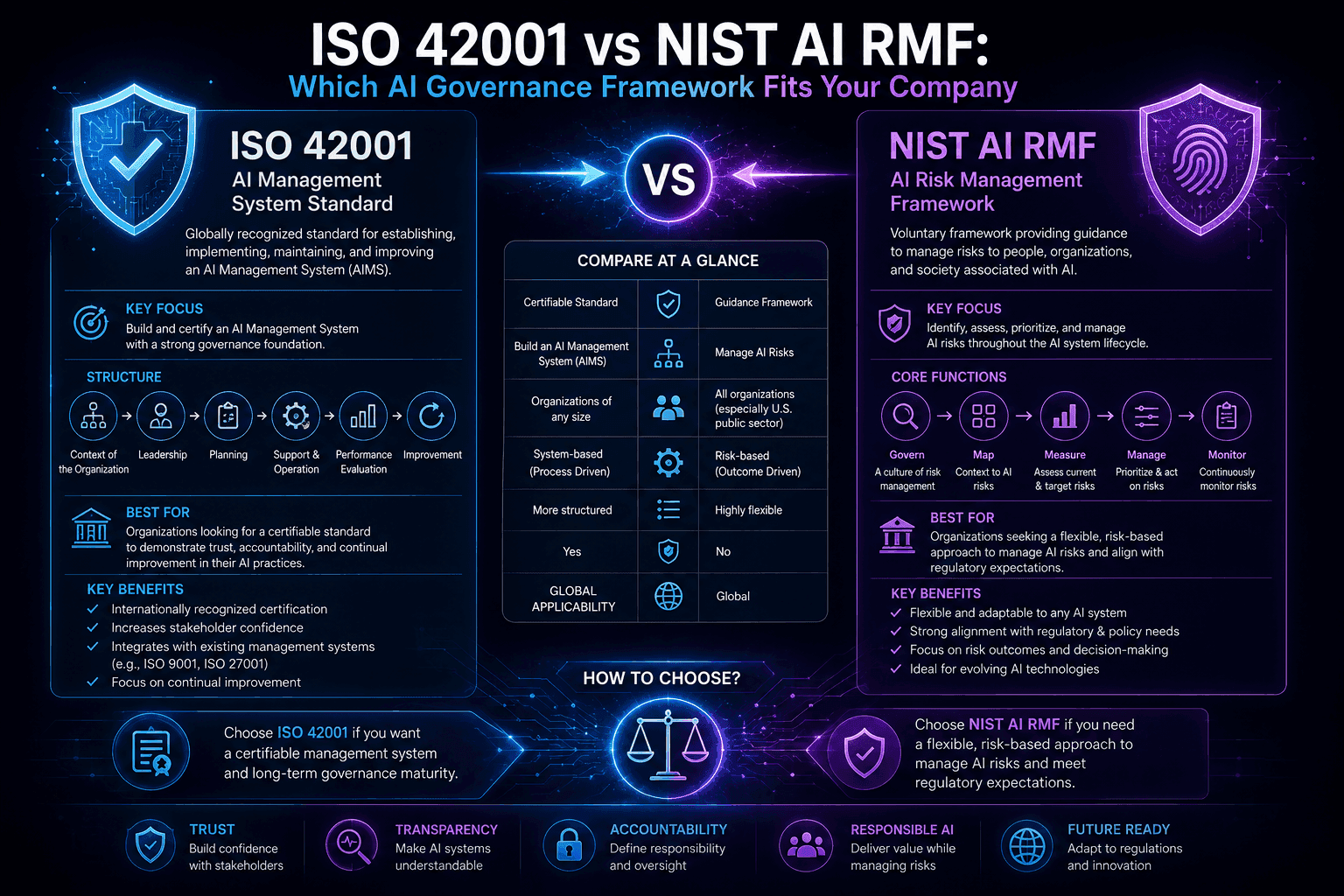
ISO/IEC 42001 is a certifiable management system standard: it defines how an organisation structures durable AI governance, and an external auditor can certify you against it. The NIST AI Risk Management Framework is a voluntary risk framework: it gives practical guidance on identifying and managing AI risk with no audit layer and no certificate. Neither is legally mandatory in the US or internationally as of 2026. The pattern most enterprise teams settle into is adopting NIST AI RMF first to establish shared taxonomy and lifecycle discipline, then layering ISO 42001 certification on top once the documentation groundwork exists and there is a commercial reason to prove it externally.
Next Best Reads
Continue your research on Enterprise Software
These links are chosen to move readers from general education into service understanding, proof, and buying-context pages.
Enterprise Software Development
Move from strategy reading into scoping for large-scale, multi-team enterprise platforms.
Explore enterprise serviceStaff Augmentation
Scale delivery capacity with dedicated engineers embedded in your enterprise team.
View staffing serviceEnterprise Platform Case Study
Review how Ortem shipped a multi-tenant production platform with real operational requirements.
Read case studyThere is a striking gap in the 2026 enterprise AI data: while roughly 79% of businesses are running or actively planning agentic AI, only around 48% have any framework in place to govern and constrain its autonomy. Adoption has comprehensively outrun control.
Two frameworks dominate the conversation about closing that gap: ISO/IEC 42001 and the NIST AI Risk Management Framework. They are frequently presented as alternatives. They are not. Understanding what each one actually is makes the sequencing decision straightforward.
The fundamental difference
ISO/IEC 42001 is a management system standard. It belongs to the same family as ISO 27001 for information security and ISO 9001 for quality. Management system standards do not tell you what your AI should do; they specify how your organisation must be structured to govern it consistently — defined roles, documented processes, internal audit, management review, continual improvement. Crucially, it is certifiable: an accredited external auditor assesses you and issues a certificate.
The NIST AI Risk Management Framework is a voluntary risk framework. It provides a structured way to think about AI risk across four functions — govern, map, measure and manage — and offers practical guidance for each. There is no audit requirement, no accreditation body, and no certificate. You align with it; you do not pass it.
That single structural difference drives almost every practical distinction between them.
| ISO/IEC 42001 | NIST AI RMF | |
|---|---|---|
| Type | Certifiable management system | Voluntary risk framework |
| External validation | Accredited third-party audit | None |
| Output | Certificate | Improved risk practice |
| Best at | Proving governance to others | Building governance internally |
| Cost driver | Audit plus evidence preparation | Internal time |
| Flexibility | Prescriptive structure | Adaptable to context |
What each one is genuinely good at
ISO 42001 is good at durability and proof. Management system standards are designed to survive staff turnover and leadership change, because the process is documented rather than living in somebody's head. And the certificate is a commercial asset: in enterprise procurement, regulated industries and public sector tenders, being able to point at an accredited certificate shortens security review cycles substantially.
NIST AI RMF is good at thinking and adapting. It is more useful earlier, when an organisation does not yet know what its AI risks are, because it provides the taxonomy to find out. It is also considerably lighter to start: you can apply it to a single high-risk system next week without committing to an organisation-wide audit programme.
The sequencing recommendation
For most organisations, the answer is NIST AI RMF first, then ISO 42001.
The reasoning is practical rather than philosophical. ISO 42001 certification requires evidence — documented risk assessments, defined roles, records of decisions, internal audit results. If you begin with the certification audit as your goal, you spend the first several months producing documentation for an auditor, often before the organisation genuinely understands its own AI risk profile. The result is a certificate sitting on top of governance nobody internalised.
If you run NIST AI RMF first, you build the taxonomy, discover your actual risks, and generate that evidence as a natural by-product of doing the work. When you then pursue ISO 42001, a large share of what the auditor asks for already exists. The audit becomes a validation exercise instead of a documentation sprint.
The exception is straightforward: if a customer contract, tender or regulator requires certification by a fixed date, ISO leads and you compress the rest. Commercial deadlines beat methodological elegance.
How this connects to the EU AI Act
Neither framework is named in the EU AI Act, and adopting either does not automatically make you compliant with it. This is worth stating plainly, because some vendor marketing implies otherwise.
What the frameworks do is give you the organisational machinery to discharge the Act's obligations reliably. The EU AI Act requires risk management, human oversight, documentation and post-market monitoring for high-risk systems. Those are precisely the things a management system exists to operate. Companies with a functioning ISO 42001 programme find AI Act conformity work substantially easier, not because the certificate counts as compliance, but because the underlying capability is already there.
In 2026 the three requirements that show up repeatedly across the EU AI Act, NIST AI RMF and ISO 42001 are the same three: full data lineage tracking, human-in-the-loop checkpoints, and risk classification applied per system. If you build those three capabilities well, you are positioned for all three regimes.
What implementation actually involves
Whichever you start with, the early work is the same and it is unglamorous.
Establish the AI inventory. You cannot govern what you have not enumerated. Every AI system and use case, its owner, its data sources, its risk classification, and what decision it affects.
Define ownership. Every AI system needs a named accountable person. Not a committee. Diffuse ownership is the single most common reason governance programmes stall.
Document the risk assessment method. How you decide a system is high or low risk, applied consistently. Auditors care less about which method you chose than about whether you applied it the same way twice.
Instrument for evidence. Records of model versions, data sources, evaluation results, and human review decisions. This is where governance meets engineering, and where teams with good observability practice have a real head start.
Run the review cycle. Management review is what separates a governance system from a governance document. It is also the part organisations skip first when the quarter gets busy.
Choosing without overthinking it
If you are early, uncertain about your risk profile, and not under procurement pressure: start with NIST AI RMF, applied to your highest-risk system first.
If you sell into regulated industries, enterprise accounts or the public sector, and security questionnaires are already slowing your deals: pursue ISO 42001, and accept that the documentation work is the cost of the commercial benefit.
If you are subject to the EU AI Act with high-risk systems: you need the substance of both regardless of certification, and should sequence based on whether your nearest pressure is regulatory or commercial.
Ortem Technologies builds AI systems with governance structure designed in from the start rather than retrofitted before an audit. If you are working out which framework fits your organisation, or need the inventory and evidence layer built properly, talk to our team or read more about our compliance practice and enterprise software services.
About Ortem Technologies
Ortem Technologies is a premier custom software, mobile app, and AI development company. We serve enterprise and startup clients across the USA, UK, Australia, Canada, and the Middle East. Our cross-industry expertise spans fintech, healthcare, and logistics, enabling us to deliver scalable, secure, and innovative digital solutions worldwide.
Get the Ortem Tech Digest
Monthly insights on AI, mobile, and software strategy - straight to your inbox. No spam, ever.
Sources & References
- 1.ISO 42001 & NIST AI RMF: Practical Steps for Responsible AI Governance - TrustCloud
- 2.5 Key Differences Between the NIST AI RMF and ISO 42001 - Vanta
- 3.ISO 42001 vs NIST AI RMF - Wolters Kluwer
About the Author
Editorial Team, Ortem Technologies
The Ortem Technologies editorial team brings together expertise from across our engineering, product, and strategy divisions to produce in-depth guides, comparisons, and best-practice articles for technology leaders and decision-makers.
Frequently Asked Questions
- Neither is legally mandated in the United States or internationally as of 2026. Both are voluntary. What is changing is commercial pressure: enterprise procurement teams and regulated customers increasingly ask which framework you operate under, and the EU AI Act creates legal obligations that these frameworks help you discharge even though the Act does not name them.
- No. The NIST AI RMF is a voluntary risk framework with no formal audit or certification layer. You can state that you align with it, and you can be assessed against it internally or by a consultancy, but there is no certificate. ISO/IEC 42001 is the certifiable option, assessed by an accredited external auditor.
- For most organisations, NIST AI RMF first. It establishes the vocabulary, the risk taxonomy and the lifecycle discipline without committing you to an audit timeline or its cost. Once that groundwork exists, ISO 42001 certification becomes substantially cheaper because most of the evidence an auditor asks for already exists. The exception is when a specific customer contract or tender requires certification on a fixed date, in which case ISO leads.
- It depends almost entirely on how much governance already exists. Organisations with mature ISO 27001 programmes and documented AI practices can move relatively quickly because the management system structure is familiar and much evidence is reusable. Organisations starting from nothing should plan for the documentation and internal audit work to dominate the timeline, not the certification audit itself.
Stay Ahead
Get engineering insights in your inbox
Practical guides on software development, AI, and cloud. No fluff — published when it's worth your time.
Ready to Start Your Project?
Let Ortem Technologies help you build innovative software solutions for your business.
You Might Also Like

How to Build a Fleet Management System in 2026: GPS, Telematics, and Architecture
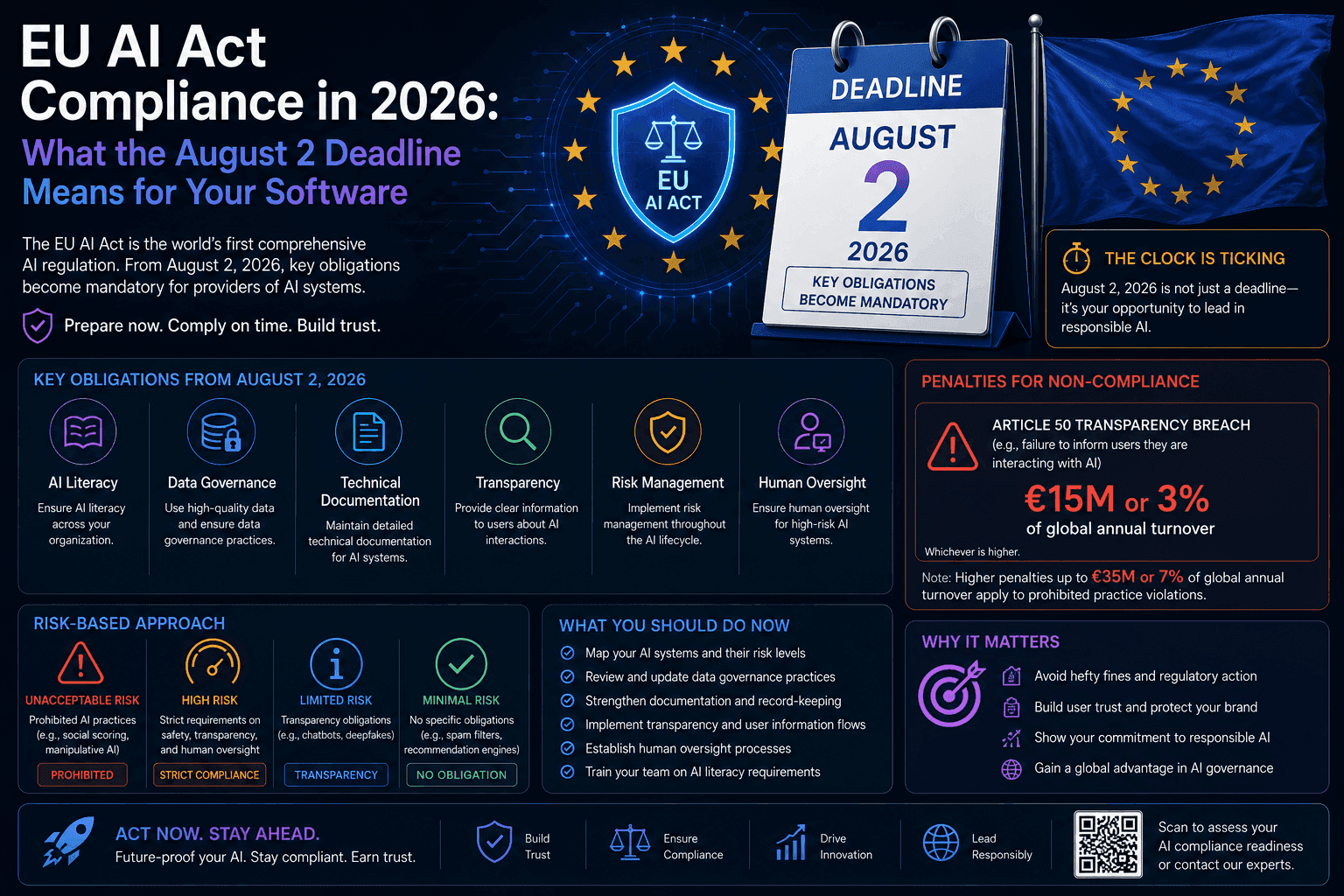
EU AI Act Compliance in 2026: What the August 2 Deadline Means for Your Software