How to Build a Fleet Management System in 2026: GPS, Telematics, and Architecture

Fleet management system MVP costs $80,000–$200,000 covering: real-time GPS tracking for all vehicles, driver and vehicle profiles, trip logging, basic maintenance alerts, and web dashboard. Production fleet management with driver behavior scoring, AI route optimization, OBD-II telematics integration, fuel analytics, and compliance (ELD/HOS logging): $200,000–$450,000. The core technical challenge is ingesting high-frequency GPS data from potentially thousands of vehicles efficiently — this is an IoT-scale data problem from day one.
Next Best Reads
Continue your research on Enterprise Software
These links are chosen to move readers from general education into service understanding, proof, and buying-context pages.
Enterprise Software Development
Move from strategy reading into scoping for large-scale, multi-team enterprise platforms.
Explore enterprise serviceStaff Augmentation
Scale delivery capacity with dedicated engineers embedded in your enterprise team.
View staffing serviceEnterprise Platform Case Study
Review how Ortem shipped a multi-tenant production platform with real operational requirements.
Read case studyFleet management software sits at the intersection of IoT data engineering and operational logistics tooling. The product must handle real-time data ingestion from potentially thousands of vehicles, present that data in real time to dispatchers and managers, and generate the analytics that drive maintenance, compliance, and efficiency decisions. Here is what building it correctly requires.
Architecture: The IoT Data Pipeline
Before any feature discussion, the architectural foundation for fleet management is a data pipeline that handles:
Ingestion at scale: 100 vehicles pinging GPS location every 30 seconds = 200 data points/minute = 288,000 data points/day from a single moderate fleet. Enterprise fleets (1,000+ vehicles) produce millions of location records per day. A naive "write everything to a single table" approach collapses under this load within months.
Two data patterns in conflict: High-frequency writes (location data coming in constantly) and complex read queries (dashboard showing current locations of all vehicles, historical route replay, driver behavior analytics over date ranges). These have opposite optimization needs at the database level.
The solution: Separate your hot path (current vehicle state) from your cold path (historical data).
- Hot path: Redis stores current state for each vehicle — latest position, speed, driver, status. Updated on every incoming message. Dashboard reads current positions from Redis in milliseconds. No SQL join required.
- Cold path: PostgreSQL with table partitioning by date range for historical location data. Partitioning keeps query performance consistent as data grows — queries against a date range only scan relevant partitions.
- Time-series option: TimescaleDB (PostgreSQL extension) handles time-series data efficiently with automatic partitioning, compression of old data, and time-series specific query functions. Recommended for fleets above 100 vehicles.
Message ingestion: GPS devices send data via MQTT (lightweight pub/sub protocol designed for IoT) or HTTP POST. Use an MQTT broker (AWS IoT Core, HiveMQ, or EMQX) for production-scale ingestion — it handles thousands of concurrent device connections efficiently. Consumer reads from the MQTT queue and writes to Redis (current state) and PostgreSQL (history) asynchronously.
GPS Hardware Options
The fleet management software is one half of the product — the GPS hardware installed in vehicles is the other. Hardware options:
OBD-II plug-in trackers (simplest): Plug into the OBD-II port (under the dashboard, required on all vehicles since 1996). Provides location, speed, trip data, engine diagnostic codes, and fuel consumption. Easy to install (no wiring). Drawback: can be unplugged.
Hardwired GPS trackers: Wired directly to vehicle power. Cannot be accidentally unplugged. Typically includes ignition detection, door sensors, and more reliable power management. Requires installation by a mechanic or installer.
ELD-certified devices: For commercial trucking requiring Hours of Service compliance (FMCSA ELD mandate). Must be FMCSA-certified. Your software must interface with certified ELD devices and meet FMCSA technical specifications.
Integration approach: Most fleet management software companies do not build proprietary GPS hardware — they integrate with established hardware vendors (Samsara, Geotab, CalAmp, Queclink) via their device SDK or data APIs. This is the recommended approach unless your competitive differentiation is in the hardware itself.
Core Features by Development Priority
Priority 1: Real-Time Tracking Dashboard
Map view showing all vehicles with current position, last update timestamp, speed, and driver. Click-through to individual vehicle detail. Geofence alerts (vehicle enters/exits defined zones). Online/offline status for each device.
Technology: Mapbox GL JS or Google Maps JavaScript API for web dashboard. WebSocket connection streaming position updates from backend. Frontend rendering optimized for 100+ simultaneous moving markers (clustering for high-density areas, virtualization for vehicle list).
Priority 2: Trip History and Route Replay
Full trip history per vehicle: start time, end time, distance, duration, stops, idle time. Route replay — play back the route on the map at accelerated speed. Trip-level driver behavior summary (top speed, harsh events).
Priority 3: Driver Behavior Monitoring
Event detection from OBD-II/GPS data:
- Speeding: Speed reading exceeds posted limit (requires road speed limit database — HERE or TomTom map data)
- Harsh braking: Deceleration exceeds threshold (e.g., >0.4g)
- Rapid acceleration: Acceleration exceeds threshold
- Excessive idling: Engine running, speed = 0, duration exceeds threshold (e.g., 5 minutes)
- Seatbelt: OBD-II or dedicated sensor
Driver score: Weighted composite of event frequency per mile driven. Displayed per driver, trended over time, benchmarked against fleet average.
Priority 4: Maintenance Management
Maintenance schedules: mileage-based (oil change every 5,000 miles), time-based (annual inspection), engine-hour-based (for heavy equipment). Alerts when upcoming. Work order creation and tracking. Service history log per vehicle.
OBD-II diagnostic trouble codes (DTCs): when a vehicle's check engine light activates, the DTC is transmitted. Fleet management software can surface these to fleet managers before the driver reports a problem.
Priority 5: Route Optimization
Given a list of stops and available vehicles/drivers, determine the optimal route assignment and sequence minimizing total distance, time, or fuel cost. This is the Traveling Salesman Problem variant known as Vehicle Routing Problem (VRP). Libraries: Google OR-Tools (open source), Routific API, or OptimoRoute API for production-grade VRP.
Fleet Sync Pro achieved 25% reduction in delivery time and 18% improvement in fuel efficiency through route optimization and driver behavior monitoring — quantifiable ROI that justifies the development investment.
Mobile Driver App
Drivers need a mobile app for:
- Current job/delivery assignment with navigation
- Trip start/end logging (or automatic based on ignition)
- Delivery confirmation (signature, photo proof of delivery)
- Vehicle inspection checklist (pre-trip, post-trip)
- ELD interface (for regulated commercial trucking)
- Communication with dispatcher
React Native for cross-platform. Must function offline with sync — drivers go through areas without coverage. Background location tracking requires careful implementation for battery management and OS background restrictions.
Fleet Sync Pro: What Ortem Built
Ortem Technologies built Fleet Sync Pro — a fleet management system for logistics companies. Key results: 25% delivery time reduction, 18% fuel efficiency improvement, significant improvement in driver safety scores.
Fleet Sync Pro's architecture handles: real-time GPS tracking via OBD-II device integration, AI-powered route optimization for multi-stop deliveries, driver behavior scoring with coaching features, predictive maintenance using OBD-II diagnostic data and ML anomaly detection, and operations dashboard for fleet managers.
The predictive maintenance layer deserves specific mention — rather than calendar-based service reminders, Fleet Sync Pro uses OBD-II sensor streams (engine temperature trends, oil life indicators, brake system sensors) to predict failures before they occur. This moved maintenance from reactive to preventive, reducing breakdown incidents and unplanned downtime.
Tech Stack (2026)
| Layer | Technology |
|---|---|
| GPS hardware integration | MQTT (AWS IoT Core or EMQX) |
| Data ingestion | Node.js message consumer |
| Current state store | Redis |
| Historical data | PostgreSQL + TimescaleDB or partitioned tables |
| API | Node.js (Fastify) or Python (FastAPI) |
| Web dashboard | React + Mapbox GL JS |
| Driver mobile app | React Native |
| Route optimization | Google OR-Tools or Routific API |
| Real-time push | WebSockets (Socket.io) |
| ML (behavior/predictive) | Python + scikit-learn or PyTorch |
Cost Summary
| Scope | Cost | Timeline |
|---|---|---|
| MVP (real-time tracking + trip history + basic dashboard) | $80,000–$200,000 | 20–28 weeks |
| Production (behavior scoring + maintenance + driver app) | $200,000–$350,000 | 8–12 months |
| Enterprise (route optimization + ML predictive maintenance) | +$80,000–$120,000 | 3–4 months |
Ortem Technologies built Fleet Sync Pro's fleet management platform. Our IoT and enterprise software development practice has shipped GPS tracking systems, logistics optimization tools, and data-intensive operational platforms. Before committing to a build, weigh the modules and build-vs-buy tradeoffs in our fleet management software development guide.
Discuss your fleet management project → | Enterprise software development services → | IoT development services →
About Ortem Technologies
Ortem Technologies is a premier custom software, mobile app, and AI development company. We serve enterprise and startup clients across the USA, UK, Australia, Canada, and the Middle East. Our cross-industry expertise spans fintech, healthcare, and logistics, enabling us to deliver scalable, secure, and innovative digital solutions worldwide.
Get the Ortem Tech Digest
Monthly insights on AI, mobile, and software strategy - straight to your inbox. No spam, ever.
About the Author
Director – AI Product Strategy, Development, Sales & Business Development, Ortem Technologies
Praveen Jha is the Director of AI Product Strategy, Development, Sales & Business Development at Ortem Technologies. With deep expertise in technology consulting and enterprise sales, he helps businesses identify the right digital transformation strategies - from mobile and AI solutions to cloud-native platforms. He writes about technology adoption, business growth, and building software partnerships that deliver real ROI.
Frequently Asked Questions
- Core fleet management features: real-time GPS location of all vehicles on a map, trip history with route replay, driver profiles linked to vehicle assignments, vehicle maintenance scheduling and alerts (mileage-based, time-based), driver behavior monitoring (speeding, harsh braking, rapid acceleration, idling), fuel consumption tracking, geofencing with entry/exit alerts, reporting (mileage by vehicle/driver, fuel costs, utilization rates), and mobile driver app for trip logging and job assignments.
- Fleet GPS tracking requires hardware in each vehicle (OBD-II tracking device, or hardwired GPS unit) that sends position, speed, and engine data to your backend via cellular (4G LTE, eSIM). Backend ingests these messages (MQTT or HTTP POST), parses the payload, stores position data in a time-series database or partitioned PostgreSQL table, and streams current positions to connected web/mobile dashboard clients via WebSocket. Data frequency: every 10–60 seconds while vehicle is moving, reduced frequency or event-based when stationary.
- ELD (Electronic Logging Device) is a US federal mandate (FMCSA regulation) requiring commercial truck drivers operating under HOS (Hours of Service) rules to use certified electronic logging devices. If you are building fleet software for US commercial trucking (trucks over 26,000 lbs GVWR on interstate commerce), ELD certification is mandatory — you must certify your device with FMCSA, which requires compliance with technical specifications for HOS data recording, driver authentication, roadside display mode, and data transfer. ELD certification is not required for delivery fleets (last-mile), buses, or non-DOT vehicles.
Stay Ahead
Get engineering insights in your inbox
Practical guides on software development, AI, and cloud. No fluff — published when it's worth your time.
Ready to Start Your Project?
Let Ortem Technologies help you build innovative software solutions for your business.
You Might Also Like
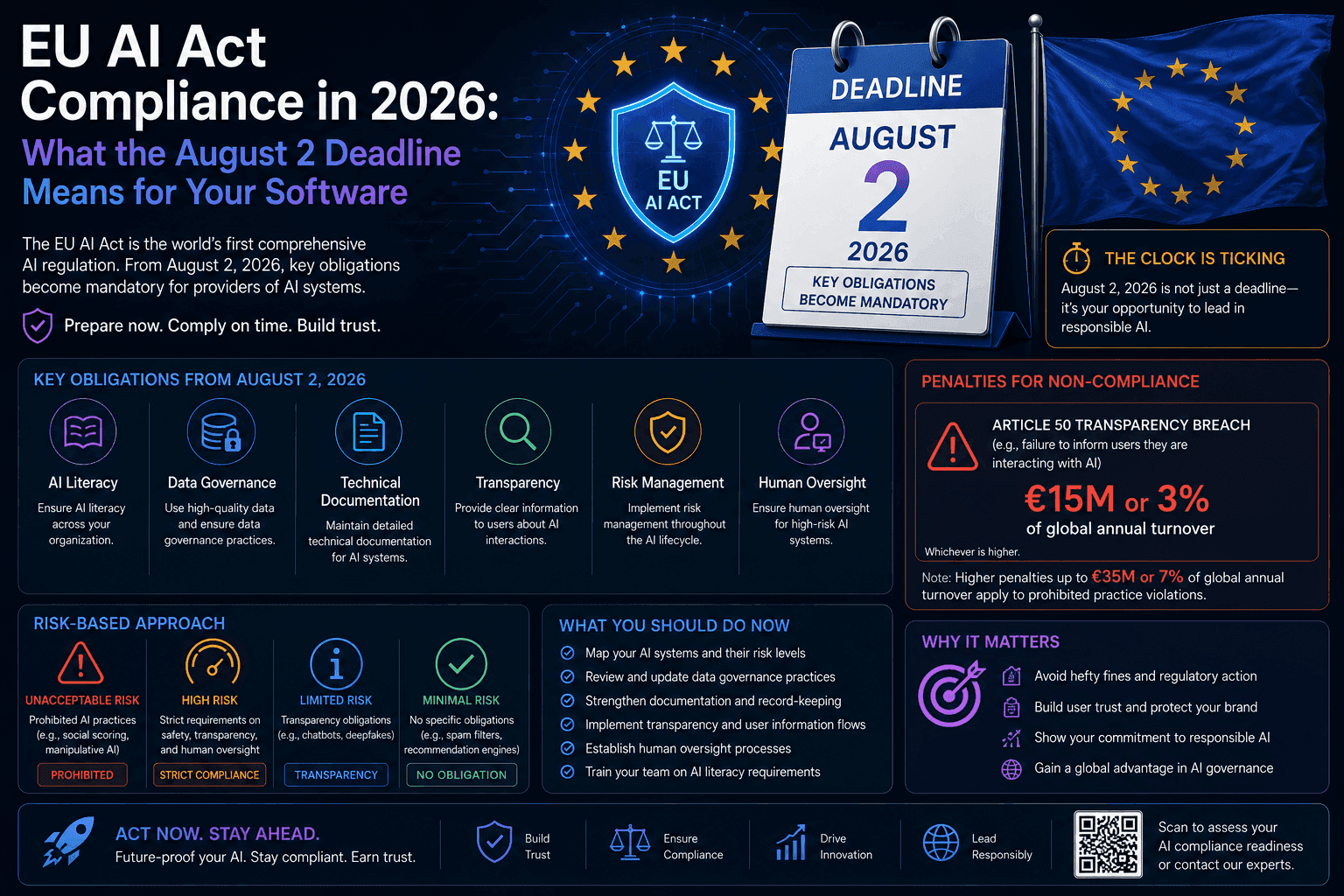
EU AI Act Compliance in 2026: What the August 2 Deadline Means for Your Software
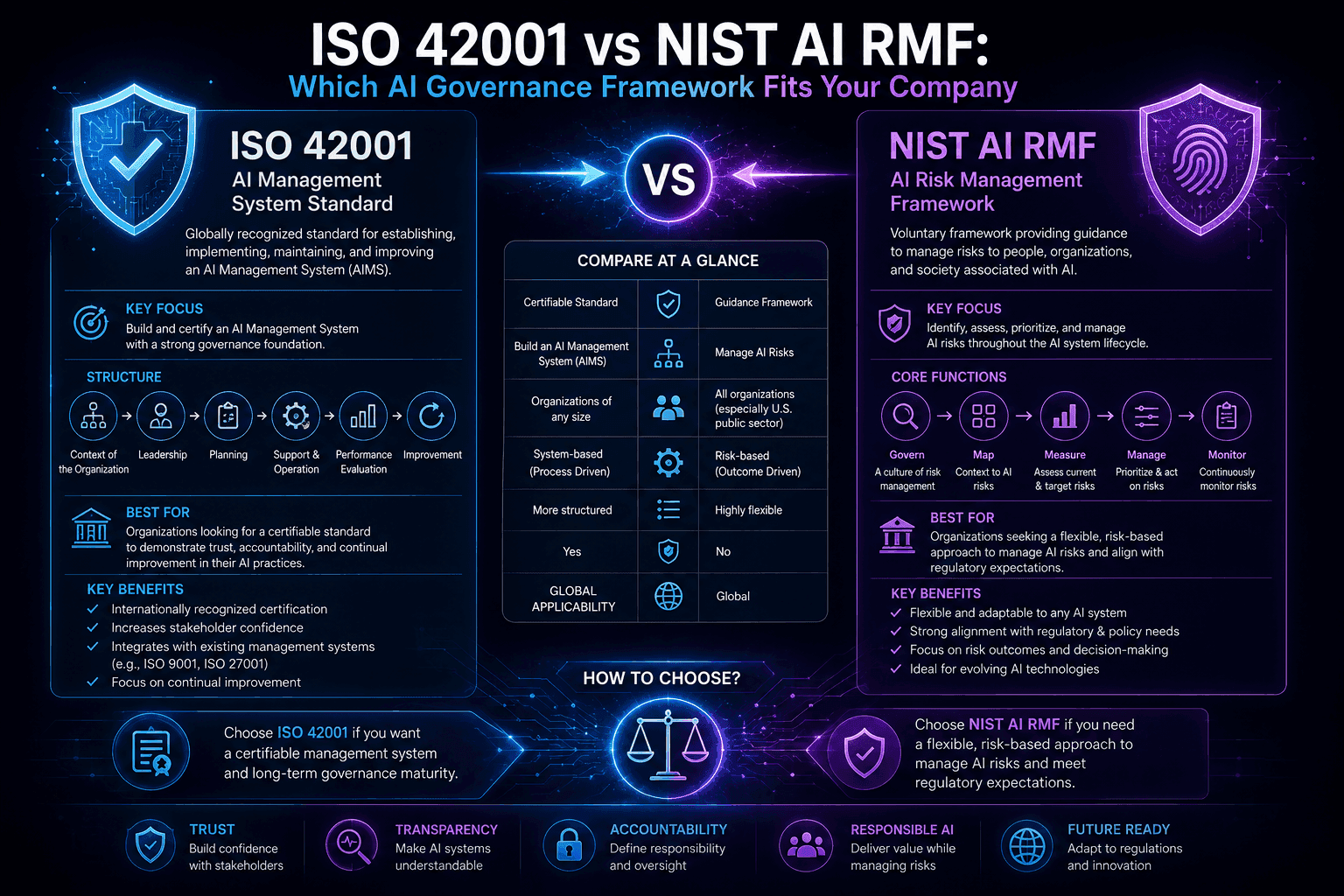
ISO 42001 vs NIST AI RMF: Which AI Governance Framework Fits Your Company