
 As Featured on GoodFirms
Forward Deployed Engineering vs IT Staff Augmentation: What 133 Companies Reveal in 2026
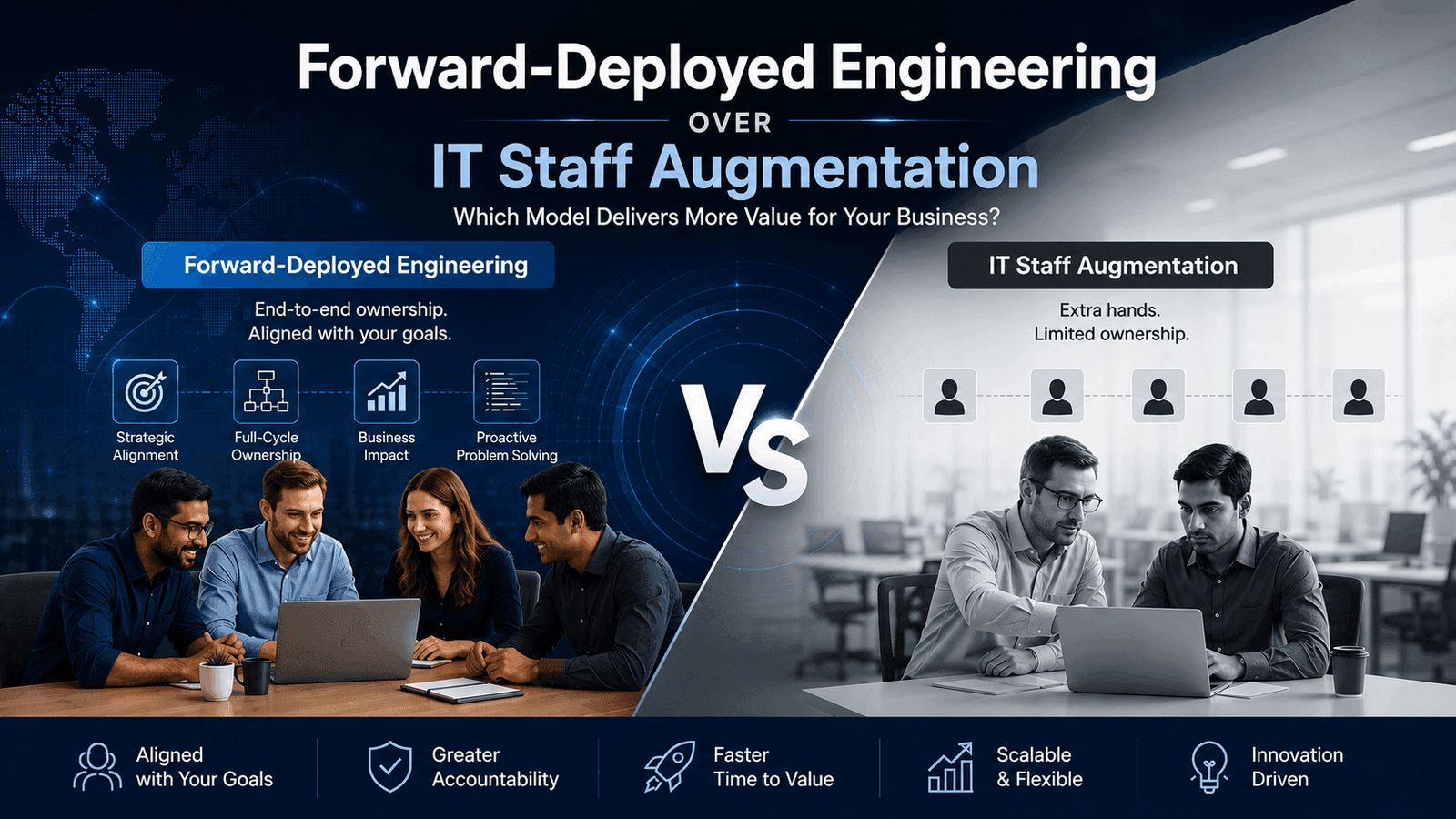
Forward deployed engineering (FDE) embeds an engineer inside the client's environment who owns the outcome, not just the deliverable — while staff augmentation adds a developer to a team the client still directs and owns. GoodFirms' 2026 survey of 133 companies found 69.7% already run some version of an FDE function and another 15.2% are building toward one, with hiring the right talent mix (85.7%) — not pricing or technology — the top challenge. Ortem was one of the companies GoodFirms interviewed for this research.
Commercial Expertise
Need help with Business Strategy?
Ortem deploys dedicated Custom Software Development squads in 72 hours.
Next Best Reads
Continue your research on Business Strategy
These links are chosen to move readers from general education into service understanding, proof, and buying-context pages.
Custom Software Planning
Convert strategy reading into a delivery brief for architecture, scope, timeline, and commercial fit.
Plan your buildOrtem Delivery Model
See how Ortem structures communication, IP ownership, oversight, and execution for global clients.
Review delivery modelUS Market Delivery Page
Helpful if your buying journey is US-led and you want to understand timezone, compliance, and engagement fit.
View US delivery page"Forward-deployed engineer" started as a Palantir job title. In 2026, GoodFirms surveyed 133 AI and software companies — Ortem Technologies among them — and found something closer to an industry-wide shift than a niche hiring trend: 69.7% of companies already run some version of a forward-deployed engineering (FDE) function, and another 15.2% are actively building toward one.
We were one of the companies GoodFirms interviewed for this research, and the data lines up with what we've seen building our own delivery model. Here's our read on what the numbers mean, plus what we told GoodFirms directly about where most companies get FDE wrong.
What forward deployed engineering actually means (and how it differs from staff augmentation)
The distinction isn't org-chart depth or seniority — it's one word: accountability.
Staff augmentation places a developer inside your team to fill a capacity gap. You direct the work, manage priorities, and own the outcome — the vendor is responsible for supplying a competent engineer, not for whether the project succeeds. Forward-deployed engineering embeds an engineer inside your environment who owns the outcome directly: success means the system works in production and gets adopted, not that code got written and handed off.
| Dimension | FDE | Staff Augmentation |
|---|---|---|
| Accountability | High — engineer owns the outcome | Low — client owns the outcome |
| Client ownership | Shared | Client-led |
| Pricing model | Outcome-based | Hourly |
| AI usage | Deep — engineer directs AI tooling | Moderate |
| Enterprise adoption | Growing fast | Mature, well-established |
Adapted from GoodFirms' survey of 133 companies on forward-deployed engineering, 2026.
Adoption is already mainstream, not experimental
Nearly 70% of companies GoodFirms surveyed run an FDE function today — 39.4% informally on specific engagements, 30.3% with a formally named team. Add the 15.2% actively building toward one, and 84.8% of companies are engaged with the model in some form.
What's pushing adoption isn't internal strategy — it's client pressure. 78.6% of companies building an FDE function cited enterprise clients needing deeper technical support than solutions engineering could provide, and 71.4% cited high-value clients demanding an embedded technical owner directly. Half said AI products were reaching clients but stalling before production, which tracks with what we see constantly: the bottleneck in 2026 usually isn't the model, it's getting AI-driven software live inside a client's actual operating environment.
The real bottleneck isn't technology — it's hiring
Ask 133 companies what's hardest about running an FDE function, and 85.7% say the same thing: finding the right mix of technical depth and business fluency. That's more than 25 points ahead of the next challenge — pricing engagements to reflect value delivered (60.7%) — and well ahead of defining measurable outcomes per engagement (53.6%).
The profile companies are hiring for backs this up: 89.3% want strong engineering skills paired with client-facing experience, 85.7% want product sense, and 82.1% want AI fluency — the ability to direct and check AI-generated work, not just write code. Business fluency, comfort in commercial and strategic conversations, shows up in 64.3% of profiles, which is the clearest signal that FDE sits deliberately between engineering and account management, not inside either one.
We put it directly to GoodFirms when they asked about this: "FDE is a full operating model, not just a new title for contractors, and it demands a very specific profile. Structured onboarding, explicit outcome definition, and tight alignment with our core platform are critical to prevent FDEs from becoming high-end staff aug instead of strategic partners."
AI is expanding the role, not replacing it
57.1% of companies running an FDE function say AI now lets a single engineer deliver more — the most common change reported. Only 10.7% say their FDEs mainly review AI-generated code instead of writing it. Read together with a separate finding — more than nine in ten companies report at least some capacity gain per FDE from AI — the shift isn't fewer engineers doing the same work, it's the same headcount covering meaningfully more client accounts without a proportional cost increase.
The capability AI has made most valuable in an FDE isn't raw coding speed (14.3%) — it's business context deep enough to direct AI's output and own the result, cited by 60.7% of companies. AI hasn't lowered the bar for what an FDE needs to know. It's raised it in a different direction: judgment matters more, not less, when the engineer is directing a tool that can write the code itself.
How FDE gets priced, and how success gets measured
No single pricing model dominates — 28.6% use a hybrid structure, 25.0% fold the cost into enterprise contract pricing, 21.4% price purely on outcomes, and traditional time-and-materials billing trails at just 3.6%, the least common approach among companies running an FDE function.
Success metrics follow the same outcome-first pattern: 78.6% of companies measure FDE success by pre-agreed business outcomes — revenue, efficiency, cost reduction — rather than internal delivery milestones like hours logged or story points. Time to production for AI or software implementation follows at 67.9%, ahead of both product adoption and client satisfaction, which tie at 60.7% each.
Every leading metric in that list measures something the client experiences directly, not an internal delivery number — which is the structural difference between how FDE and staff augmentation engagements typically get scored.
What we'd tell you before you build an FDE function
GoodFirms asked the companies it surveyed what they wished they'd known before building their own FDE function. Ours, in our own words:
"A fully AI-native, FDE-first delivery organization where every client engagement is treated as a product, not a project."
That's the design principle behind how we structure engagements — one forward-deployed engineer anchoring the relationship, backed by a shared platform team rather than a rotating cast of contractors. The mistake we've watched other companies make, and the one we warned GoodFirms about directly, is treating FDE as a rebrand: same delivery process, new job title, no actual change in how outcomes get owned. Without structured onboarding, an explicit outcome definition up front, and real alignment to the client's platform, an "FDE" quietly drifts back into being a very expensive staff-augmentation hire.
How to evaluate a vendor claiming to offer FDE
"We do FDE" means something different at every company, since the model still hasn't standardized into a single playbook. Before you sign, ask:
- Is the function formal or informal, and how many dedicated FDEs does the vendor actually have? A named team with a track record is a different commitment than "we can do that too."
- How will success be measured — and was that agreed before the engagement started? Outcomes, time to production, and adoption metrics should be defined in writing up front, not retrofitted after the fact.
- Who owns the IP, in writing? The market is close to evenly split between client-owned and negotiated terms — don't assume.
- Is pricing outcome-based, retainer-based, or bundled into a broader contract — and what happens if scope shifts mid-engagement?
- How specifically does AI tooling change what the FDE delivers, versus what a traditional staff-augmentation contractor would deliver on the same task?
Where this leaves the FDE-vs-staff-augmentation decision
The two models aren't mutually exclusive, and most companies in the GoodFirms survey run them side by side rather than replacing one with the other — routing clients to whichever fits the engagement. If you need capacity inside a process you already run and own, staff augmentation is faster to start and cheaper per hour. If you need enterprise-grade software to actually reach production and get adopted, and you want someone accountable for that outcome rather than just the hours logged, that's the gap forward-deployed engineering exists to close.
We run both models at Ortem. If you're not sure which one your project actually needs, book a free consultation and we'll tell you honestly — including if the answer is neither, and what you actually need is a dedicated development team instead.
About Ortem Technologies
Ortem Technologies is a premier custom software, mobile app, and AI development company. We serve enterprise and startup clients across the USA, UK, Australia, Canada, and the Middle East. Our cross-industry expertise spans fintech, healthcare, and logistics, enabling us to deliver scalable, secure, and innovative digital solutions worldwide.
Get the Ortem Tech Digest
Monthly insights on AI, mobile, and software strategy - straight to your inbox. No spam, ever.
Sources & References
- 1.Forward Deployed Engineering vs IT Staff Augmentation: What 133 Companies Reveal in 2026 - GoodFirms
- 2.Staff Augmentation Services - Ortem Technologies
About the Author
Director – AI Product Strategy, Development, Sales & Business Development, Ortem Technologies
Praveen Jha is the Director of AI Product Strategy, Development, Sales & Business Development at Ortem Technologies. With deep expertise in technology consulting and enterprise sales, he helps businesses identify the right digital transformation strategies - from mobile and AI solutions to cloud-native platforms. He writes about technology adoption, business growth, and building software partnerships that deliver real ROI.
Frequently Asked Questions
- Mostly, based on the data — every company with a formal, named FDE team came from an organization with 51 or more engineers, and the model was rarest among companies with 1-10 engineers. That doesn't rule out FDE for smaller teams, but the formal, dedicated version needs enough engineering headcount to spare before it makes sense to separate out as its own function.
- No. Most companies run FDE and staff augmentation side by side, routing clients to whichever model fits the engagement, rather than replacing one with the other. FDE is best understood as an added layer of accountability for complex, high-stakes clients, not a wholesale swap of your delivery model.
- The distinction is ownership, not job title. Solutions engineering and customer success typically support a sale or manage a relationship. An FDE carries direct, ongoing responsibility for whether the implementation actually works in production and delivers the business result — which is why treating an FDE as a "super solutions engineer" is one of the more common early mistakes companies make when building the function.
- It isn't a direct apples-to-apples comparison, since the pricing models differ. Rather than a flat hourly rate, most FDE engagements use hybrid pricing, outcome-based pricing, or costs folded into a broader enterprise contract — reflecting that clients are paying for accountability and outcomes, not hours of engineering time.
- Starting informally is the more common, lower-risk path — 39.4% of companies in the GoodFirms survey ran FDE informally on specific engagements before ever formalizing it. The priority is getting the structure right first: clear ownership, explicit outcome definitions, and real onboarding, before scaling headcount into a dedicated team.
Stay Ahead
Get engineering insights in your inbox
Practical guides on software development, AI, and cloud. No fluff — published when it's worth your time.
Ready to Start Your Project?
Let Ortem Technologies help you build innovative software solutions for your business.
You Might Also Like
White-Label AI Solutions for Agencies: How to Sell AI Without Building a Team
How to Write an AI Project RFP in 2026: Template and Red-Flag Detector
