Should You Hire a Freelancer, Software Development Company, or In-House Team?
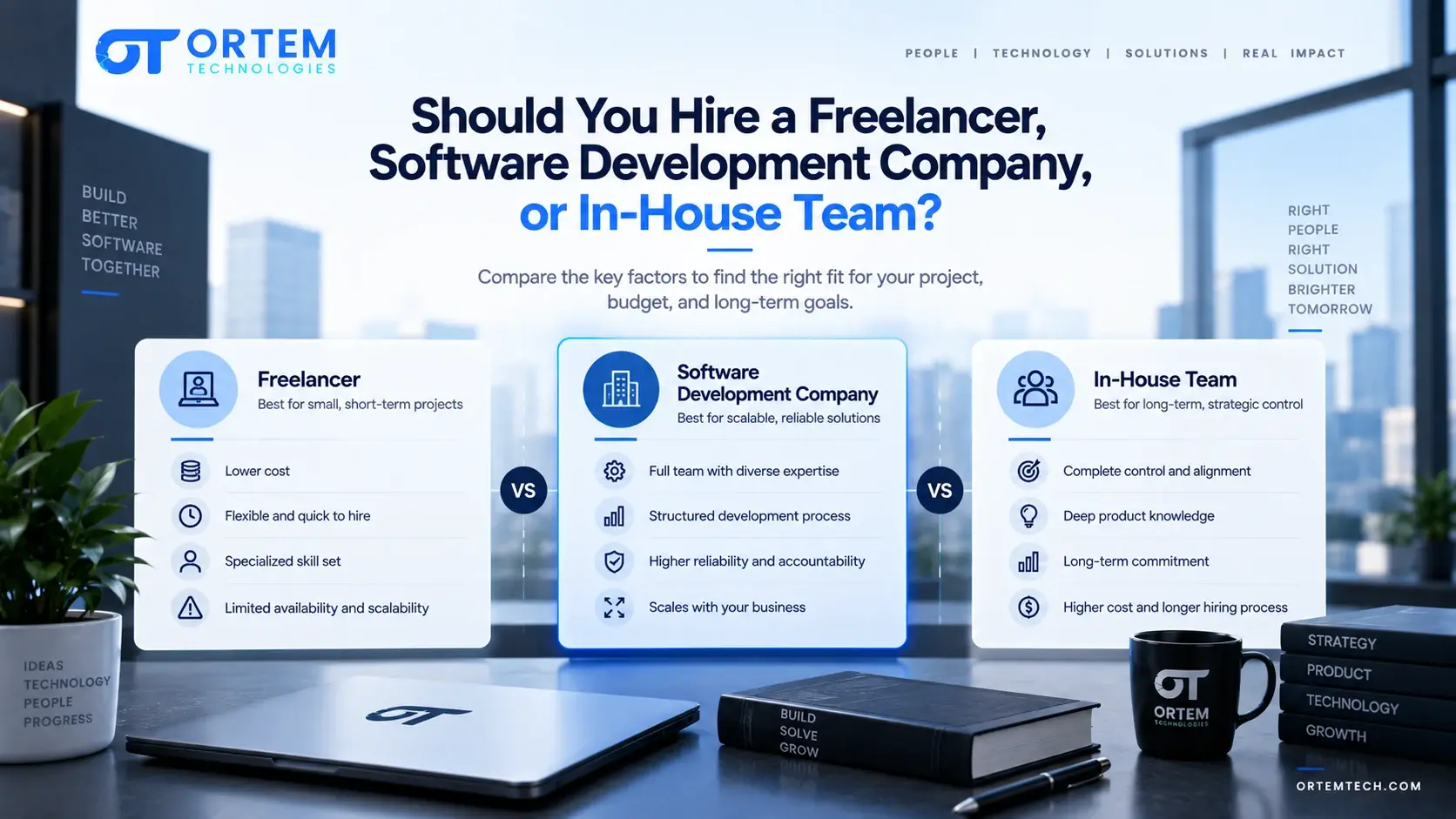
Choose a freelancer for small, clearly scoped, technically narrow work — especially when you already have product and technical leadership and just need implementation capacity. Choose a software development company when the project needs several disciplines working together (architecture, engineering, QA, DevOps, security) and you want a complete team fast without building an engineering organization. Choose an in-house team when software is a long-term strategic capability, not a one-time project. Choose a hybrid model — internal product and technical ownership plus external engineering capacity — when you want to keep ownership internal but lack some of the skills or bandwidth to deliver alone. Ortem's Software Delivery Performance Index (OSDPI) scores ten delivery-readiness factors to make the choice evidence-based rather than a guess based on hourly rate.
Commercial Expertise
Need help with Software Development?
Ortem deploys dedicated Custom Software Development squads in 72 hours.
Next Best Reads
Continue your research on Software Development
These links are chosen to move readers from general education into service understanding, proof, and buying-context pages.
Custom Software Development
Build exactly what you need — dashboards, platforms, SaaS, and internal tools with dedicated squads.
Explore software serviceMVP Development
Launch faster with a scoped MVP that proves your concept before full product investment.
See MVP serviceCustom Platform Case Study
Multi-tenant SaaS built with production-grade architecture, compliance, and operational scale.
Read case studyWhen a business decides to build custom software, one of the first questions is not how to build it, but who should build it.
There are three common choices:
Freelancer → Software Development Company → In-House Team
There is also a fourth option:
Hybrid Team
The right choice depends less on the job title of the people writing the code and more on the complexity, business criticality, required capabilities, ownership expectations, continuity requirements and long-term direction of the product.
Score Readiness Before You Score Delivery Models
Before comparing freelancer, agency and in-house options, it helps to know what the project actually needs — not just who might supply it. A project with real gaps in product clarity, architecture or operational readiness will strain any delivery model, freelancer or otherwise.
Ortem built the Ortem Software Delivery Performance Index (OSDPI) for exactly this: a free, no-signup framework that scores a project across ten weighted readiness dimensions plus a security gate, then flags which gaps a delivery-model decision needs to account for.
Start Here: Which Model Is Right for You?
Use this decision path before comparing the options in detail.
Choose a Freelancer If
The project is:
- Small
- Clearly defined
- Relatively straightforward
- Limited in technical scope
- Dependent on one or two primary skills
Typical examples include:
- Corporate website
- CMS customization
- Small internal tool
- Single API integration
- Frontend implementation
- Automation script
- Focused bug-fixing project
A freelancer can be an excellent choice when the company already has product, technical or QA leadership and mainly needs implementation capacity.
Do not automatically choose a freelancer when the project requires architecture, UX, multiple engineering disciplines, DevOps, security, complex integrations or long-term production support.
Choose a Software Development Company If
The project requires a cross-functional delivery team.
This may include:
- Product management
- Business analysis
- UX/UI
- Architecture
- Frontend development
- Backend development
- Mobile development
- QA
- DevOps
- Cloud engineering
- Security
- Data engineering
- AI engineering
A development company is especially useful when the business needs several capabilities quickly without first building an entire engineering organization.
Choose an In-House Team If
Software is becoming a long-term strategic capability rather than a one-time project.
An internal team becomes more attractive when:
- Software is the product.
- Technology is a competitive advantage.
- Development will continue for years.
- Requirements change continuously.
- Deep business knowledge needs to stay inside the organization.
- Engineering is itself a strategic capability.
Choose a Hybrid Model If
The business wants internal ownership but lacks some of the skills or capacity required to deliver the product.
For example:
Internal: Product Management + Technical Ownership
External: Engineering + QA + DevOps + Specialist Expertise
This can work particularly well when a company is building its first engineering organization, modernizing legacy systems or needs temporary specialist capacity.
The 60-Second Decision Test
| Question | If Yes, Consider |
|---|---|
| Is the project small and narrowly defined? | Freelancer |
| Does it require several technical disciplines? | Development Company |
| Is the product strategically important? | In-House / Hybrid |
| Will development continue for years? | In-House / Hybrid |
| Do you lack specialist technical skills? | Development Company / Hybrid |
| Do you want internal ownership with external capacity? | Hybrid |
| Is the software business-critical? | Development Company / In-House / Hybrid |
| Can one person safely own the architecture and delivery? | Freelancer may work |
| Will the team need to scale up or down during delivery? | Development Company / Hybrid |
A useful shorthand is:
Small + simple → Freelancer Complex + project-based → Development Company Strategic + continuous → In-House Strategic + capability gap → Hybrid
These are starting points, not automatic answers.
TL;DR
Choose a freelancer when:
- The project is relatively small.
- Scope is clearly defined.
- Technology is straightforward.
- One or two primary skills are sufficient.
- The business can manage the project closely.
- Business continuity risk is low.
Choose a software development company when:
- The project requires multiple disciplines.
- Architecture, UX/UI, development, QA and DevOps must work together.
- You need a complete delivery team quickly.
- The product is too complex for one developer.
- You need structured project management.
- You do not want to build an engineering organization immediately.
Choose an in-house team when:
- Software is strategically central to the business.
- Product development is continuous.
- The company needs deep, long-term product ownership.
- Requirements and priorities change frequently.
- Building internal engineering capability is itself a strategic objective.
Choose a hybrid model when:
- Product ownership should remain internal.
- External expertise is required.
- Specialist skills are missing internally.
- Temporary engineering capacity is needed.
- The company is gradually building its own engineering organization.
What This Decision Is Really About
The common way to compare these models is:
Freelancer vs agency vs employees.
That is too narrow.
A better question is:
Which delivery model gives this project the capabilities, ownership, continuity and operating discipline it requires?
A serious software project may require:
- Product management
- Business analysis
- UX/UI
- Solution architecture
- Frontend development
- Backend development
- Mobile development
- QA
- DevOps
- Cloud engineering
- Security
- Data engineering
- AI engineering
- Project management
- Technical documentation
One person may cover several of these roles.
A development company may provide them as a team.
An internal organization may build them over time.
The decision is therefore fundamentally a capability and ownership decision. It's the same ownership question that comes up when deciding whether to build custom software at all or buy an existing SaaS product — both ask what the business actually needs to own versus consume.
What Actually Determines Software Delivery Performance?
The number of developers on a project does not, by itself, tell you whether the project is positioned to deliver successfully.
Ortem evaluates software delivery readiness using the Ortem Software Delivery Performance Index (OSDPI).
OSDPI evaluates ten factors that influence the ability of a software team to move from requirements to production:
| Delivery Dimension | Weight | What Ortem Evaluates |
|---|---|---|
| Product Clarity | 15% | Requirements, priorities, business rules and decision readiness |
| Architecture Readiness | 10% | Architecture, technical decisions and system boundaries |
| Team Capability | 15% | Required skills, seniority and role coverage |
| Execution Flow | 10% | Work breakdown, dependencies between tasks and delivery coordination |
| Quality & Testing | 10% | Test coverage, QA capability and defect prevention |
| Deployment Readiness | 10% | Environments, CI/CD, release process and rollback capability |
| Feedback Speed | 10% | Speed of discovering and resolving incorrect assumptions or defects |
| Dependency Readiness | 5% | APIs, credentials, data, infrastructure and third-party dependencies |
| Operational Readiness | 10% | Monitoring, security, backups and production support |
| Ownership & Continuity | 5% | Documentation, knowledge distribution and ability to transfer responsibility |
| Total | 100% |
Each dimension is scored from 0 to 5.
The overall score is:
OSDPI = Σ (Dimension Score ÷ 5 × Dimension Weight)
This produces a score between 0 and 100.
OSDPI Interpretation
| Score | Interpretation |
|---|---|
| 85–100 | Highly prepared delivery environment |
| 70–84 | Strong delivery readiness |
| 55–69 | Moderate delivery risk |
| 40–54 | High delivery risk |
| 0–39 | Significant readiness gaps |
However, the overall score should not hide a critical weakness.
If any of the following dimensions scores below 2/5, the project should be treated as constrained until the issue is addressed:
- Product Clarity
- Architecture Readiness
- Team Capability
- Dependency Readiness
- Operational Readiness
For example, a project could achieve a reasonable overall score while having no access to a critical third-party API.
The average score would not remove that dependency.
This is why OSDPI uses both an overall score and critical-factor checks.
Why OSDPI Matters When Choosing a Delivery Model
The same project can produce very different OSDPI profiles under different delivery models.
A freelancer may score highly on:
Specialist capability
but lower on:
Role coverage, continuity and operational support
A development company may score highly on:
Team breadth, delivery capacity and specialist coverage
while requiring stronger client-side:
Product ownership and decision-making
An internal team may score highly on:
Domain knowledge and long-term ownership
while initially scoring lower on:
Team completeness and specialist availability
A hybrid model can potentially improve those gaps by combining internal ownership with external capabilities.
This gives a business a more useful question than:
"Which type of developer should we hire?"
The better question is:
"Which delivery model produces the strongest delivery system for this particular project?"
OSDPI Is an Ortem Framework
OSDPI is an Ortem Technologies analytical framework, not a claim that these weights or thresholds are an industry-wide standard.
The framework can be used immediately as a structured decision tool — the full OSDPI methodology and free interactive calculator live at their own canonical page, with a worked example and score-band explanations.
As Ortem accumulates anonymized project data, the methodology can be expanded into an empirical benchmark showing how OSDPI scores correlate with outcomes such as:
- Schedule variance
- Budget variance
- Defect rates
- Post-launch incidents
- Rework
- Project changes
- Delivery predictability
That future dataset could allow Ortem to publish:
Ortem Software Delivery Benchmark Report
Ortem Development Team Cost Benchmark
Ortem Project Delivery Dataset
Ortem Software Delivery Model Index
The distinction matters.
A methodology should not be presented as empirical research until it has been tested against a documented dataset.
1. When a Freelancer Makes Sense
A freelancer can be an excellent choice for the right type of project.
Freelancers are often effective when the work is:
- Small
- Well-defined
- Technically straightforward
- Narrowly scoped
- Independently deliverable
Examples include:
- Corporate website
- CMS customization
- Small internal tool
- Specific API integration
- Bug-fixing project
- Frontend implementation
- Automation
- Specialized technical work
A freelancer can also work extremely well as part of an existing internal engineering organization.
For example, a company may already have a technical lead and QA team but need a specialist for:
- React development
- Mobile development
- AI integration
- Cloud migration
- Performance optimization
In that situation, the freelancer fills a defined capability gap rather than becoming the entire delivery organization.
2. Where Freelancer Models Become Riskier
Risk increases as project complexity grows.
Consider a system requiring:
- Multi-tenant architecture
- Mobile applications
- Payment integration
- SSO
- Cloud infrastructure
- Data migration
- Security controls
- Automated testing
- Production monitoring
One freelancer may have excellent programming skills.
But the project may require more than programming.
The client may suddenly become responsible for coordinating:
Designer
Developer
QA
DevOps
Security
Product decisions
The coordination itself becomes a delivery responsibility.
The question is therefore not:
"Is the freelancer good enough?"
It is:
"Does the delivery system around the freelancer provide everything the project requires?"
3. Advantages of Hiring a Freelancer
Lower initial organizational overhead
The business can access technical capability without creating a full engineering organization.
Direct communication
Clients often communicate directly with the person doing the work.
Flexibility
A freelancer can be useful for narrowly defined assignments.
Specialized expertise
An experienced specialist can be extremely valuable for a specific technical problem.
Good fit for existing teams
Freelancers can increase implementation capacity without replacing internal ownership.
4. Risks of a Freelancer Model
Potential risks include:
Single-person dependency
What happens if the freelancer becomes unavailable?
Limited specialization
One person may not cover architecture, security, QA and DevOps equally well.
Continuity risk
Knowledge may become concentrated in one person.
Capacity constraints
A freelancer has limited bandwidth.
Management burden
The client may need to coordinate requirements, testing, deployment and priorities.
Documentation risk
Documentation quality depends heavily on the individual and the agreement.
These risks can be managed through:
- Client-owned repositories
- Documentation requirements
- Testing standards
- Individual access controls
- Clear handover requirements
5. When a Software Development Company Makes Sense
A software development company is often appropriate when the project requires a cross-functional delivery team.
For example:
Product
Defines priorities and requirements.
UX/UI
Designs user journeys and interfaces.
Architecture
Defines the technical system.
Engineering
Builds the application.
QA
Tests workflows and integrations.
DevOps
Manages infrastructure and deployment.
Project management
Coordinates scope, schedule, risks and communication.
A development company can provide these capabilities without requiring the client to hire each role individually.
However, hiring a company does not automatically solve delivery risk.
The actual team, experience, engineering discipline and ownership model still matter.
6. The Real Advantage of a Development Company
The strongest reason to hire a development company is not simply that it has "more developers."
It is that it can provide complementary capabilities as a coordinated team.
Consider an enterprise SaaS platform.
The project may require:
- Senior architect
- Backend engineer
- Frontend engineer
- Product designer
- QA engineer
- DevOps specialist
- Project manager
Hiring every role permanently may not make sense for a business building one new product.
A development company can assemble an appropriate team around the project.
7. A Development Company Does Not Automatically Mean Better Quality
An agency can still fail because of:
- Weak project management
- Inexperienced engineers
- Poor architecture
- High staff turnover
- Misaligned incentives
- Sales promises that exceed delivery capability
- Weak QA
- Poor documentation
- Undisclosed subcontracting
- Insufficient technical leadership
External sourcing therefore requires its own evaluation process.
The client should evaluate the actual delivery team rather than selecting a company solely because its website or portfolio looks impressive.
8. What to Verify When Hiring a Development Company
Ask:
Who will actually build the product?
Do not evaluate only the sales team.
Who is the technical lead?
Who owns architecture?
Who performs QA?
Who handles production infrastructure?
Who manages security?
Who remains after launch?
How much of the work is subcontracted?
Have they delivered systems with similar complexity?
Can you speak to previous clients?
Can they explain how they estimate risk?
Can they explain what happens when scope changes?
These questions turn vendor selection into an evidence-based evaluation rather than a branding exercise. For the complete set, see what questions to ask before hiring a software development company — and once you have proposals in hand, how to compare them fairly.
9. When an In-House Team Makes Sense
An internal engineering organization becomes attractive when software is not simply a project.
It is a long-term capability of the business.
Examples include companies where:
- Software is the primary product.
- Technology is a major competitive advantage.
- Product requirements change continuously.
- Engineering decisions directly affect business strategy.
- The company expects years of continuous development.
- Deep domain knowledge needs to remain inside the company.
In these situations, engineering capability itself becomes an organizational asset.
10. Advantages of an In-House Team
Deep domain knowledge
Engineers become familiar with the business.
Product proximity
Engineering can work closely with users and business teams.
Long-term ownership
Knowledge stays inside the organization.
Rapid iteration
Product and engineering can operate as one continuous function.
Strategic control
Technology decisions remain directly within the business.
Institutional knowledge
Technical and business knowledge accumulates over time.
These advantages can be especially significant for software companies and digital-first businesses.
11. The Hidden Cost of Building an In-House Team
Hiring developers is not the same as creating an engineering organization.
An internal team may require:
- Recruiting
- Salaries
- Benefits
- Management
- Engineering leadership
- QA
- DevOps
- Security
- Product management
- Development tools
- Infrastructure
- Training
- Retention
- Replacement hiring
A company may hire three developers and still lack:
- Architecture leadership
- Product management
- QA
- Cloud expertise
- Security expertise
The result can be a team that is large enough to create software but not mature enough to operate it reliably.
12. In-House Does Not Automatically Mean Faster
An internal team can still move slowly.
The key factors are not simply headcount.
Consider:
- Product decision speed
- Architecture quality
- Team composition
- Communication
- Testing
- Deployment
- Feedback cycles
- Dependencies
- Operational readiness
A six-person team with clear ownership and strong delivery practices can outperform a larger team that constantly waits for decisions, works around dependencies or discovers defects late.
This is one reason Ortem evaluates the complete delivery system through OSDPI rather than using team size as a proxy for delivery capability.
13. The Hybrid Model
The hybrid model is often overlooked.
It can look like:
Internal team
Owns:
- Product strategy
- Business knowledge
- Priorities
- Technical ownership
- Architecture decisions
External team
Provides:
- Additional engineers
- Specialized expertise
- QA
- UX
- DevOps
- Temporary capacity
This can provide internal ownership without requiring the company to build every specialist capability immediately.
14. When Hybrid Is Particularly Useful
Hybrid teams can make sense when:
You are building your first product team
External engineering capacity accelerates development while internal capability grows.
You need specialist expertise
For example:
- AI
- Cybersecurity
- Cloud architecture
- Data engineering
- Mobile development
You have a temporary workload spike
External capacity can be added without permanent hiring.
You need modernization
An external team can help modernize legacy systems while internal teams retain knowledge.
You want knowledge transfer
The external team can develop, document and train the internal team.
15. Freelancer vs Development Company vs In-House: Cost
Cost comparisons can be misleading.
Freelancer
You may pay directly for engineering capacity.
But may also need:
- Design
- QA
- DevOps
- Project management
- Security
- Additional specialists
Development company
The quoted price may include several disciplines.
The price can therefore be higher than a single developer's rate while requiring less client-side coordination.
In-house
You pay for the complete employment relationship and organizational capability.
The cost includes much more than salary.
A better comparison is:
Total delivery cost = people + management + tools + infrastructure + coordination + risk + continuity
16. Do Not Compare Hourly Rates Alone
Suppose:
Freelancer
$40/hour
Development company
$90/hour
It is tempting to conclude that the freelancer is more than twice as cost-effective.
But this assumes both are providing the same output.
If the company rate includes:
- Project management
- QA
- Architecture
- DevOps
- Security
- Documentation
while the freelancer rate covers only development, the comparison is not equivalent.
Compare delivered capability, not hourly rate.
17. Complexity Should Influence the Delivery Model
A useful starting point is:
Low complexity
Freelancer can often work well.
Moderate complexity
Freelancer, development company or hybrid can work depending on internal capability.
High complexity
Development company, internal team or hybrid is usually more appropriate.
But complexity alone is not enough.
A small application containing sensitive data or a business-critical workflow may require a more mature delivery model than its screen count suggests.
18. Business Criticality Matters More Than Project Size
Consider two applications.
Application A
A simple internal calculator.
If it goes offline for a day, little happens.
Application B
A small payment-processing service.
It may contain fewer screens, but a failure can directly affect revenue.
Application B may require:
- Monitoring
- Incident response
- Security
- Backups
- Disaster recovery
- Strong testing
Therefore:
Choose the delivery model based on both technical complexity and business criticality.
19. Security and Regulatory Requirements
Security-sensitive systems may require broader organizational capability.
Consider:
- Authentication
- Access controls
- Audit logging
- Encryption
- Security testing
- Data retention
- Incident response
- Compliance reporting
A single freelancer may be technically capable of building part of such a system.
The question is whether the overall delivery and operational model provides enough assurance.
20. Continuity and Key-Person Risk
Ask:
What happens if the person or organization responsible for this software becomes unavailable tomorrow?
For a freelancer:
- Is the source code in a client-controlled repository?
- Is documentation current?
- Can another developer understand the system?
- Are infrastructure accounts client-owned?
For an agency:
- What happens if the lead engineer leaves?
- Is knowledge distributed?
- Is the project documented?
- Can another team member take over?
For an internal team:
- What happens if the engineering lead resigns?
- Is there sufficient organizational knowledge?
Continuity should therefore be designed into the project regardless of delivery model.
21. Intellectual Property and Ownership
Before starting work, clarify:
- Source-code ownership
- Documentation ownership
- Design ownership
- Data ownership
- Infrastructure ownership
- Third-party libraries
- Reusable components
- AI prompts and configurations
- Model-related assets
Ownership should align with the contract and SOW — this is exactly what a properly scoped Statement of Work is meant to pin down before work starts, regardless of which delivery model you choose.
The client should also know whether the software can be transferred to another development team.
22. Communication and Time-Zone Considerations
Communication overhead becomes more important as a project becomes more complex.
Consider:
- Time-zone overlap
- Response expectations
- Meeting cadence
- Documentation practices
- Decision-making process
- Language
- Escalation
A distributed team can work extremely well when these processes are designed deliberately.
23. The Ortem Delivery Model Decision Matrix
A comparison table is useful, but it should produce a decision rather than just provide information.
Use the following scoring system.
Step 1: Score Each Model
Score each model from 1 to 5:
| Score | Meaning |
|---|---|
| 1 | Poor fit |
| 2 | Weak fit |
| 3 | Acceptable |
| 4 | Strong fit |
| 5 | Excellent fit |
Score Freelancer, Development Company and In-House separately.
Step 2: Apply the Weights
Start with these weights:
| Decision Factor | Weight |
|---|---|
| Project complexity | 15 |
| Business criticality | 15 |
| Required technical breadth | 15 |
| Speed to assemble capability | 10 |
| Long-term product ownership | 10 |
| Internal technical capability | 10 |
| Scalability of delivery capacity | 5 |
| Security / compliance capability | 5 |
| Continuity / key-person risk | 5 |
| Budget flexibility | 5 |
| Specialized expertise required | 5 |
| Total | 100 |
Calculate:
Weighted Points = Score × Weight
Each model receives a score between 100 and 500.
The highest-scoring model becomes the initial recommendation, not the automatic final decision.
24. How to Score the Matrix
Use evidence from the actual project.
Project complexity
Freelancer
Score high when the project is small and technically narrow.
Development company
Score high when multiple disciplines are required.
In-house
Score high when the product will become a long-term engineering capability.
Business criticality
Score models higher when they can provide the operational redundancy and support the business actually requires.
Technical breadth
Score higher when the model can realistically provide:
- Architecture
- Engineering
- QA
- DevOps
- Security
- Data
- AI
Speed to assemble capability
A mature development company may score highly when the business needs a complete team immediately.
An in-house model generally scores lower initially because recruiting takes time.
Long-term ownership
In-house usually scores highest when the product will be continuously developed for years.
Internal technical capability
If strong technical leadership already exists internally, an external engineering team may integrate effectively.
25. Example Decision
Imagine a company is building a medium-complexity B2B SaaS platform.
It requires:
- Web application
- Backend API
- Database
- Multiple user roles
- Payment integration
- Admin portal
- QA
- Cloud infrastructure
- Ongoing development
The company currently has:
- One founder
- One product manager
- No engineering team
A possible scoring could look like:
| Factor | Weight | Freelancer | Development Company | In-House |
|---|---|---|---|---|
| Project complexity | 15 | 2 | 5 | 4 |
| Business criticality | 15 | 2 | 5 | 5 |
| Technical breadth | 15 | 2 | 5 | 5 |
| Speed to assemble | 10 | 4 | 5 | 1 |
| Long-term ownership | 10 | 2 | 3 | 5 |
| Internal capability | 10 | 1 | 5 | 1 |
| Delivery scalability | 5 | 2 | 4 | 5 |
| Security / compliance | 5 | 2 | 4 | 5 |
| Continuity | 5 | 2 | 4 | 5 |
| Budget flexibility | 5 | 5 | 3 | 2 |
| Specialist expertise | 5 | 3 | 5 | 3 |
Calculate:
Weighted Score = Score × Weight
The result provides a directional comparison:
Freelancer: weak fit
Development company: strongest immediate fit
In-house: potentially strongest long-term ownership model but expensive and slower to establish initially
The practical answer may therefore be:
Start with a development company or hybrid model, while building internal product and technical ownership over time.
26. Critical Risk Overrides
A weighted score should not automatically decide the engagement model.
Run these tests before signing.
Override 1 — Missing Capability
If the chosen model cannot provide a capability essential to delivery, stop and reassess.
Override 2 — Key-Person Dependency
If one person leaving would seriously jeopardize the project, introduce redundancy.
Override 3 — Business-Critical Operation
If the software directly affects revenue, customers or core operations, require an appropriate production support model.
Override 4 — Security Requirement
If the chosen model cannot provide the required security capability, the score is irrelevant.
Override 5 — Long-Term Ownership
If the product will become a permanent strategic asset, decide explicitly who will own the product and technical knowledge after the initial build.
27. When a Freelancer Is the Better Choice
A freelancer is often appropriate when most of these are true:
- The scope is relatively small.
- Requirements are clear.
- Technology is familiar.
- One primary specialization is sufficient.
- The business can manage delivery.
- QA and deployment are relatively simple.
- Business continuity risk is low.
28. When a Development Company Is the Better Choice
A development company is often appropriate when:
- Multiple disciplines are required.
- The business needs a complete team quickly.
- The project is more complex than one developer can safely own.
- The client lacks technical leadership.
- External specialist expertise is required.
- The project has a defined beginning and end.
- The company does not yet want to establish a full engineering organization.
29. When In-House Is the Better Choice
An internal team becomes more compelling when:
- Software is the core product.
- Product development will continue indefinitely.
- Deep domain expertise is strategically important.
- Product and engineering need constant interaction.
- The company expects significant technical investment.
- Engineering itself is a strategic capability.
30. When Hybrid Is the Better Choice
Hybrid is particularly attractive when:
- The company has product leadership but limited engineering capacity.
- External specialists are required.
- Internal employees should retain ownership.
- Workload is temporarily higher than internal capacity.
- The organization is building its first engineering team.
For example:
Internal product manager + internal technical owner + external engineering team + internal QA.
This allows strategic ownership to remain internal while delivery capacity scales externally.
31. Why the Cheapest Delivery Model Can Be the Most Expensive
Consider:
Freelancer
$35,000
Development company
$70,000
In-house team for six months
$150,000+
The freelancer may appear to be the obvious choice.
But the project may later require:
- Additional QA
- Architecture consulting
- DevOps support
- Security testing
- Project management
- Rework
The original price is no longer comparable.
The correct comparison is:
Total cost to achieve the required outcome
rather than:
Lowest developer rate
32. A Better Way to Compare the Models
For each option, calculate:
Delivery cost
People and services.
Management cost
Internal time required to coordinate the model.
Infrastructure cost
Cloud and tooling.
Specialist cost
Additional expertise.
Risk cost
Potential cost of failure, rework or delay.
Continuity cost
Potential cost of knowledge loss or replacement.
Long-term cost
Maintenance and support.
This produces a more realistic Total Delivery Cost.
33. Questions to Ask Before Choosing
Ask:
What happens if the lead developer leaves?
Who owns the architecture?
Who tests the product?
Who handles production incidents?
Who makes technical decisions?
Who manages changing requirements?
Who owns the repository?
Who controls production infrastructure?
Who documents the system?
Can another team take over?
What happens after launch?
The more important the application, the more important these questions become.
34. Delivery Model Decision Checklist
Project
- Is the scope clearly defined?
- How complex are the workflows?
- How many technical disciplines are required?
- Is the software business-critical?
Freelancer
- Can one person realistically deliver the work?
- Is specialist support available if required?
- Is continuity protected?
- Can the client manage delivery?
Development Company
- Is the actual delivery team identified?
- Are architecture and QA included?
- Is DevOps covered?
- Are relevant references available?
- Is subcontracting disclosed?
In-House
- Is technical leadership available?
- Is QA covered?
- Is DevOps covered?
- Is security covered?
- Can the organization recruit and retain the required skills?
Hybrid
- Is ownership clearly defined?
- Who makes technical decisions?
- Who manages priorities?
- How will knowledge transfer work?
- What work remains internal?
Ownership
- Source-code ownership is clear.
- Repository ownership is clear.
- Infrastructure ownership is clear.
- Data ownership is clear.
- Documentation ownership is clear.
- Exit and handover obligations are defined.
Common Mistakes When Choosing a Software Development Team
1. Choosing on Hourly Rate
Cost per hour is not equivalent to cost per outcome.
2. Choosing on Portfolio Appearance
A polished portfolio does not prove delivery capability.
3. Talking Only to Sales
The people selling the project may not be the people delivering it.
4. Hiring Developers Without Technical Leadership
A team can write code without having a coherent architecture.
5. Ignoring QA
Development and quality assurance are different responsibilities.
6. Ignoring Production
Someone must own deployment, monitoring, backups and incidents.
7. Ignoring Continuity
The project should survive personnel changes.
8. Assuming In-House Means Lower Risk
Internal teams can still suffer from skill gaps, turnover and slow decisions.
9. Assuming Agencies Are Automatically Safer
Vendor selection and management still matter.
10. Ignoring the Post-Launch Model
The team that builds the software may not be the right long-term maintenance model.
A Practical Rule of Thumb
Small + simple + clearly defined
→ Freelancer or specialist.
Medium + cross-functional + project-based
→ Development company or hybrid.
Complex + business-critical + continuously evolving
→ In-house or hybrid, potentially with an external development company providing additional capacity.
Strategic software product
→ Build internal product ownership regardless of whether engineering execution is partly outsourced.
Ortem Delivery Model Framework
At Ortem Technologies, we recommend evaluating five layers before selecting a software delivery model:
1. Complexity
How difficult is the software to build and operate?
2. Capability
How many different skills are required?
3. Ownership
How deeply should the business own the product and technical knowledge?
4. Continuity
What happens if people or providers change?
5. Economics
What is the total cost of achieving and maintaining the required outcome?
The strongest delivery model is the one that balances all five.
Building an Ortem Evidence Base
The decision framework above is an Ortem methodology.
It should not be called empirical research until Ortem has collected and analyzed its own documented dataset.
A future Ortem research program could collect anonymized information across:
- Project type
- Project complexity
- Delivery model
- Team composition
- Initial estimates
- Actual delivery duration
- Budget
- Scope changes
- Defect rates
- Post-launch incidents
- Maintenance requirements
- Client approval delays
- Technical dependencies
- Delivery outcomes
With sufficient data, Ortem could publish industry benchmarks such as:
Ortem Software Delivery Benchmark Report
Ortem Development Team Cost Benchmark
Ortem Project Delivery Dataset
Ortem Software Delivery Model Index
That would allow Ortem to progress from an expert methodology to genuine, evidence-backed industry research.
Until such a dataset exists, the accurate terminology is:
Ortem Delivery Model Decision Framework
rather than:
Ortem research proves...
That distinction strengthens credibility.
Final Takeaway
There is no universally best way to build software.
A freelancer can be ideal for a focused project and unsuitable for a complex enterprise platform.
A development company can provide architecture, engineering, QA, DevOps and project-management capabilities, but the provider still needs to be evaluated carefully.
An in-house team provides deep long-term ownership and domain knowledge but requires investment in hiring, leadership and engineering operations.
A hybrid model can combine internal ownership with external expertise and capacity.
The most important question is therefore not:
"Which option is cheapest?"
It is:
"Which delivery model provides the capabilities, ownership, continuity and operating discipline this software requires?"
The Ortem Software Delivery Performance Index (OSDPI) provides one way to make that decision more explicit by evaluating product clarity, architecture, team capability, execution, quality, deployment, feedback, dependencies, operations and continuity rather than focusing only on developer count.
Need Help Choosing the Right Software Development Model?
Before hiring a freelancer, signing an agency contract or committing to an internal engineering organization, evaluate your project across:
Complexity
Business criticality
Technical breadth
Security
Required ownership
Continuity
Delivery speed
Total cost
Ortem Technologies can help assess those factors and determine whether your project is better suited to:
A specialist freelancer
A complete software development team
An internal engineering organization
A hybrid delivery model
Or a combination that changes as the product matures.
Talk to Ortem Technologies before choosing your software delivery model. We can help you evaluate the project, define the capabilities required and design a delivery structure around the actual needs of your business.
Discuss Your Software Development Team Requirements →
Methodology note: The OSDPI scoring framework, decision matrices and thresholds in this article are Ortem Technologies' analytical tools, not universal industry standards. They should be treated as structured planning aids until validated against a sufficiently large Ortem project dataset. External research should be used as supporting context rather than presented as Ortem's own research.
About Ortem Technologies
Ortem Technologies is a premier custom software, mobile app, and AI development company. We serve enterprise and startup clients across the USA, UK, Australia, Canada, and the Middle East. Our cross-industry expertise spans fintech, healthcare, and logistics, enabling us to deliver scalable, secure, and innovative digital solutions worldwide.
Get the Ortem Tech Digest
Monthly insights on AI, mobile, and software strategy - straight to your inbox. No spam, ever.
Sources & References
- 1.Contingent Workforce and IT Staffing Trends - Staffing Industry Analysts
- 2.Estimating Project Time and Costs - Project Management Institute
Frequently Asked Questions
- When the project is small, clearly defined, technically straightforward, and dependent on one or two primary skills — a corporate website, CMS customization, a single API integration, a focused bug-fix. A freelancer also works well as an add-on to an existing internal team that already has product, technical and QA leadership and just needs extra implementation capacity. Avoid a freelancer-only model when the project needs architecture, UX, multiple engineering disciplines, DevOps, security or long-term production support.
- Not necessarily once you compare delivered capability rather than hourly rate. A freelancer's rate often covers development only, leaving the client to separately source design, QA, DevOps, security and project management. A development company's rate frequently bundles those disciplines into one coordinated team. Comparing $40/hour to $90/hour without accounting for what each actually includes is comparing two different scopes, not two prices for the same output.
- Hiring developers is not the same as building an engineering organization. A company can hire three developers and still lack architecture leadership, product management, QA, cloud expertise and security expertise — producing a team large enough to write software but not mature enough to operate it reliably. The real cost includes recruiting, management, engineering leadership, tooling, infrastructure, training and retention, not just salaries.
- A hybrid model keeps product strategy, business knowledge and technical ownership internal while an external team supplies additional engineers, specialized expertise, QA, DevOps or temporary capacity. It works particularly well for a company building its first engineering organization, modernizing legacy systems, needing temporary specialist capacity (AI, cybersecurity, cloud architecture), or wanting knowledge transfer from an external team into a growing internal one.
- Who will actually build the product, not just who sells it. Who owns architecture, who performs QA, who handles production infrastructure and security, who remains after launch, and how much of the work is subcontracted. Ask whether they have delivered systems of similar complexity, whether you can speak to past clients, and how they handle scope changes. These turn vendor selection into evidence-based evaluation instead of a branding exercise — see the [full list of hiring questions](/blog/questions-to-ask-before-hiring-software-development-company/) for the complete set.
Stay Ahead
Get engineering insights in your inbox
Practical guides on software development, AI, and cloud. No fluff — published when it's worth your time.
Ready to Start Your Project?
Let Ortem Technologies help you build innovative software solutions for your business.
You Might Also Like
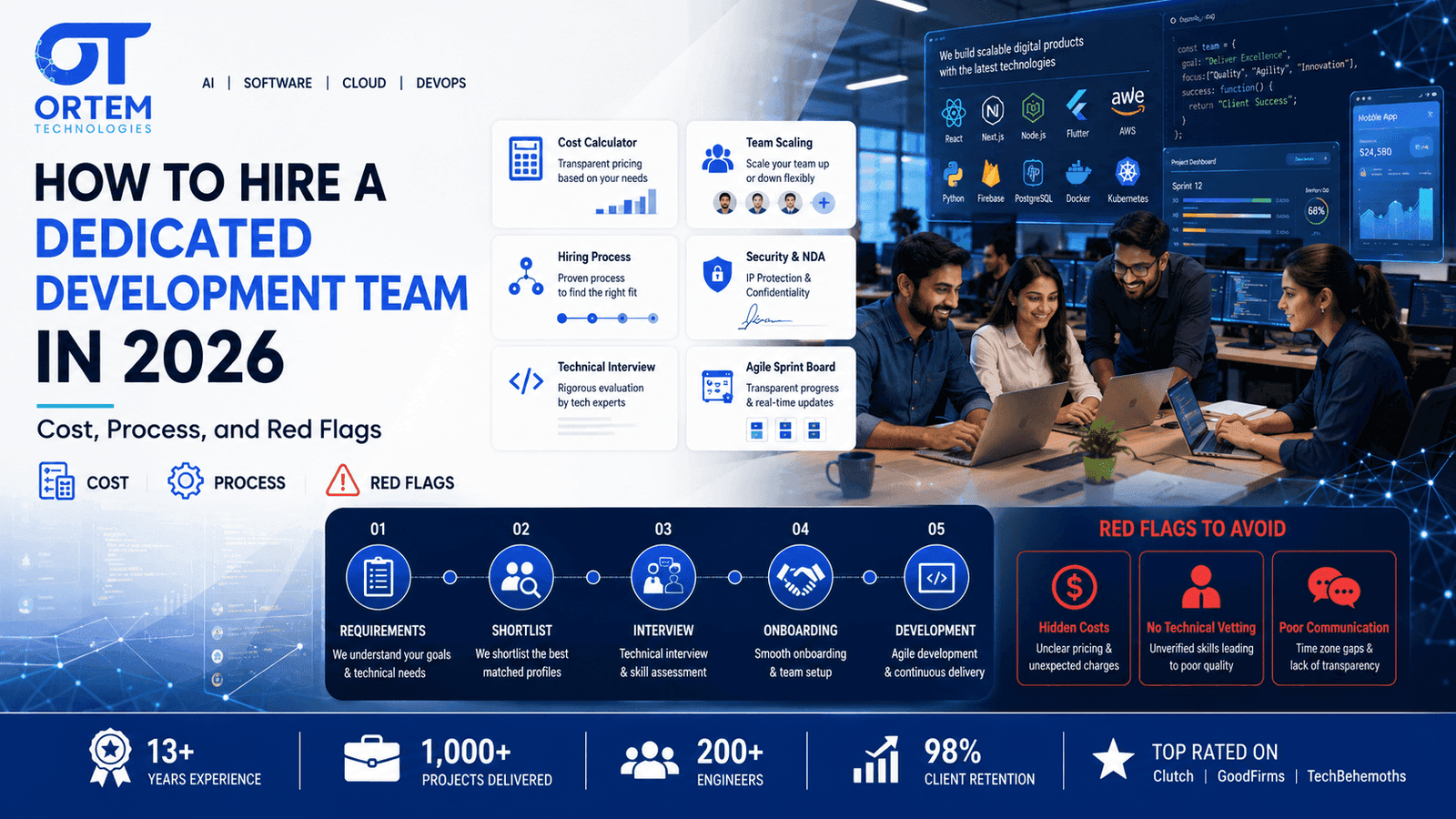
How to Hire a Dedicated Development Team in 2026: Cost, Process, and Red Flags
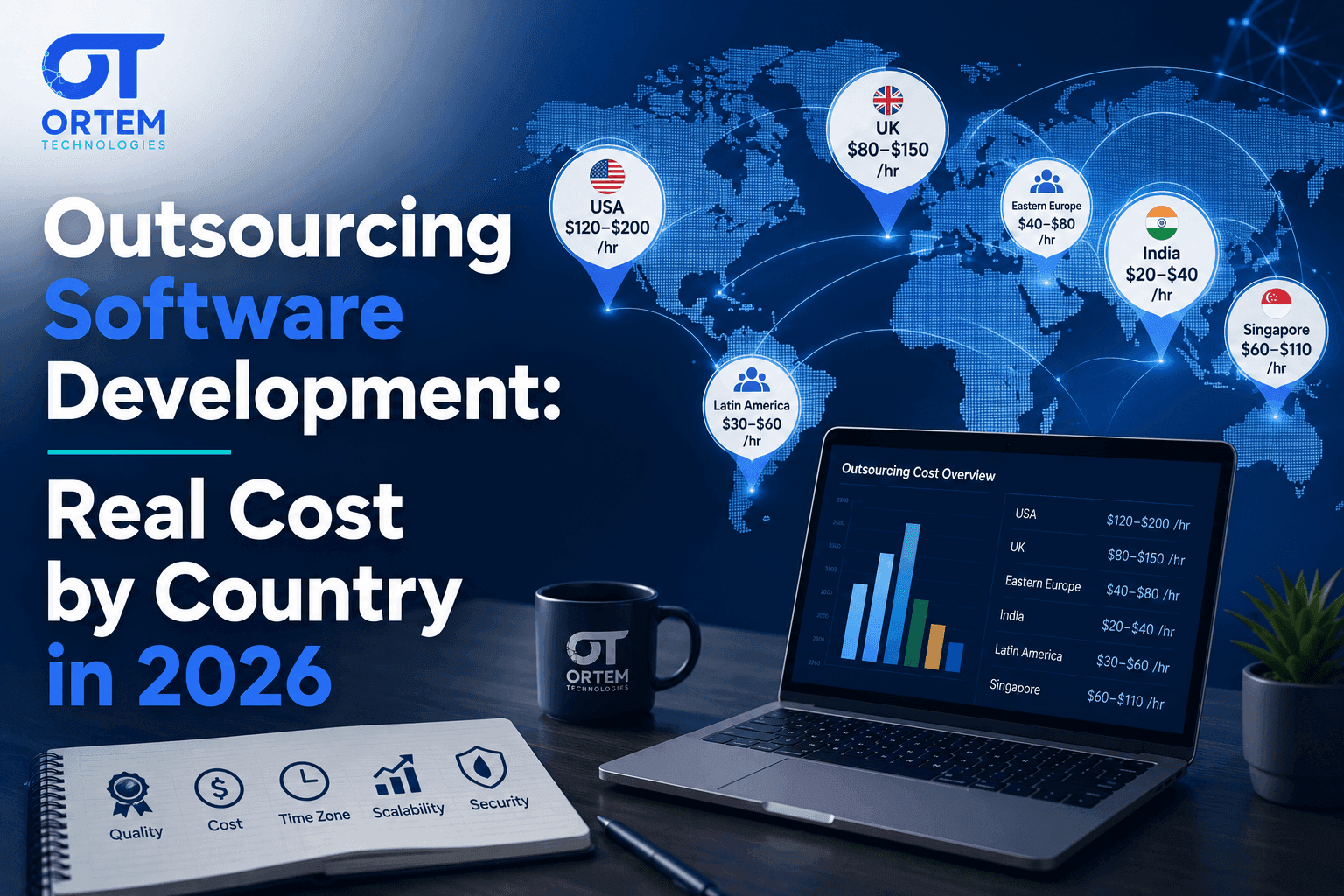
Outsourcing Software Development: Real Cost by Country in 2026