
Supabase vs Firebase for Multi-Tenant B2B SaaS
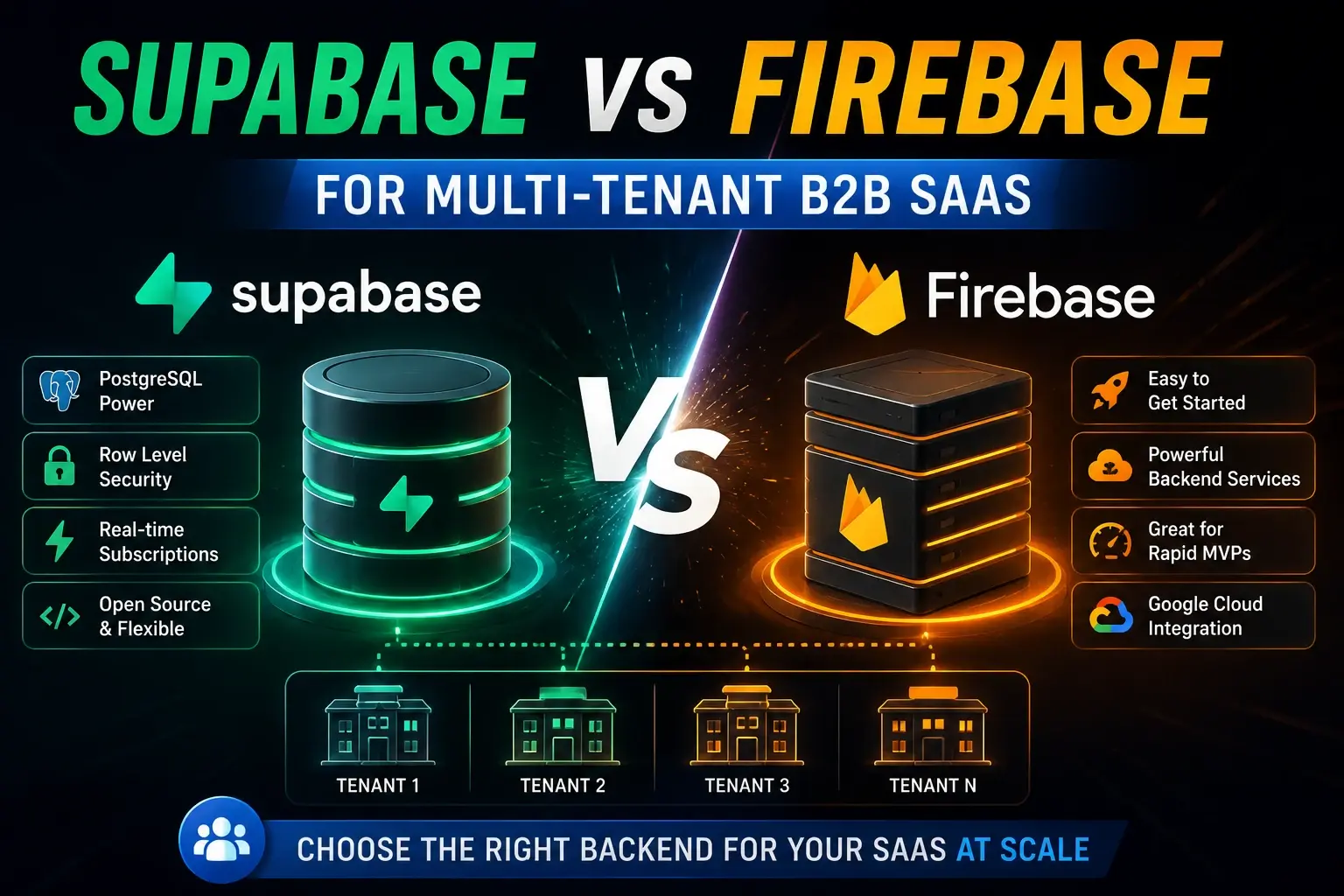
For multi-tenant B2B SaaS, Supabase is the stronger default. Postgres Row Level Security enforces tenant isolation inside the database engine itself, so a forgotten filter in application code cannot leak another tenant's rows, and B2B read patterns — dashboards, reports, admin tables — are punished by Firestore's per-document-read pricing in a way they are not by Supabase's compute-based model. Firebase remains the better choice when the product is mobile-first, needs offline sync, or depends on real-time fan-out to many concurrent clients. The decision is not which backend is better in general; it is whether your isolation model, read pattern and exit cost favour a relational database or a document one.
Next Best Reads
Continue your research on SaaS & Products
These links are chosen to move readers from general education into service understanding, proof, and buying-context pages.
SaaS Development Services
Move from product research into architecture, multi-tenancy, billing, and launch planning.
Explore SaaS serviceMVP Development
Use this path if your intent is validation, phased scope control, or faster launch for a new product.
See MVP serviceSaaS Platform Case Study
Review how Ortem shipped a multi-tenant production SaaS platform end to end.
Read case studyNearly every Supabase versus Firebase comparison is written for the same reader: a developer starting a project, weighing SDK ergonomics, free tiers and how fast they can ship a prototype. Those comparisons are fine, and they are not the one you need if you are building a multi-tenant B2B product.
A B2B SaaS backend has to satisfy constraints a consumer app never encounters. One customer's data must be provably invisible to another, and you will eventually have to explain that mechanism to a security reviewer. Your read patterns are dashboards and reports rather than feeds. And a single enterprise deal can arrive with a deployment requirement your provider does not support, at which point the cost of leaving becomes a real number rather than a hypothetical.
Judged on those constraints, the comparison narrows to three questions.
Question 1: Where Is Tenant Isolation Enforced?
This is the decision. Everything else is a trade you can revisit.
Supabase enforces it in the database. Postgres Row Level Security lets you attach a predicate to a table that the engine applies to every query against it, no matter which code issued that query. A multi-tenant policy typically restricts rows to those whose tenant identifier matches a claim carried in the request's JWT.
The property that matters is not elegance, it is durability under staff turnover. Six months from now a developer who has never read your isolation design will write a new query against that table. They will forget the tenant filter, because everyone eventually does. With RLS, the query still cannot return another tenant's rows — the filter is not in the query, it is in the table.
Firestore enforces it at the API boundary. Security rules evaluate against document paths and request context, and they work well. But isolation correctness becomes a property of how your data is shaped: every access path has to encode the tenant, and every rule has to be written to check it.
That holds cleanly right up until the first feature that legitimately crosses tenants — usage analytics, internal admin tooling, cross-tenant benchmarking for a customer who wants to know how they compare to their peers. At that point you are writing privileged code that deliberately steps around your own isolation model, and the guarantee weakens to "this code is correct" rather than "the database will not permit otherwise."
Both approaches ship products. The difference is what you can tell a security reviewer, and how much of your isolation guarantee depends on code review catching mistakes.
Question 2: What Does Your Read Pattern Cost?
Firestore bills per document read. Supabase bills for compute and storage. For consumer applications that difference is often academic. For B2B it is structural.
Consider the shape of B2B usage. An admin table showing 50 records is 50 reads. A dashboard aggregating 500 records is 500 reads. A report that joins across four entities multiplies again. And critically, these are reloaded constantly by a small number of high-intent users who live in the product all day.
That is the inverse of the consumer pattern. A consumer app reads few documents per session across a very large number of users. A B2B app reads a great many documents per session across a small number of users — which is precisely the pattern per-operation pricing punishes hardest.
A worked estimate. Take 200 tenants, five active users each, twenty sessions per user per working day, and forty document reads per session. That is 200 x 5 x 20 x 40 = 800,000 reads per working day, or roughly 17 million per month before a single report is run. Whether that is trivial or painful depends on the current published per-read rate, which changes — check it against your own numbers rather than trusting a figure in any article, including this one. The point is the shape: the same workload does not move a compute-based bill at all.
The usual counter is caching, and it is a fair one. Aggressive client and server caching genuinely blunts this. But you are then building and maintaining a caching layer to work around your database's pricing model, which is engineering effort spent on something a relational backend would not have asked of you.
Question 3: What Does Leaving Cost?
Supabase is Postgres. The database underneath is a standard Postgres instance, so the data layer is portable — a pg_dump restores onto RDS, Cloud SQL, or a server you run yourself. What you would rewrite is the surrounding integration: auth, storage, realtime. That is real work, but it is bounded and it does not touch your queries.
Firestore is proprietary. There is no equivalent target to restore into. Leaving means migrating the data and rewriting every query against a different data model, because document-shaped data does not land cleanly in a relational schema without redesign.
For consumer products this is often an acceptable risk that never materialises. For B2B it is different, because the trigger usually is not dissatisfaction — it is a customer. An enterprise buyer requires EU-only data residency, or self-hosting, or a compliance regime your provider does not cover. Now the migration is not a technical preference; it is a deal.
Where Firebase Is Genuinely the Better Answer
This is not a one-sided comparison, and choosing Supabase reflexively for a product that needs what Firebase does well is the same mistake in the other direction.
Offline-first mobile. Firebase's SDKs handle local persistence, queued writes and conflict resolution properly. If your users work in basements, on job sites, or anywhere connectivity is unreliable, this is a large amount of hard engineering you get for free. Supabase does not match it out of the box.
High-fan-out real-time. Supabase Realtime streams Postgres changes over websockets and comfortably handles collaborative dashboards, notifications and live status. Firebase was designed around real-time sync from the beginning and remains stronger when many concurrent clients need the same updates pushed instantly.
Genuinely unstructured or fast-changing data. If your core entity legitimately has no stable schema — user-defined forms, heterogeneous event payloads — a document store is the honest fit, and forcing it into Postgres means either a JSONB column that gives up most relational benefits or a schema that fights you every sprint.
Deep Google Cloud commitment. If your team already runs on GCP, the integration with Cloud Functions, BigQuery and Google identity is real leverage worth weighing.
Side-by-Side: The Multi-Tenant Criteria
| Criterion | Supabase | Firebase / Firestore |
|---|---|---|
| Tenant isolation | RLS policies enforced by the database engine | Security rules enforced at the API boundary |
| Isolation survives a forgotten filter | Yes | No — depends on path design and rule coverage |
| Cross-tenant queries | Native SQL, policies bypassed deliberately | Requires privileged code outside the rules model |
| Pricing shape | Compute and storage | Per document read, write and delete |
| B2B dashboard read cost | Flat with query volume | Scales directly with documents read |
| Relational modelling | Native — joins, constraints, transactions | Denormalisation required |
| Migration path out | pg_dump to any Postgres host | Data migration plus full query rewrite |
| Offline-first mobile | Limited | Best in class |
| High-fan-out real-time | Good | Best in class |
| Self-hosting for enterprise deals | Supported | Not available |
A Practical Default
If you are building a multi-tenant B2B SaaS product with a web-first interface, relational entities, dashboard-style reads, and enterprise customers who will eventually ask hard questions about data residency and isolation — start with Supabase. RLS answers the question a security reviewer actually asks, the pricing model matches how B2B products are used, and Postgres portability keeps a bad outcome recoverable.
Choose Firebase when the product is mobile-first with offline requirements, when real-time fan-out to many concurrent clients is a core feature rather than a nicety, or when your data genuinely has no stable schema.
And be honest about which one you are building. Plenty of B2B products have a mobile component; very few of them are mobile-first in the sense that should drive a backend decision.
Frequently Asked Questions
Is Supabase or Firebase better for multi-tenant SaaS? Supabase is the stronger default, mainly because Row Level Security enforces tenant isolation inside the database engine rather than in application code. Firebase wins when the product is mobile-first, needs offline sync, or depends on high-fan-out real-time.
How does Row Level Security handle tenant isolation? A policy attaches a predicate to a table and Postgres applies it to every query against that table, regardless of which code issued it. Typically rows are restricted to those whose tenant identifier matches a claim in the request JWT. Isolation therefore survives developer error, because the filter lives in the table rather than in the query.
Why does Firestore get expensive for B2B dashboards? Because it bills per document read, and B2B interfaces read many documents per session across few users — the inverse of the consumer pattern that per-operation pricing suits. A 500-record dashboard is 500 reads every time someone loads it.
Can you do multi-tenancy in Firestore? Yes — usually via a tenant collection prefix or a separate project per tenant. The prefix approach works until you need a query that crosses tenants. Project-per-tenant gives the hardest isolation but makes provisioning and schema changes grow linearly with customer count.
How hard is it to migrate off each one? Supabase is portable Postgres, so the data layer moves with pg_dump and you rewrite the auth, storage and realtime integration. Firestore is proprietary, so leaving means a data migration and a rewrite of every query.
Does Supabase support real-time like Firebase? It does, over websockets on Postgres changes, and it is fine for collaborative dashboards and notifications. Firebase is still stronger for high-fan-out consumer scenarios and offline-first mobile.
Building a multi-tenant platform and want the isolation model reviewed before you commit to it? Our SaaS development practice covers multi-tenant architecture, and our multi-tenant SSO and RLS walkthrough goes deeper on wiring row-level isolation to a real identity provider.
Get a multi-tenant architecture review → | SaaS development services →
About Ortem Technologies
Ortem Technologies is a premier custom software, mobile app, and AI development company. We serve enterprise and startup clients across the USA, UK, Australia, Canada, and the Middle East. Our cross-industry expertise spans fintech, healthcare, and logistics, enabling us to deliver scalable, secure, and innovative digital solutions worldwide.
Get the Ortem Tech Digest
Monthly insights on AI, mobile, and software strategy - straight to your inbox. No spam, ever.
Sources & References
- 1.Row Level Security - PostgreSQL Documentation
- 2.Row Level Security in Supabase - Supabase
- 3.Cloud Firestore Security Rules - Google Firebase
- 4.Understand Cloud Firestore Billing - Google Firebase
Frequently Asked Questions
- Supabase is the stronger default for multi-tenant B2B SaaS, mainly because Postgres Row Level Security enforces tenant isolation inside the database engine rather than in application code. Firebase is the better choice when the product is mobile-first, needs offline sync, or depends on real-time updates fanned out to many concurrent clients. The deciding factors are your isolation model, your read pattern, and how much migration risk you are willing to carry.
- A Postgres RLS policy attaches a predicate to a table, and the database applies it to every query against that table regardless of which code issued it. A typical multi-tenant policy restricts rows to those whose tenant_id matches a claim in the request JWT. The practical benefit is that isolation survives developer error: a new query written months later by someone who has never seen your isolation design still cannot return another tenant's rows, because the filter is not in the query, it is in the table.
- Firestore bills per document read. B2B interfaces are read-heavy in a specific way — an admin table showing 50 records is 50 reads, a dashboard aggregating 500 records is 500 reads, and both are reloaded constantly by a small number of high-intent users. Consumer apps read few documents per session across many users; B2B apps read many documents per session across few users, which is the pattern per-operation pricing treats worst. Supabase bills for compute and storage, so the same query volume does not change the bill.
- Yes, and plenty of products do. The common patterns are a tenant collection prefix, where every path begins with the tenant ID, or a separate Firebase project per tenant. Both work. The prefix approach makes isolation a property of your path structure, which holds cleanly until you need a query that crosses tenants — usage analytics, internal admin tooling, cross-tenant benchmarking. Project-per-tenant gives the hardest isolation available but turns provisioning, schema changes and billing into operational work that grows linearly with customer count.
- Supabase is Postgres with an open-source stack, so the database itself is portable — a pg_dump restores onto RDS, Cloud SQL or your own server, and what you would rewrite is the auth, storage and realtime integration rather than the data layer. Firestore is proprietary, so leaving means both a data migration and a rewrite of every query, because there is no equivalent target to restore into. That asymmetry matters most for B2B, where a single enterprise customer can demand a deployment model your current provider does not offer.
- It does, but the two are not equivalent at the extremes. Supabase Realtime streams Postgres changes over websockets and is more than adequate for collaborative dashboards, notifications and live status. Firebase was built around real-time sync from the start and remains stronger for high-fan-out consumer scenarios and for offline-first mobile clients, where its SDK handles local persistence and conflict resolution in ways Supabase does not match out of the box.
Stay Ahead
Get engineering insights in your inbox
Practical guides on software development, AI, and cloud. No fluff — published when it's worth your time.
Ready to Start Your Project?
Let Ortem Technologies help you build innovative software solutions for your business.
You Might Also Like

Best Construction Fleet Management Software in 2026 (7 Compared)

Best Property Management Software 2026: Buildium vs AppFolio vs Residenta Compared
