OpsCommand — Enterprise Fleet, Logistics & Intelligent Operations Platform
A production-grade enterprise operations platform built for a multinational transportation and field-services organization, unifying fleet management, vehicle maintenance, inspections, work orders, driver operations, operational analytics, document compliance, and intelligent workflow automation in a single system.
Client
Multinational Transportation & Field Services Organization (NDA)
Project Value
Confidential — NDA Protected
Rating
The Challenge
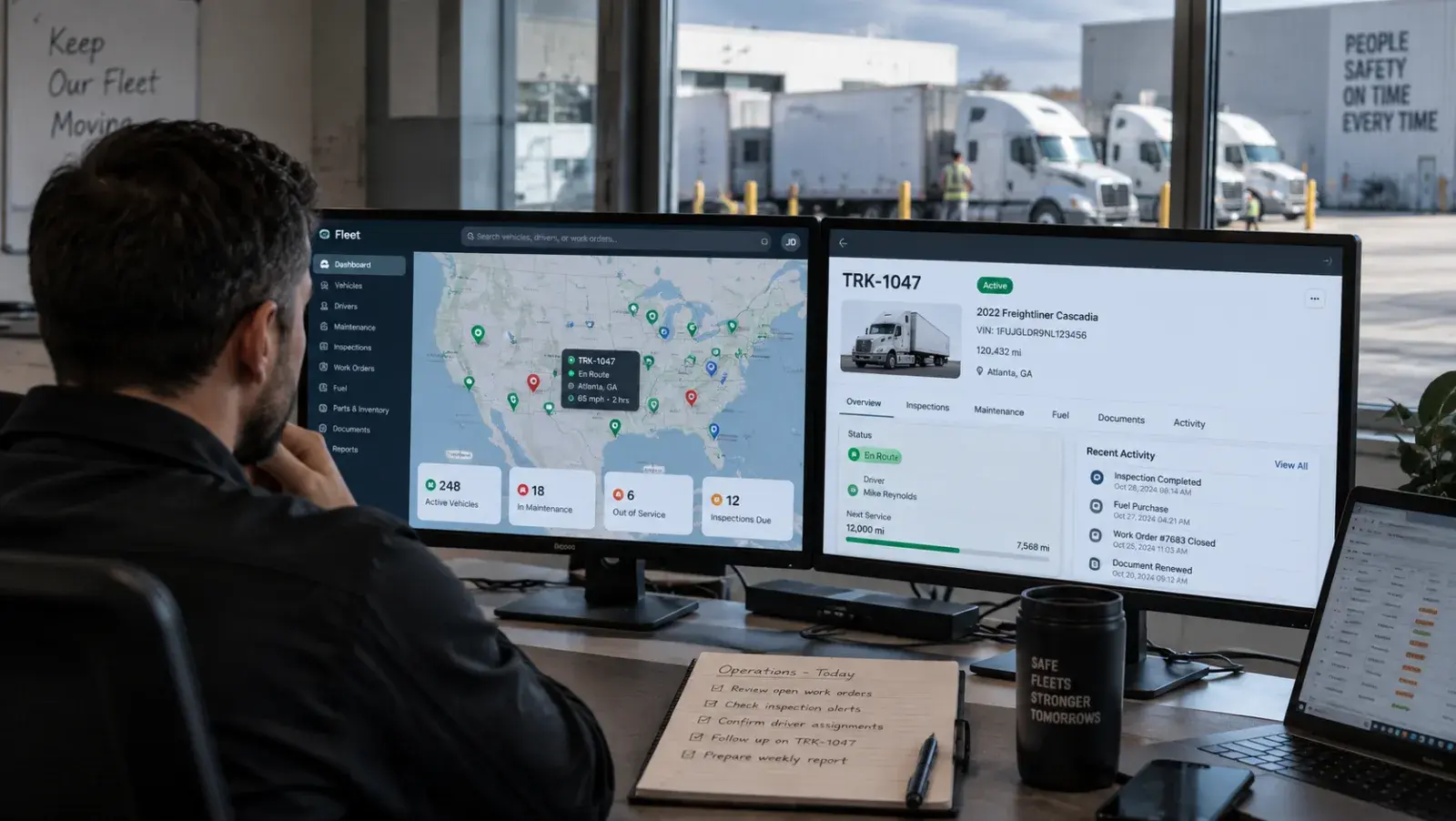
The client operated a distributed fleet across multiple operating locations, with fleet managers, dispatch teams, drivers, maintenance personnel and administrators using different processes to manage the same physical assets. Vehicle, maintenance, inspection and driver information all existed — but it did not form one operational system.
A vehicle could have a valid inspection in one system, a pending maintenance issue somewhere else, a document approaching expiry in another place, and a separate spreadsheet holding the information the operations team actually needed. Fleet managers could not see the complete condition of a vehicle without checking multiple systems. Maintenance teams received issues through different channels.
Drivers completed inspections using inconsistent workflows. Document renewals depended on manual reminders. Work orders could be created without being connected to the original inspection defect, and management reporting depended on manually consolidating operational information.
The organization needed more than a fleet dashboard: it needed a single operational platform connecting the complete lifecycle of a vehicle, from assignment and inspection through maintenance, repair and return to service.
The Goal
Build a production-grade fleet and logistics platform that gives operational teams a real-time view of the fleet while connecting vehicle data, driver workflows, inspections, maintenance, work orders, documents, inventory and operational reporting.
The platform had to support centralized fleet and vehicle lifecycle management, driver and assignment management, digital vehicle inspections, defect identification and escalation, maintenance scheduling, work-order management, parts and inventory, fuel tracking, compliance and document reminders, real-time operational dashboards, mobile workflows for drivers and field personnel, role-based access control, auditability, cloud deployment and intelligent automation.
The architecture also needed to leave room for future AI capabilities, including predictive maintenance, natural-language operational queries and automated exception detection.
Solution & Implementation
1Analysis
Ortem began by mapping the operational lifecycle rather than starting with application screens: vehicle onboarding → assignment → inspection → dispatch → operation → defect → maintenance → work order → repair → verification → return to service. The analysis also mapped the people involved at every stage.
Fleet managers need the current state of the fleet, upcoming maintenance, compliance status and operational exceptions. Operations managers need vehicle availability, assignments, dispatch information and outstanding issues. Drivers need a fast mobile workflow for inspections, defect reporting and operational updates. Maintenance technicians need actionable work orders, vehicle history, repair information and required parts.
Administrators need system configuration, users, roles, permissions and operational controls. This identified the key architectural requirement: vehicle data could not be treated as isolated records. The vehicle had to become the central operational object connecting inspections, drivers, maintenance, documents, fuel, work orders and historical activity.
2Designing Solution
The platform was designed around an operational data model rather than independent application modules, with one core relationship: vehicle → driver assignment → inspection → defect → work order → technician → parts → repair → vehicle status. That structure lets a single operational event propagate through the relevant workflow.
When a driver reports a serious brake issue, the system records the inspection result, the vehicle receives an operational exception, a maintenance issue and work order are created, the maintenance team receives the assignment, required parts are associated with the work order, the repair is recorded, inspection and maintenance history are updated, and the vehicle returns to an operational state.
The objective was to eliminate the handoffs that previously caused information to disappear between systems.
3Customizing Business Logic
The business rules were designed around real fleet operations rather than generic CRUD.
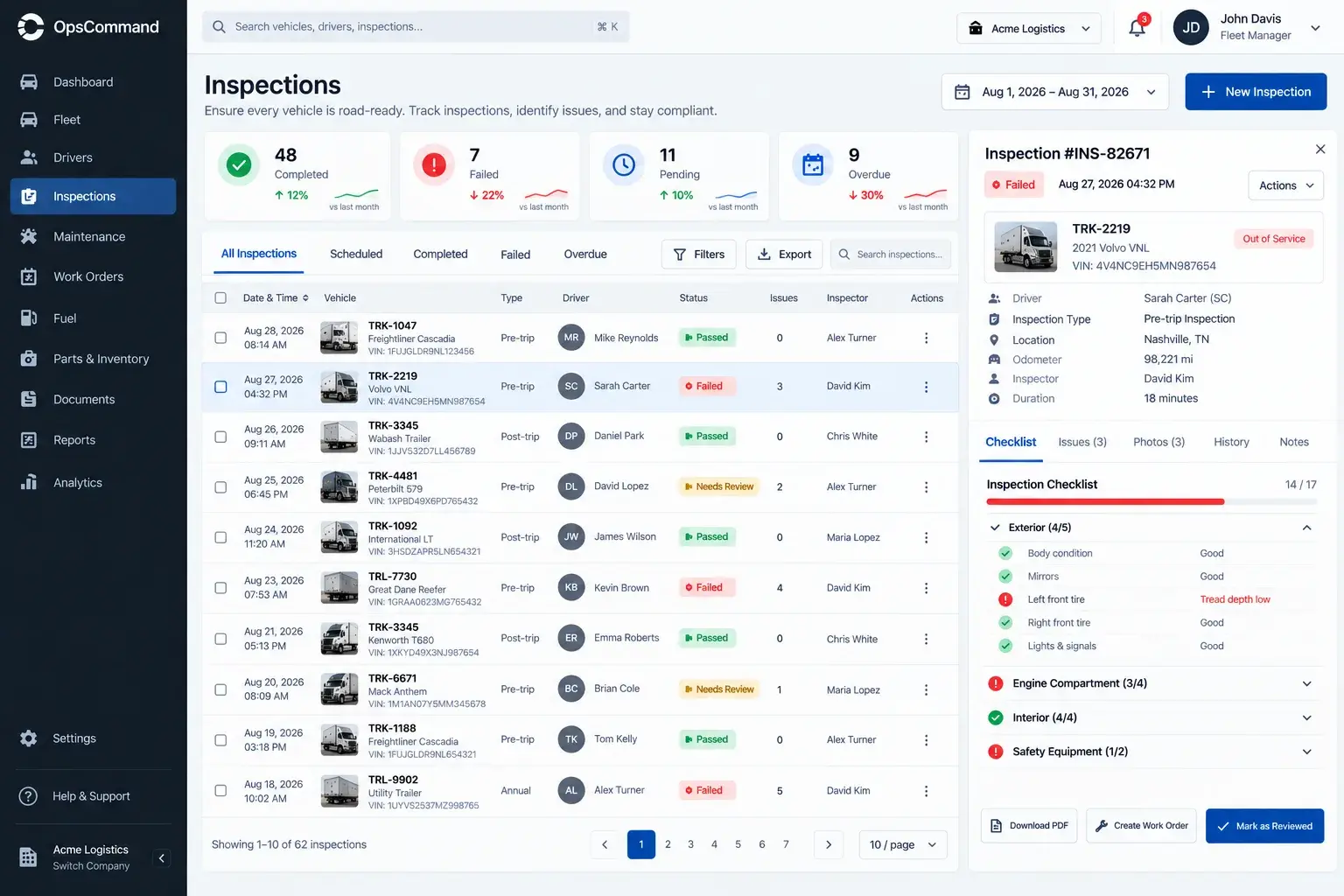
Administrators configure inspection templates by vehicle type — brakes, tires, lights, transmission, safety equipment, fluid levels, body condition and mechanical defects — and a defect found during a mobile inspection flows directly into maintenance as inspection → issue → priority → work order → repair, with no manual re-entry.
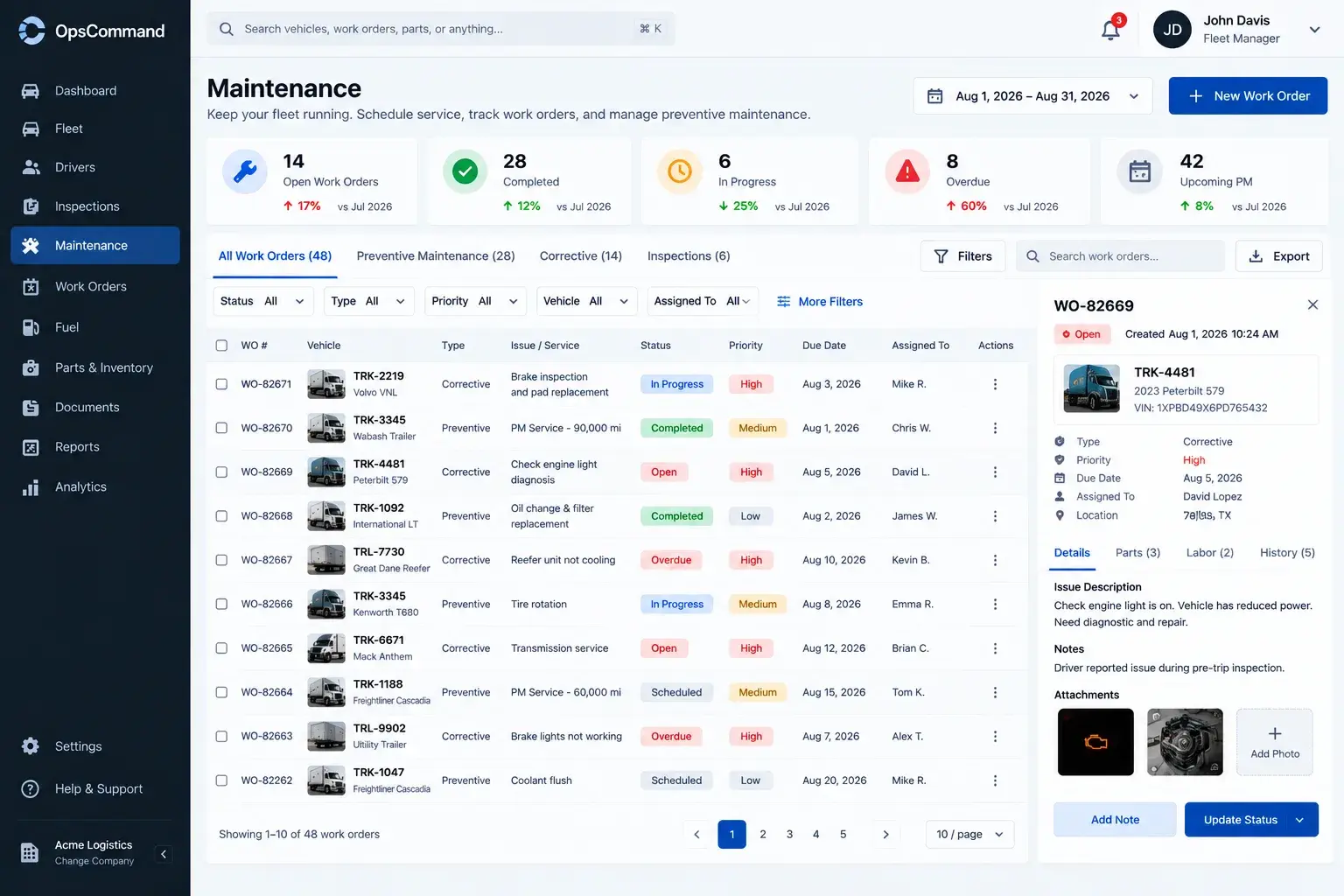
Configurable reminders track insurance, registration, emissions testing, inspection certificates, permits and custom compliance documents, turning expirations into operational tasks. Maintenance is managed as open issues, assigned work, active repairs, parts requirements and completed work, with every work order holding vehicle, issue, technician, parts, labour, cost and completion.
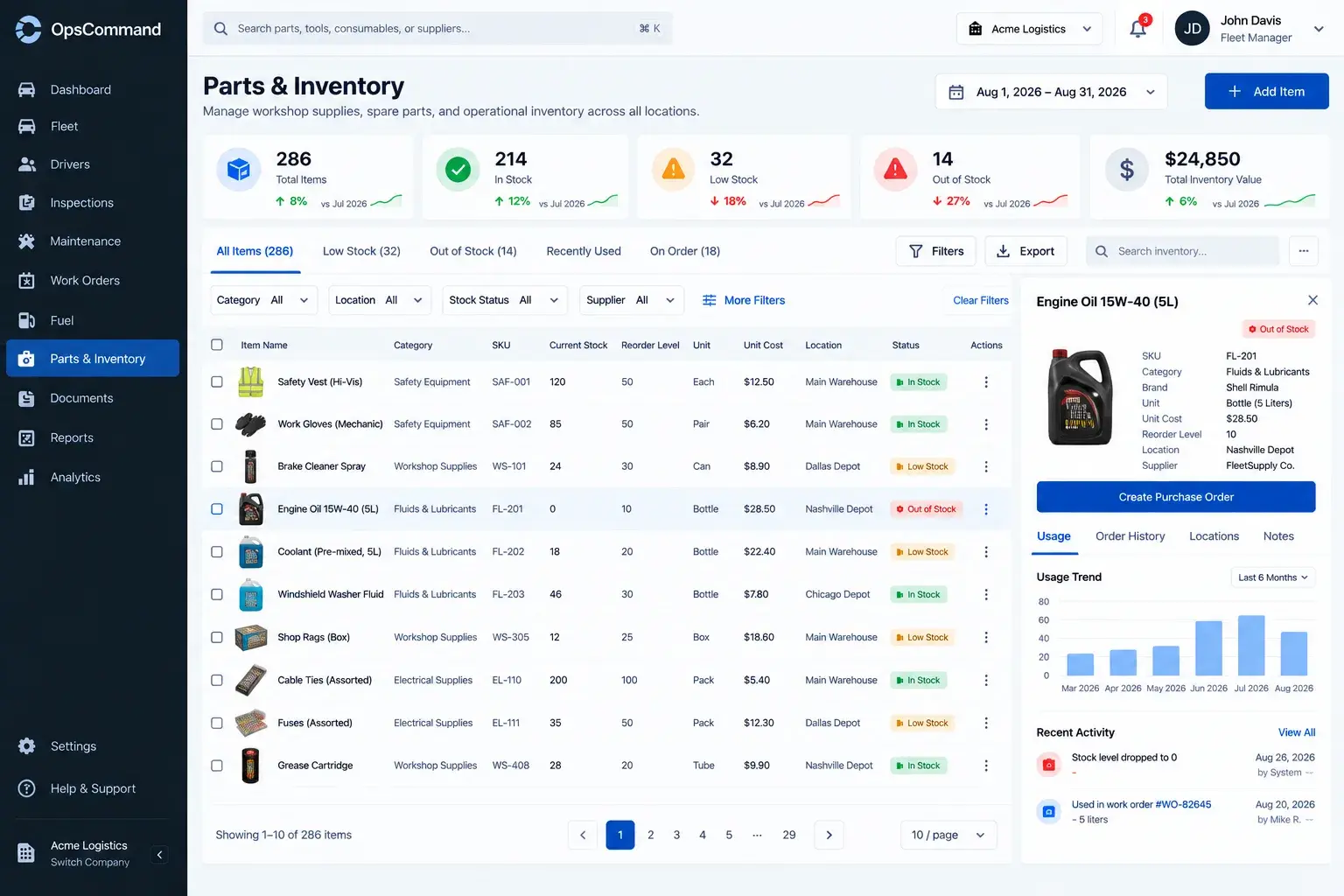
Parts used in a repair are linked to the work order, and fuel quantity, cost, odometer, location and date are captured per vehicle to build vehicle- and fleet-level efficiency history.
Drivers get a separate mobile experience focused on their current workflow, and role-based access gives fleet administrators, fleet managers, maintenance managers, technicians, drivers and read-only management each the capabilities their responsibility requires.
4Scale & Optimize
Once the core workflows were functional, the platform was optimized around the bottlenecks that matter at fleet scale.
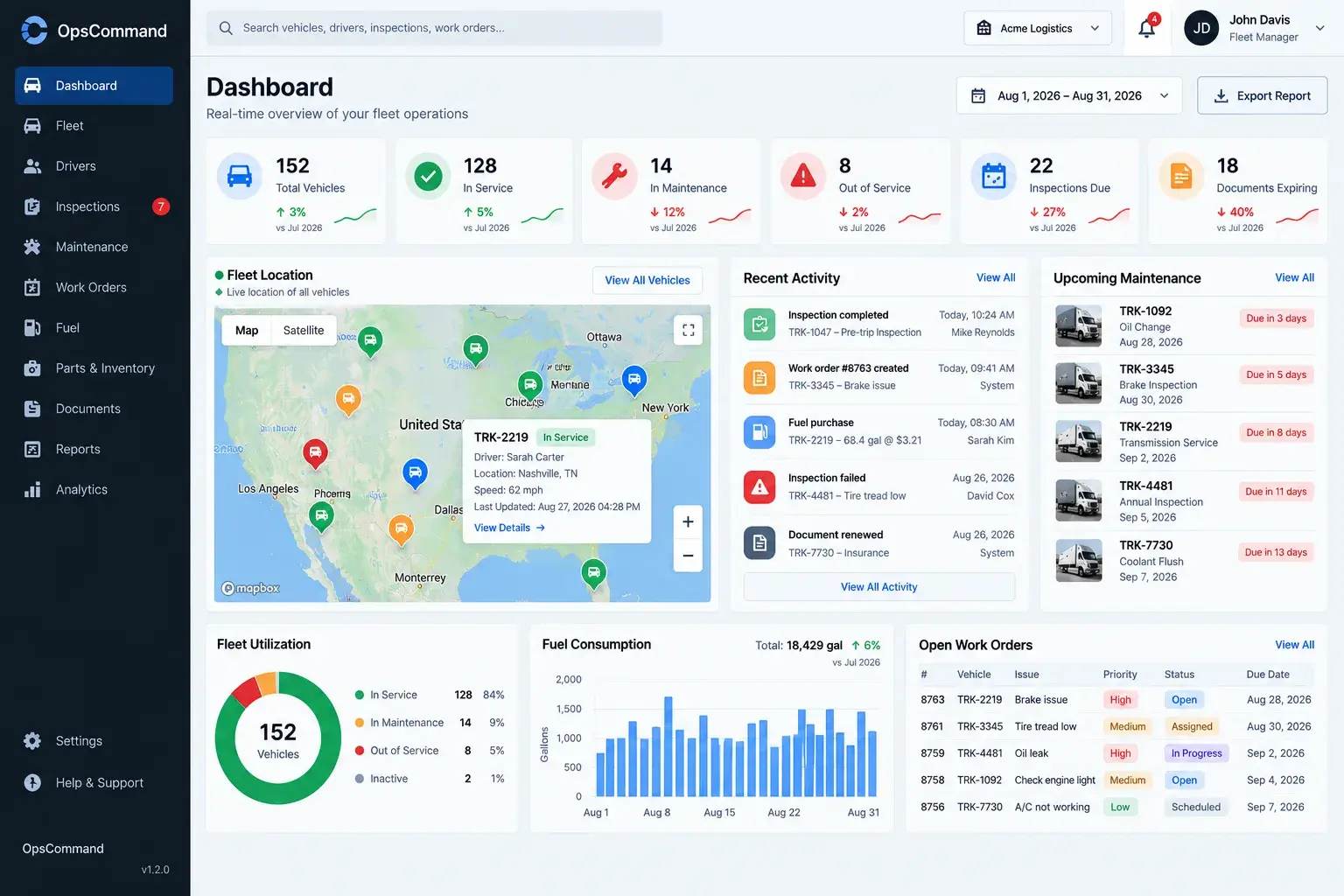
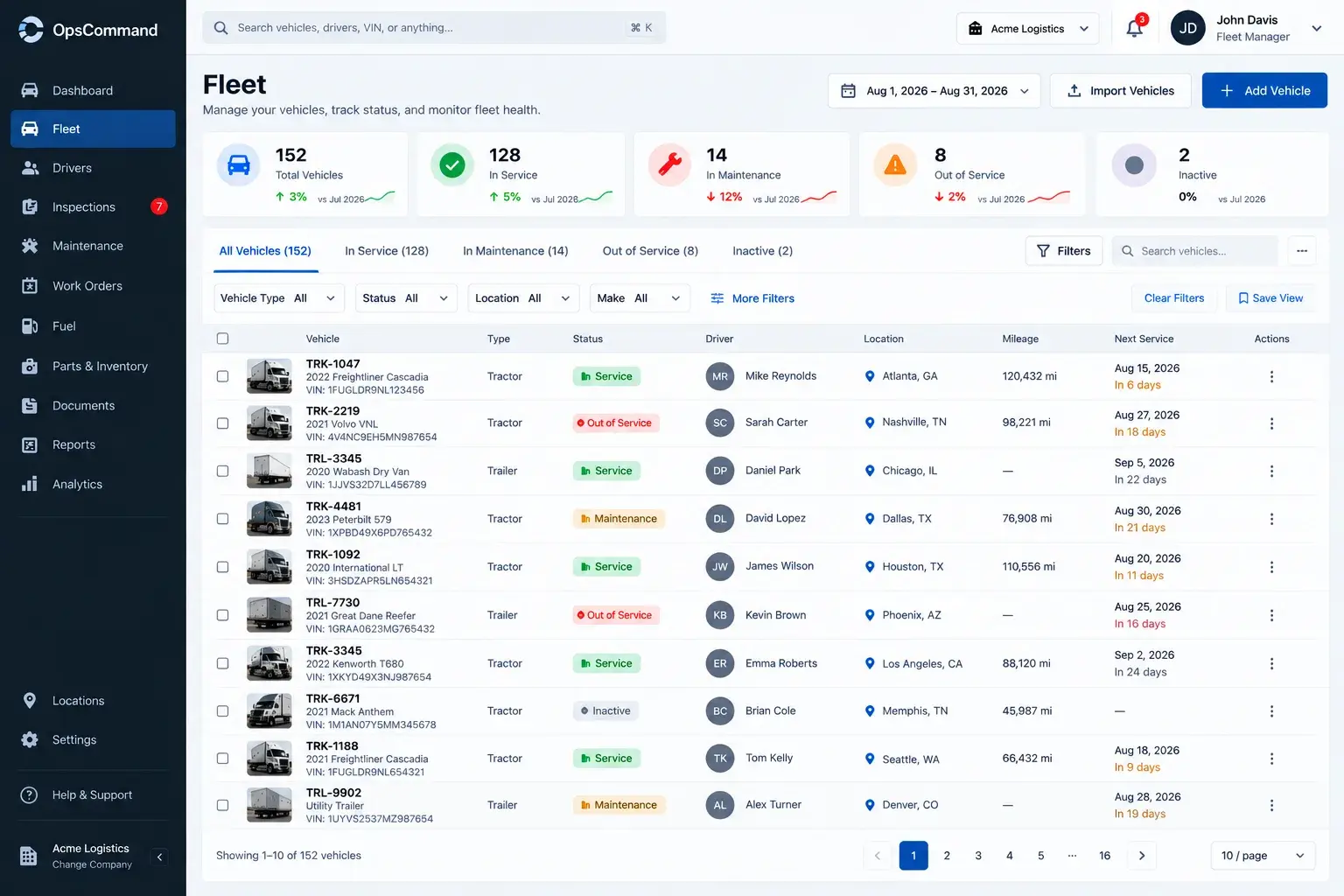
The most important was keeping the vehicle profile useful: instead of opening several pages, fleet managers see vehicle information, current driver, operational status, open work orders, inspection history, fuel trends, upcoming renewals and recent activity in one asset view that works as an operational command center.
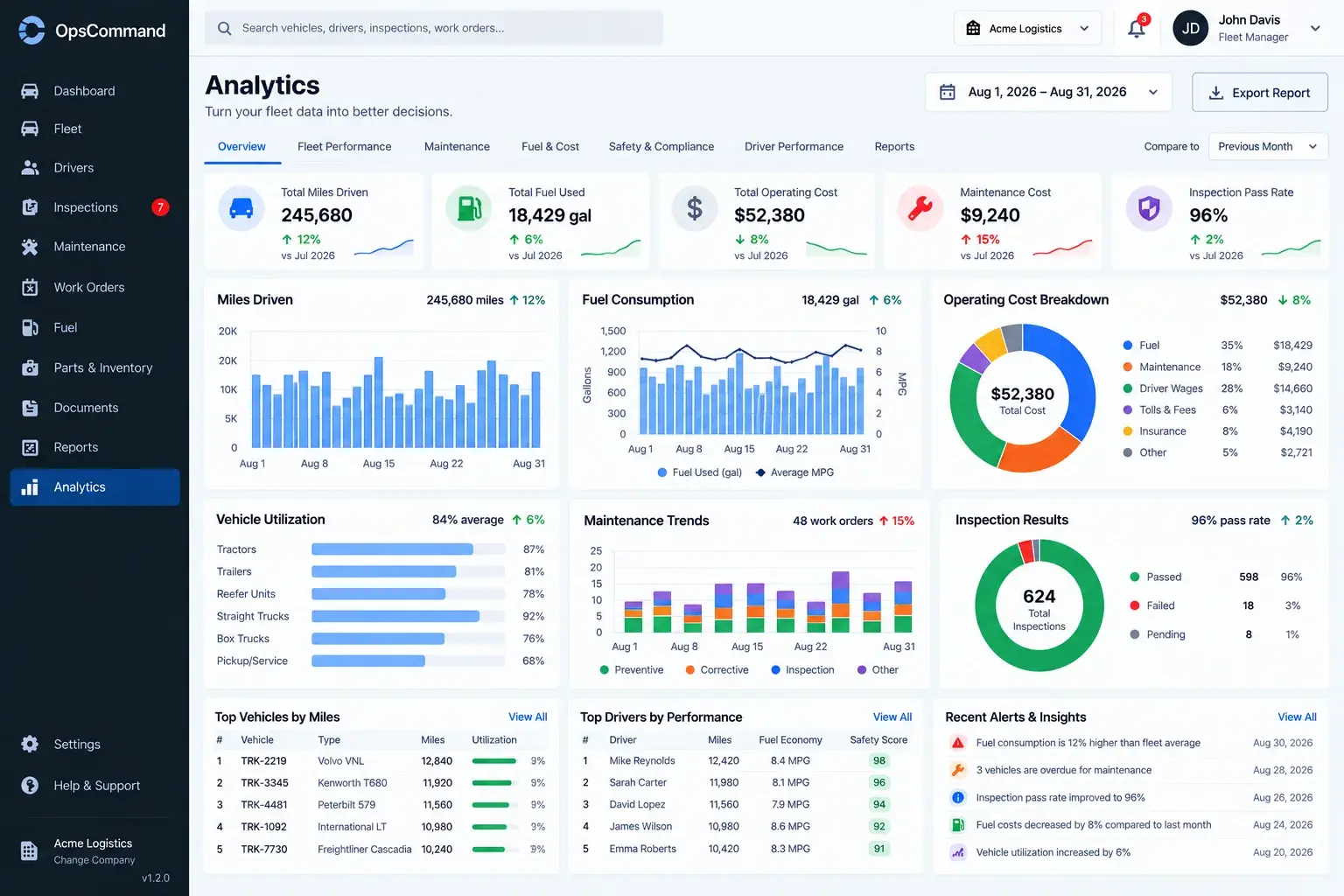
The real-time dashboard was optimized so multiple users can update operational records without relying on page refreshes to see changes, and it is designed around exceptions and actions rather than vanity metrics — so an operations manager can answer "what requires attention right now?" without opening multiple systems.
AI was then designed as an intelligence layer over the operational system rather than a replacement for core fleet software, reaching operational data only through defined, controlled interfaces.
Results & Impact
Operational System
Inspection Workflow
Operational Visibility
Manual Coordination
Maintenance History
AI-Ready Architecture
Multi-Role Operation
Enterprise Integration
Fleet management — centralized vehicle profiles and lifecycle management
Digital vehicle inspections — configurable templates with automatic issue escalation
Maintenance management — preventive and corrective maintenance workflows
Work orders — technician assignment, parts, labour and repair history
Parts & inventory — inventory levels with work-order-linked consumption
Fuel management — vehicle and fleet fuel tracking with efficiency analytics
Document compliance — configurable renewal reminders and expiry tracking
Driver management — driver assignment and field operations
Real-time dashboards — live fleet KPIs and operational exceptions
Mobile workflows — field-friendly vehicle and inspection operations
Role-based access — permissions based on operational responsibility
Intelligent automation — AI-ready architecture for predictive and natural-language workflows
Key Technologies
Project Gallery
See It in Action
From failed inspection to repair in one system: a driver inspection fails, one click creates the work order, it lands in the technician queue, and the fleet dashboard reflects it. Illustrative platform views; client under NDA.
Technical Approach
The platform follows a modular architecture built around a centralized operational data model. The vehicle is treated as the primary operational entity, and related entities — drivers, inspections, defects, work orders, maintenance records, fuel events, documents and parts — maintain explicit relationships with that asset. This makes it possible to answer operational questions without reconstructing information from separate applications.
The API layer isolates business logic from user interfaces, so web and mobile applications consume the same underlying workflows. Real-time application events keep operational dashboards synchronized, while background services handle scheduled reminders, notifications, document expiry events and other asynchronous workflows. AI services access controlled operational information through defined interfaces rather than unrestricted production data, which creates a cleaner path toward enterprise AI, predictive maintenance and natural-language operations.
Architecture at a Glance
- Drivers, technicians and fleet managers
- Web and mobile applications
- API and business logic layer
- Fleet, inspection, maintenance, work order, inventory, fuel and compliance services
- Operational database
- Events and automation
- AI and analytics layer
- Enterprise integrations — ERP, telematics, accounting, identity and BI
What Changed After the Platform
Before: driver → inspection → spreadsheet or manual report → manager → maintenance team → work order → repair → manual status update → fleet manager.
After: driver → digital inspection → issue detection → priority → work order → technician → parts → repair → vehicle status → fleet dashboard.
The difference is not simply a better interface. The workflow itself became software-controlled and traceable.
Intelligent Operations Layer
The structured operational data creates three AI opportunities. Predictive maintenance analyzes historical inspection, repair and maintenance data to identify recurring patterns and potential upcoming failures.
Natural-language fleet queries let authorized managers ask questions such as which vehicles have recurring brake issues, which have maintenance due within 30 days, or which assets show unusually high fuel consumption — translated into controlled queries against authorized operational data.
Intelligent exception detection flags unexpected fuel consumption, repeated defects, excessive maintenance frequency, unusual downtime and recurring vehicle-specific issues, shifting fleet management from record keeping toward operational intelligence.
Enterprise Integrations
The API layer is designed so fleet data does not remain isolated.
A mature deployment can connect with ERP (financial and asset management), HR and workforce systems (employee and driver information), telematics (location, mileage and sensor data), fuel systems, accounting (maintenance and operational costs), identity providers (enterprise authentication and access management), notification services (email, SMS and push) and analytics platforms (business intelligence and executive reporting) — without tightly coupling the core application to one vendor.
Technology choices are adapted to the client's existing environment, integration requirements, security constraints and scale.
About the Engagement
The client identity, commercial agreement, internal operational data and selected implementation details are protected under NDA. This case study therefore focuses on the product that was developed, the operational problems it addressed, the architecture used to solve them and the capabilities demonstrated through the engagement. Images on this page are illustrative representations of the platform and do not show client data.
Related capabilities: fleet management software development, logistics software development, AI and machine learning, IoT development and data engineering and analytics.
Frequently Asked Questions
About Ortem Technologies
Ortem Technologies is a premier custom software, mobile app, and AI development company. We serve enterprise and startup clients across the USA, UK, Australia, Canada, and the Middle East. Our cross-industry expertise spans fintech, healthcare, and logistics, enabling us to deliver scalable, secure, and innovative digital solutions worldwide.
Related Case Studies

Confidential US-Based Manufacturing Organization (NDA)
PlantOps — Enterprise Manufacturing Operations & Industrial IoT Platform
Regional Nonprofit Consortium (NDA)
CivicHub — Unified Identity & Multi-Tenant Platform for a Regional Nonprofit Consortium
Ready to Build Something Like This?
We've built transportation & logistics solutions like this for teams across the US, UK, and Middle East. Fixed scope. Fixed price. Senior engineers from day one.
Free 30-minute scoping call — no commitment, no sales pitch.