
Buying AI in a Tiered-Model World: A 2026 Procurement Guide
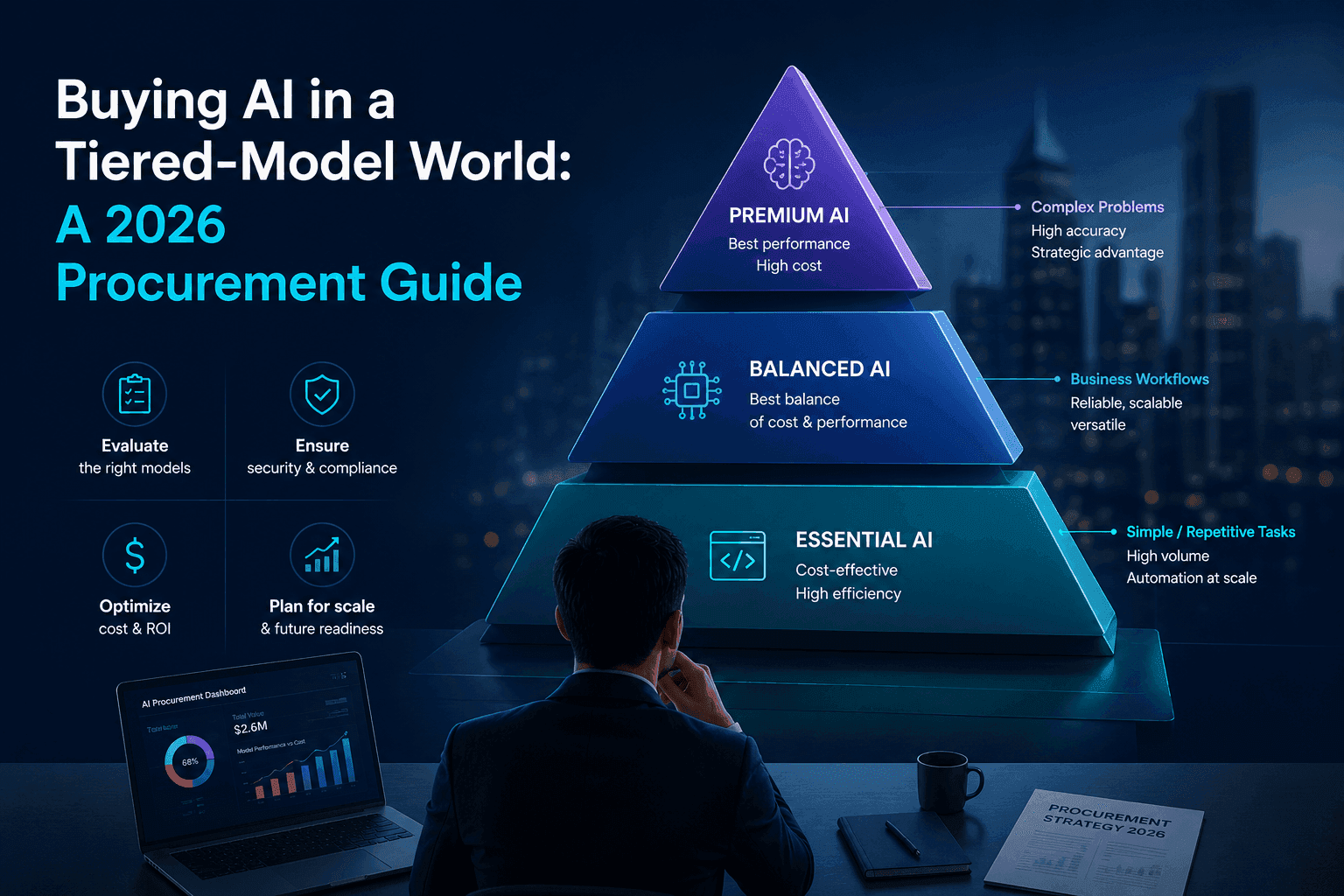
Model procurement in 2026 changed shape because labs shifted from single flagship releases to tiered model families aimed at different jobs: frontier reasoning, balanced everyday use, and low-cost high-volume work. August 2026 alone saw roughly 18 confirmed releases across 15 providers. The practical consequence is that the buying decision is no longer which model to standardise on, but which tier each workload should route to and how to stay portable when the lineup changes again. The three things that matter are workload-to-tier mapping, contract terms covering deprecation and price change, and an adapter layer that keeps swapping cheap.
Next Best Reads
Continue your research on Buyer's Guide
These links are chosen to move readers from general education into service understanding, proof, and buying-context pages.
Why Ortem
See how Ortem compares on delivery model, pricing transparency, and engineering quality.
See why OrtemOrtem Pricing
Understand engagement models and cost ranges before you shortlist a development partner.
View pricingGet a Free Estimate
Free 30-minute session to scope your build cost, timeline, and team structure with Ortem.
Get free estimateSomething changed in how AI labs ship, and it changed what buying AI looks like.
Through 2024 and much of 2025, releases were flagship events: one new frontier model, broadly better than its predecessor, and the buying decision was whether to move to it. In 2026 the pattern is tiered families. A single release now spans a frontier reasoning tier, a balanced everyday tier, and a fast low-cost tier, each priced for a different job. August 2026 alone brought roughly 18 confirmed releases across 15 providers.
That turns procurement from a selection problem into a routing problem.
What tiering actually means for buyers
When one lab ships three models at meaningfully different price points, standardising on "the good one" stops being sensible. The frontier tier can cost an order of magnitude more per million tokens than the fast tier from the same family. Running high-volume classification through a frontier reasoning model is not a small inefficiency; it is often the largest single line in an inference bill.
The corollary is that the interesting question moved. It is no longer "which lab is ahead this quarter", which changes too often to build a procurement strategy on. It is "which of my workloads belongs on which tier, and how quickly can I move them when the lineup shifts again".
Mapping workloads to tiers
The most useful sorting principle is the cost of being wrong.
Frontier tier earns its price where errors are expensive, hard to detect, or reach a customer without a human seeing them first. Complex multi-step reasoning, code generation on consequential paths, analysis feeding decisions with real financial weight.
Balanced tier covers the majority of production work in most organisations. Good enough for nuanced tasks, cheap enough to run continuously.
Fast tier suits high-volume, bounded work where errors are cheap and visible: classification, routing, extraction, short summarisation, first-pass filtering ahead of human review.
The single most common finding when teams audit this properly is that a large share of traffic sits on a tier well above what the workload needs, usually because a default was set during prototyping and never revisited. Cost attribution through your observability layer is what makes that visible; without per-feature attribution the bill is a single number nobody can act on.
Finding out empirically rather than by reputation
Benchmark tables are a weak guide to your specific workload. They measure general capability on public tasks, which correlates loosely with performance on your particular extraction problem over your particular documents.
The reliable method is unglamorous. Build an evaluation set from your real traffic — a few hundred representative cases with known good outcomes — and run it across tiers and providers. You get an answer specific to your workload in a day or two, and you get a reusable asset that makes every subsequent model decision faster.
This also gives you something to point at in a procurement conversation that is not vendor marketing.
Contract terms that matter more than price
Price per million tokens is the number everyone negotiates. It is rarely the term that hurts.
Deprecation notice. How much warning before a model you depend on is withdrawn or re-tiered? This determines your migration runway, and in a market shipping this fast, it is the term most likely to bite. Teams that skipped it in 2025 spent 2026 doing unplanned migrations.
Price change terms. Can pricing move mid-term, and with what notice? Tiered lineups get re-priced as competition shifts.
Data handling and training use. Whether your inputs and outputs may be used for training, retention periods, and where processing happens. This intersects directly with EU AI Act obligations and with any data residency commitments you have made to your own customers.
Availability and rate limits. Committed throughput matters if your product depends on it. Best-effort capacity is fine for internal tooling and unsuitable for a customer-facing critical path.
The adapter layer is the real decision
Everything above becomes low-stakes if switching is cheap, and high-stakes if it is not. Which makes your architecture the more consequential choice.
The pattern is straightforward and worth being disciplined about. Business logic — what capability you need, what constitutes a valid result, what happens on failure — lives in your code and imports nothing provider-specific. Each model provider sits behind an adapter implementing your own interface. Which model serves which workload is configuration, not code.
Teams built this way re-route a workload to a different tier or provider in days, and can run an evaluation across three providers without touching application logic. Teams that imported a provider SDK throughout their codebase measure the same change in months, which in practice means they do not make it, and they overpay indefinitely.
We made the same argument about agent protocols and it holds here for the same reason: in a fast-moving market, the value is in optionality rather than in picking correctly once.
A procurement checklist
Before signing, work through this list. It takes an afternoon and routinely saves considerably more.
Inventory your AI workloads and current spend per workload — you cannot route what you have not enumerated. Build an evaluation set from real traffic. Test each significant workload across at least two tiers, including one cheaper than your current default. Confirm your architecture puts model choice behind an interface. Negotiate deprecation notice and price-change terms alongside rate. Check data handling against your regulatory and customer commitments. Then instrument cost attribution before you scale up, not after the bill arrives.
Ortem Technologies builds AI systems that are provider-agnostic by construction, because we have migrated enough client workloads between models to know what the alternative costs. If you are evaluating model tiers or want an architecture that keeps the decision reversible, see our LLM integration services, our pricing and engagement models, or talk to our team.
About Ortem Technologies
Ortem Technologies is a premier custom software, mobile app, and AI development company. We serve enterprise and startup clients across the USA, UK, Australia, Canada, and the Middle East. Our cross-industry expertise spans fintech, healthcare, and logistics, enabling us to deliver scalable, secure, and innovative digital solutions worldwide.
Get the Ortem Tech Digest
Monthly insights on AI, mobile, and software strategy - straight to your inbox. No spam, ever.
Sources & References
- 1.AI Model Releases: August 2026 Tracker - Digital Applied
- 2.AI Model Releases in August 2026: Confirmed Updates - BenchLM
- 3.AI Updates Today — Latest AI Model Releases - llm-stats
About the Author
Editorial Team, Ortem Technologies
The Ortem Technologies editorial team brings together expertise from across our engineering, product, and strategy divisions to produce in-depth guides, comparisons, and best-practice articles for technology leaders and decision-makers.
Frequently Asked Questions
- Start from the cost of being wrong. Workloads where an error is expensive or hard to detect justify a frontier tier. High-volume workloads with cheap, visible errors and human review downstream usually run fine on a fast tier at a fraction of the price. The common mistake is defaulting everything to the most capable model, which is the single largest source of avoidable inference spend in most organisations.
- Beyond price and rate limits: deprecation notice periods, whether pricing can change mid-term and with what notice, data handling and training-use commitments, availability terms, and what happens to your access if a model is re-tiered or withdrawn. Deprecation notice is the term teams most often skip and most often regret, because it determines how much runway you get for a forced migration.
- Keep business logic free of provider SDKs and put every model call behind your own interface. What the model does for you should be defined in your code; which model does it should be configuration. Teams with that structure switch providers in days. Teams that imported a provider SDK throughout their codebase measure the same migration in months.
- For a meaningful share of production workloads, yes. Classification, extraction, routing, summarisation of short documents and similar bounded tasks frequently run acceptably on fast tiers. The way to find out is empirical: build an evaluation set from your real traffic and run it across tiers. Most teams that do this discover they are overpaying on at least one high-volume path.
Stay Ahead
Get engineering insights in your inbox
Practical guides on software development, AI, and cloud. No fluff — published when it's worth your time.