AI Model Risk Governance for FinTech: Building for Audit From Day One
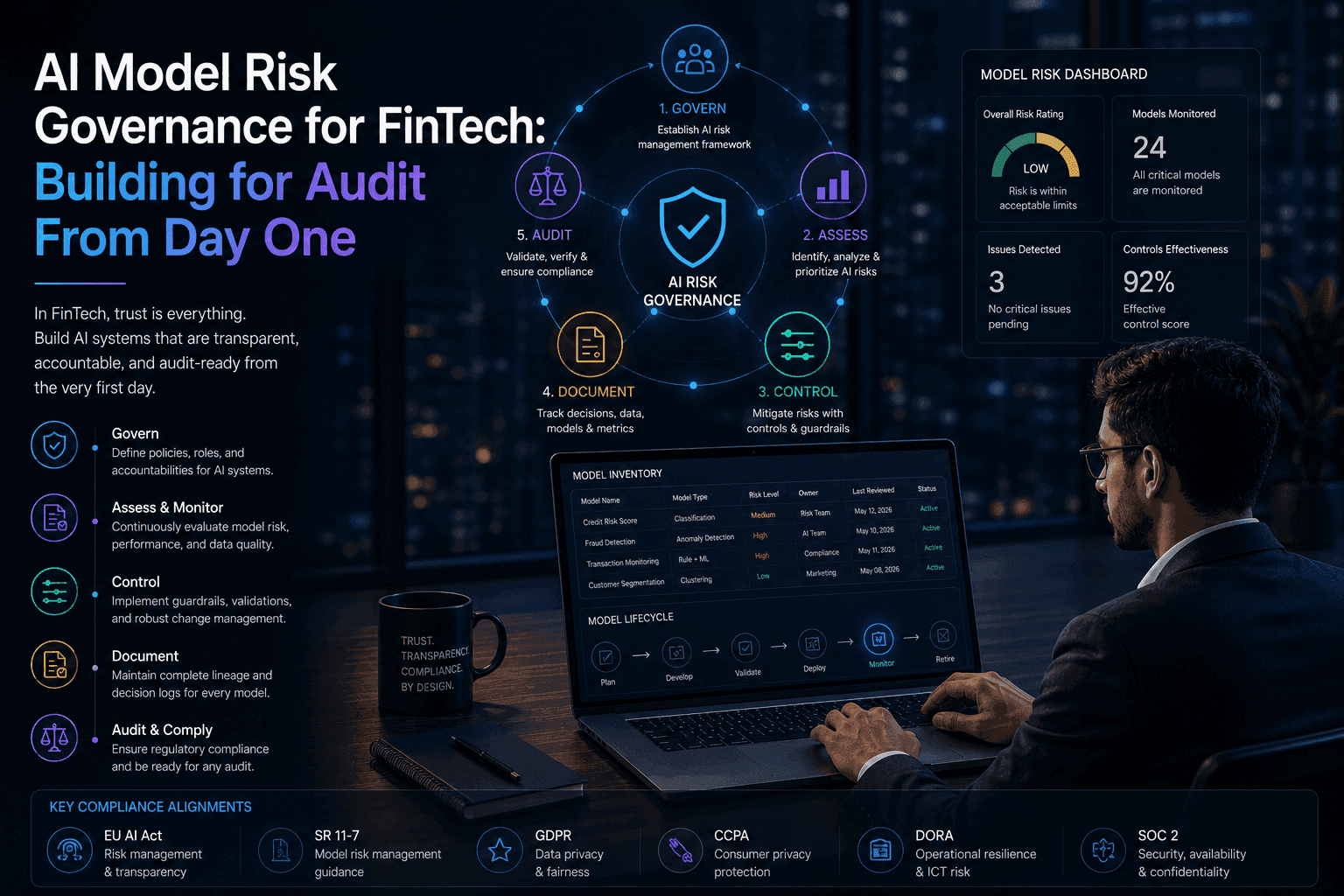
FinTech AI now sits under three overlapping regimes: existing model risk management expectations from financial regulators, the EU AI Act's high-risk obligations for credit and creditworthiness use cases, and standing audit and record-keeping duties. The practical advantage financial firms hold is that model risk discipline already exists in the sector — model inventories, validation, challenger models and documented override authority are established practice. The efficient path is extending that existing framework to cover AI systems rather than standing up a separate AI governance programme, with four artefacts doing most of the work: a model inventory, end-to-end data lineage, a human review log, and retained evidence an examiner can inspect.
Next Best Reads
Continue your research on FinTech
These links are chosen to move readers from general education into service understanding, proof, and buying-context pages.
Cybersecurity Services
Turn compliance-awareness content into a concrete programme for app security, audits, and remediation.
Explore security serviceCompliance & Security
Review how Ortem handles security controls, governance, and regulated software delivery requirements.
View compliance pageFinTech Case Study
Study a security-sensitive banking product build where reliability, payments, and trust were central.
Read case studyEvery sector is currently working out how to govern AI. Financial services is the one sector that has been doing a version of this for decades, and most firms are underusing that advantage.
Model risk management is established practice in banking and increasingly in fintech: maintain an inventory of models, validate them independently, understand their limitations, document who may override them and on what basis. The EU AI Act asks strikingly similar questions with different vocabulary.
The firms making this transition efficiently are extending the model risk function to cover AI. The firms struggling are running AI governance as a separate technology initiative in parallel, duplicating effort and producing two sets of evidence that do not reconcile.
Three regimes, one control set
FinTech AI in 2026 sits at the intersection of three sets of expectations.
Existing model risk management. Supervisory expectations around model inventories, independent validation, conceptual soundness, ongoing monitoring and documented use limitations. Well established, well understood, already staffed in most regulated firms.
The EU AI Act. Creditworthiness assessment sits among the listed high-risk use cases, which brings risk management, technical documentation, logging, human oversight and post-market monitoring obligations. Applies extraterritorially to any firm serving EU customers, as covered in our EU AI Act guide.
Standing audit and record-keeping duties. Whatever your regulator already requires about retaining evidence and reconstructing decisions.
The productive insight is that these three regimes want substantially the same underlying capability: know what models you run, know what data feeds them, know what decisions they influenced, and be able to prove all of it afterwards.
The four artefacts that carry most of the weight
In practice, four things do most of the work across all three regimes.
The model inventory. Every model and AI system, its owner, purpose, the decision it influences, risk classification, data sources, validation status, current version, and whether a human reviews outputs. This is the foundational artefact. Every other governance activity assumes it exists, and it is the first thing any examiner asks for. Firms that maintain it well find everything downstream easier; firms that reconstruct it annually find everything harder.
End-to-end data lineage. Where the data feeding a decision came from, what transformations it passed through, and which version of which dataset was live when a given decision was made. This is the requirement that most often exposes architectural debt, because retrofitting lineage into pipelines that were not designed to carry it is genuinely difficult.
The human review log. Not just that a human was in the loop, but what they saw, what they decided, whether they overrode the model, and the rationale they gave. This is where the EU AI Act's human oversight requirement becomes concrete and auditable, and it is a product design problem as much as a compliance one.
Retained evidence. The ability to reconstruct a specific decision months later. If a customer disputes a credit decision from March, can you show which model version scored them, on what data, and who reviewed it? If not, the gap is real regardless of how complete the policy documentation looks.
Where AI genuinely differs from traditional models
Extending model risk practice to AI works well, but there are three places where the older framework needs genuine adaptation rather than relabelling.
Non-determinism. A traditional scorecard produces the same output for the same input every time. A large language model may not. Validation approaches built around reproducibility need rethinking when the system is stochastic, and evidence needs to capture the actual output produced rather than assuming it can be regenerated.
Opacity of foundation models. When the model is a third-party foundation model, you do not have visibility into training data or architecture in the way you would for an internally built model. Governance shifts toward evaluating behaviour rather than inspecting construction, and toward contractual assurances from the provider.
Drift at the input layer. Traditional model monitoring watches for population drift in structured inputs. AI systems consuming free text, documents or user prompts drift in ways that are harder to detect with conventional statistical monitoring, and that is where observability instrumentation becomes a governance tool rather than just an engineering one.
Building for audit from the start
The phrase "auditable by construction" is worth taking seriously, because the alternative is genuinely expensive.
Systems designed to produce evidence as a by-product of operating are cheap to audit. Systems that require a project to reconstruct evidence are expensive to audit, and the reconstruction is never as convincing as contemporaneous records.
Concretely, this means logging the model version alongside every decision rather than assuming you can infer it from deployment history. It means capturing the input payload, not just a reference to a mutable record that may have changed since. It means recording human review as a first-class event with its own timestamp and rationale field, rather than inferring approval from the absence of an objection.
None of this is technically difficult. It is simply much harder to add later, which is why it belongs in the initial architecture rather than the compliance remediation backlog.
What to prioritise if you are starting now
If your fintech is deploying AI into credit, underwriting, fraud or customer decisioning and you do not yet have this structure, the sequence that produces the fastest risk reduction is straightforward.
Begin with the inventory, because you cannot govern or classify what you have not enumerated, and because it usually reveals that the actual AI footprint is both smaller and more concentrated than the organisation assumed.
Classify each entry against the AI Act tiers next. Creditworthiness use cases will surface immediately as high-risk and deserve disproportionate attention; a marketing content generator will not.
Then close the evidence gap on the high-risk systems specifically — lineage, decision logs, human review records — before broadening. Attempting uniform coverage across every AI system at once is how these programmes stall.
Finally, fold the whole thing into the existing model risk governance cycle rather than running it separately. The reporting lines, challenge process and validation cadence already exist. Reusing them is both cheaper and more credible to a regulator than inventing a parallel structure.
Ortem Technologies builds financial software where auditability is an architectural requirement rather than a later phase. If you are extending model risk governance to cover AI systems, or need decision logging and lineage built into a platform properly, see our fintech development work, our compliance approach, or talk to our team.
About Ortem Technologies
Ortem Technologies is a premier custom software, mobile app, and AI development company. We serve enterprise and startup clients across the USA, UK, Australia, Canada, and the Middle East. Our cross-industry expertise spans fintech, healthcare, and logistics, enabling us to deliver scalable, secure, and innovative digital solutions worldwide.
Get the Ortem Tech Digest
Monthly insights on AI, mobile, and software strategy - straight to your inbox. No spam, ever.
Sources & References
- 1.AI Act — Regulatory Framework for AI - European Commission
- 2.US Companies Face EU AI Act's August 2026 Compliance Deadline - Holland & Knight
- 3.ISO 42001 & NIST AI RMF: Practical Steps for Responsible AI Governance - TrustCloud
About the Author
Private 1:1 AI Tutor · Director of Sales & Business Development, Moksh Tech
Praveen Jha is a private 1:1 AI tutor and enterprise AI sales leader based in Ahmedabad, India. He teaches executives, founders and engineers to ship real work with ChatGPT, Claude, Cursor and Claude Code, and is an Oracle Certified Generative AI Professional and AWS Certified Solutions Architect. He wrote his articles here while Director of AI Product Strategy, Sales & Business Development at Ortem Technologies.
Frequently Asked Questions
- They overlap without replacing each other. Existing model risk expectations focus on whether a model is conceptually sound, properly validated and appropriately used. The EU AI Act adds requirements around risk classification, technical documentation, human oversight design, transparency and post-market monitoring. Firms with mature model risk functions will find much of the AI Act evidence already exists in a different format.
- The ability to reconstruct the decision. That means the model version in use at the time, the input data and its lineage, the output produced, any human review or override that occurred, and the rationale recorded for it. If a decision cannot be reconstructed after the fact, the governance framework has a gap regardless of how good the documentation looks.
- Creditworthiness assessment is among the use cases the EU AI Act treats as high-risk, because it materially affects a person's access to essential services. That brings the full obligation set: risk management, technical documentation, logging, human oversight and post-market monitoring. Fraud detection and anti-money-laundering systems require case-by-case assessment depending on how directly they affect individuals.
- At minimum: every model and AI system in use, its owner, its business purpose, the decision it influences, its risk classification, its data sources, its validation status and date, its current version, and whether a human reviews its outputs. The inventory is the foundational artefact — every other governance activity depends on knowing what exists.
Stay Ahead
Get engineering insights in your inbox
Practical guides on software development, AI, and cloud. No fluff — published when it's worth your time.
Ready to Start Your Project?
Let Ortem Technologies help you build innovative software solutions for your business.
You Might Also Like
Fintech App Development in 2026: Compliance, Cost, and Architecture for US and Global Markets

Financial Software Development Company: What Fintech Builds Require in 2026