
Software Development Estimation: 8 Techniques, Accuracy Ranges and a Free Template
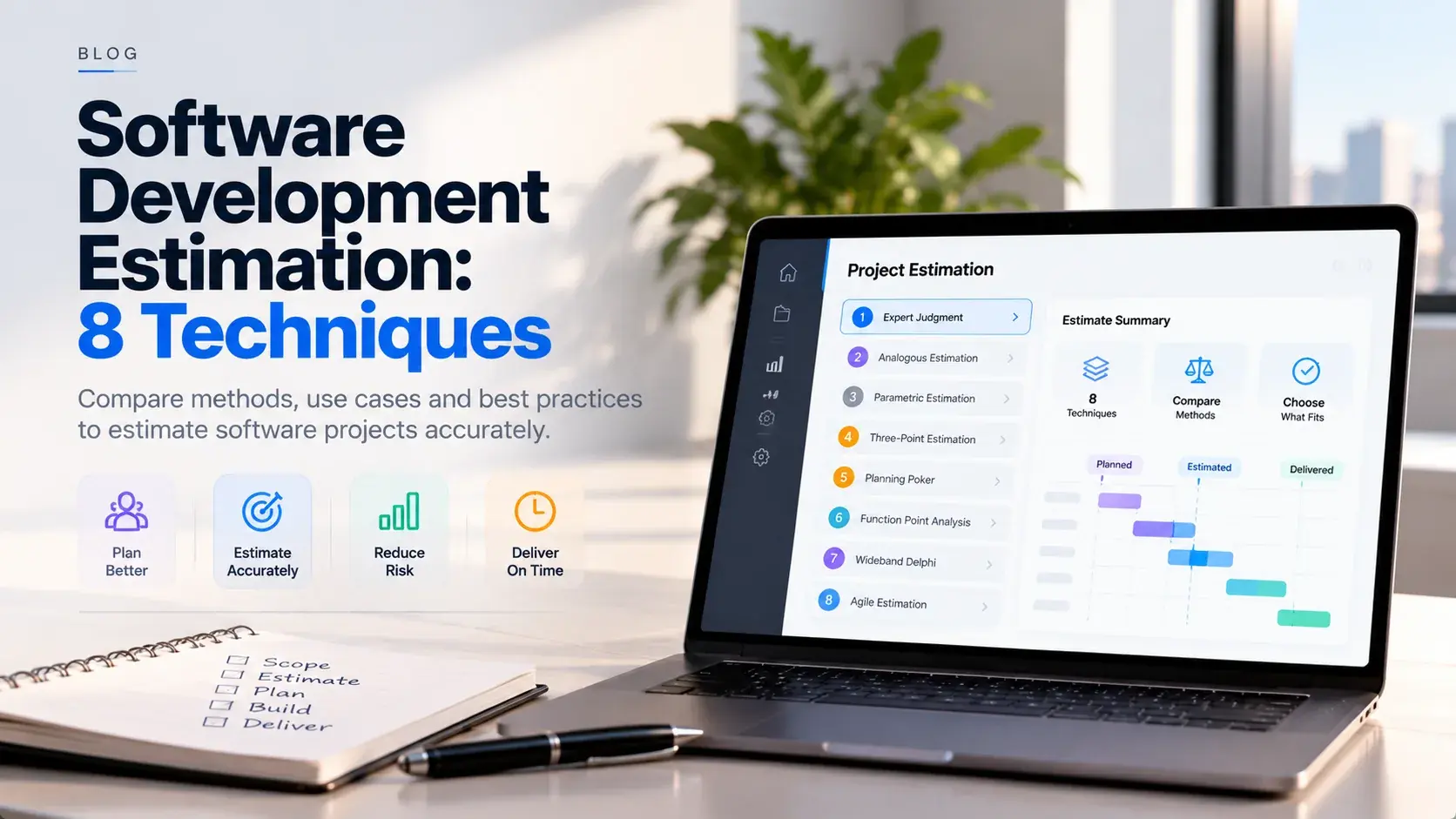
Software development estimation is forecasting the effort, time and cost needed to build software. The most used techniques are expert judgment, analogous estimation, bottom-up estimation from a work breakdown, three-point (PERT) estimation, parametric models such as COCOMO II and function points, story points with planning poker, and throughput-based Monte Carlo forecasting. Good estimates are ranges with stated assumptions, and they narrow as requirements become clearer.
Commercial Expertise
Need help with Business Strategy?
Ortem deploys dedicated Custom Software Development squads in 72 hours.
Next Best Reads
Continue your research on Business Strategy
These links are chosen to move readers from general education into service understanding, proof, and buying-context pages.
Custom Software Planning
Convert strategy reading into a delivery brief for architecture, scope, timeline, and commercial fit.
Plan your buildOrtem Delivery Model
See how Ortem structures communication, IP ownership, oversight, and execution for global clients.
Review delivery modelUS Market Delivery Page
Helpful if your buying journey is US-led and you want to understand timezone, compliance, and engagement fit.
View US delivery pageSoftware development estimation is forecasting the effort, time and cost needed to build software. It is hard, and it goes wrong for predictable reasons. Requirements are unclear early, hidden work gets left out, and optimism creeps in.
This guide explains why estimates miss, compares eight estimation techniques, shows how to turn effort into cost, and gives a simple template you can copy.
Why Software Estimates Miss
The track record is sobering. McKinsey research with the University of Oxford found that large IT projects ran 45% over budget and 7% over time on average, while delivering 56% less value than predicted. A separate study by Flyvbjerg and Budzier, published in Harvard Business Review, found that one in six IT projects was a "black swan" with an average cost overrun of 200%.
Most misses come from five causes:
- Unclear requirements. You cannot estimate what nobody has defined.
- Missing work. Integrations, data migration, testing, security and deployment are often left out.
- Optimism. People estimate the happy path and forget interruptions and rework.
- Scope change. New ideas arrive during the project without new budget.
- Single numbers. A point estimate hides the uncertainty everyone should be planning for.
The cone of uncertainty
The cone of uncertainty describes how estimates narrow as a project progresses. At the idea stage, the true effort can be as much as four times higher or lower than the estimate. Once requirements and design are complete, the range becomes much tighter.
The lesson is simple. Give wide ranges early, and re-estimate at each milestone as you learn more.
8 Software Estimation Techniques Compared
| Technique | Best for | Accuracy | Effort to produce |
|---|---|---|---|
| Expert judgment | Early, small projects | Low to medium | Low |
| Analogous | Projects similar to past ones | Medium | Low |
| Bottom-up (WBS) | Defined scope, fixed bids | Medium to high | High |
| Three-point (PERT) | Any task-level estimate | Medium to high | Medium |
| Parametric (COCOMO II, function points) | Large, well-specified systems | Medium to high | High |
| Story points and planning poker | Agile teams with stable velocity | Medium | Medium |
| Monte Carlo forecasting | Teams with throughput history | High for delivery dates | Medium |
| AI-assisted estimation | Fast first drafts from requirements | Depends on data and review | Low |
1. Expert judgment
An experienced engineer estimates based on what they know. It is fast and still the most common method in practice. It works best when the estimator has built similar systems and when two or more experts estimate independently, then compare.
2. Analogous estimation
You compare the new project with finished ones and adjust for differences. It is quick and grounded in real data, but only if you have tracked actual effort on past projects.
3. Bottom-up estimation
You break the project into a work breakdown structure: modules, features and tasks. Then you estimate each task and add them up. It is slow, but it exposes missing work, and it is the right method for fixed-price bids.
4. Three-point (PERT) estimation
For each task, estimate three numbers:
- O, optimistic: everything goes right
- M, most likely: normal conditions
- P, pessimistic: realistic problems occur
Expected effort = (O + 4M + P) ÷ 6
Standard deviation ≈ (P − O) ÷ 6
For example, a task with O = 10 hours, M = 16 hours and P = 34 hours has an expected effort of 18 hours. The spread tells you how much contingency the task needs.
5. Parametric estimation
Parametric models calculate effort from measurable inputs. COCOMO II estimates effort from software size and a set of cost drivers. Function point analysis, maintained by IFPUG, sizes software by the functions it delivers to users rather than lines of code. Both need calibration to your team, but they bring discipline to large projects.
6. Story points and planning poker
Agile teams often estimate relative size in story points instead of hours. In planning poker, each team member picks a card in secret and everyone reveals at once. Big differences start a useful conversation about what people are assuming. Over a few sprints, the team's velocity converts points into a delivery forecast.
7. Monte Carlo forecasting
If your team tracks how many items it finishes each week, you can simulate thousands of possible futures from that history. The result is a probability, such as "an 85% chance of finishing by 12 March". It answers "when will it be done?" better than adding up estimates.
8. AI-assisted estimation
AI tools can now turn a requirements document into a first breakdown of modules, features and tasks with hour ranges. This is a fast way to get a structured draft and to spot missing work. It still needs review by engineers who know the domain.
Disclosure: Ortem builds an AI estimation tool. Azimuth turns raw requirements into module, feature and task breakdowns with hour estimates, then generates proposal documents. It learns from actual versus estimated hours over time.
From Effort to Cost: Software Project Cost Estimation
Once you have effort, cost follows a simple structure:
- Development effort in hours, from your chosen technique
- Multiply by the blended hourly rate of the team
- Add project management and QA, which many estimates leave out
- Add design, DevOps and infrastructure set-up
- Add third-party costs such as licences, APIs and hosting
- Add contingency that reflects uncertainty: wider early, narrower later
Write down every assumption. "Includes iOS and Android, excludes data migration" prevents more disputes than any formula.
For typical budgets by project type, see our guide to custom software development cost, and for time, how long custom software takes.
Free Software Development Estimate Template
Copy this structure into a spreadsheet.
| Module | Feature | Task | Optimistic (h) | Most likely (h) | Pessimistic (h) | PERT (h) | Assumptions and risks |
|---|---|---|---|---|---|---|---|
| Authentication | Sign-up and login | Email and password flow | 6 | 10 | 18 | 10.7 | Uses managed auth provider |
| Authentication | Sign-up and login | Social login (Google, Apple) | 4 | 8 | 16 | 8.7 | Apple developer account ready |
| Payments | Subscriptions | Stripe checkout and webhooks | 10 | 16 | 34 | 18.0 | Single currency |
Then add rows for project management, QA, design and deployment, a contingency line, and the blended rate. Totals should show a range, not a single number.
Agile Estimation vs Fixed-Price Estimation
- Fixed price needs a bottom-up estimate, a clear scope and a change process. Expect a higher price, because the vendor carries the risk.
- Time and materials with agile estimation suits evolving products. Budget by phase, and re-forecast every few sprints.
- Hybrid: a fixed-price discovery phase, then agile delivery with a capped budget, works well for many new products.
Red Flags in a Vendor's Estimate
- A single number with no range or assumptions
- No line for testing, project management or deployment
- No questions asked about integrations or data
- An estimate far below every other bid, with no explanation
Our guide to comparing software development proposals covers what else to check. If you want an estimate from us, we start with a short discovery so the range is honest. See our custom software development service.
About Ortem Technologies
Ortem Technologies is a premier custom software, mobile app, and AI development company. We serve enterprise and startup clients across the USA, UK, Australia, Canada, and the Middle East. Our cross-industry expertise spans fintech, healthcare, and logistics, enabling us to deliver scalable, secure, and innovative digital solutions worldwide.
Get the Ortem Tech Digest
Monthly insights on AI, mobile, and software strategy - straight to your inbox. No spam, ever.
Sources & References
- 1.Delivering large-scale IT projects on time, on budget, and on value - McKinsey & Company
- 2.Why Your IT Project May Be Riskier Than You Think (Flyvbjerg and Budzier) - Harvard Business Review
- 3.Cone of Uncertainty - Wikipedia
- 4.Software development effort estimation - Wikipedia
- 5.COCOMO - Wikipedia
- 6.International Function Point Users Group - IFPUG
- 7.Planning Poker - Mountain Goat Software
About the Author
Sales Head, Ortem Technologies LLC
Nirav B is the Sales Head at Ortem Technologies LLC. He works with businesses planning custom software, mobile and AI projects, helping them scope the work, choose an engagement model and plan delivery with Ortem's engineering team.
Frequently Asked Questions
- Software development estimation is the process of forecasting how much effort, time and money a software project will need. A good estimate is a range, based on a breakdown of the work and a written list of assumptions, rather than a single number.
- The main techniques are expert judgment, analogous estimation, bottom-up estimation, three-point or PERT estimation, parametric models such as COCOMO II and function point analysis, story points with planning poker, and throughput-based Monte Carlo forecasting. Most teams combine two or three.
- Estimates miss because requirements are unclear early on, hidden work such as integrations, testing and deployment is left out, optimism creeps in, and scope changes during the project. McKinsey research with Oxford found large IT projects ran 45% over budget on average.
- Three-point or PERT estimation uses an optimistic (O), most likely (M) and pessimistic (P) estimate for each task. The expected effort is (O + 4M + P) ÷ 6, and the standard deviation is roughly (P − O) ÷ 6, which helps you set a realistic range.
- Estimate effort in hours for each piece of work, multiply by the blended hourly rate of the team, and add project management, quality assurance and a contingency based on how uncertain the scope is. Then add non-development costs such as design, infrastructure and third-party licences.
- Story points measure relative size and work well for agile teams with a stable velocity, because they avoid arguing about exact hours. Hours are easier for clients and fixed budgets to understand. Many teams use story points for sprint planning and convert to hours or cost for budgeting.
Stay Ahead
Get engineering insights in your inbox
Practical guides on software development, AI, and cloud. No fluff — published when it's worth your time.
Ready to Start Your Project?
Let Ortem Technologies help you build innovative software solutions for your business.
You Might Also Like

Forward Deployed Engineering vs IT Staff Augmentation: What 133 Companies Reveal in 2026

White-Label AI Solutions for Agencies: How to Sell AI Without Building a Team