
CommercePulse — Unified Data Warehouse & Real-Time Revenue Intelligence
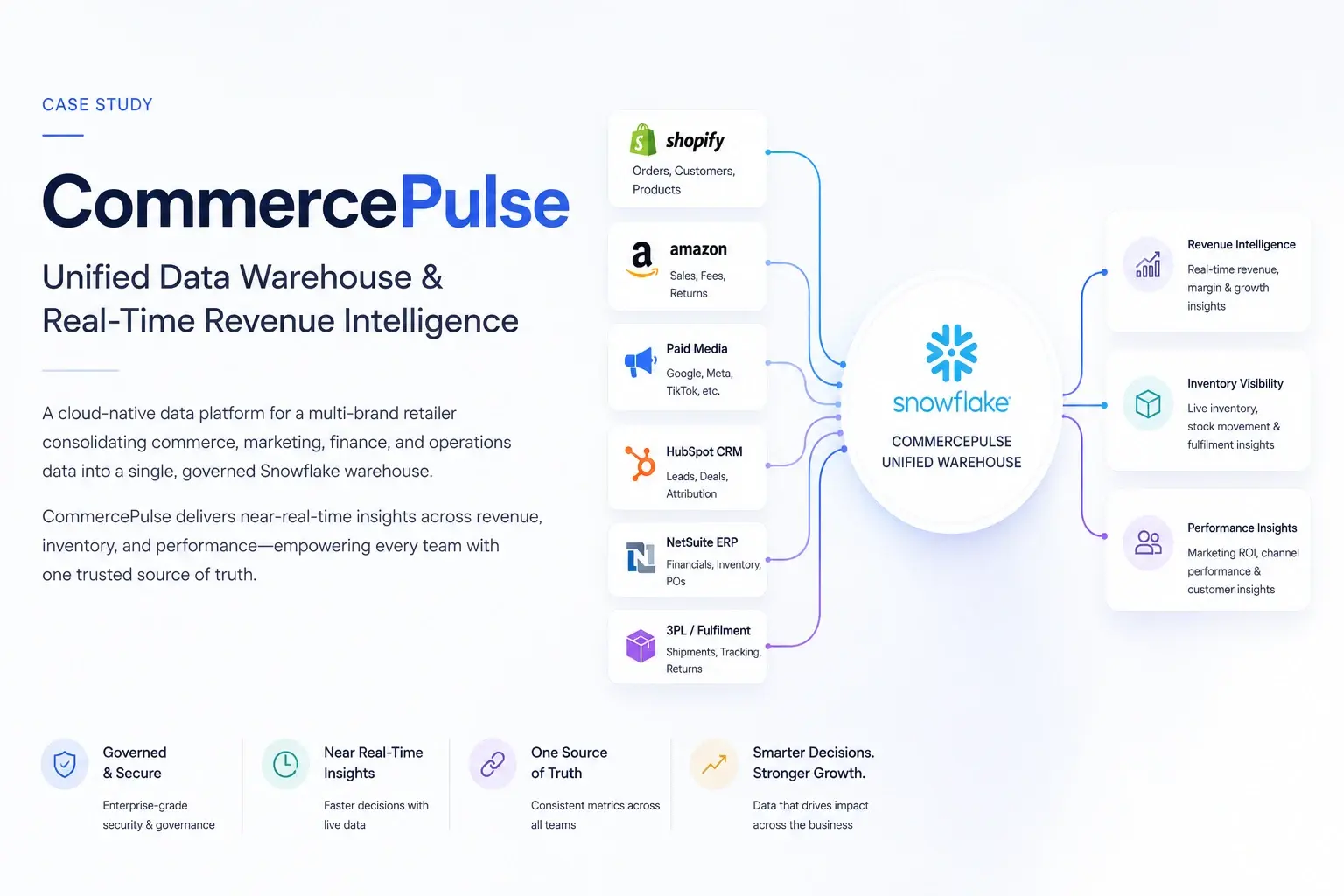
A cloud-native data platform for a multi-brand retailer operating across Shopify, Amazon, paid media, HubSpot CRM, NetSuite ERP, and a third-party fulfilment provider. CommercePulse consolidates fragmented commercial data into a governed Snowflake warehouse, powers near-real-time revenue and inventory reporting, and gives finance, operations, and marketing one trusted definition of performance.
Client
Multi-Channel Retail Group (NDA, North America)
Project Value
$185,000
Rating
The Challenge
The client ran multiple direct-to-consumer brands across Shopify storefronts, Amazon marketplaces, advertising platforms, HubSpot, NetSuite, and an outsourced fulfilment provider — and every department worked from its own spreadsheets and manual exports. Finance closed revenue several days after month-end because orders, refunds, discounts, shipping, marketplace fees, and returns all had to be reconciled by hand across systems.
Marketing could see ad-platform conversions but could not tie spend to net revenue, repeat purchases, or product-level margin. Operations tracked stock in the ERP while e-commerce managers worked from storefront counts that were often stale.
The underlying problem was not missing data but an unreliable foundation: fourteen sources on different refresh schedules with incompatible identifiers, gross-revenue figures distorted by refunds and marketplace fees, inventory reporting lagging live demand, dashboard numbers that changed depending on who wrote the query, and source schema changes that could silently break pipelines before anyone noticed.
The Goal
Deploy a governed data platform that centralises commerce, marketing, financial, CRM, and fulfilment data behind a consistent semantic layer; deliver near-real-time visibility into revenue, inventory, and acquisition performance; and surface data-quality failures before they reach decision-makers.
The architecture had to support self-serve BI for non-technical stakeholders while staying maintainable by the internal analytics team — with a freshness target under 15 minutes for priority sales and inventory metrics, automated testing on critical transformations, and one documented definition for revenue, contribution margin, customer lifetime value, and inventory availability.
Solution & Implementation
1Analysis
Ran stakeholder workshops across finance, e-commerce, marketing, supply chain, and the executive team to map how each group defined revenue, orders, returns, stock, and acquisition performance — surfacing conflicting KPI definitions, undocumented spreadsheet logic, duplicate customer records, and the manual reconciliation steps behind the reporting delay.
A parallel source-system audit covered Shopify, Amazon Seller Central, NetSuite, HubSpot, Google Ads, Meta Ads, the fulfilment provider, and support tooling, classifying each by business criticality, volume, refresh frequency, ownership, API limits, and historical availability.
The output was a metric dictionary with agreed logic for gross and net revenue, refunds and marketplace fees, contribution margin by channel and product, CAC and ROAS, new versus returning customers, inventory on hand and in transit, and order-to-delivery cycle time.
2Designing Solution
Designed a Snowflake-centred warehouse on layered ingestion and transformation patterns: an immutable raw layer retained for auditability and reprocessing; a staging layer normalising timestamps, currencies, customer IDs, SKUs, and order states; a core layer of conformed dimensions (customer, product, channel, campaign, location, date) and fact tables for orders, order lines, refunds, fulfilment events, ad spend, inventory movements, and support interactions; and curated analytics marts for finance, growth, merchandising, operations, and executive reporting.
Airbyte and custom Python connectors handle ingestion, Airflow orchestrates dependencies, retries, backfills, and alerting, and dbt owns transformation logic, documentation, testing, and lineage. Incremental models transform only changed data to hold down processing time and warehouse cost, while webhook and API-polling patterns give priority sales and inventory workflows lower latency than overnight batch.
3Customizing Business Logic
The value came from encoding the client's actual commercial logic rather than copying source tables into a warehouse. A unified order and customer model resolves identity across storefront, marketplace, CRM, and support systems, treating cancellations, partial refunds, exchanges, gift cards, tax, shipping, discounts, and marketplace fees according to finance-approved accounting rules.
A product-normalisation layer maps channel-specific SKUs and bundle components to a canonical catalogue so product and category reporting works across every sales channel. Attribution logic connects campaign spend to first-time and repeat purchases while preserving source-level reporting for channel managers.
The semantic layer exposes consistently defined metrics to BI tools so executives, analysts, and department leads read the same measures without rewriting SQL, with role-based access separating executive, finance, marketing, and operational views over one governed dataset.
4Scale & Optimize
Data reliability was built in rather than bolted on. dbt tests and Great Expectations checks validate unique keys, accepted values, referential integrity, freshness, volume anomalies, duplicates, and revenue reconciliation thresholds — so a changed source API, a stalled critical table, or daily revenue outside tolerance raises an alert before wrong figures reach a dashboard.
Airflow is configured for retries, failure recovery, dependency-aware orchestration, and controlled backfills, and source-to-dashboard lineage makes any executive metric traceable back to its transformation model and originating records. The architecture accommodates new brands, marketplaces, regions, and sources through reusable ingestion patterns, so additions do not require rebuilding the warehouse.
Results & Impact
Reporting Turnaround
Priority Data Freshness
Manual Reporting Time
Data Sources Unified
Revenue Reconciliation Accuracy
Pipeline Reliability
Data Quality Coverage
Dashboard Adoption
Engagement
A single governed warehouse combines storefront, marketplace, ERP, CRM, advertising, fulfilment, and support data into one analytics foundation
dbt transformation models standardise revenue, refunds, discounts, marketplace fees, customer identity, product catalogues, and inventory logic
Incremental ELT pipelines transform only changed data, enabling frequent refreshes without full-table reloads
Automated data-quality tests catch schema changes, null spikes, duplicates, failed reconciliations, and stale sources before dashboards are affected
A documented semantic layer gives finance, marketing, operations, and leadership one agreed definition of every core metric
Raw-layer immutability allows historical replay when a source system changes, without losing original records
Modular ingestion patterns let new channels, brands, and regions be added without reworking the core data model
Key Technologies
Project Gallery
Technical Approach
CommercePulse uses an ELT architecture that preserves raw source extracts before applying standardisation and business logic. That separation lets the team replay historical data when a source system changes, investigate discrepancies without losing original records, and build new reporting models without disturbing existing dashboards.
The warehouse follows a layered modelling approach. Raw data captures source events as received; staging models normalise identifiers, timestamps, currencies, and state values; core models create reusable facts and conformed dimensions; and analytics marts expose curated datasets built for specific business decisions. The structure keeps executive dashboards from depending directly on unstable vendor schemas.
Data quality is enforced at deployment rather than treated as an operational afterthought. Every critical model carries tests for uniqueness, accepted values, relationship integrity, freshness, and reconciliation, and automated alerts flag unexpected row-count changes, delayed loads, duplicate order events, and material variance between warehouse revenue and source-system totals.
The orchestration layer makes recovery predictable. When an API rate limit, schema update, or temporary outage interrupts a load, the platform retries safely, records the failure, and isolates affected downstream jobs so the data team can remediate without silently publishing partial data.
Frequently Asked Questions
About Ortem Technologies
Ortem Technologies is a premier custom software, mobile app, and AI development company. We serve enterprise and startup clients across the USA, UK, Australia, Canada, and the Middle East. Our cross-industry expertise spans fintech, healthcare, and logistics, enabling us to deliver scalable, secure, and innovative digital solutions worldwide.
Related Case Studies
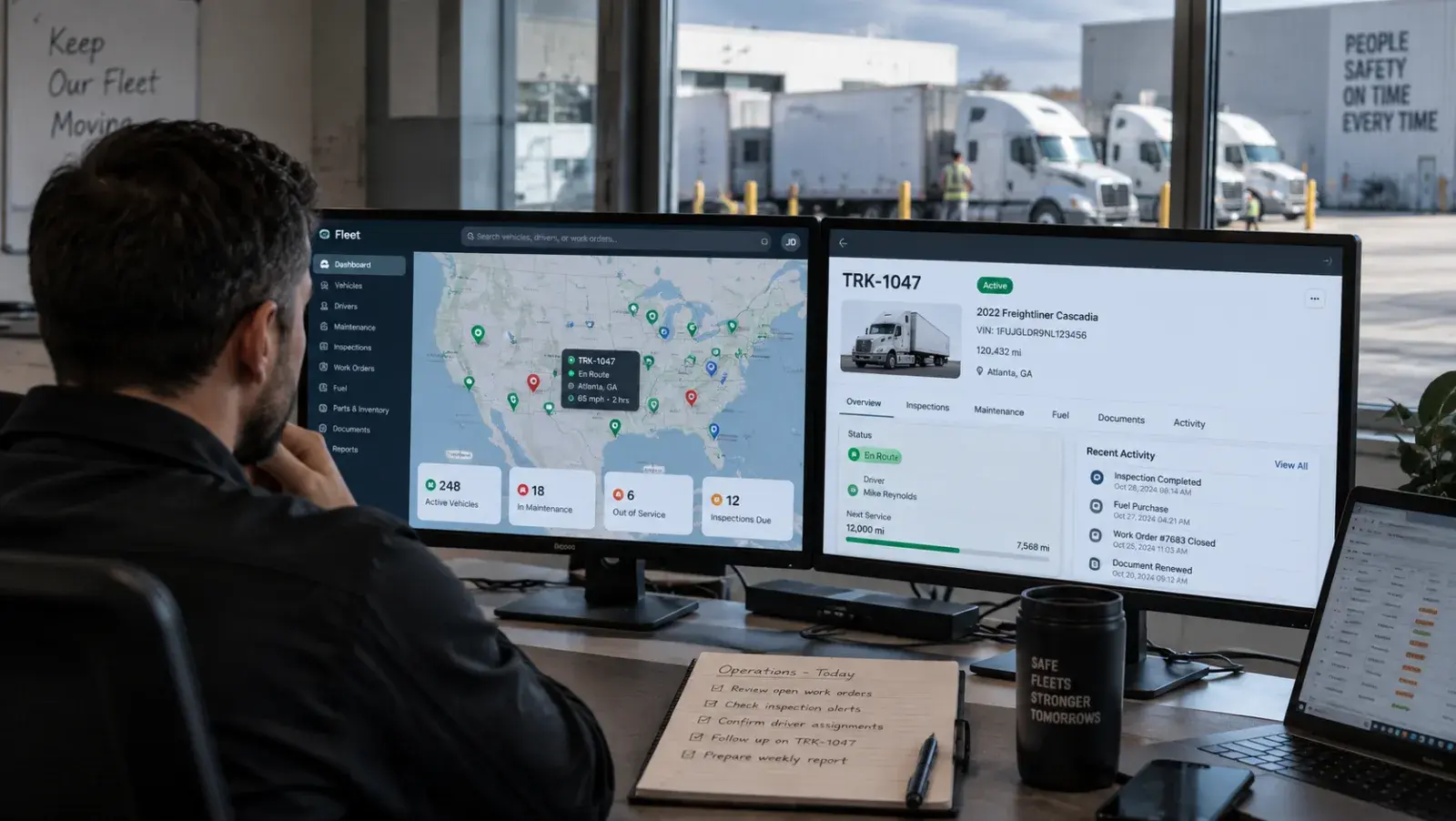
Multinational Transportation & Field Services Organization (NDA)
OpsCommand — Enterprise Fleet, Logistics & Intelligent Operations Platform

Confidential US-Based Manufacturing Organization (NDA)
PlantOps — Enterprise Manufacturing Operations & Industrial IoT Platform
Ready to Build Something Like This?
We've built e-commerce solutions like this for teams across the US, UK, and Middle East. Fixed scope. Fixed price. Senior engineers from day one.
Free 30-minute scoping call — no commitment, no sales pitch.