
Fleet Sync Pro — Modern Fleet Operations SaaS Platform
Built Fleet Sync Pro — a modern, multi-tenant SaaS platform that replaces spreadsheet-based fleet operations with real-time vehicle management, work order automation, proactive maintenance reminders, fuel cost tracking, and role-based access control. Trusted by fleet managers, maintenance technicians, and drivers to run end-to-end fleet operations from a single dashboard.
Client
Fleet Sync Pro
Project Value
$85,000+
Rating
The Challenge
Fleet managers across logistics, transport, and field services were running operations on spreadsheets and disconnected tools — manually tracking oil changes, fuel fill-ups, parts inventory, and driver assignments across 100+ vehicles.
Maintenance reminders were missed causing costly breakdowns, fuel spend was unmonitored allowing 10–20% budget leakage, and issues reported by drivers sat in email inboxes instead of triggering structured work orders. With no role-based access, managers, technicians, and drivers all operated from the same admin views, creating confusion and compliance risk.
The Goal
Design and ship a production-grade multi-tenant fleet management SaaS with vehicle registry, work order lifecycle management, interval-based service reminders, fuel tracking with MPG analytics, driver-reported issue management, parts and inventory tracking, digital inspection forms, fleet reporting with CSV/PDF export, and a five-role RBAC system — delivered as a responsive web app accessible from desktop, tablet, and mobile.
Solution & Implementation
1Analysis
Conducted discovery workshops with fleet operators, maintenance managers, and drivers across three transport businesses to map the full vehicle lifecycle — from acquisition through daily operations, scheduled maintenance, and retirement.
Identified six core operational breakdowns: untracked service intervals leading to compliance failures, fuel spend invisibility, no structured work order flow, reactive rather than proactive issue management, zero parts inventory visibility, and no audit trail for inspections.
Designed the platform data model around five actor roles — Admin, Fleet Manager, Maintenance Manager, Technician, and Driver — each with scoped permissions enforced at the database level.
2Designing Solution
Selected React 18 with TypeScript and Vite for the frontend — delivering a fast, component-driven SPA with real-time updates via Supabase Realtime. Tailwind CSS and shadcn/ui establish a consistent, professional design language optimised for operations software used on shop-floor tablets and office desktops alike.
The backend is built entirely on Supabase: PostgreSQL with Row-Level Security for multi-tenant data isolation, Auth for email/password and Google OAuth, Storage for inspection photos and document uploads, and Edge Functions for scheduled reminder dispatch.
3Customizing Business Logic
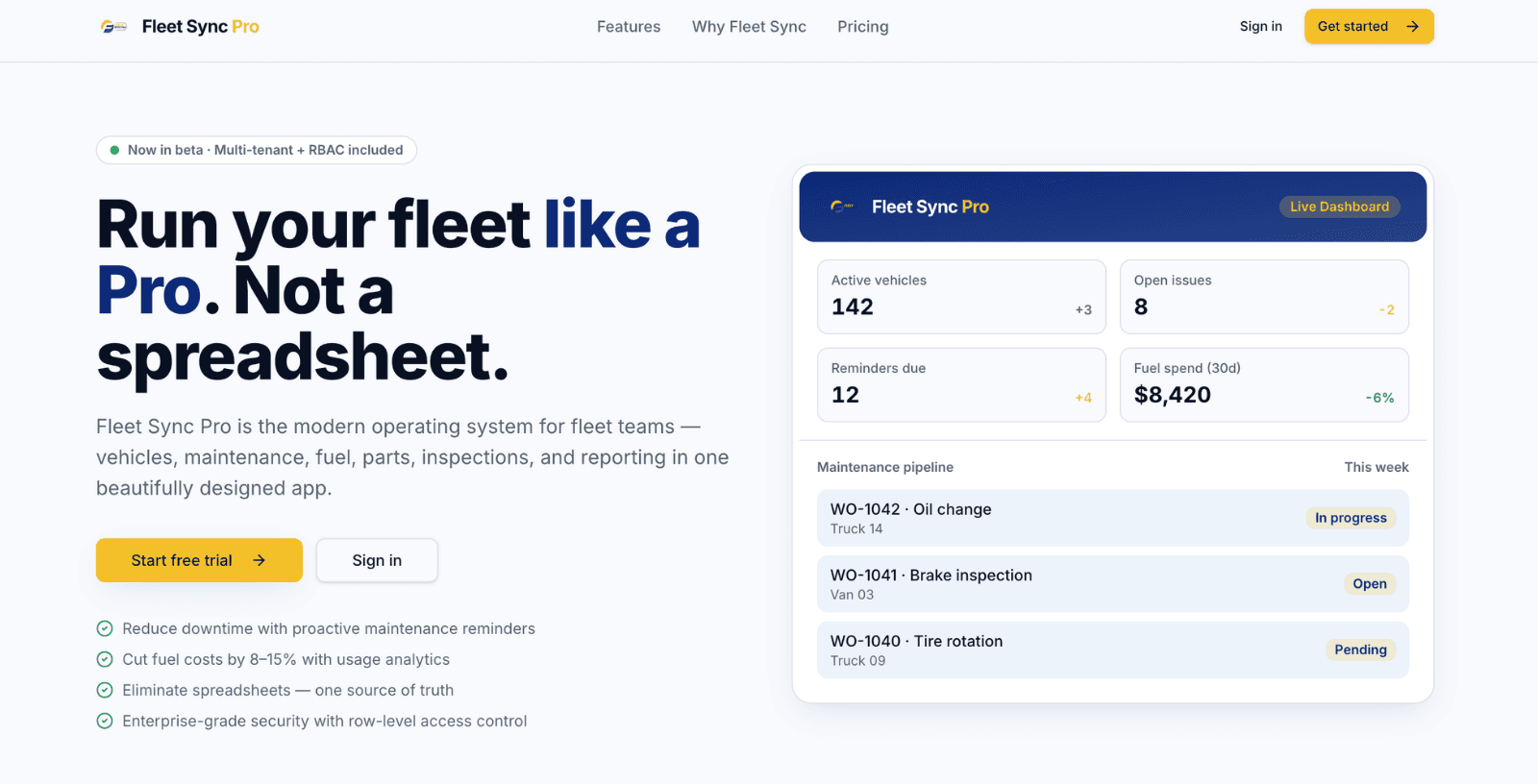
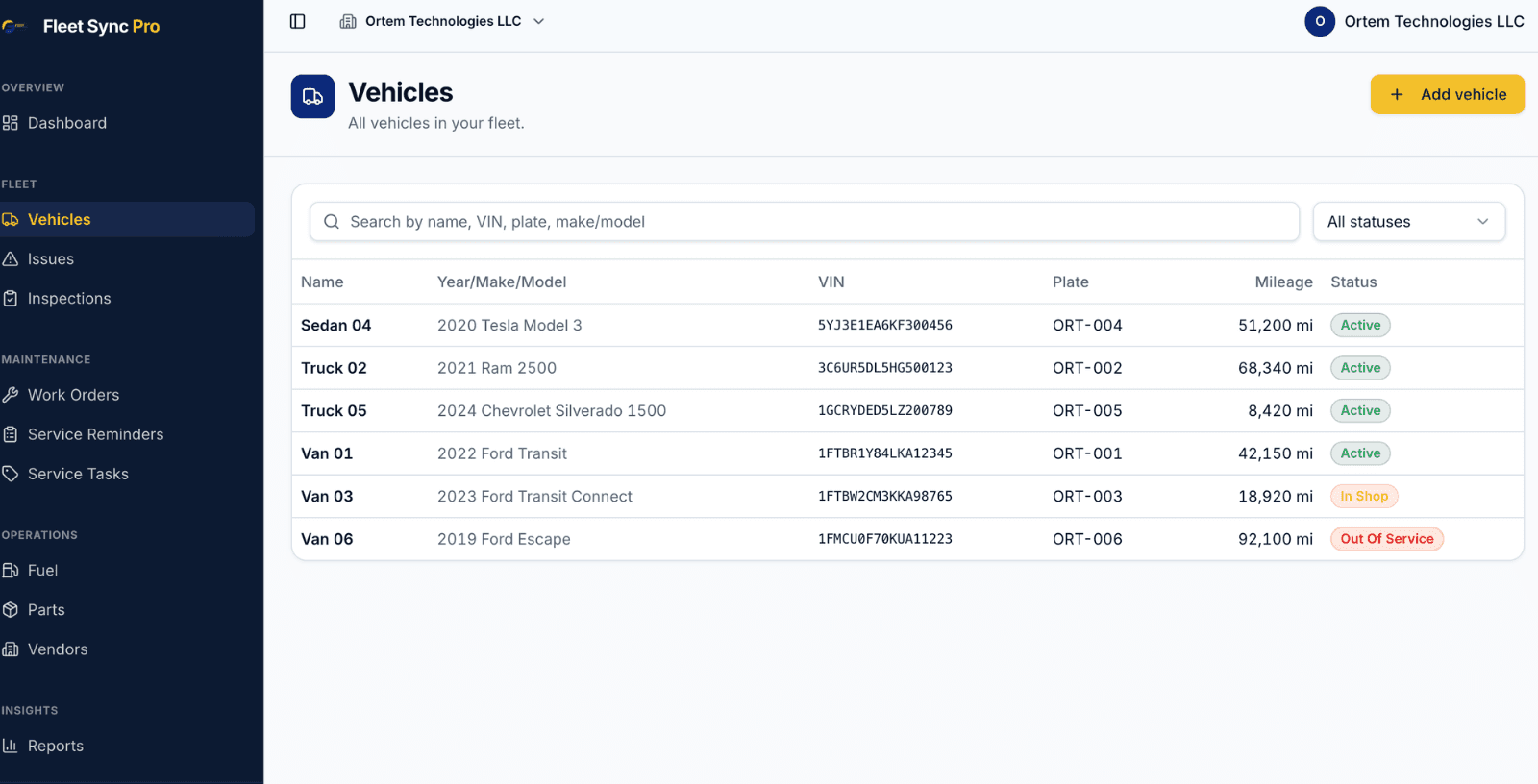
The operations dashboard presents four live KPI cards — Active Vehicles, Open Issues, Reminders Due, and 30-day Fuel Spend — with real-time delta indicators. The Maintenance Pipeline shows the current week's work orders with auto-numbered IDs (WO-1042), job type (Oil Change, Brake Inspection, Tire Rotation), assigned vehicle, and status badge (In Progress, Open, Pending).
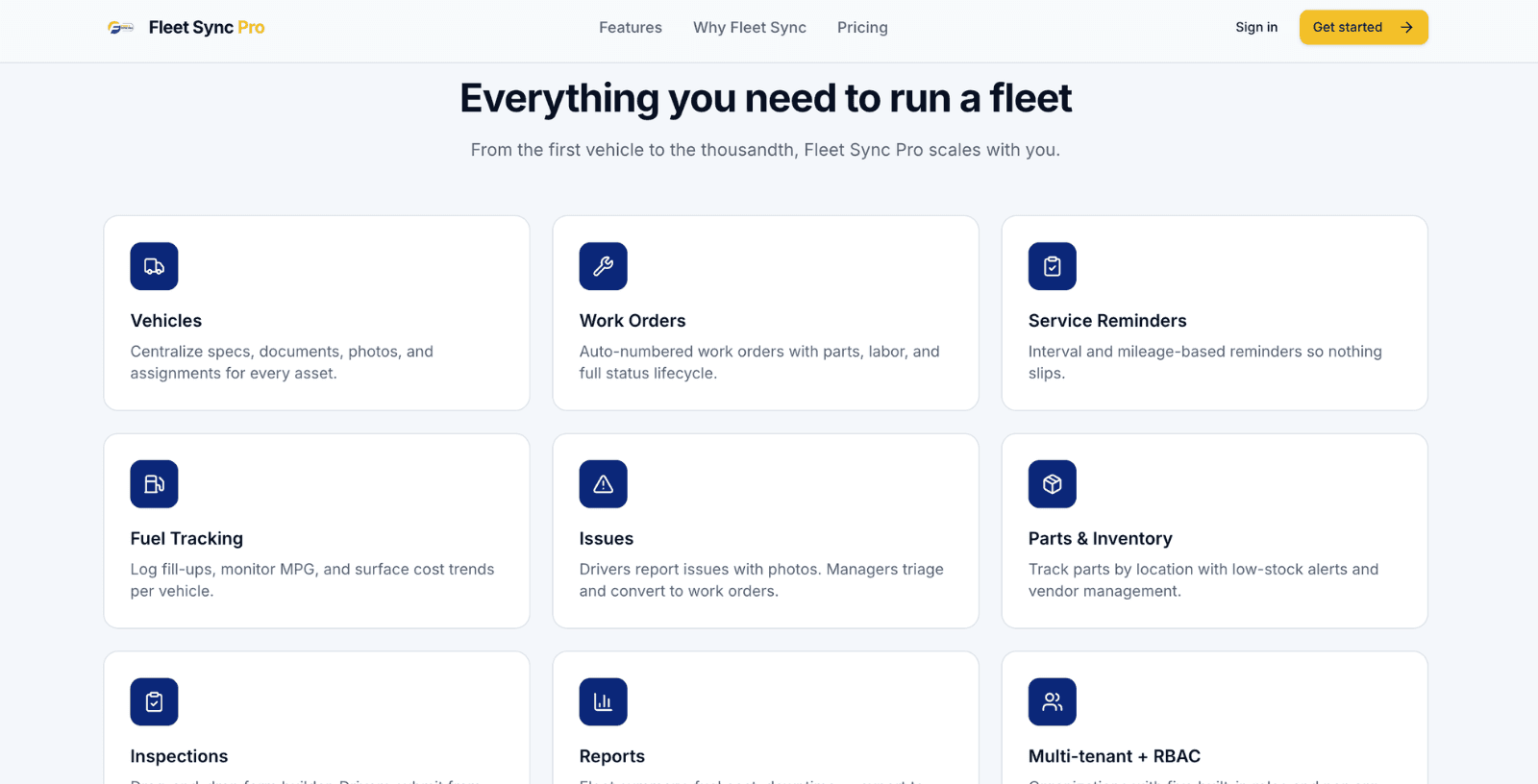
Service Reminders are configured per vehicle by interval (mileage or time) with automated pre-due notifications. Fuel tracking captures every fill-up by vehicle, calculates MPG, and surfaces 30-day cost trends. A drag-and-drop inspection form builder lets managers define custom DVIR checklists per vehicle class; drivers submit completed forms with photo attachments from any device.
4Scale & Optimize
Implemented per-organisation feature flags enabling Fleet Sync Pro to roll out beta capabilities to specific tenants without a full release. The five-role RBAC (Admin, Fleet Manager, Maintenance Manager, Technician, Driver) is enforced at both UI and PostgreSQL RLS layers — technicians can only update assigned work orders, drivers can only report issues, admins control all configuration.
All fleet summary, fuel cost, and downtime data exports to CSV or PDF for offline reporting and compliance submissions.
Results & Impact
Fuel Cost Reduction
Downtime Reduction
Work Order Throughput
Vehicles Managed
RBAC Roles
Multi-tenant architecture with per-organisation data isolation enforced at PostgreSQL Row-Level Security — zero data leakage between fleet operator accounts
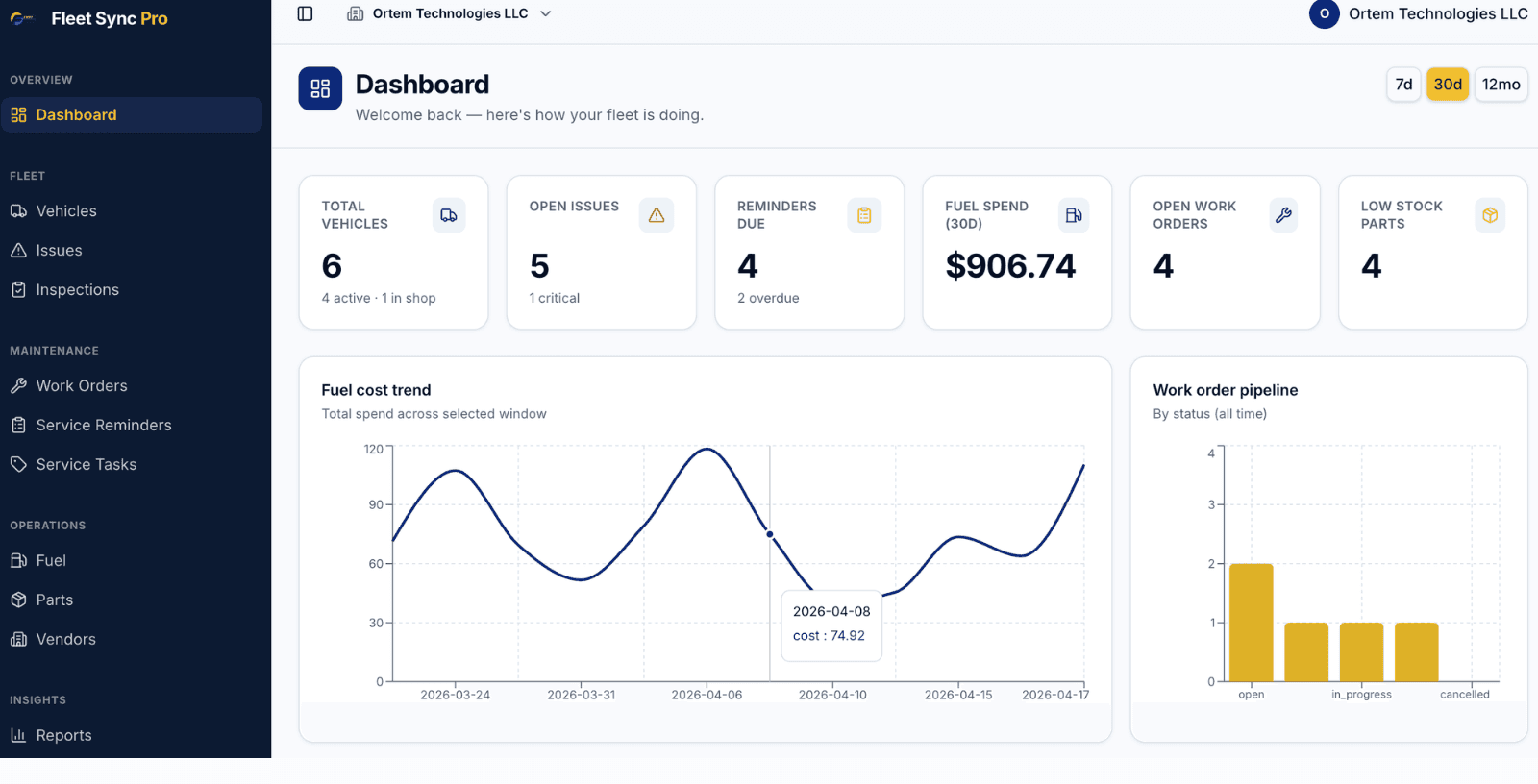
Real-time operations dashboard: Active Vehicles, Open Issues, Reminders Due, and 30-day Fuel Spend KPIs update live via Supabase Realtime
Auto-numbered work order system with parts, labor, full status lifecycle (Open → In Progress → Pending → Closed) and direct conversion from driver-reported issues
Interval and mileage-based service reminders with automated pre-due notifications — eliminating the manual calendar tracking that causes compliance failures
Fuel fill-up logging with per-vehicle MPG calculation and 30-day cost trend analysis — clients report 8–15% fuel cost reduction within 90 days
Five-role RBAC enforced at both UI navigation and PostgreSQL RLS — role-appropriate views for every user type with no configuration overlap
Drag-and-drop DVIR inspection form builder — managers configure custom checklists per vehicle class; drivers submit with photo attachments from any device
Per-organisation feature flags enable controlled beta rollout of advanced analytics and GPS integration readiness without a full platform release
Key Technologies
Project Gallery
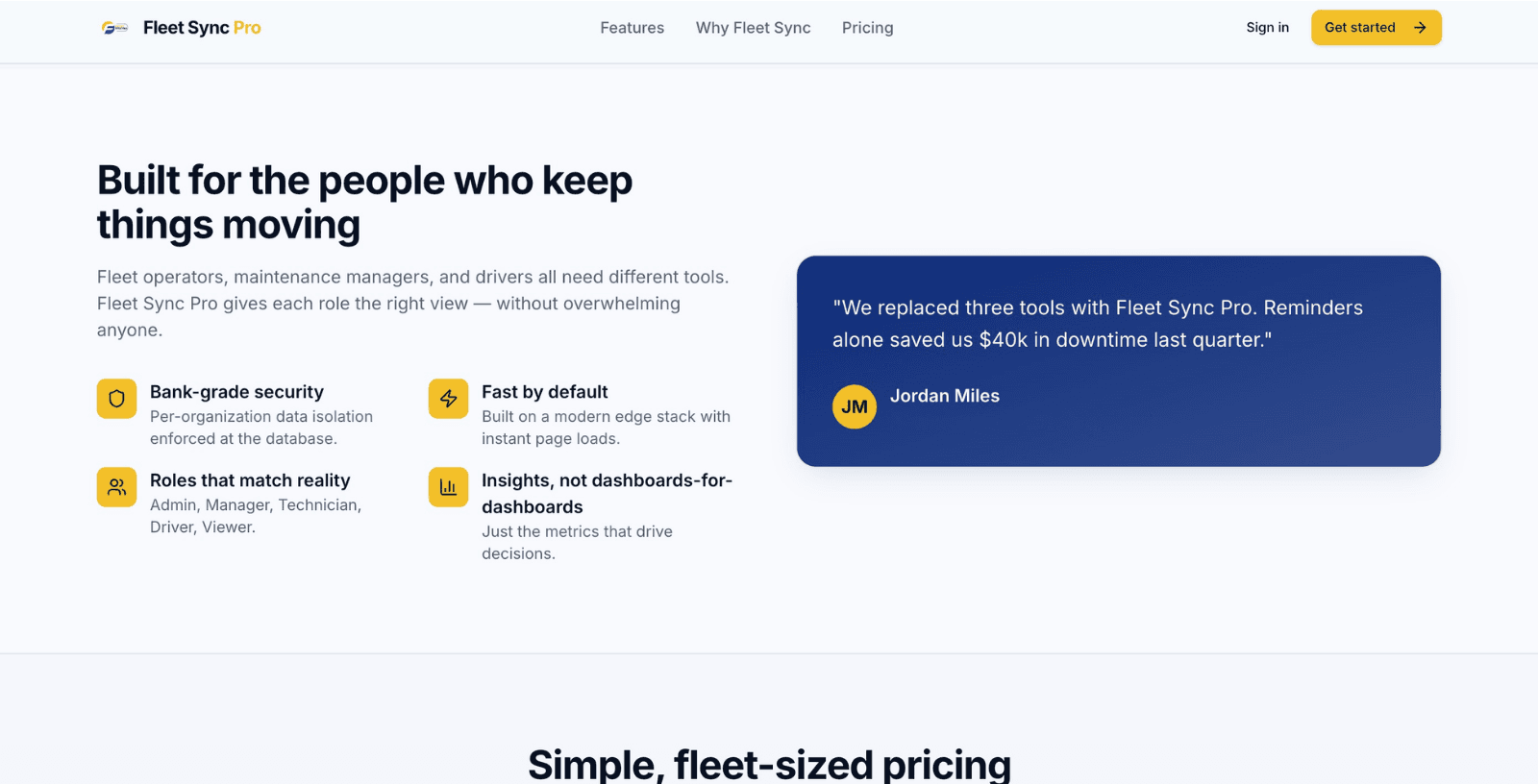
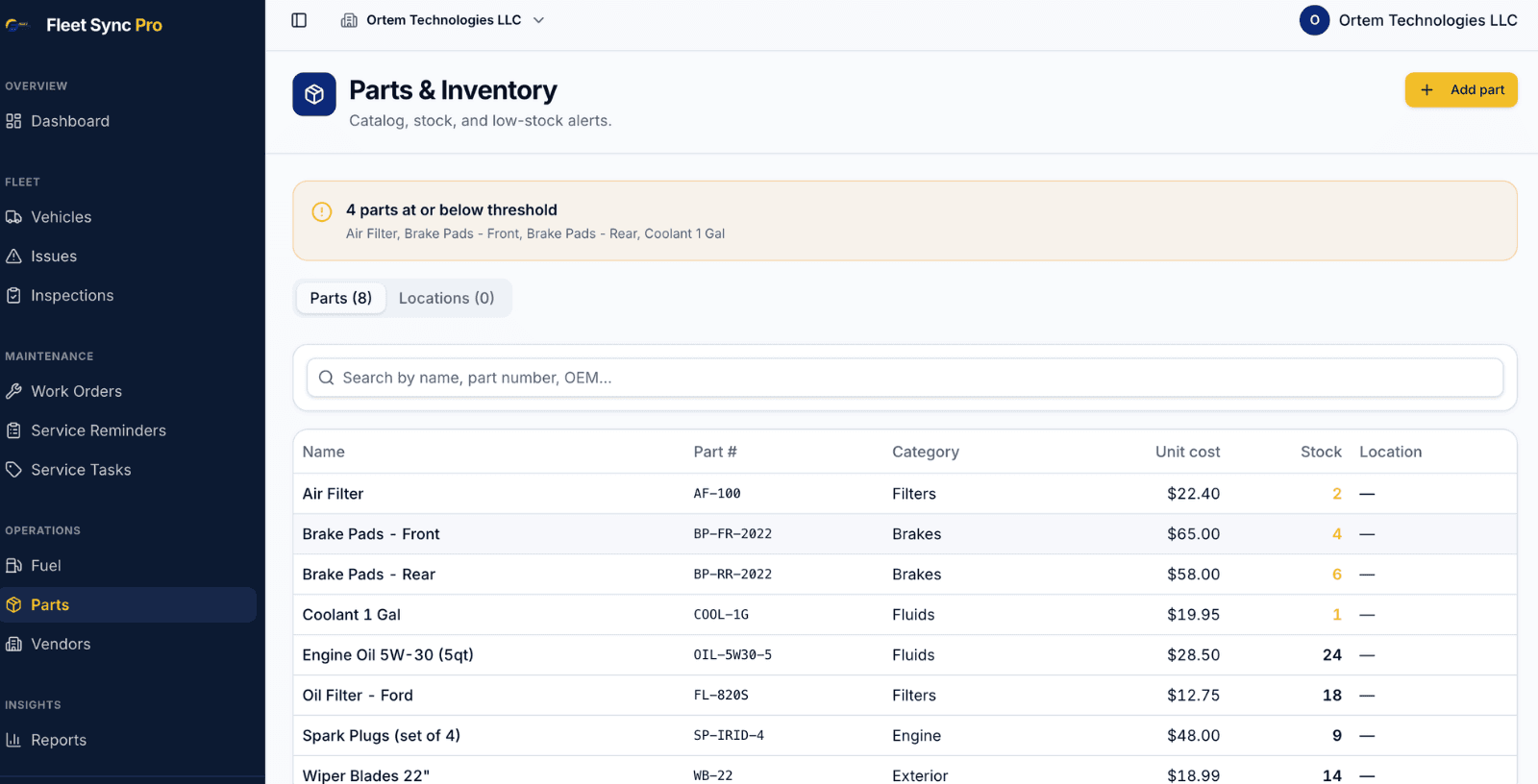
"We replaced three tools with Fleet Sync Pro. Reminders alone saved us $40k in downtime last quarter. Our technicians close work orders in the app, our drivers report issues from their phones, and I see everything in one dashboard."
Fleet Sync Pro
Fleet Sync Pro
Want similar results for your business?
We build the same for teams like yours — fixed scope, fixed price, senior engineers only.
Technical Approach
Fleet Sync Pro's multi-tenant architecture enforces data isolation at the PostgreSQL Row-Level Security (RLS) layer rather than relying on application-level tenant_id filtering. Every table containing fleet data has an organisation_id column, and RLS policies enforce that queries from one organisation's session can only return rows matching their organisation_id — regardless of which API endpoint triggered the request.
This means a misconfigured API route cannot accidentally expose one fleet operator's vehicle data to another operator's session; the database layer enforces isolation before any row is returned.
The five-role RBAC (Admin, Fleet Manager, Maintenance Manager, Technician, Driver) is implemented as an additional RLS predicate: Technicians can only read and update work orders assigned to them, Drivers can only create issue reports, and Managers see aggregated data across their assigned fleet but not administrative configuration.
The service reminder system is built around a dual-trigger model: interval-based reminders (trigger when a vehicle's mileage reaches the configured service interval, e.g., every 5,000 miles for an oil change) and time-based reminders (trigger when a calendar duration expires, e.g., annual brake inspection regardless of mileage).
Mileage tracking is updated when fuel fill-up records are submitted (odometer reading at fill-up) and when driver daily inspection forms include odometer capture. When a service reminder crosses its threshold, a notification is created in the platform and an email/push alert is sent to the assigned Fleet Manager and Maintenance Manager.
Pre-due alerts (default 500 miles before the service interval, or 14 days before a time-based reminder) give managers lead time to schedule maintenance before the deadline is missed.
The fuel tracking module captures every fill-up event: vehicle, date, odometer reading, fuel quantity, total cost, fuel grade, and station location. Per-vehicle MPG is computed from consecutive fill-up odometer deltas divided by fuel quantity — smoothed with a 3-fill-up rolling average to reduce the impact of partial fill-ups.
The 30-day fuel cost dashboard aggregates fill-up cost by vehicle and by fleet group, enabling fleet managers to identify vehicles with declining MPG (indicating engine issues or driver behaviour) before fuel spend becomes a budget problem.
Bulk CSV export of all fill-up records supports fleet accounting workflows and provides the raw data for fleet management consultants analysing total cost of ownership per vehicle class.
Frequently Asked Questions
About Ortem Technologies
Ortem Technologies is a premier custom software, mobile app, and AI development company. We serve enterprise and startup clients across the USA, UK, Australia, Canada, and the Middle East. Our cross-industry expertise spans fintech, healthcare, and logistics, enabling us to deliver scalable, secure, and innovative digital solutions worldwide.
Related Case Studies
Multinational Transportation & Field Services Organization (NDA)
OpsCommand — Enterprise Fleet, Logistics & Intelligent Operations Platform

Confidential US-Based Manufacturing Organization (NDA)
PlantOps — Enterprise Manufacturing Operations & Industrial IoT Platform
Ready to Build Something Like This?
We've built logistics & fleet management solutions like this for teams across the US, UK, and Middle East. Fixed scope. Fixed price. Senior engineers from day one.
Free 30-minute scoping call — no commitment, no sales pitch.