AI Coding Agent ROI: Measuring Past the 24% Pull Request Lift
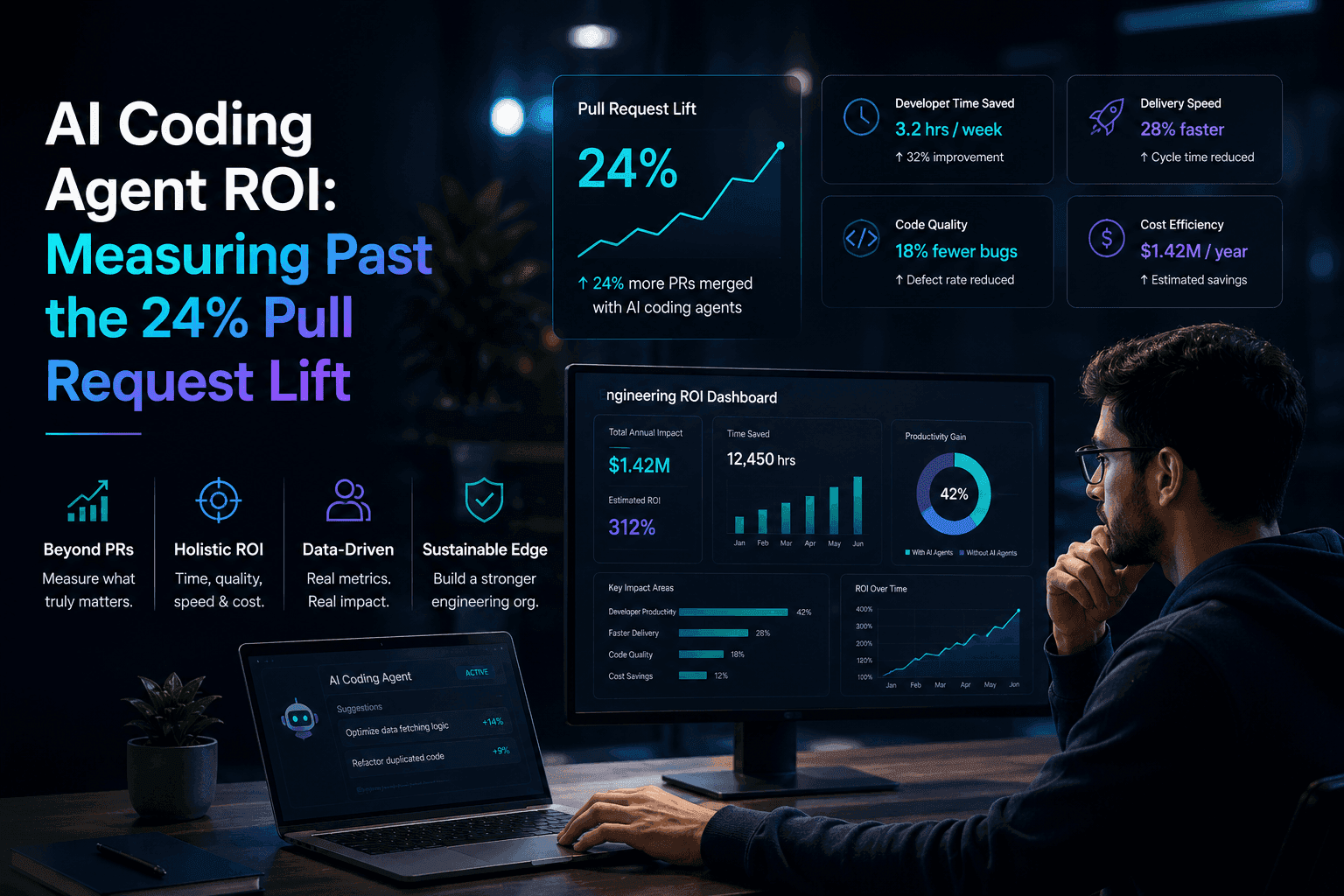
Published 2026 research on AI coding agent productivity ranges from roughly a 20% slowdown to a 100% speedup depending on methodology, cohort, language and codebase quality. Microsoft's 2026 field study found adopters merged about 24% more pull requests. DX Research, surveying around 121,000 developers, found gains plateauing near 10% even with 93% adoption. Both can be true because they measure different windows: immediate task speed versus sustained delivery throughput. A defensible ROI measurement needs four metrics rather than one — merged output, rework rate, incident rate, and token spend — because the costs of AI-assisted code typically appear weeks after the merge that produced the headline gain.
Next Best Reads
Continue your research on AI Tooling
These links are chosen to move readers from general education into service understanding, proof, and buying-context pages.
AI & ML Solutions
Move from tooling comparisons into real model deployment, MLOps, and production AI pipelines.
Explore AI servicesAI Agent Development
See how Ortem builds autonomous workflows, tool-using agents, and human-in-the-loop systems.
View agent serviceAI Platform Case Study
See a production AI system with real data architecture, model integration, and launch outcomes.
Read case studyThe AI coding productivity literature in 2026 looks contradictory. Microsoft's field study found adopters merging around 24% more pull requests. DX Research, surveying roughly 121,000 developers, found productivity gains plateauing near 10% despite 93% adoption. Other published results span from a 20% slowdown to a 100% speedup.
The instinct is to decide which study is right. That is the wrong move. They are measuring different things over different windows, and the gap between them is the most commercially useful finding in the whole literature.
Why credible studies disagree
Four variables account for most of the spread.
What was measured. Time to complete a defined task is not the same as pull requests merged, which is not the same as features delivered. Each is further from the developer's keyboard and closer to business value, and the measured gain shrinks at each step.
Who was measured. Gains differ sharply between developers new to a codebase and developers who know it deeply. The most-cited counterintuitive result in this space came from experienced open-source maintainers working in code they knew intimately, where AI assistance slowed them down — plausibly because the overhead of reviewing generated code exceeded the cost of writing it themselves.
Codebase conditions. Clean, well-typed, well-tested code with clear conventions is a good environment for a coding agent. A large legacy codebase with implicit conventions and thin test coverage is not. The same tool produces very different results across the two.
The measurement window. This is the decisive one. Measure the week of the merge and you capture the gain. Measure the following month and you capture the rework, review burden and incidents that the gain partly financed.
The costs that arrive late
The 2026 analyses converge on a pattern worth taking seriously: immediate task-speed gains often carry downstream costs that surface weeks after merge.
Rework. Code accepted quickly but not quite right gets revised later. This appears in a metric nobody was watching, some distance from the pull request that produced the headline number.
Review load. When generation stops being the bottleneck, review becomes it. Reviewers face more code, and reviewing generated code is a different cognitive task from reviewing a colleague's — it lacks the shared context that lets a reviewer skim safely.
Incidents. Some quality regression reaches production. Attributing incidents back to AI-assisted code is methodologically awkward but not impossible if you tag provenance at merge.
Token spend. At organisational scale this becomes a genuine line item, reaching millions of dollars annually in large deployments. It also scales with adoption rather than headcount, which makes it behave differently from seat-based tooling budgets.
Tool brittleness. A 2026 analysis categorising more than 3,800 publicly reported bugs across Claude Code, Codex CLI and Gemini CLI concluded that current coding agents remain fairly brittle. Engineering time absorbing that brittleness is a real cost even when it never reaches production.
The four metrics worth tracking
A defensible ROI picture needs four numbers together. Any one alone will mislead.
| Metric | What it captures | Why alone it misleads |
|---|---|---|
| Merged output | The headline gain | Ignores whether output was correct |
| Rework rate | Code changed again soon after merge | Noisy without a baseline |
| Incident rate | Quality reaching production | Lags by weeks |
| Token spend | Direct marginal cost | Says nothing about value |
Rework rate is the one most teams lack and most need. Define it simply — lines or files modified again within some window after merge — and establish the baseline before rolling out, because without a pre-adoption baseline the number is uninterpretable.
Measuring honestly
The methodological trap in this area is that the people evaluating the tools usually want them to succeed. Guarding against that requires a little discipline.
Establish baselines before rollout, not after. Retrospective baselines reconstructed from memory or from a period that already included partial adoption are close to worthless.
Compare cohorts rather than time periods where you can. Year-over-year comparison confounds AI adoption with every other change in the same window — team composition, product phase, technical debt. A cohort comparison between teams with and without access is far cleaner, and is broadly what the stronger 2026 studies did.
Measure over a quarter, not a sprint. The gains appear immediately and the costs appear late. A two-week measurement window is structurally biased toward a positive result.
Tag provenance at merge so you can attribute rework and incidents later. This is a small amount of engineering work that makes every subsequent question answerable.
What this means for the rollout decision
None of this argues against adopting coding agents. Adoption is close to universal and the tools genuinely help, particularly for developers onboarding to unfamiliar code, for boilerplate, for test generation and for exploratory work.
It argues against justifying adoption with a single flattering metric, then being surprised when delivery velocity does not move the way the business case predicted.
The teams getting sustained value share a few habits. They invest in codebase conditions — types, tests, clear conventions — because those multiply agent effectiveness far more than tool choice does. They treat review capacity as the new constraint and staff for it. They instrument token spend per team from the start. And they keep measuring after the pilot ends, which is precisely when most measurement programmes stop.
If you are planning or reviewing a rollout, our AI coding agent rollout playbook covers the adoption mechanics, and this piece covers whether it worked.
Ortem Technologies runs AI-assisted delivery across client engagements and instruments the outcomes rather than assuming them. If you want help establishing baselines and measurement before a rollout, see our dedicated development teams, our staff augmentation practice, or talk to our team.
About Ortem Technologies
Ortem Technologies is a premier custom software, mobile app, and AI development company. We serve enterprise and startup clients across the USA, UK, Australia, Canada, and the Middle East. Our cross-industry expertise spans fintech, healthcare, and logistics, enabling us to deliver scalable, secure, and innovative digital solutions worldwide.
Get the Ortem Tech Digest
Monthly insights on AI, mobile, and software strategy - straight to your inbox. No spam, ever.
Sources & References
About the Author
Private 1:1 AI Tutor · Director of Sales & Business Development, Moksh Tech
Praveen Jha is a private 1:1 AI tutor and enterprise AI sales leader based in Ahmedabad, India. He teaches executives, founders and engineers to ship real work with ChatGPT, Claude, Cursor and Claude Code, and is an Oracle Certified Generative AI Professional and AWS Certified Solutions Architect. He wrote his articles here while Director of AI Product Strategy, Sales & Business Development at Ortem Technologies.
Frequently Asked Questions
- On individual tasks, usually yes. On sustained team throughput, the evidence is genuinely mixed. Published 2026 results span roughly a 20% slowdown to a 100% speedup depending on who was measured, in what language, on what codebase, and over what window. The pattern that reconciles them is that task-level speed improves more reliably than delivery-level throughput, because some of the gain is consumed by review, rework and incident handling downstream.
- Four together. Merged output for the headline gain. Rework rate, meaning code changed again shortly after merge, which catches quality regressions. Incident rate attributable to recently shipped code. And token spend, which at organisational scale can reach millions of dollars annually. Any one alone is misleading; the four together give a defensible picture.
- It varies enormously by usage pattern, but the important planning point is that at organisational scale token spend becomes a material line item rather than a rounding error, and it scales with adoption rather than headcount. Instrument per-team and per-repository attribution before rolling out broadly, because retrofitting cost visibility after a large bill arrives is considerably harder.
- Several effects compound. Early gains come from the easiest tasks, and the remaining work is harder to automate. Review capacity becomes the constraint once generation is no longer the bottleneck. And rework from accepted-but-imperfect code consumes some of the initial gain. The plateau is not evidence the tools do not work; it is evidence the bottleneck moved.
Stay Ahead
Get engineering insights in your inbox
Practical guides on software development, AI, and cloud. No fluff — published when it's worth your time.