GPT-5.6 Luna, Terra, Sol: Which Tier Fits Your Product (2026 Cost Breakdown)
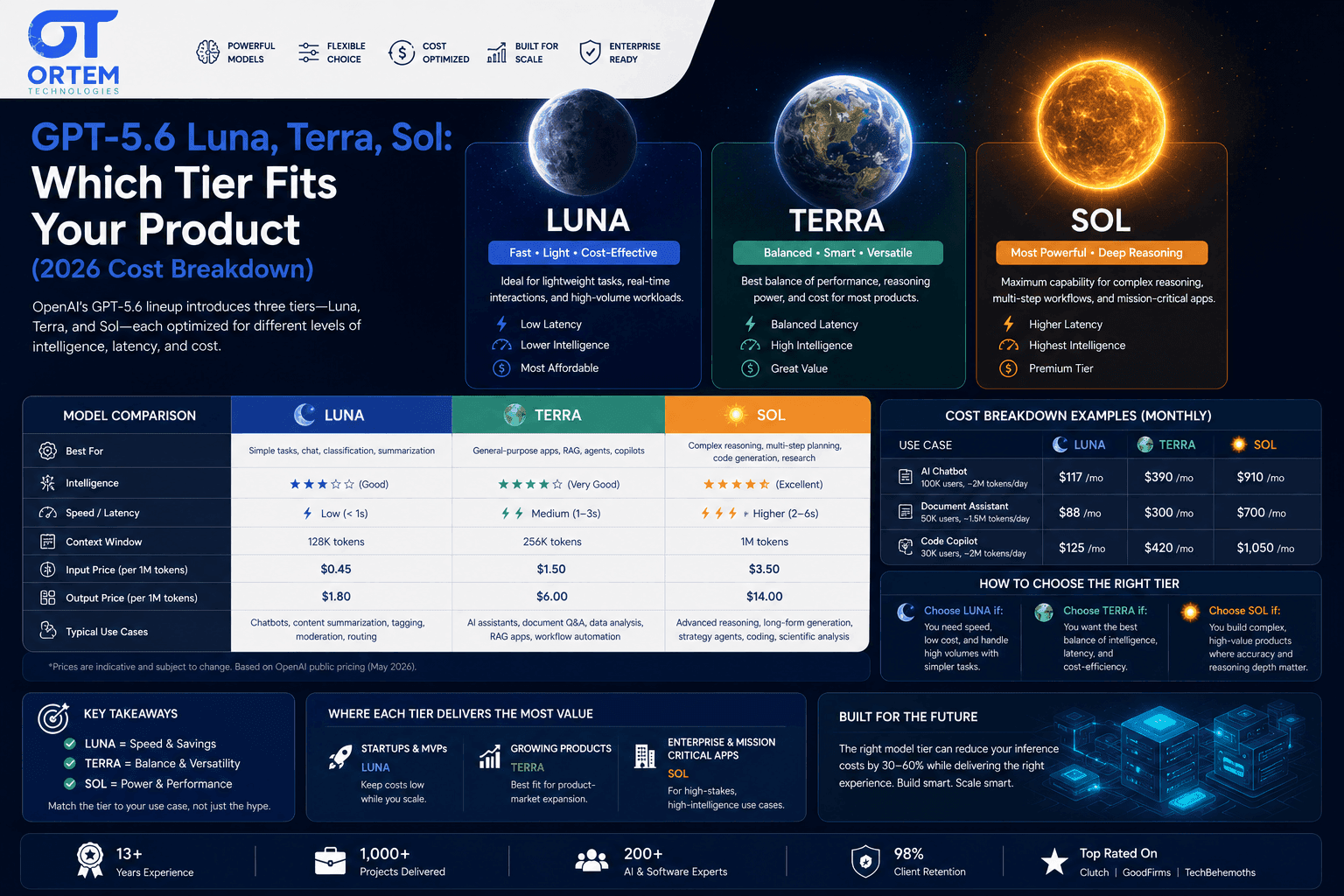
OpenAI's GPT-5.6 family, launched July 2026, comes in three sizes — Luna (smallest, ~$1/M input tokens), Terra (mid), and Sol (flagship, ~$5/M input tokens) — all with a 1 million token context window and a February 2026 knowledge cutoff. For most business products the right answer is a mix: Sol (or a rival frontier model) for complex reasoning, Luna or Terra for high-volume classification, extraction, and summarization. Routing between tiers typically cuts inference spend 40–70% versus sending everything to the flagship. Ortem Technologies builds exactly this tiered routing into LLM integrations.
GPT-5.6 is OpenAI's flagship model family released in July 2026, shipped in three sizes — Luna, Terra, and Sol — priced from roughly $1 to $5 per million input tokens, each with a 1 million token context window. The three-tier structure formalizes what production teams already knew: most business workloads do not need the biggest model, and the money is made in matching tier to task.
Next Best Reads
Continue your research on AI Engineering
These links are chosen to move readers from general education into service understanding, proof, and buying-context pages.
AI & ML Solutions
Move from architecture reading into real model deployment, MLOps, and production AI pipelines.
Explore AI servicesLLM Integration
Integrate large language models into your product — RAG, fine-tuning, copilots, and APIs.
Explore LLM serviceAI Platform Case Study
See a production AI system with real data architecture, model integration, and launch outcomes.
Read case studyOpenAI shipped the GPT-5.6 family this week in three sizes — Luna, Terra, and Sol — priced from about $1 to $5 per million input tokens, all carrying a 1 million token context window and a February 2026 knowledge cutoff. The interesting part is not the benchmarks. It is that OpenAI's own packaging now assumes what production teams learned the hard way: one size does not fit all workloads, and the flagship is the wrong default for most of your traffic.
Here is how to map the tiers to real business workloads, with the cost math.
The tier map
| Tier | Approx. input price | Right for | Wrong for |
|---|---|---|---|
| Luna | ~$1/M tokens | Classification, extraction, routing, formatting, high-volume summarization | Multi-step reasoning, complex code |
| Terra | mid-band | Drafting, RAG answering, moderate analysis, most chat products | Hard agent orchestration |
| Sol | ~$5/M tokens | Complex reasoning, agent planning, hard codegen, ambiguous instructions | High-volume mechanical tasks (pure waste) |
The math that matters: a document pipeline processing 50,000 documents a month at ~3,000 input tokens each burns 150M tokens monthly. On Sol that line is ~$750; on Luna ~$150 — for extraction work where the small model scores identically on a decent evaluation set. Multiply across every mechanical task in your product and the routing dividend typically lands at 40–70% of the total bill, which is the same conclusion we reached in our agent inference budget guide from the cost side.
The 1M context window: useful, and a trap
Genuinely useful: whole-repo code analysis, long-document review, agents that accumulate long working sessions. A trap: context is billed per token, per call. An architecture that "simplifies" by stuffing everything into context pays for that simplicity on every single request. Retrieval that selects the relevant 5,000 tokens beats a 500,000-token context dump on cost, latency, and — in most of our evaluations — accuracy, because models still attend better to short, relevant context than to haystacks.
Rule of thumb: use long context for genuinely long artifacts, use retrieval for knowledge. Do not use long context as a substitute for building retrieval properly. Our LLM integration practice treats retrieval design as the core of the build for exactly this reason.
Should you migrate?
Not on headlines. The migration checklist we run for clients:
- Evaluation set first. If you cannot score a model change against your real tasks, you are not migrating — you are gambling. Building the harness takes days and pays forever.
- Test down-tier moves before up-tier moves. The money is usually in demoting high-volume simple tasks to Luna/Terra, not in promoting everything to Sol.
- Check prompt portability. Tuned prompts carry assumptions. Re-run, re-score, adjust.
- Keep the old model wired as fallback until the new one has a week of production telemetry. Vendor-independence architecture (see our multi-model strategy guide) makes this a config change.
Where GPT-5.6 fits in a multi-vendor world
Claude Opus 4.8 and Sonnet 5, Gemini 3, and Llama 4 all remain competitive at their respective tiers, and this week's protocol and pricing news cuts against betting a product on any single vendor. The durable position: an abstraction layer, task-based routing across tiers (and vendors where it wins), and an evaluation harness that makes every future release — GPT-5.6 included — a report you run, not a rewrite you fear.
The bottom line
GPT-5.6's three-tier structure is OpenAI telling you, in pricing, that flagship-everywhere is the wrong architecture. Take the hint. Route by task difficulty, guard the context window like the budget line it is, and migrate on evaluation results, not launch posts.
We scope, build, and cost-optimize LLM integrations — including tier routing and evaluation harnesses — for products from MVP to enterprise scale. See our LLM integration services, or book a free consultation and we will model your workload across the GPT-5.6 tiers in one call. Need the capability in-house? We place production AI engineers in 5–10 days.
About Ortem Technologies
Ortem Technologies is a premier custom software, mobile app, and AI development company. We serve enterprise and startup clients across the USA, UK, Australia, Canada, and the Middle East. Our cross-industry expertise spans fintech, healthcare, and logistics, enabling us to deliver scalable, secure, and innovative digital solutions worldwide.
Get the Ortem Tech Digest
Monthly insights on AI, mobile, and software strategy - straight to your inbox. No spam, ever.
Sources & References
- 1.July 2026 AI Releases - ThursdAI
- 2.LLM Integration Services - Ortem Technologies
About the Author
Director – AI Product Strategy, Development, Sales & Business Development, Ortem Technologies
Praveen Jha is the Director of AI Product Strategy, Development, Sales & Business Development at Ortem Technologies. With deep expertise in technology consulting and enterprise sales, he helps businesses identify the right digital transformation strategies - from mobile and AI solutions to cloud-native platforms. He writes about technology adoption, business growth, and building software partnerships that deliver real ROI.
Frequently Asked Questions
- They are three sizes of the same model family: Luna is the smallest and cheapest (~$1 per million input tokens), Terra the mid-tier, and Sol the flagship (~$5 per million input tokens) with the strongest reasoning. All three share the 1 million token context window and a February 2026 knowledge cutoff. Capability differences show up mainly on multi-step reasoning, complex code, and instruction-following under ambiguity.
- Match tier to workload: Sol for complex reasoning, agent orchestration, and hard code generation; Terra for standard drafting, RAG answering, and moderate analysis; Luna for classification, extraction, routing, formatting, and other high-volume mechanical tasks. Most production systems should run a router that mixes tiers — flagship-only deployments typically overspend 40–70%.
- It is genuinely useful for whole-repository code work, long-document analysis, and long-running agent sessions. It is not a replacement for retrieval: you pay for every input token on every call, so stuffing a million tokens of context into requests is the most expensive possible architecture. Retrieval that selects the relevant 5,000 tokens beats context-stuffing on cost and usually on accuracy.
- Run your evaluation set against both before switching — never migrate on benchmark headlines. If you have no evaluation harness, that is the first thing to fix, because it converts every future model release from a risky migration into a routine report. Teams typically see the biggest wins moving high-volume simple tasks down-tier, not moving everything to the newest flagship.
- At roughly $1–5 per million input tokens across tiers, GPT-5.6 is priced competitively against Claude Sonnet 5/Opus 4.8 and Gemini 3. Real product cost depends far more on architecture — routing, caching, context discipline — than on which vendor's flagship you pick; the spread between a disciplined and undisciplined integration of the same model is larger than the spread between vendors.
Stay Ahead
Get engineering insights in your inbox
Practical guides on software development, AI, and cloud. No fluff — published when it's worth your time.
Ready to Start Your Project?
Let Ortem Technologies help you build innovative software solutions for your business.
You Might Also Like
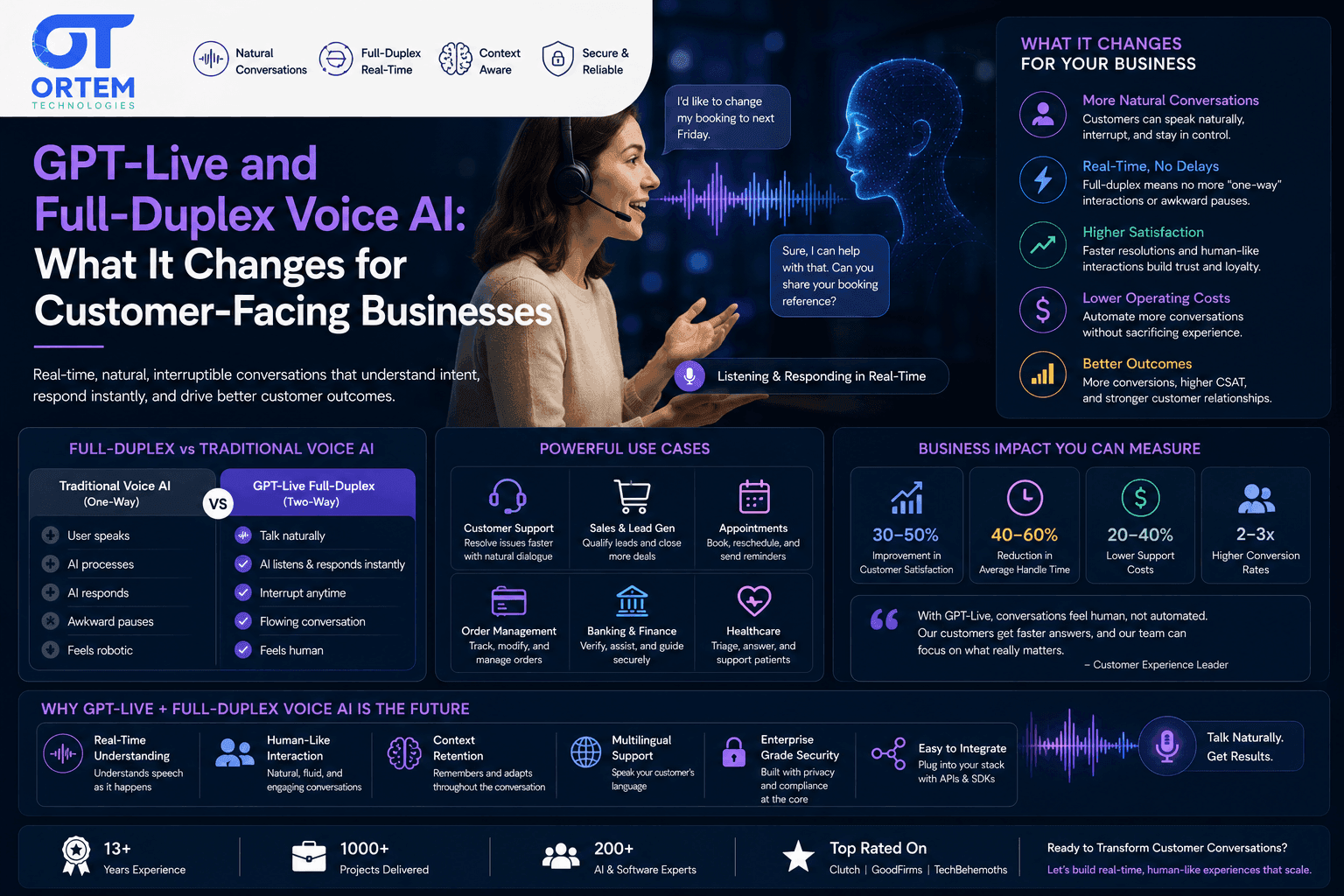
GPT-Live and Full-Duplex Voice AI: What It Changes for Customer-Facing Businesses
Kimi K3 Tops Coding Benchmarks: Should US Companies Use Chinese AI Models?