HIPAA-Compliant App Development in 2026: Checklist, Architecture and Cost Drivers
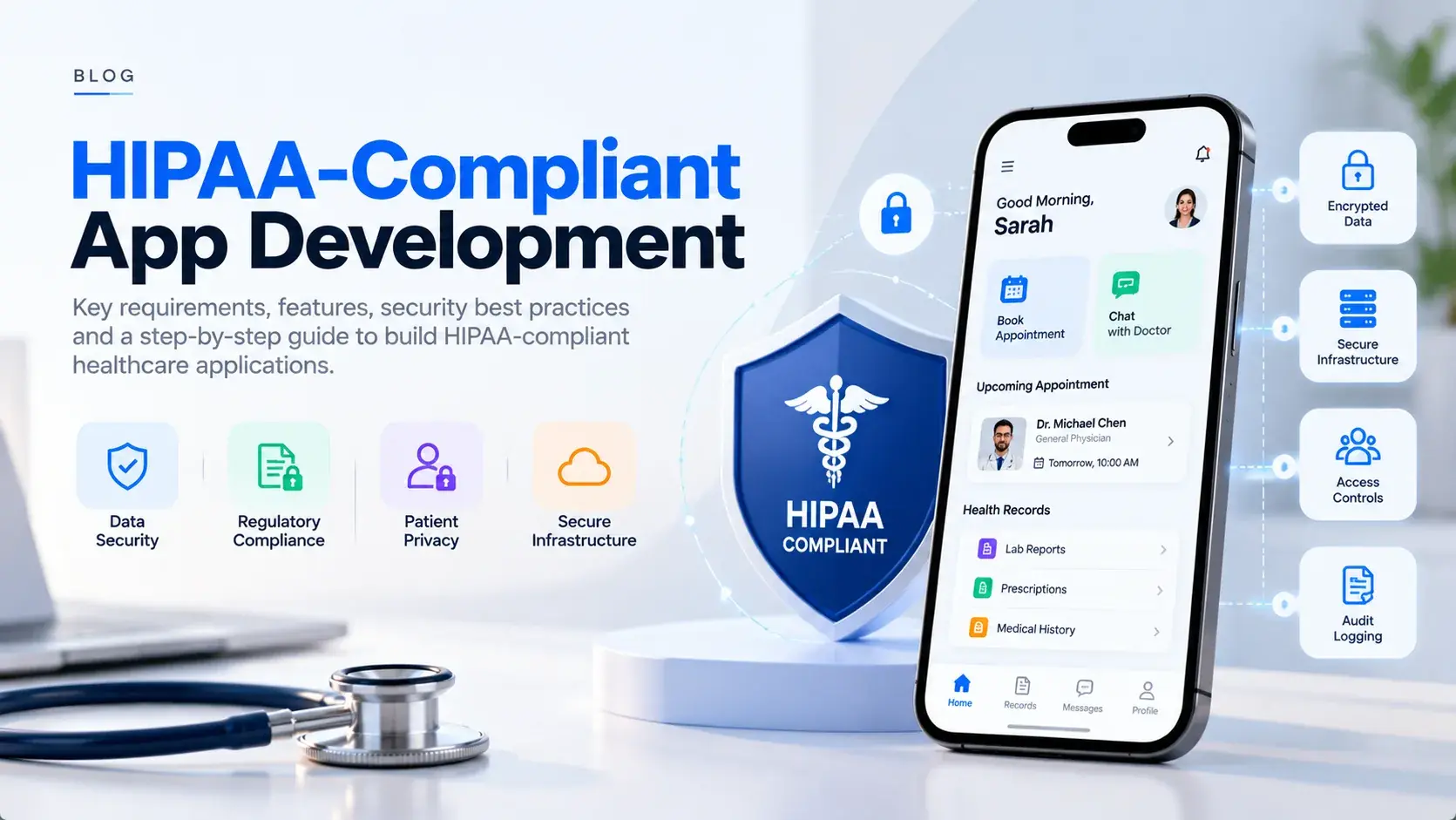
First confirm HIPAA applies: your app handles protected health information for a covered entity or business associate. Then run a risk analysis and build the Security Rule safeguards: access control, audit logs, integrity checks, strong authentication and encryption. Sign a business associate agreement with every vendor that touches PHI, and document everything. Consumer health apps may fall under the FTC Health Breach Notification Rule instead.
Next Best Reads
Continue your research on Healthcare Tech
These links are chosen to move readers from general education into service understanding, proof, and buying-context pages.
HIPAA-Compliant Development
Build HIPAA-compliant healthcare software with audit-ready architecture and end-to-end encryption.
View HIPAA serviceHealthcare Industry Page
See Ortem's full healthcare tech scope — EHR, telehealth, wearables, and clinical data systems.
View healthcare pageRegulated App Case Study
A compliance-critical product build with security controls, data privacy, and high availability.
Read case studyA HIPAA-compliant app protects patient data with documented safeguards. It also has a signed agreement with every vendor that touches that data. There is no certificate that makes an app HIPAA compliant. Compliance is something you build, document and maintain.
This guide covers when HIPAA applies and how to turn the Security Rule into engineering controls. It also covers hosting, mobile and AI features, and what drives cost. It is engineering guidance, not legal advice.
Does HIPAA Apply to Your App?
HIPAA applies to covered entities and their business associates.
- Covered entities are healthcare providers that bill electronically, health plans and healthcare clearinghouses.
- Business associates are companies that create, receive, maintain or transmit protected health information (PHI) on behalf of a covered entity.
If you build an app for a clinic, hospital or health plan, and it handles PHI, you are almost certainly a business associate. You need a business associate agreement (BAA) with that customer.
Consumer health apps
Some people download a fitness or symptom app on their own. If it has no link to a provider or plan, it is usually outside HIPAA. It may still fall under the FTC Health Breach Notification Rule. The FTC updated that rule in 2024 to make clear it covers health apps and similar technologies. It requires notice to users and the FTC after a breach of unsecured health data.
| Your situation | Main rules to consider |
|---|---|
| App built for a provider, plan or clearinghouse | HIPAA Privacy, Security and Breach Notification Rules |
| Vendor processing PHI for a covered entity | HIPAA as a business associate, plus your BAA terms |
| Direct-to-consumer health or wellness app | FTC Health Breach Notification Rule, state privacy laws |
Step 1: Run a Risk Analysis
The Security Rule requires a risk analysis. This is a thorough review of risks to the confidentiality (privacy), integrity (accuracy) and availability of electronic PHI. Do it before you design, and update it when the system changes.
List where PHI is created, stored, sent and displayed. Then list what could go wrong at each point and how you will reduce the risk. This document drives every decision that follows.
Step 2: Map the Security Rule to Engineering Controls
The Security Rule's technical safeguards in 45 CFR 164.312 translate directly into features.
| Safeguard | Requirement | Engineering control |
|---|---|---|
| Access control | Only authorised people and software can access ePHI | Unique user IDs, role-based access, automatic logoff, emergency access procedure |
| Audit controls | Record and examine activity in systems with ePHI | Immutable audit logs of reads, writes and exports, with regular review |
| Integrity | Protect ePHI from improper change or destruction | Checksums, versioning, database constraints, backups |
| Person or entity authentication | Verify that a person is who they claim to be | Strong passwords plus multi-factor authentication, session management |
| Transmission security | Protect ePHI sent over networks | TLS for every connection, no PHI in URLs |
Encryption appears in the rule as an "addressable" specification. That means you must implement it where reasonable or document an equivalent measure. For a modern app, encrypt PHI in transit and at rest.
Administrative safeguards, such as security officer roles, workforce training and incident response, and physical safeguards, such as device and facility controls, apply too. Your hosting provider covers part of the physical side.
Step 3: Sign BAAs With Every Vendor That Touches PHI
This is where many health apps fail. Any third party that creates, receives, stores or transmits PHI for you needs a BAA. Check each one:
- Cloud hosting and databases
- Email and SMS providers for appointment reminders and notifications
- Customer support tools where patients may share health details
- Analytics and crash reporting, which can capture PHI from screens and logs
- Video calling for telehealth
- AI and LLM APIs used for summaries, chat or transcription
HHS guidance on cloud computing is clear on one point: a cloud provider that stores ePHI is a business associate even if the data is encrypted and the provider cannot see it.
Step 4: Choose HIPAA-Eligible Hosting
The major clouds, including AWS, Microsoft Azure and Google Cloud, sign BAAs and publish lists of services eligible for PHI. AWS, for example, maintains a HIPAA Eligible Services Reference.
Two cautions:
- Only use eligible services for PHI. A service outside the list is not covered by the BAA.
- Configuration is your job. The provider secures the infrastructure; you secure your accounts, networks, storage and access.
Step 5: Avoid the Mobile-Specific Leaks
Mobile apps leak PHI in ways web apps do not.
- Push notifications: Never put PHI in the notification text. Use "You have a new message".
- Local storage: Encrypt any cached data and clear it on logout.
- Screenshots and app switcher: Hide sensitive screens in the app switcher preview.
- Logs: Strip PHI from client and server logs and crash reports.
- Lost devices: Support remote session revocation and short session lifetimes.
Step 6: Handle AI Features Carefully
AI features such as visit summaries, clinical note drafting and patient chat are now common in health apps. Treat them like any other vendor:
- Send PHI only to AI services covered by a BAA.
- Prefer providers and endpoints that do not retain prompts for training.
- Log prompts and outputs in your own audit trail.
- Keep a clinician in the loop for anything that affects care.
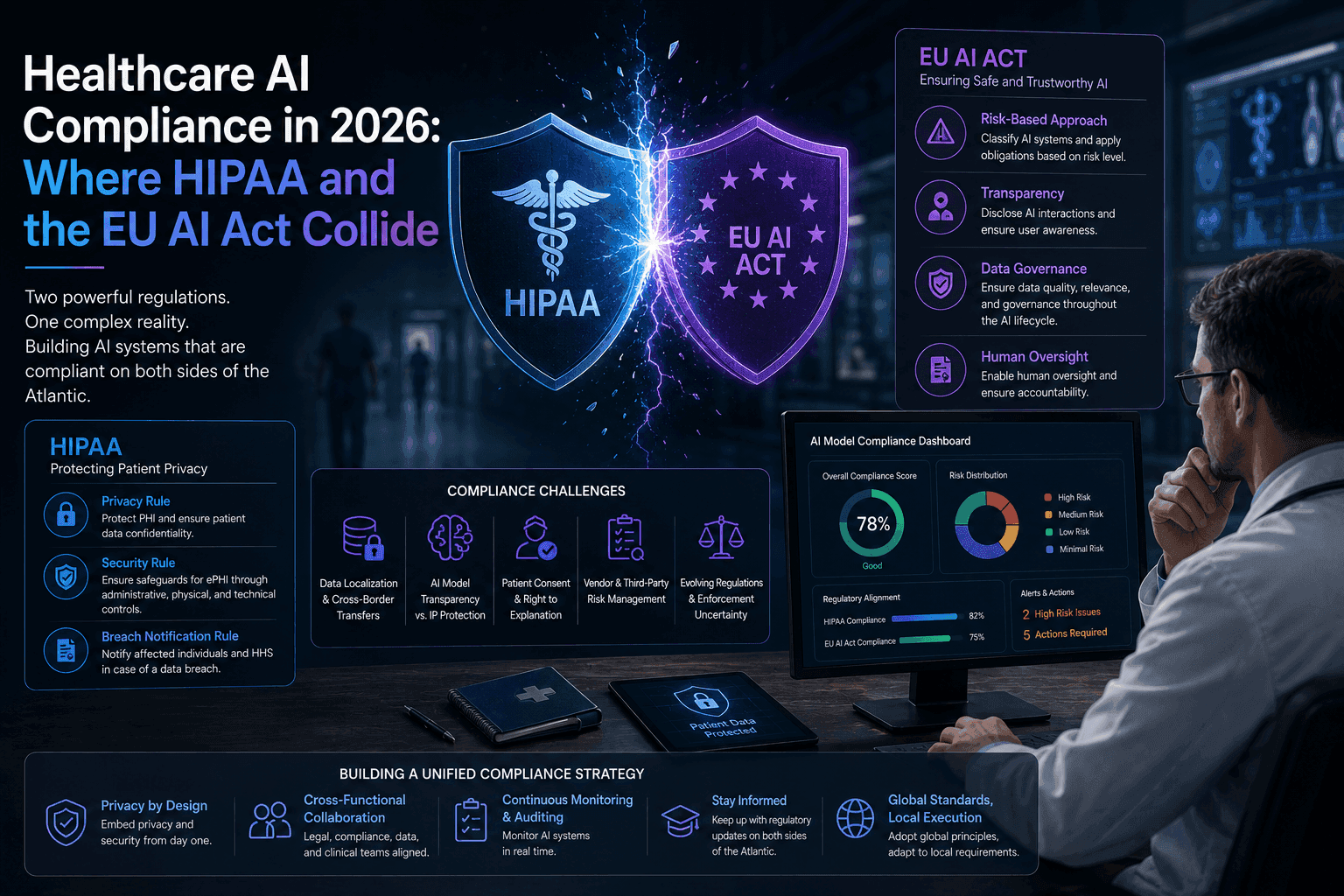
Our guide to healthcare AI compliance under HIPAA and the EU AI Act goes deeper on this.
Step 7: Plan for Breaches
HIPAA's Breach Notification Rule says you must tell affected people without unreasonable delay. The limit is 60 days after you discover a breach of unsecured PHI. Larger breaches also require notifying HHS and, in some cases, the media. Write and rehearse your incident response plan before launch.
HIPAA-Compliant App Checklist
- Confirmed whether HIPAA, the FTC rule or both apply
- Documented risk analysis, updated on major changes
- Unique user IDs, role-based access and MFA
- Audit logs for all access to PHI
- Encryption in transit (TLS) and at rest
- BAAs with every vendor that handles PHI
- HIPAA-eligible hosting, correctly configured
- No PHI in push notifications, URLs or logs
- Backups and a tested disaster recovery plan
- Incident response and breach notification plan
- Workforce security training and written policies
- Regular security testing, such as penetration tests
What Drives the Cost of HIPAA-Compliant Development
Compliance adds work in predictable places:
- Security architecture and threat modelling up front
- Audit logging and access control features
- Compliant hosting and the security tooling around it
- Vendor reviews and BAAs for every integration
- Risk analysis and documentation
- Security testing before launch and at regular intervals
The total depends on scope, so treat compliance as its own line in the estimate. For typical budgets, see our guides to healthcare app development cost and telehealth app development cost.
Working With a Development Partner
Choose a partner who will sign a BAA and has built HIPAA systems before. Ask them to show their security practices, not just claim them. Ortem builds HIPAA-aligned healthcare software and signs BAAs where we handle PHI. See our HIPAA-compliant development service.
About Ortem Technologies
Ortem Technologies is a premier custom software, mobile app, and AI development company. We serve enterprise and startup clients across the USA, UK, Australia, Canada, and the Middle East. Our cross-industry expertise spans fintech, healthcare, and logistics, enabling us to deliver scalable, secure, and innovative digital solutions worldwide.
Get the Ortem Tech Digest
Monthly insights on AI, mobile, and software strategy - straight to your inbox. No spam, ever.
Sources & References
- 1.45 CFR Part 164 Subpart C — Security Standards for the Protection of Electronic Protected Health Information - eCFR
- 2.Guidance on HIPAA and Cloud Computing - U.S. Department of Health and Human Services
- 3.16 CFR Part 318 — Health Breach Notification Rule - eCFR
- 4.Health Breach Notification Rule (final rule, May 2024) - Federal Register
- 5.HIPAA Eligible Services Reference - Amazon Web Services
About the Author
Editorial Team, Ortem Technologies
The Ortem Technologies editorial team brings together expertise from across our engineering, product, and strategy divisions to produce in-depth guides, comparisons, and best-practice articles for technology leaders and decision-makers.
Frequently Asked Questions
- Your app needs to comply with HIPAA if it creates, receives, maintains or transmits protected health information on behalf of a covered entity, such as a healthcare provider, health plan or clearinghouse, or as their business associate. A consumer app that people use on their own, with no connection to a covered entity, is usually outside HIPAA but may be covered by the FTC Health Breach Notification Rule.
- Run a documented risk analysis, implement the Security Rule's administrative, physical and technical safeguards, encrypt PHI in transit and at rest, enforce unique user logins and access controls, keep audit logs, sign business associate agreements with every vendor that handles PHI, train your team, and keep policies and records up to date.
- HIPAA-compliant hosting means running your app on infrastructure whose provider signs a business associate agreement and offers services eligible for PHI. Major clouds such as AWS, Microsoft Azure and Google Cloud offer this, but compliance also depends on how you configure the services.
- Under the current Security Rule, encryption is an addressable implementation specification, meaning you must implement it where reasonable and appropriate or document an equivalent alternative. In practice, encrypting PHI in transit and at rest is expected for any modern app.
- Only if the AI provider signs a business associate agreement covering the service you use, and the service is configured to meet your obligations. Do not send PHI to consumer AI tools or APIs without a BAA. Several major AI and cloud providers offer BAA-eligible endpoints for enterprise customers.
- HIPAA adds cost for security architecture, audit logging, access controls, encryption, compliant hosting, vendor reviews, risk analysis, documentation and security testing. The amount depends on the app's scope, so treat compliance as a line item in the estimate rather than an afterthought.
Stay Ahead
Get engineering insights in your inbox
Practical guides on software development, AI, and cloud. No fluff — published when it's worth your time.
Ready to Start Your Project?
Let Ortem Technologies help you build innovative software solutions for your business.
You Might Also Like
Healthcare AI Compliance in 2026: Where HIPAA and the EU AI Act Collide

AI in Healthcare 2026: The Shift to Autonomous Patient Care & Precision Medicine