Healthcare AI Compliance in 2026: Where HIPAA and the EU AI Act Collide
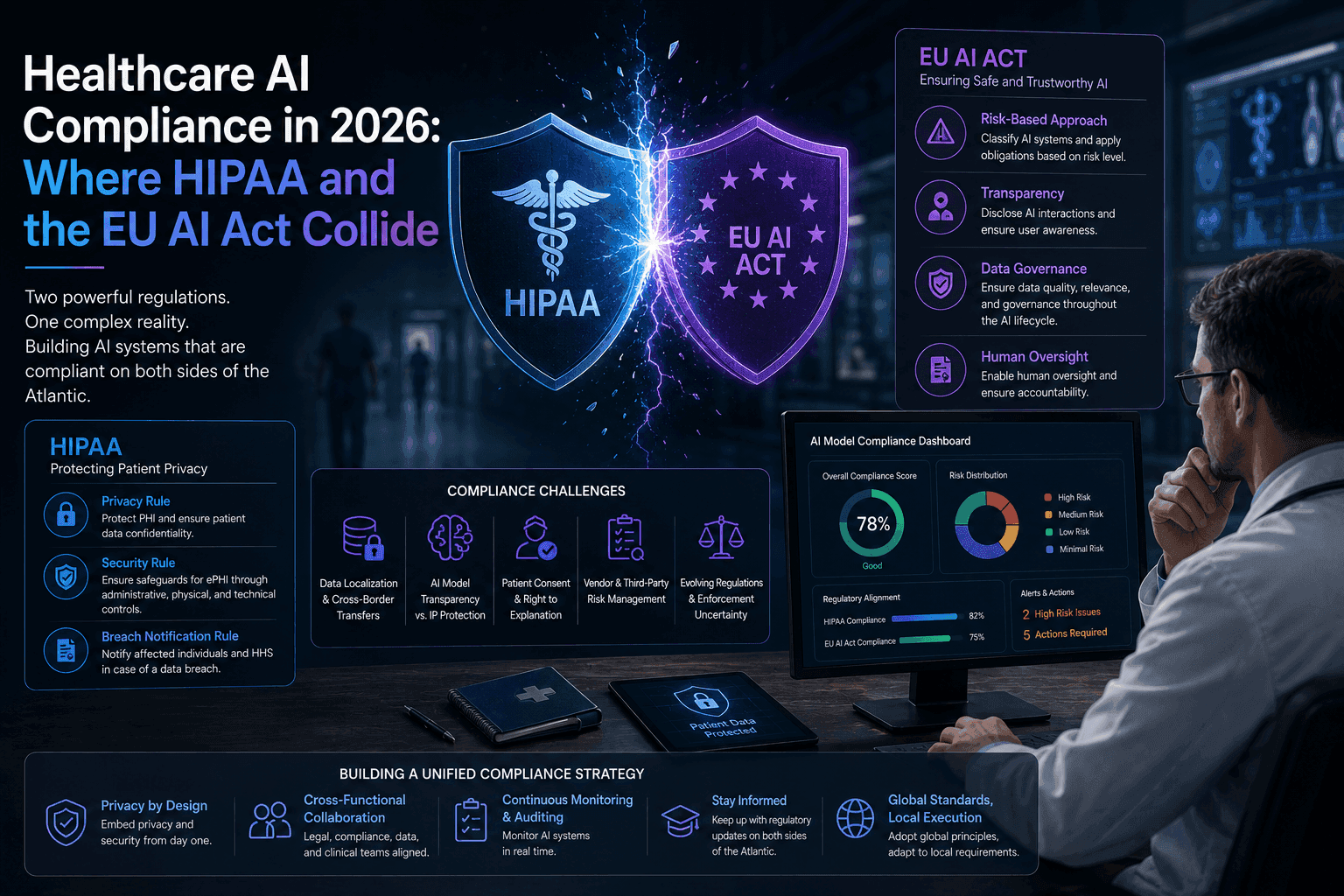
Healthcare AI products serving both US and EU markets now carry obligations under HIPAA and the EU AI Act at the same time. HIPAA governs how protected health information is safeguarded, accessed and disclosed. The EU AI Act governs how the AI system itself is classified, documented, overseen and monitored — and most clinical decision-support use cases fall into its high-risk tier. The two regimes overlap substantially in audit logging, access control and accountability, but the AI Act adds requirements HIPAA has no equivalent for: risk classification, technical documentation of the model, human oversight design, and post-market monitoring.
Next Best Reads
Continue your research on Healthcare Tech
These links are chosen to move readers from general education into service understanding, proof, and buying-context pages.
HIPAA-Compliant Development
Build HIPAA-compliant healthcare software with audit-ready architecture and end-to-end encryption.
View HIPAA serviceHealthcare Industry Page
See Ortem's full healthcare tech scope — EHR, telehealth, wearables, and clinical data systems.
View healthcare pageRegulated App Case Study
A compliance-critical product build with security controls, data privacy, and high availability.
Read case studyHealthcare software has always carried more regulatory weight than most software. In 2026, clinical AI carries two distinct regimes at once, and they ask fundamentally different questions.
HIPAA asks: was the patient's information protected? The EU AI Act asks: was the system that made a recommendation about this patient classified, documented, supervised and monitored?
A product can answer the first question perfectly and the second not at all. That gap is where most healthcare AI teams are currently exposed.
Two regimes, two different questions
The distinction is worth being precise about, because the assumption that a mature HIPAA programme carries you through AI Act obligations is both common and wrong.
HIPAA is a data protection regime. It governs protected health information: how it is safeguarded technically and administratively, who may access it, under what circumstances it may be disclosed, and what contractual structure must exist with vendors who touch it. Its unit of concern is the information.
The EU AI Act is a product safety regime. It governs the AI system: what risk tier it occupies, what documentation must exist about how it was built and validated, how a human retains meaningful oversight of its outputs, and how it is monitored once deployed. Its unit of concern is the system and the decision it influences.
You can hold PHI impeccably and still have no idea which risk tier your triage model occupies, no maintained technical documentation, and no designed human oversight. Under HIPAA that is fine. Under the AI Act it is not.
Why most clinical AI lands in the high-risk tier
The EU AI Act classifies by use case. Healthcare appears among the listed high-risk domains, and the reasoning is intuitive: these systems influence decisions affecting a person's health, treatment and access to care.
In practice the line runs roughly like this. Administrative applications — appointment scheduling, form completion, routine documentation assistance — generally sit in lower tiers. Clinical applications that inform decisions about a patient — triage prioritisation, diagnostic support, treatment recommendation, risk scoring — generally sit high.
The nuance that catches teams out is that the same model can straddle both. A large language model summarising clinical notes for administrative convenience is one thing; the same model surfacing a suggested differential diagnosis is another. The regulation follows what the output is used for, which means feature-level classification is necessary rather than product-level.
This is also the moment the sector's security posture becomes relevant. Across 2026 industry surveys, healthcare reported the highest rate of confirmed or suspected AI agent security incidents of any sector, at around 92.7%. Regulators are not arriving into a sector with a clean record.
Where the two regimes genuinely overlap
The encouraging part is that a meaningful share of the control set serves both regimes with a single implementation.
Audit logging. HIPAA requires records of PHI access. The AI Act requires records of high-risk system operation. A well-designed logging layer that captures who accessed what, which model version produced which output, and what a clinician did with it, satisfies substantial parts of both.
Access control. Role-based access is a HIPAA staple and equally serves the AI Act's expectations around who may operate and override a high-risk system.
Accountability structures. HIPAA requires named privacy and security responsibility. The AI Act requires accountable human oversight. Different framing, compatible implementation.
Encryption and data handling. Straightforwardly reusable.
If you are building fresh, designing these once against the stricter of the two requirements is materially cheaper than building for HIPAA and retrofitting.
Where the AI Act adds genuinely new work
Four requirements have no real HIPAA equivalent, and these are where the additional effort concentrates.
Risk classification per use case. A documented determination of which tier each AI feature occupies and why. HIPAA has no analogue because it does not care what the software does, only what it does with data.
Technical documentation of the system. Purpose, architecture, characteristics of training and validation data, performance metrics, and known limitations. Clinical teams often have much of this from validation work, but scattered across study documents, model cards and engineering wikis rather than maintained as a coherent file.
Human oversight design. Not a policy statement that clinicians remain responsible, but an actual designed mechanism: where a human reviews, what information they see when they do, how they override, and evidence that the override path is real rather than theoretical. This is a product design requirement, and it is covered in more depth in our guide to human-in-the-loop patterns.
Post-market monitoring. Ongoing tracking of how the system performs in the field, including drift and adverse outcomes, with a route for that information to change the product. HIPAA has nothing comparable.
A practical build sequence
For teams shipping clinical AI into both markets, the sequence that avoids duplicated work looks like this.
Start by classifying at the feature level, not the product level, and write down the reasoning. This single artefact determines how much of the rest applies and is the first thing an assessor asks for.
Build the logging layer once, against the union of both regimes, capturing PHI access and model operation in the same trace. Retrofitting a second logging system later is significantly more expensive than over-building slightly at the start.
Design the oversight mechanism into the clinical workflow rather than around it. Oversight that adds friction gets routed around by busy clinicians, which produces both a safety problem and an evidence problem — the logs will show approvals that were not meaningful reviews.
Maintain the technical documentation as a living artefact tied to your release process. Documentation regenerated in a panic before an assessment is both expensive and unconvincing.
What this means commercially
Healthcare AI vendors selling into both the US and EU now face a compliance surface materially larger than either market alone. That is a barrier, but it is also a moat. Teams that build the classification, documentation, oversight and monitoring layers properly can sell into regulated buyers who will not touch competitors that cannot produce the evidence.
We have built healthcare software used by half a million families, and our HIPAA-compliant development practice now scopes AI Act obligations alongside HIPAA safeguards rather than treating them as sequential projects. If you are shipping clinical AI into both markets, see our healthcare software development work or book a consultation to map your feature-level risk classification before it becomes an assessment finding.
Further reading: HIPAA-Compliant App Development: Checklist and Costs
About Ortem Technologies
Ortem Technologies is a premier custom software, mobile app, and AI development company. We serve enterprise and startup clients across the USA, UK, Australia, Canada, and the Middle East. Our cross-industry expertise spans fintech, healthcare, and logistics, enabling us to deliver scalable, secure, and innovative digital solutions worldwide.
Get the Ortem Tech Digest
Monthly insights on AI, mobile, and software strategy - straight to your inbox. No spam, ever.
Sources & References
- 1.EU AI Act: Transparency Obligations Take Effect 2 August 2026 - Cooley
- 2.AI Act — Regulatory Framework for AI - European Commission
- 3.State of AI Agent Security 2026 - Gravitee
About the Author
Private 1:1 AI Tutor · Director of Sales & Business Development, Moksh Tech
Praveen Jha is a private 1:1 AI tutor and enterprise AI sales leader based in Ahmedabad, India. He teaches executives, founders and engineers to ship real work with ChatGPT, Claude, Cursor and Claude Code, and is an Oracle Certified Generative AI Professional and AWS Certified Solutions Architect. He wrote his articles here while Director of AI Product Strategy, Sales & Business Development at Ortem Technologies.
Frequently Asked Questions
- Most clinical decision-support use cases do fall into the high-risk tier, because healthcare sits among the listed high-risk domains and these systems influence decisions affecting a person's health and access to care. Classification follows the use case rather than the technology, so administrative tools such as appointment scheduling generally sit lower, while triage, diagnosis support and treatment recommendation generally sit high.
- No. HIPAA governs the protection of health information — safeguards, access, disclosure, business associate agreements. The EU AI Act governs the AI system itself: how it is classified, documented, overseen and monitored. A model can handle PHI in a fully HIPAA-compliant way while having no risk classification, no technical documentation and no human oversight design, which leaves it non-compliant under the AI Act.
- Beyond HIPAA records, high-risk systems under the AI Act require technical documentation covering the system's purpose, design, training and validation data characteristics, performance metrics and known limitations, plus a risk management record and evidence of post-market monitoring. Much of this is material clinical teams already produce for validation, but it typically lives in scattered places rather than a maintained file.
- Partially, and that overlap is worth exploiting. Audit logging, access control, encryption and accountability structures serve both regimes with one implementation. What does not transfer is the AI-specific layer: risk classification, model documentation, human oversight design and post-market monitoring have no HIPAA equivalent and must be built separately.
Stay Ahead
Get engineering insights in your inbox
Practical guides on software development, AI, and cloud. No fluff — published when it's worth your time.
Ready to Start Your Project?
Let Ortem Technologies help you build innovative software solutions for your business.
You Might Also Like
AI in Healthcare 2026: The Shift to Autonomous Patient Care & Precision Medicine
Building AI That Assists but Never Decides: A Framework for Human-in-the-Loop Healthcare Software