Human-in-the-Loop Design Patterns for Production AI Agents
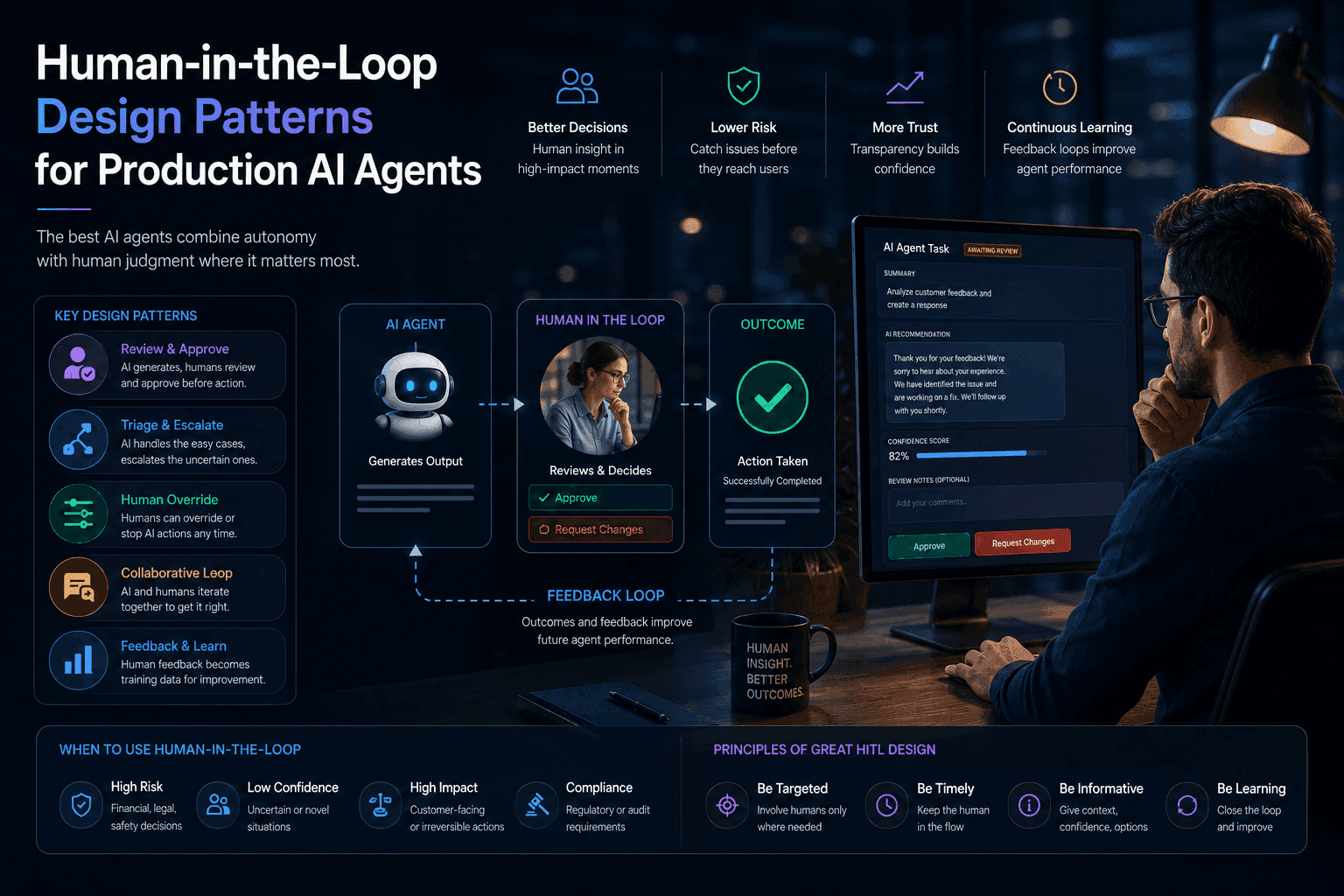
Human-in-the-loop design for AI agents means building explicit checkpoints where a person reviews, approves or overrides an agent action before it takes effect. In 2026 this shifted from best practice to obligation, because the EU AI Act requires meaningful human oversight for high-risk systems. The patterns that work in production are confidence-threshold routing where high-confidence actions execute automatically and low-confidence ones queue for review, irreversibility gating where any action that cannot be undone requires approval regardless of confidence, and batch review where similar pending decisions are grouped so a reviewer can clear many quickly. The failure mode to avoid is approval theatre: a review step that operators click through without genuine consideration, which satisfies neither safety nor audit.
Next Best Reads
Continue your research on AI Engineering
These links are chosen to move readers from general education into service understanding, proof, and buying-context pages.
AI & ML Solutions
Move from architecture reading into real model deployment, MLOps, and production AI pipelines.
Explore AI servicesLLM Integration
Integrate large language models into your product — RAG, fine-tuning, copilots, and APIs.
Explore LLM serviceAI Platform Case Study
See a production AI system with real data architecture, model integration, and launch outcomes.
Read case studyEvery team deploying agents into consequential workflows arrives at the same tension. Full autonomy is fast and occasionally catastrophic. Full human review is safe and defeats the purpose of the agent.
Human-in-the-loop design is the engineering answer to that tension. Since 2 August 2026 it is also a regulatory requirement for high-risk systems under the EU AI Act, which means the design quality of your approval paths is now something an assessor may examine.
The patterns below are what actually survive contact with production, and the anti-patterns are what auditors are learning to look for.
Gate on irreversibility, not on decisions
The most common design mistake is placing the checkpoint too early.
Teams often gate the agent's decision: before it decides what to do, a human confirms the plan. This slows everything down and reduces risk very little, because the consequential step is still ahead and the human is approving an intention rather than an effect.
The better position is immediately before irreversible effect. Let the agent reason, retrieve, draft and plan without interruption. Gate the moment it is about to do something that cannot be undone: send an external message, move money, delete data, change permissions, publish content.
This single reframing typically cuts approval volume dramatically while covering more actual risk, because most agent steps are reversible and most risk concentrates in a small number of terminal actions.
Confidence-threshold routing
The second pattern is routing by the agent's own confidence, with high-confidence actions executing automatically and low-confidence ones queuing for human review.
This works well provided the threshold is calibrated from data rather than chosen by intuition. The method that produces a defensible number is straightforward: run the agent for a period with everything queued, record both the confidence score and whether the reviewer agreed with the proposed action, then plot agreement against confidence. The threshold is where auto-execution would have produced an error rate your business can absorb.
Two cautions. Confidence distributions shift when the underlying model changes, so a threshold calibrated on one model version is not automatically valid on the next — this is one of the practical costs of model tier changes that procurement discussions often miss. And confidence is not accuracy; a model can be confidently wrong, which is why irreversibility gating should override confidence routing rather than sit beneath it.
Batch review for volume
Where an agent produces many similar decisions, one-at-a-time review collapses under its own weight.
Batch review groups pending items by similarity so a reviewer can assess a pattern rather than repeat an identical judgement fifty times. Twenty near-identical refund approvals reviewed as a group, with outliers surfaced separately, is both faster and more accurate than twenty sequential prompts, because the reviewer can see the distribution and spot the item that does not belong.
The design requirement is that outliers must be visually distinct within the batch. A batch interface that renders every item identically encourages bulk approval and reintroduces the problem it was meant to solve.
The anti-pattern: approval theatre
This is the failure mode worth naming explicitly, because it is common, it looks fine on a dashboard, and it is becoming an audit finding.
Approval theatre is a review step that exists in the workflow but not in practice. A reviewer facing hundreds of approvals a day with minimal context will approve nearly all of them, quickly, without meaningful consideration. The system logs hundreds of human reviews. None of them were reviews.
The signals that reveal it are measurable, and assessors are learning to ask for them: approval rates approaching 100%, median review times of a second or two, and a complete absence of recorded overrides. If your oversight mechanism has never produced a rejection, it is not functioning as a control.
The fixes are design fixes rather than policy fixes. Reduce volume by gating only on irreversibility. Give reviewers the context needed to make a real judgement, including why the agent proposed this and what it is uncertain about. Make rejection as easy as approval — if the reject path requires a form and the approve path requires a click, you have designed the outcome.
What to record
Oversight that cannot be evidenced is oversight you cannot demonstrate.
For each reviewed action, record what was proposed, what the agent's confidence was, what the reviewer saw at decision time, what they decided, how long they took, and the rationale where an override occurred. The "what they saw" field is the one teams forget and the one that matters most in a dispute, because it establishes whether the reviewer had a genuine basis for the decision.
This record is also, conveniently, a large part of what the EU AI Act expects for high-risk systems, and it slots naturally into the agent observability layer rather than needing a separate system.
Designing for the operator, not the auditor
The closing point is the one that determines whether any of this works.
Oversight mechanisms designed primarily to satisfy an auditor tend to add friction without adding judgement, and operators route around friction. Oversight designed primarily to help the operator make a good decision quickly tends to produce genuine review, which satisfies the auditor as a consequence.
If your reviewers experience the approval queue as an obstacle, they will clear it as fast as possible and your control is decorative. If they experience it as the place where they catch things worth catching, it works — and the logs will show it, because there will be overrides in them.
Ortem Technologies builds production agent systems where oversight is designed into the workflow rather than layered on before an audit. If you are deploying agents into consequential workflows and need approval architecture that holds up to both operators and assessors, see our AI agent development services, our LLM integration work, or talk to our engineers.
About Ortem Technologies
Ortem Technologies is a premier custom software, mobile app, and AI development company. We serve enterprise and startup clients across the USA, UK, Australia, Canada, and the Middle East. Our cross-industry expertise spans fintech, healthcare, and logistics, enabling us to deliver scalable, secure, and innovative digital solutions worldwide.
Get the Ortem Tech Digest
Monthly insights on AI, mobile, and software strategy - straight to your inbox. No spam, ever.
Sources & References
- 1.AI Act — Regulatory Framework for AI - European Commission
- 2.EU AI Act: Transparency Obligations Take Effect 2 August 2026 - Cooley
- 3.AI Agent Risks & Guardrails: 2026 Enterprise Security Guide - Atlan
About the Author
Private 1:1 AI Tutor · Director of Sales & Business Development, Moksh Tech
Praveen Jha is a private 1:1 AI tutor and enterprise AI sales leader based in Ahmedabad, India. He teaches executives, founders and engineers to ship real work with ChatGPT, Claude, Cursor and Claude Code, and is an Oracle Certified Generative AI Professional and AWS Certified Solutions Architect. He wrote his articles here while Director of AI Product Strategy, Sales & Business Development at Ortem Technologies.
Frequently Asked Questions
- A designed checkpoint where a person reviews an agent action before it takes effect, with the information and authority to change the outcome. The important qualifiers are information and authority: showing a reviewer an action with no context, or giving them no practical way to reject it, produces the appearance of oversight without the substance.
- At the point of irreversible effect rather than at the point of decision. An agent can reason, draft, retrieve and plan freely; the gate belongs immediately before the action that changes the outside world — sending the message, moving the money, deleting the record. Gating earlier slows the agent without reducing risk, because the risky step is still ahead.
- Empirically, from production data rather than intuition. Run the agent with everything queued for review, record both the agent's confidence and whether the human agreed, then set the threshold where auto-execution would have produced an acceptable error rate. Recalibrate after model changes, because confidence distributions shift when the underlying model does.
- For high-risk systems, yes. The Act requires that high-risk AI systems be designed so they can be effectively overseen by people during use, including the ability to intervene or interrupt operation. It is a design obligation rather than a policy statement, which is why it needs to appear in the product architecture rather than only in a governance document.
Stay Ahead
Get engineering insights in your inbox
Practical guides on software development, AI, and cloud. No fluff — published when it's worth your time.
Ready to Start Your Project?
Let Ortem Technologies help you build innovative software solutions for your business.
You Might Also Like
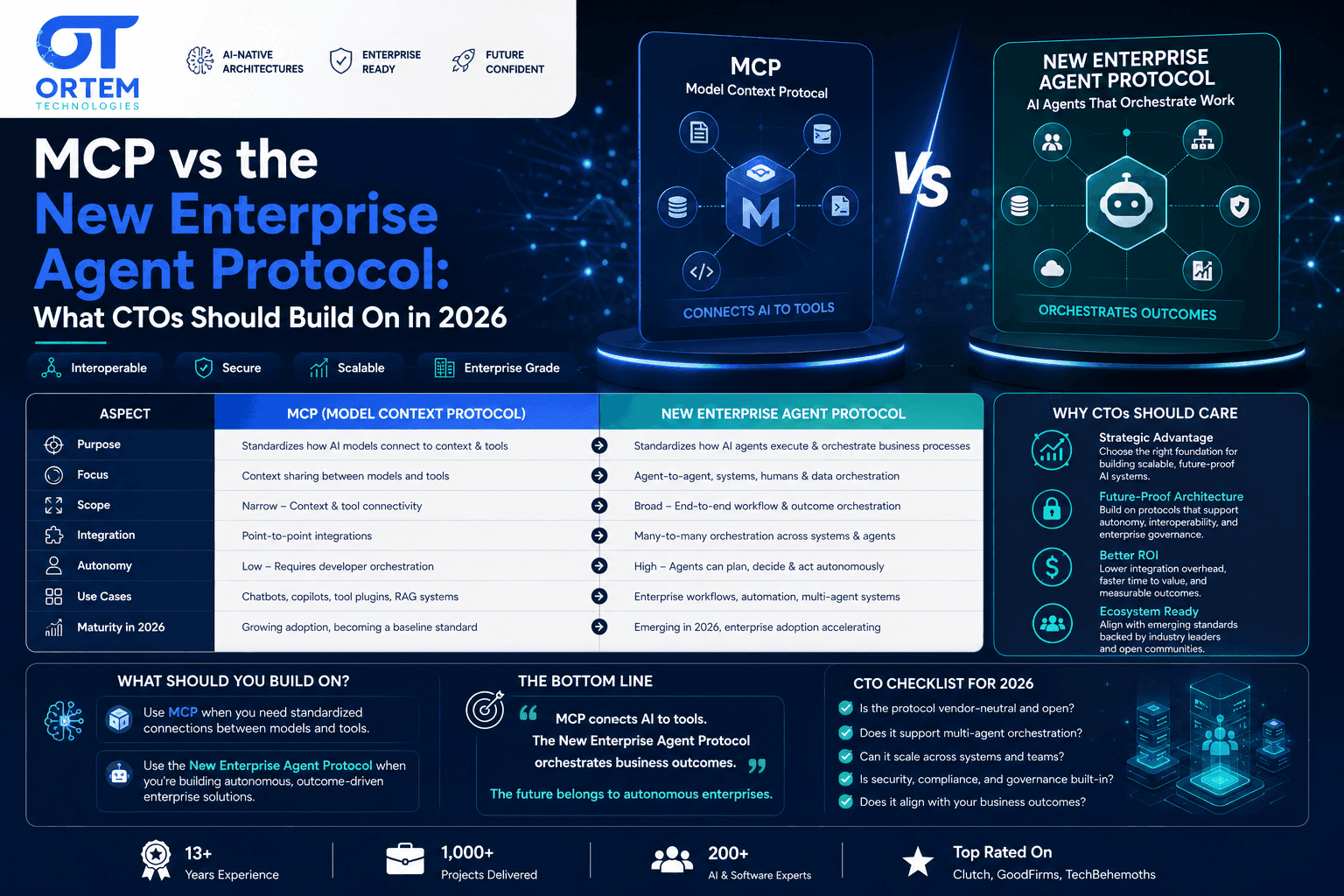
MCP vs the New Enterprise Agent Protocol: What CTOs Should Build On in 2026
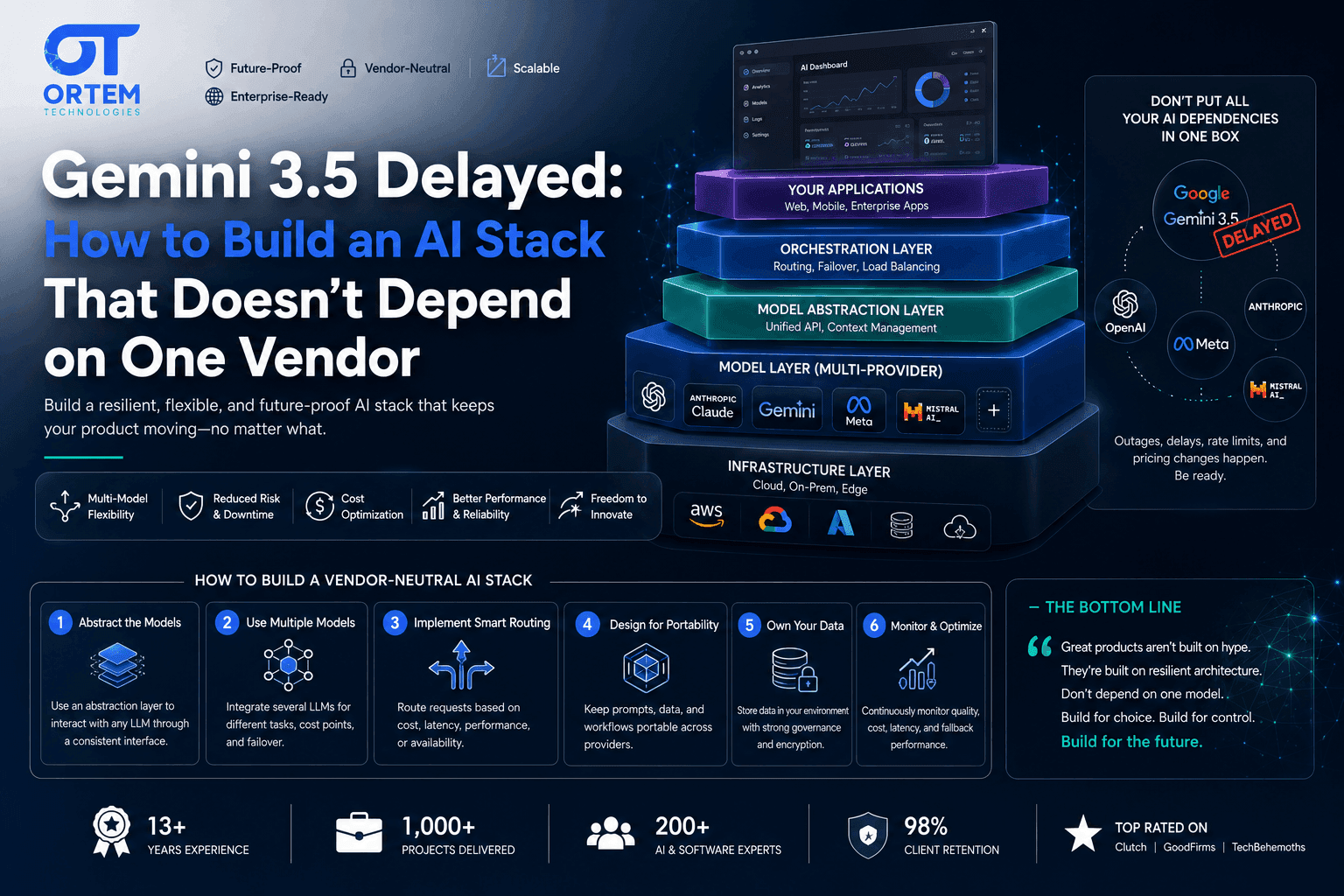
Gemini 3.5 Delayed: How to Build an AI Stack That Doesn't Depend on One Vendor