
v0 vs Google Stitch: One Ends at a Design, the Other at a Deployed URL
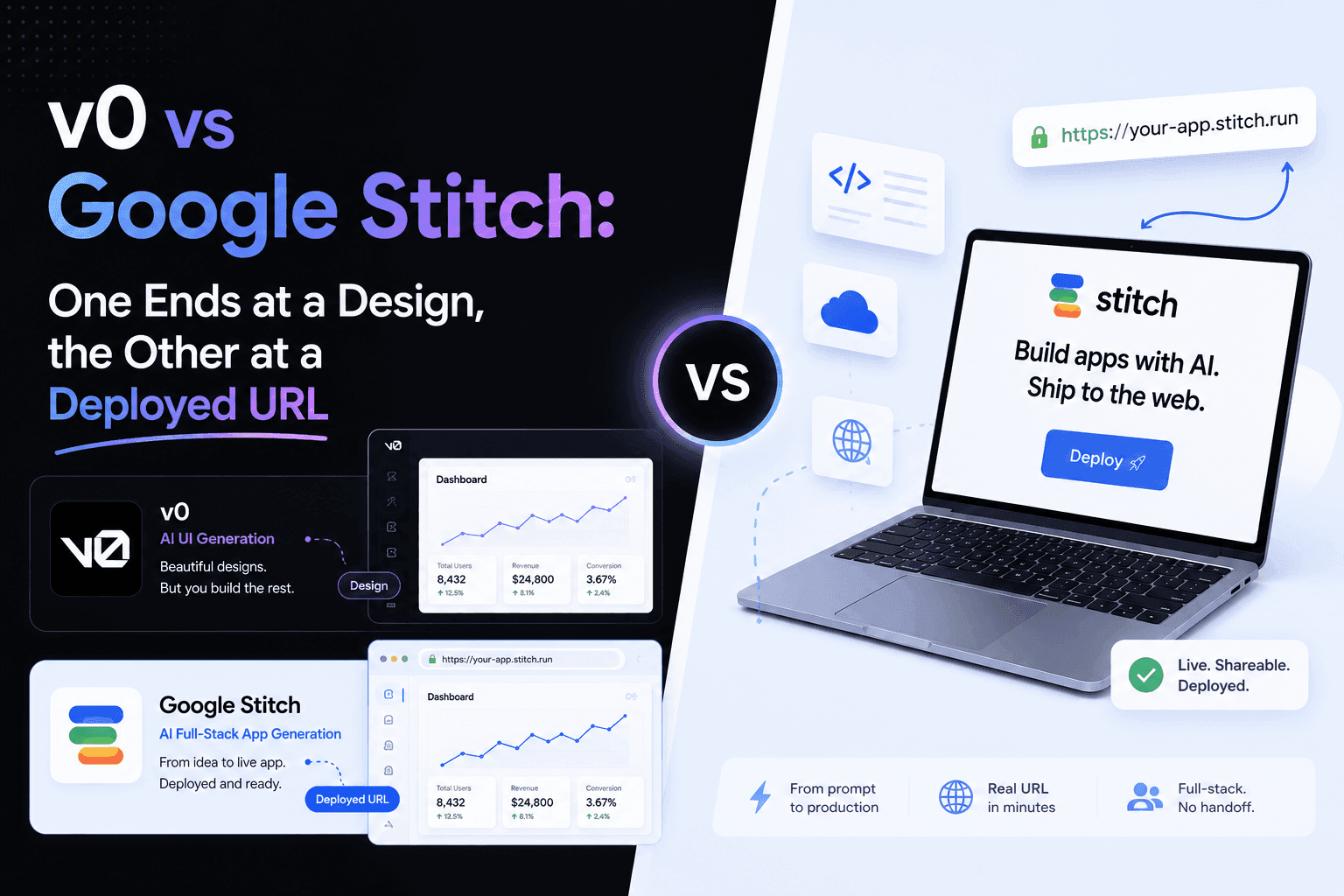
Google Stitch is a design tool and v0 is a builder. Stitch generates UI on an infinite canvas and exports HTML and CSS, with no backend and no deployment, and it is free as a Google Labs experiment. v0 generates React components on shadcn/ui, connects databases and APIs, and deploys to Vercel in one click, with a free tier and paid plans from $30 per user per month. If your stack is Next.js and you need components you can ship, use v0. If you are exploring what a product should look like, or your stack is not React, use Stitch. Most teams that run both use Stitch to narrow design directions and v0 to build the approved one.
Next Best Reads
Continue your research on AI Engineering
These links are chosen to move readers from general education into service understanding, proof, and buying-context pages.
AI & ML Solutions
Move from architecture reading into real model deployment, MLOps, and production AI pipelines.
Explore AI servicesLLM Integration
Integrate large language models into your product — RAG, fine-tuning, copilots, and APIs.
Explore LLM serviceAI Platform Case Study
See a production AI system with real data architecture, model integration, and launch outcomes.
Read case studyThey look like competitors and they are not. Google Stitch and v0 both turn a text prompt into a user interface, then stop at completely different points — and picking the wrong one costs you either a rebuild or a design phase you did not need.
The short version: Stitch ends at a design. v0 ends at a deployed URL. If you need to explore what something should look like, Stitch is free and faster. If you need React components that go into a real Next.js codebase, v0 is the only one of the two that produces them.
What each one actually does
Google Stitch is a design tool. You describe a screen, it generates UI on an infinite canvas, and you iterate until the direction is right. It exports HTML and CSS. It does not build applications, it does not connect to a backend, and it does not deploy anything. It is a Google Labs experiment, which explains both the price and the roadmap uncertainty.
v0 by Vercel is a builder. You describe what you want, it generates working React components built on shadcn/ui, wires up databases and APIs, and deploys to Vercel in one click. Prompt to live URL, no intermediate design artifact.
That difference cascades into everything else.
Side by side
| Google Stitch | v0 by Vercel | |
|---|---|---|
| Output | UI designs on a canvas, HTML/CSS export | React components on shadcn/ui |
| Ends at | A design you still have to build | A deployed URL |
| Backend | None | Databases and APIs connected |
| Deployment | None | One click to Vercel |
| Fits into | Any stack, after a rewrite | Next.js directly, no cleanup |
| Price | Free (Google Labs experiment) | Free tier, then $30/user/month |
| Best at | Exploring directions fast | Shipping production components |
The code question is the real decision
This is where teams get caught. Stitch produces HTML and CSS. v0 produces structured, component-based React that drops into a modern frontend stack without cleanup.
If your codebase is Next.js with shadcn/ui — an extremely common 2026 stack — v0's output is genuinely usable as-is. Stitch's output is a visual reference that a developer then rebuilds. That rebuild is not a flaw in Stitch; it is what a design tool is supposed to hand off. It only becomes a problem when someone chose Stitch expecting to skip the build.
If your codebase is anything other than React — Flutter, Vue, Rails with Hotwire, native mobile — v0's advantage largely evaporates. You are rewriting its output too, at which point Stitch's free canvas is the better exploration surface.
Price is not the deciding factor, but it is not nothing
Stitch is free. v0 is free to try and $30 per user per month after that.
For a solo developer or a startup exploring concepts, free wins and the decision is easy. For a team already paying for Vercel and shipping Next.js, $30 a seat is trivially recovered on the first component you do not hand-build.
The trap is treating them as a spend comparison. They are not doing the same job, so the cheaper one is only cheaper if it does the job you actually need.
Which to choose
Choose Google Stitch when:
- You are exploring what a product should look like and do not yet know
- Nobody on the team is a designer and you need something credible to react to
- Your stack is not React, so generated React buys you nothing
- Budget is genuinely zero
Choose v0 when:
- You are on Next.js, or React with shadcn/ui
- You need working components, not a picture of components
- You want a live URL to put in front of someone this afternoon
- The team already lives in the Vercel ecosystem
Use both, in sequence, which is what most teams that have run them both end up doing: Stitch to generate and narrow design directions for free, then v0 to turn the approved direction into production React. Add Cursor or Claude Code to assemble those components into a full application with real backend logic.
Where each one breaks down
Stitch's limit is that it stops at the handoff. Every screen it produces still needs building. On a project of any size, that is the majority of the work, and the design artifact does not shorten it as much as people expect.
v0's limit is the lock-in shape. Its output assumes React, shadcn/ui and Vercel. That is a productive set of assumptions if you already hold them and an expensive one if you do not. Deploying elsewhere is possible; it just removes the one-click part that makes v0 feel fast.
Both share the same ceiling. Generated UI is good at the first eighty percent of a screen — layout, spacing, standard components. Neither is good at the last twenty, which is where your actual product logic, edge cases and brand live. Teams that ship well with these tools use them to skip the boilerplate, not to skip the design decisions.
Frequently asked
Is Google Stitch free? Yes, it is currently free as a Google Labs experiment. That also means no pricing or availability commitment.
Does v0 only work with Next.js? It generates React on shadcn/ui, which works in any React project. The one-click deployment is Vercel-specific.
Can Stitch export code? It exports HTML and CSS, which is a reference rather than production component code.
Which is better for a non-designer? Stitch, for exploring options at no cost. Move to v0 once you know what you are building.
Ortem Technologies builds production React and Next.js applications, including work that starts from AI-generated components. Web development → | Next.js development → | Talk to our team →
About Ortem Technologies
Ortem Technologies is a premier custom software, mobile app, and AI development company. We serve enterprise and startup clients across the USA, UK, Australia, Canada, and the Middle East. Our cross-industry expertise spans fintech, healthcare, and logistics, enabling us to deliver scalable, secure, and innovative digital solutions worldwide.
Get the Ortem Tech Digest
Monthly insights on AI, mobile, and software strategy - straight to your inbox. No spam, ever.
Sources & References
- 1.Google Stitch vs v0 vs Lovable 2026 - NxCode
- 2.V0 vs Stitch: Which AI Tool Should You Choose - InsiderAITrends
- 3.Google Stitch vs v0 (2026) - Vibecoding
About the Author
Digital Marketing Head, Ortem Technologies
Mehul Parmar is the Digital Marketing Head at Ortem Technologies, leading the marketing team under the direction of Praveen Jha. A seasoned digital marketing expert with 15 years of experience and 500+ projects delivered, he specialises in SEO, SEM, SMO, Affiliate Marketing, Google Ads, and Analytics. Certified in Google Ads & Analytics, he is proficient in CMS platforms including WordPress, Shopify, Magento, and Asp.net. Mehul writes about growth marketing, search strategies, and performance campaigns for technology brands.
Frequently Asked Questions
- Yes. Stitch is currently free as a Google Labs experiment, which also means there is no long-term pricing or availability commitment attached to it.
- v0 generates React components built on shadcn/ui, which work in any React project. The one-click deployment is specific to Vercel.
- It exports HTML and CSS. That is a visual reference rather than component code, so a developer still rebuilds it in your actual stack.
- Start with Stitch to explore directions at no cost, then move to v0 once you know what you are building and need components you can ship.
Stay Ahead
Get engineering insights in your inbox
Practical guides on software development, AI, and cloud. No fluff — published when it's worth your time.
Ready to Start Your Project?
Let Ortem Technologies help you build innovative software solutions for your business.
You Might Also Like
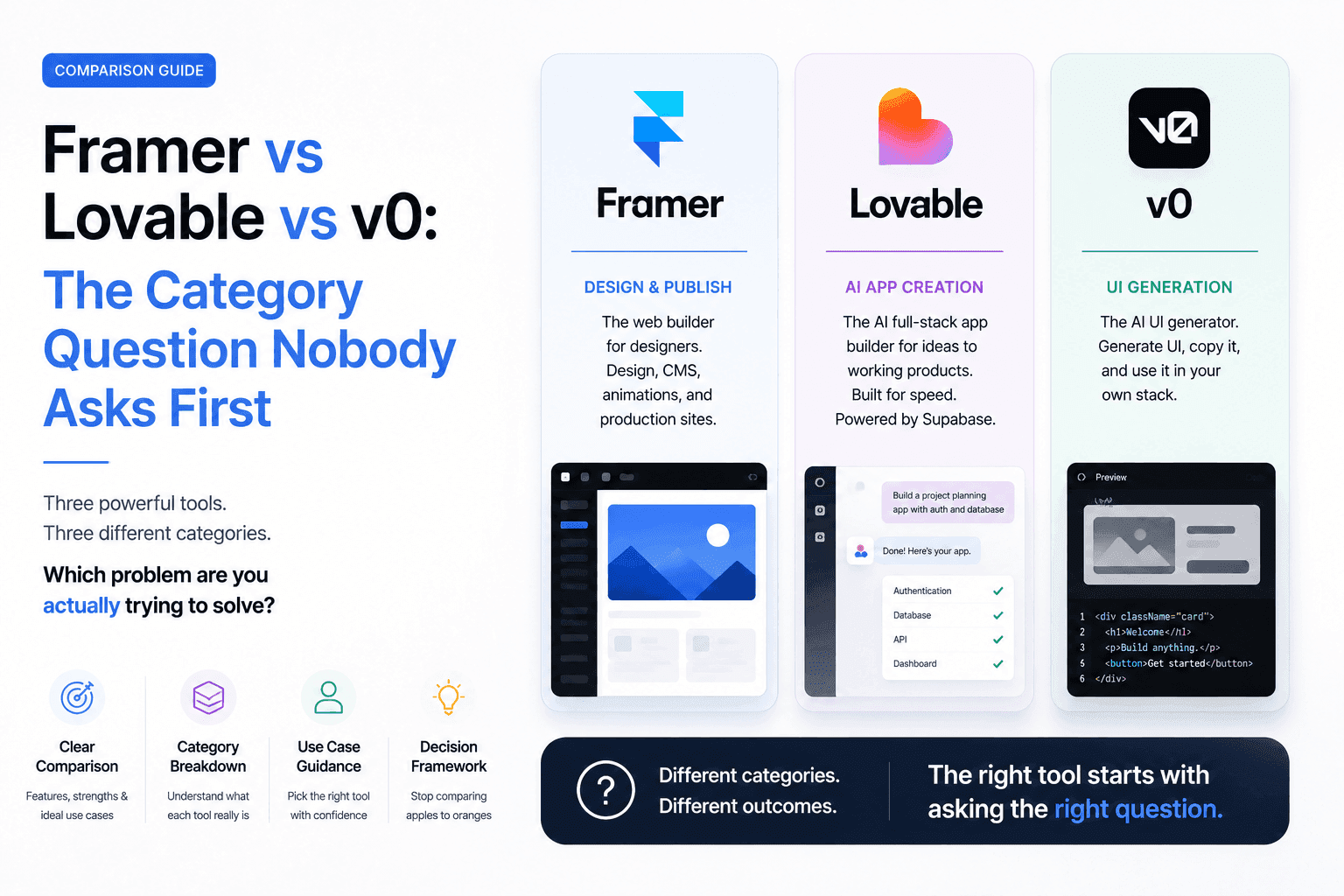
Framer vs Lovable vs v0: The Category Question Nobody Asks First
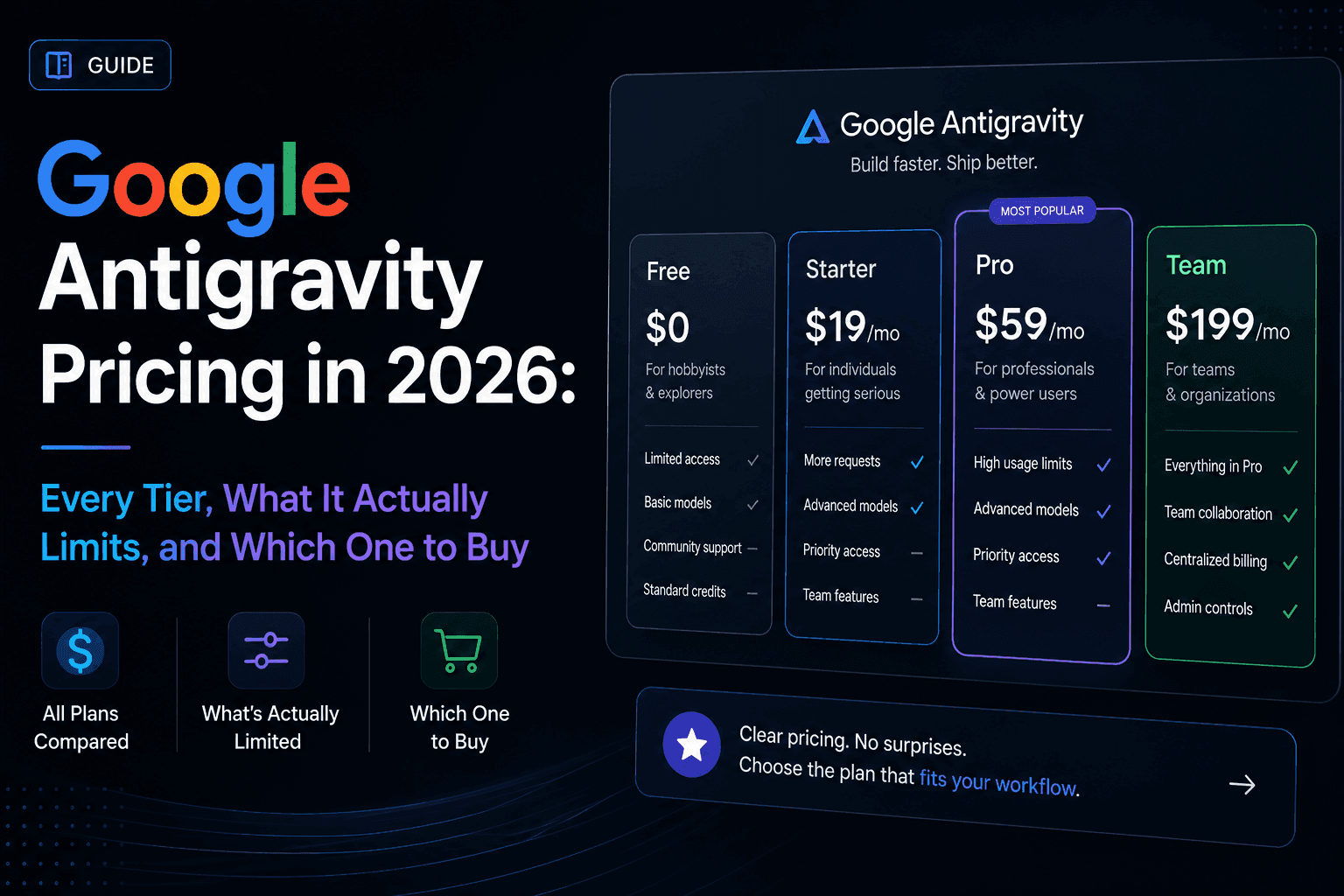
Google Antigravity Pricing in 2026: Every Tier, What It Actually Limits, and Which One to Buy