Framer vs Lovable vs v0: The Category Question Nobody Asks First
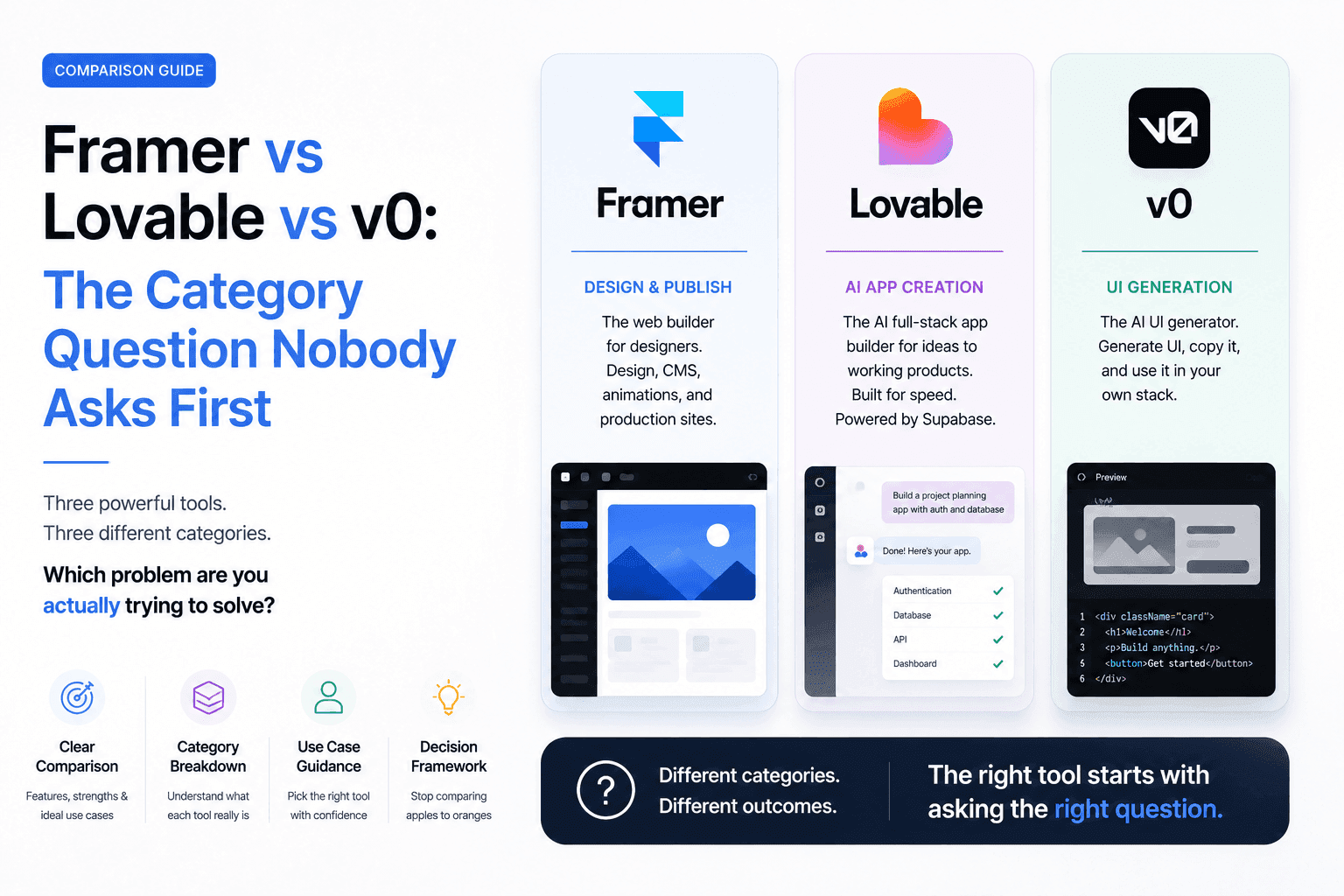
Framer is an AI-augmented no-code tool that produces a hosted site a marketing team can edit without developers, at roughly $5 to $20 per month. Lovable and v0 are AI-native code generators: Lovable produces a working application from a prompt with Supabase authentication and a database included, and v0 produces React components on shadcn/ui for a codebase you already have, from $30 per user per month. The rule that settles most cases: anything needing authentication, a database or API integrations belongs with a code generator, and anything that is fundamentally content edited by non-developers belongs with Framer.
Next Best Reads
Continue your research on AI Engineering
These links are chosen to move readers from general education into service understanding, proof, and buying-context pages.
AI & ML Solutions
Move from architecture reading into real model deployment, MLOps, and production AI pipelines.
Explore AI servicesLLM Integration
Integrate large language models into your product — RAG, fine-tuning, copilots, and APIs.
Explore LLM serviceAI Platform Case Study
See a production AI system with real data architecture, model integration, and launch outcomes.
Read case studyThe comparison people actually want here is not "which tool is better." It is a category question that the pricing pages deliberately blur: Framer is an AI-augmented no-code tool, Lovable and v0 are AI-native code generators. They produce different artifacts, hand off to different people, and fail in different ways.
Get the category right and the tool choice is almost automatic.
The dividing line
Framer generates a website you edit visually. The output is a Framer site, hosted by Framer, maintained by whoever owns the content — usually marketing. No developer required after launch.
Lovable generates a working product from a prompt: exportable React, Supabase authentication and database setup included. The output is an application you own and deploy.
v0 generates components, not products. React on Next.js, Tailwind and shadcn/ui, ready to paste into a codebase you already have. It is the bridge between needing a specific component and writing it by hand.
Side by side
| Framer | Lovable | v0 | |
|---|---|---|---|
| Category | AI-augmented no-code | AI-native code generator | AI-native code generator |
| Output | Hosted Framer site | Exportable React app | React components |
| Auth and database | No | Supabase, set up for you | You wire it up |
| Who maintains it | Marketing, no dev needed | Developers | Developers |
| Price | $5–20/month | Free tier, paid plans | Free tier, then $30/user/month |
| Sweet spot | Polished marketing sites | A working product from one prompt | Components into an existing codebase |
The cost comparison everyone gets wrong
Framer looks expensive next to a free tier and is usually the cheapest of the three in practice.
The reason is where the work lands after launch. Framer's cost is the subscription, and a marketing team runs the site without a developer. Lovable and v0 have lower software costs, and then engineering time becomes the real line item as the site evolves — every content change, every new section, every campaign landing page is a developer task unless someone builds a CMS layer.
For a marketing site that changes weekly, that inverts the maths completely. For a product with authentication and a database, it does not — you were always going to need engineers.
Choose by what the thing has to do
Framer, when it is a marketing site. Landing pages, portfolios, campaign microsites, anything where visual polish matters and the content changes often. Framer is still the best fit for polished visual marketing work, and the no-code editing is the entire point rather than a limitation.
Lovable, when you need a product from nothing. It is the most complete AI-native builder for founders: one prompt to a working application, with Supabase auth and database handled. If your idea needs users to log in and data to persist, this is the shortest path to something real.
v0, when the codebase already exists. You are not starting from zero, you need a specific component built well, and you want React that drops into Next.js with shadcn/ui and no cleanup. It is a component factory, not an app builder — which is exactly right when you already have an app.
The rule that settles most arguments
Anything requiring authentication, a database, or API integrations belongs with an AI-native code generator. Lovable or v0, not Framer.
Anything that is fundamentally content, edited by non-developers, belongs with a no-code tool. Framer, not Lovable or v0.
Teams get into trouble by choosing on demo quality rather than on that question. Framer demos beautifully and then hits a wall the first time someone needs a login. Lovable ships an app fast and then the marketing team cannot change a headline without filing a ticket.
What none of them solve
All three produce a strong first version and none of them own the long tail. The generated eighty percent — layout, standard components, responsive behaviour — is genuinely good and genuinely fast. The remaining twenty percent is your product logic, your edge cases, your accessibility obligations and your brand, and that is still engineering and design work.
The teams that get the most out of these tools use them to delete boilerplate, then spend the time they saved on the part that differentiates the product. The teams that struggle expected the tool to make the last twenty percent disappear.
Frequently asked
Is Framer cheaper than Lovable or v0? On subscription, roughly comparable at $5–20/month. In total cost of ownership for a marketing site, usually much cheaper, because it does not consume developer time after launch.
Can Framer handle a login? Not in the way an application needs. If you require authentication and a database, use Lovable or v0.
Can v0 build a whole app? It builds components extremely well. For a complete product from a single prompt, Lovable is the closer fit.
Which is best for a non-technical founder? Lovable for a product, Framer for a site. v0 assumes you have a codebase and developers.
Ortem Technologies builds web platforms and products, including migrations off no-code tools once they hit their ceiling. Web development → | MVP development → | Talk to our team →
About Ortem Technologies
Ortem Technologies is a premier custom software, mobile app, and AI development company. We serve enterprise and startup clients across the USA, UK, Australia, Canada, and the Middle East. Our cross-industry expertise spans fintech, healthcare, and logistics, enabling us to deliver scalable, secure, and innovative digital solutions worldwide.
Get the Ortem Tech Digest
Monthly insights on AI, mobile, and software strategy - straight to your inbox. No spam, ever.
Sources & References
- 1.Webflow vs Lovable vs Framer vs v0: B2B Website Decision Guide - Amply
- 2.Best AI Website Builders in 2026 - Vibe Coding Academy
- 3.Framer AI Website Builder Review - Tiiny Host
About the Author
Digital Marketing Head, Ortem Technologies
Mehul Parmar is the Digital Marketing Head at Ortem Technologies, leading the marketing team under the direction of Praveen Jha. A seasoned digital marketing expert with 15 years of experience and 500+ projects delivered, he specialises in SEO, SEM, SMO, Affiliate Marketing, Google Ads, and Analytics. Certified in Google Ads & Analytics, he is proficient in CMS platforms including WordPress, Shopify, Magento, and Asp.net. Mehul writes about growth marketing, search strategies, and performance campaigns for technology brands.
Frequently Asked Questions
- On subscription they are broadly comparable, with Framer around $5 to $20 per month. On total cost of ownership for a marketing site Framer is usually much cheaper, because it does not consume developer time after launch.
- Not in the way an application needs. If you require login, a database or API integrations, use Lovable or v0 instead.
- v0 is strongest at generating components for an existing codebase. For a complete product from a single prompt, Lovable is the closer fit.
- Lovable if you are building a product, Framer if you are building a site. v0 assumes you already have a codebase and developers to put its components into.
Stay Ahead
Get engineering insights in your inbox
Practical guides on software development, AI, and cloud. No fluff — published when it's worth your time.
Ready to Start Your Project?
Let Ortem Technologies help you build innovative software solutions for your business.
You Might Also Like
Google Antigravity Pricing in 2026: Every Tier, What It Actually Limits, and Which One to Buy
Human-in-the-Loop Design Patterns for Production AI Agents